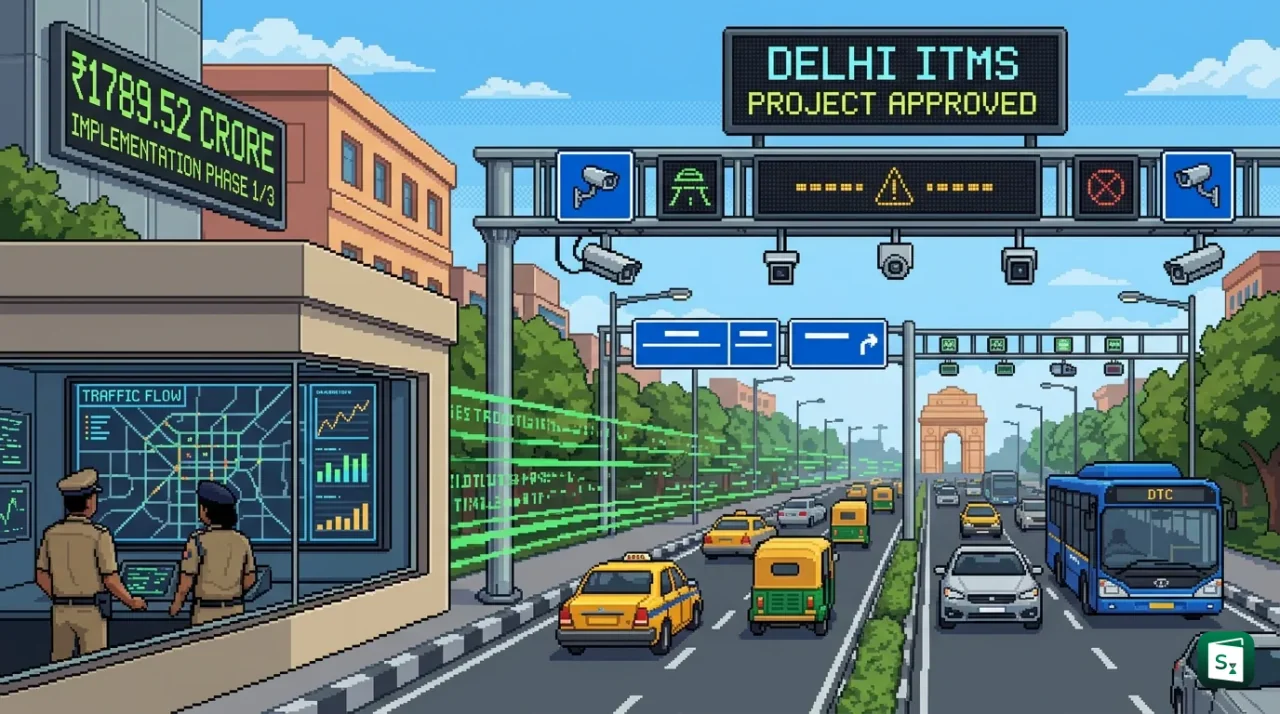
The Cabinet Committee on Economic Affairs (CCEA), chaired by Prime Minister Narendra Modi, approved the ₹1,789.52 crore Intelligent Traffic Management System (ITMS) for Delhi on 30 September 2026. The project will be implemented by the Delhi Police across 42 identified traffic corridors. It will replace fixed timers and manual control with adaptive signals, automated enforcement and real-time commuter information to ease congestion in a city with around 71 lakh active vehicles.
What Is the Intelligent Traffic Management System?
The Intelligent Traffic Management System (ITMS), where ITMS is the full form, is a technology platform that manages city traffic using real-time data, artificial intelligence and connected devices. A smart traffic management system of this type links traffic signals, enforcement cameras, sensors and information displays on one common network. The Delhi ITMS will bring regulation, enforcement and public information together through Traffic Command and Control Centres, backed by a secure data centre and disaster recovery infrastructure.
The core idea is simple. Instead of running signals on fixed time cycles and depending on manual policing at junctions, the system watches actual road conditions and responds instantly. Sensors and cameras measure traffic flow, the software adjusts signal timings and coordinates junctions along a corridor, and the control room detects congestion, slow movement and incidents to order diversions. The Delhi system will use open standards and application programming interfaces (APIs), which are common technical rules that allow different software systems to connect, so it can be expanded and linked with other platforms in future.
Why Delhi Needs ITMS Now
Delhi has around 71 lakh active registered vehicles, and vehicle growth has clearly outpaced the expansion of road infrastructure. Yet traffic regulation still depends heavily on 1,529 traffic signals that run on fixed timers with manual intervention. Under this old method, a signal programmed for 30 or 35 seconds keeps the same red and green duration even when one road is crowded and the crossing road is almost empty.
The Delhi Police also face a second problem of fragmentation. Enforcement cameras for red light jumping and speeding work in isolation. There is no single city wide system that links signal control, enforcement, traffic information, diversions and crime alerts using artificial intelligence. The idea of a unified ITMS for Delhi has been discussed since before the 2010 Commonwealth Games and again in 2014, 2019 and 2023, but earlier proposals at a smaller scale and lower cost did not move to full implementation. The current approval addresses both gaps by treating congestion as a management and information problem, not only as a road construction problem, and by making better use of existing road capacity.
42 Corridors, 1,092 Signals and 1,029 Enforcement Points: What the Project Covers
The Delhi ITMS project will cover 42 identified traffic corridors at an approved cost of ₹1,789.52 crore, inclusive of taxes. The Delhi Police will be the implementing agency. The physical scale of the project is defined by two main networks, one for controlling movement and one for detecting violations.
| Component | Coverage | Function |
|---|---|---|
| Adaptive Traffic Control System locations | 1,092 locations | Adjust signal timings as per live traffic and coordinate signals along corridors |
| Enforcement locations | 1,029 locations | Detect violations through cameras and sensors with automatic number plate recognition |
| Traffic corridors | 42 corridors | Priority stretches where signals, enforcement and information systems are integrated |
| Command infrastructure | Main command centre plus disaster recovery site | Central monitoring, analytics, incident response and data backup |
The Adaptive Traffic Control System (ATCS) is a signal system that changes the length and sequence of red and green lights based on live traffic counts. Signals on the same corridor are also synchronised so vehicles can move with fewer stoppages. At roundabouts, the system can relax control during lean hours and switch on automated regulation during heavy flow to prevent gridlock.
How ITMS Will Manage Signals, Emergencies and Commuter Information
The Delhi ITMS will work on three connected tracks of control, care and communication. The Delhi Police control rooms will receive continuous feeds from cameras, vehicle detectors and signal controllers. Artificial intelligence tools will analyse the feeds to spot congestion, slow moving traffic, stalled vehicles, debris on roads, accidents and unusual build up, and officers can then change signals, open diversions and send field teams faster.
The second track supports emergency movement. The system will create green corridors for ambulances and disaster response vehicles by holding or clearing signals along a route. During breakdowns, accidents, VIP movements and route diversions, the same monitoring will help keep priority routes open. This link between traffic control and emergency response is one of the main benefits claimed for the project.
The third track informs commuters. Variable Message Signs, which are electronic display boards on roads, along with digital platforms will share live updates on congestion, diversions, parking availability and road conditions. The Delhi Police plan to share this data with navigation service providers so route suggestions in mobile apps can reflect actual Delhi road conditions. The system will also use AI based analytics to flag stolen, hot listed and blacklisted vehicles, repeat violators and vehicles linked to hit and run cases, which adds a crime control function to traffic management.
What Is ITMS Challan and Is ITMS Challan Real or Fake?
An ITMS challan is an electronic traffic fine generated automatically when ITMS cameras record a violation such as red light jumping, speeding or riding without helmet. It is a genuine enforcement notice linked to the Parivahan system and must be verified on official portals, not treated as fake without checking.
The doubt around whether an ITMS challan is real or fake has grown because messages about online fines and new portals like itmschallan.parivahan.gov.in have spread fast since June 2026. Under the established process used in states such as Goa, violation data from cameras is pushed to the National Informatics Centre ITMS application. A traffic officer then verifies the image and vehicle number within the stipulated time. After approval, the vehicle owner gets an SMS notice with seven days to respond, and if there is no response, an e-challan is generated for online payment or payment at a counter.
In Delhi, the expanded network will automate detection of red light and stop line violations, speeding, wrong way driving, riding without helmet, driving without seat belt, illegal parking and use of mobile phone while driving. Automatic Number Plate Recognition (ANPR), a camera technology that reads vehicle registration numbers from images, will support this process along with red light violation detection and speed violation detection systems. Owners can check status through the Delhi traffic challan check facility on the Parivahan portal, the ITMS portal or the Delhi Traffic Police online challan window by entering vehicle number or challan number, and can pay through the ITMS challan pay online option. Any message that asks for payment outside these official portals or through unknown links should be checked carefully before payment.
How to Pay ITMS Challan Online
To pay an ITMS challan online, the vehicle owner should open the official Parivahan e-challan or ITMS challan portal, select check challan status, enter the vehicle registration number or challan number, verify the violation photo and details, and then complete payment through the secure gateway. If the fine remains unpaid, the case can move to a virtual court under the Motor Vehicles Act, 1988, which is the central law governing road transport and traffic penalties in India.
Implementation in Three Phases: Timeline, Integrator and Oversight
The Delhi ITMS will be executed in 3 phases over 24 months, followed by 5 years of operation and maintenance. Implementation will be performance driven. Each later phase will start only after the earlier phase clears prescribed testing, commissioning, acceptance and performance parameters.
| Phase | Duration | Planned Work |
|---|---|---|
| Phase 1 | 12 months | Cover 5 corridors, install around 250 smart signals and set up the main command centre |
| Phase 2 | 6 months | Extend to part of the remaining 37 corridors with additional signals and systems |
| Phase 3 | 6 months | Complete coverage of all 42 corridors with total of 1,092 adaptive signals and set up disaster recovery site |
The Delhi Police will select a Master System Integrator through competitive bidding to supply, install, test and maintain the system. The Centre for Development of Advanced Computing (C-DAC), a scientific society under the Ministry of Electronics and Information Technology known for high performance computing and digital solutions, will act as the Project Management Consultant. C-DAC will provide technical scrutiny, monitoring, validation and acceptance support during both implementation and maintenance. Three committees headed at the levels of the Union Home Secretary, the Delhi Police Commissioner and the Special Commissioner of Police (Traffic) will oversee the project. Delhi Police functions under the Ministry of Home Affairs, so central approval through the Cabinet Committee on Economic Affairs (CCEA), the cabinet panel chaired by the Prime Minister that decides on major economic projects, was required for funding and rollout.
Significance for Urban Mobility and Road Safety
The Delhi ITMS treats traffic as a data problem that can be solved with better information and faster decisions. For daily commuters, coordinated signals and early incident alerts can reduce waiting time at junctions and make travel time more predictable. For the Delhi Police, central control means fewer points of manual handling and a clearer record of violations with photo evidence.
For road safety, automatic detection increases the chance that violations are actually recorded, which can improve discipline on roads. Features such as helmet and seat belt detection, speed control and wrong way driving alerts directly target behaviours linked to deaths and injuries. For emergency services, green corridor support can save critical minutes. For city administration, data on traffic volumes, peak offence points and congestion patterns will help plan diversions, parking policy and future road use without depending only on new construction. Similar camera based enforcement in cities such as Goa, Indore and Guwahati has shown that technology can sharply raise detection, though timely verification, correct mobile number records and actual fine collection remain essential for results.
Key Takeaways
- The Cabinet Committee on Economic Affairs approved the ₹1,789.52 crore ITMS project for Delhi on 30 September 2026 for implementation by the Delhi Police.
- The Delhi ITMS will cover 42 traffic corridors with 1,092 adaptive signal locations and 1,029 enforcement locations.
- An ITMS challan is a genuine e-challan generated after camera detection and police verification, and it can be checked and paid on the Parivahan and ITMS portals.
- The project will be executed in 3 phases over 24 months, followed by 5 years of operation and maintenance, with C-DAC as Project Management Consultant.
- Adaptive signals adjust green and red timings as per live traffic, while green corridors give priority to ambulances and emergency vehicles.