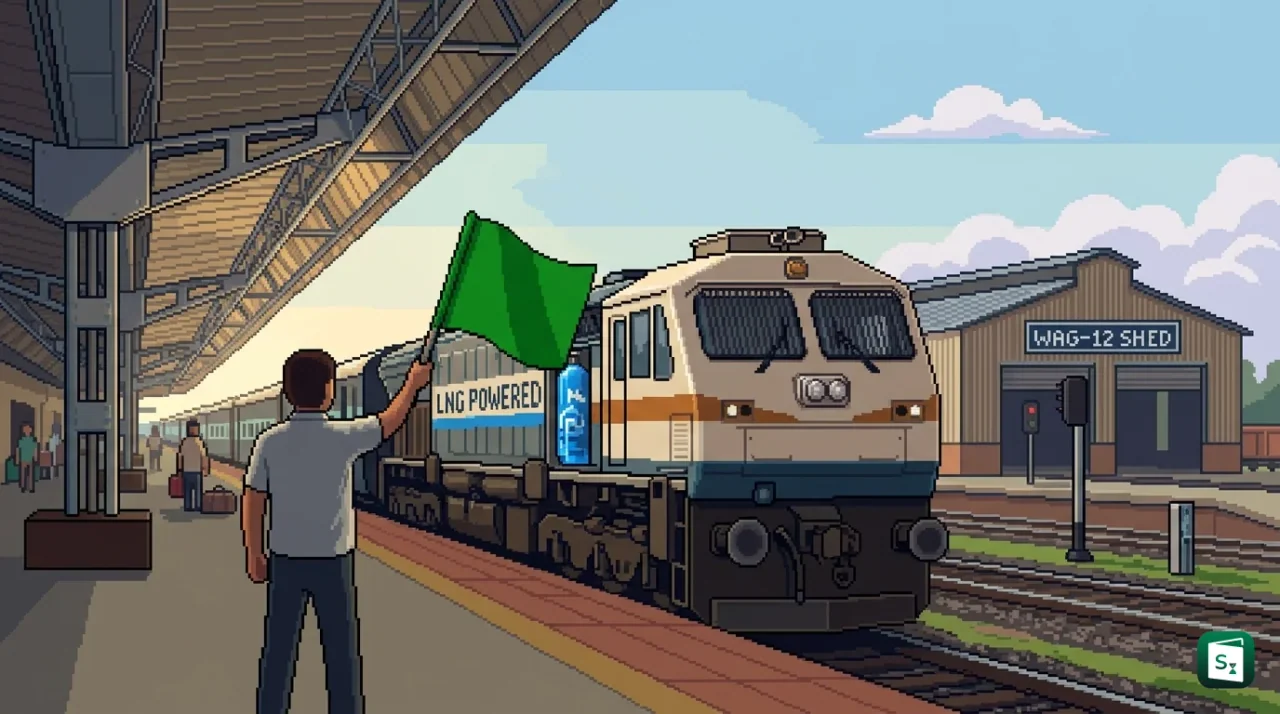
Union Home Minister Amit Shah flagged off India’s first LNG diesel dual fuel DEMU train from Sabarmati railway station in Ahmedabad on 27 September 2026. Gujarat Chief Minister Bhupendra Patel joined the event where Shah also inaugurated railway development projects worth ₹1,472 crore. The eight coach non AC train can run on both liquefied natural gas and diesel and replaces about 40 percent of diesel with gas.
What Is LNG and What Is an LNG Train?
LNG stands for Liquefied Natural Gas. An LNG train in Indian Railways means a railway train that uses LNG as fuel, while in the oil and gas industry the same phrase means a production unit that cools gas into liquid.
LNG is natural gas that is cooled to about minus 162 degrees Celsius. Cooling shrinks the gas to about one six hundredth of its volume, so it becomes a clear liquid that is easy to store and move in special insulated tanks. Indian Railways stores this liquid in cryogenic tanks fitted on the train, warms it back into gas, and burns it in the engine along with diesel. LNG burns cleaner than diesel, so it releases less carbon dioxide, nitrogen oxides and particulate matter.
The word train causes confusion because it has two very different uses. In railways, a train is the vehicle that runs on tracks. In LNG plants in countries like Qatar and Nigeria, a train is one complete set of machines that liquefies gas, so a large plant can have Train 1, Train 2 or Train 7. The Sabarmati launch refers only to the railway meaning, a passenger train powered by LNG.
LNG is different from the other common gas fuels seen in India. The table below explains the difference in simple terms.
| Fuel | Full Form | Main Use in India | How It Is Stored |
|---|---|---|---|
| LNG | Liquefied Natural Gas | Trucks, buses, ships and now the Sabarmati DEMU train | As liquid at very low temperature |
| CNG | Compressed Natural Gas | Cars, auto rickshaws and city buses | As compressed gas at high pressure |
| LPG | Liquefied Petroleum Gas | Cooking cylinders in homes | As liquid under moderate pressure |
| PNG | Piped Natural Gas | Cooking and heating through pipelines in cities | As gas supplied through pipes |
What Is a DEMU Train and How Does an LNG Train Work?
What Is a DEMU Train?
A DEMU train stands for Diesel Electric Multiple Unit. It is a self propelled passenger train that does not need a separate locomotive because diesel engines fitted inside its driving power cars produce electricity for traction motors.
Indian Railways uses DEMU trains mainly for short and medium distance services on routes where electric locomotives or MEMU trains (Mainline Electric Multiple Units) cannot run. A typical DEMU rake has a Driving Power Car (DPC) at each end and several trailer coaches in the middle. The driver can drive from either end, so the train does not need to be turned around at the last station. Most DEMU coaches are built by the Integral Coach Factory (ICF) in Chennai, which was set up in 1955 and functions under the Ministry of Railways. The Sabarmati LNG train uses 1,400 HP DPCs, a common power rating for Indian DEMU services.
How Does an LNG Train Work?
The Sabarmati LNG train works on a diesel plus LNG dual fuel system. Diesel starts combustion in the engine and LNG then replaces about 40 percent of the diesel, which lowers fuel cost and cuts smoke and other pollutants without reducing power.
Indian Railways converted two 1,400 HP Driving Power Cars at the Integrated Coaching Depot (ICD) in Sabarmati for this project. Each DPC now carries an LNG tank of about 2,200 litres. The tank stores liquid gas, warms it back into gas through a regasification unit, and feeds it into the engine with a controlled amount of diesel. The cryogenic storage and regasification systems were supplied by INOX India, a Vadodara based company that makes cryogenic equipment. The engine conversion to dual fuel mode was carried out with support from the former Indian Railways Organisation for Alternate Fuels (IRAOF), which had planned to convert an initial batch of 10 power cars.
The system is flexible by design. The loco pilot can switch between LNG and diesel based on fuel availability, so the train keeps running even when LNG is not available. One full LNG refill supports about 222 km of daily running. The two converted power cars completed field trials of more than 2,000 km at Sabarmati and then entered regular passenger service. The Research Designs and Standards Organisation (RDSO), headquartered in Lucknow and set up in 1957 as the research arm of Indian Railways, conducted emission and safety tests before clearance.
| Feature of Sabarmati LNG DEMU | Detail |
|---|---|
| Train type | 8 coach non AC DEMU with 2 DPCs |
| Engine power | 1,400 HP per Driving Power Car |
| LNG tank capacity | About 2,200 litres per DPC |
| Diesel replacement | Up to 40 percent with LNG |
| Trial distance | More than 2,000 km at Sabarmati |
| Range per refill | About 222 km |
| Estimated saving | ₹11.9 lakh per DPC per year, ₹23.9 lakh per rake per year |
First LNG Diesel DEMU Train Flagged Off From Sabarmati
Indian Railways operationalised the first LNG diesel dual fuel DEMU train at Sabarmati in January 2026 and formally dedicated it to the nation on 27 September 2026. The Ahmedabad division of Western Railway carried out the modification, trials and passenger operation. Divisional Railway Manager Ved Prakash inspected the rake and confirmed that it ran in regular service without operational problems after the trials.
The inaugural run operated between Sabarmati and Mahesana in Gujarat. The regular route for daily commercial service has not been finalised yet. Indian Railways plans to convert eight more DEMU Driving Power Cars under the same programme after final approvals.
The flag off took place at Sabarmati railway station in Ahmedabad, Gujarat. Sabarmati is a major station of the Ahmedabad division under Western Railway, whose headquarters is at Churchgate in Mumbai. The station serves Ahmedabad city and connects to the Delhi Mumbai main line, the Ahmedabad Palanpur section and suburban sections towards Kalol. It also houses the Integrated Coaching Depot that modified the DEMU and the new WAG-12 shed. The station has seen major growth in passenger facilities, Metro linkage and road connectivity in recent years. It is also close to the Sabarmati Ashram founded by Mahatma Gandhi in 1917, which gives the area historic importance.
Sabarmati was a natural choice for the pilot. The depot had space for cryogenic handling, the division runs many DEMU passenger services on non electrified and suburban stretches, and the Research Designs and Standards Organisation could closely monitor trials. The success at Sabarmati now gives Indian Railways a tested model to extend dual fuel operation to other DEMU routes.
Railway Projects Worth ₹1,472 Crore Inaugurated Alongside
The Sabarmati programme covered safety, capacity and freight maintenance in the Ahmedabad division. The total package is valued at ₹1,472 crore. The table below breaks down the main components announced on 27 September 2026.
| Project | Length or Capacity | Cost |
|---|---|---|
| WAG-12 Maintenance Shed at Sabarmati | Homing and maintenance for 300 locomotives | ₹700 crore |
| Kavach on Ahmedabad Palanpur and Ahmedabad Samakhiali sections | 404 km (157 km plus 247 km) | ₹411 crore |
| Doubling of Sabarmati Sarkhej line | 21 km, target completion by March 2028 | ₹313.27 crore |
| Automatic Block Signalling in Ahmedabad division | 122.57 km | ₹118.83 crore |
| Kavach on Sabarmati Kalol Sabarmati section | Suburban safety section | ₹48 crore |
WAG-12 Maintenance Shed and Locomotive Profile
WAG stands for Wide gauge, Alternating current, Goods. The number 12 marks the class series. The WAG-12B is India’s most powerful freight locomotive with a continuous output of 12,000 HP (about 9,000 kilowatts). It is a twin section locomotive with two units coupled together. It can haul freight equal to nearly 600 trucks in a single run. Earlier two separate locomotives were needed for such heavy loads.
The locomotives are manufactured at the Electric Locomotive Factory at Madhepura in Bihar, which was set up as a joint venture with Alstom of France. The factory supplies locomotives mainly for the Eastern Dedicated Freight Corridor, a special freight only rail line built by the Dedicated Freight Corridor Corporation of India (DFCCIL), a public sector company under the Ministry of Railways. The WAG-12B has eight axles, weighs about 180 tonnes, and is designed for a maximum speed of 100 kmph, upgradeable to 120 kmph. The new Sabarmati shed will improve availability and repair turnaround for these engines in western India and support heavy freight movement towards ports in Gujarat.
Kavach, Automatic Signalling and Doubling
Kavach is India’s indigenous Automatic Train Protection system. It was developed by the Research Designs and Standards Organisation. Kavach applies brakes automatically if the loco pilot misses a signal, exceeds the speed limit or risks a collision, and it helps operations in low visibility. The Sabarmati Kalol Sabarmati section already has the system. Work has now started to extend Kavach to the Ahmedabad Palanpur and Ahmedabad Samakhiali sections.
Automatic Block Signalling allows more trains to run safely on the same track by dividing the line into small blocks with signals that control entry automatically. The Ahmedabad division has commissioned the system on the Sabarmati Kalol Bhandu Motidaur and Sabarmati Sanand Jakhwada sections. This will improve punctuality and allow passenger and freight trains to follow each other at closer intervals.
The Sabarmati Sarkhej doubling will add a second line on a busy 21 km stretch covering Sabarmati, Gandhigram, Vastrapur and Sarkhej stations. The work includes one major bridge, 16 minor bridges, 13 road underbridges and six level crossings. Doubling will ease congestion near Ahmedabad, improve suburban services and strengthen connectivity towards the Sarkhej Dholera industrial region.
Significance for Green Rail Transport and Fuel Economics
Indian Railways is India’s largest diesel consumer in transport, so even a partial shift to gas brings large savings. Trial data from Sabarmati shows that LNG substitution can save about ₹11.9 lakh per Driving Power Car in a year. For a full eight coach rake with two power cars, the saving is about ₹23.9 lakh per year. The saving comes from the lower price of gas compared to diesel and from cleaner combustion that reduces maintenance. LNG also cuts carbon dioxide, nitrogen oxides and particulate matter, which improves air quality along stations and rail colonies.
The LNG pilot fits into a larger shift away from diesel. Diesel use by Indian Railways fell from 293 crore litres in 2015-16 to 108 crore litres in 2024-25. Broad gauge electrification has reached 99.6 percent of the network (as of September 2026), up from about 30 percent before 2014. Sweden is the only country with 100 percent railway electrification, but its network is about one tenth the size of India’s network. Electrification now powers most long distance trains, while LNG, CNG and hydrogen are being tested for the remaining non electrified, suburban and heritage routes where overhead wires are costly or difficult.
The LNG launch follows the launch of India’s first hydrogen train. Prime Minister Narendra Modi flagged off the NaMo Green Rail, India’s first hydrogen fuel cell train, between Jind and Sonipat in Haryana on 17 July 2026. That ten coach train generates electricity on board by mixing hydrogen and oxygen and releases only water vapour. It can carry about 2,600 passengers and runs with a dedicated hydrogen storage and refuelling facility at Jind. The trial of India’s first double stack long haul container train from Jawaharlal Nehru Port Trust in Mumbai to Vadodara has also been completed, which can nearly double freight capacity on the same track.
| Feature | LNG Diesel DEMU (Sabarmati) | Hydrogen Train (Jind Sonipat) | Conventional Diesel DEMU |
|---|---|---|---|
| Fuel | LNG plus diesel in dual fuel engine | Hydrogen in fuel cells plus batteries | Only diesel |
| Emission at use | Lower smoke and gases, but some carbon remains | Only water vapour | High carbon dioxide and particulates |
| Diesel saving | About 40 percent | Almost full diesel replacement on that route | No saving |
| Infrastructure needed | Cryogenic LNG tanks and refilling | Hydrogen production, storage at 500 bar and dispensing at Jind | Diesel depots |
| Best use | Short and medium DEMU routes as a transition fuel | Non electrified routes as a zero emission pilot | Existing non electrified routes |
For India’s goal of Net Zero by 2070, LNG acts as a transition fuel and hydrogen acts as the long term clean option. LNG uses existing engine designs with small changes, so it can be rolled out fast and at lower cost. Hydrogen needs entirely new trains and fuel stations, so it will take more time and investment. Together with full electrification, the Make in India production of locomotives, coaches and safety systems like Kavach, the two pilots show a practical path where each route gets the cleanest fuel that suits its traffic and geography.
Key Takeaways
- India’s first LNG diesel dual fuel DEMU train was flagged off from Sabarmati in Ahmedabad on 27 September 2026.
- DEMU stands for Diesel Electric Multiple Unit and LNG stands for Liquefied Natural Gas.
- The Sabarmati train uses two 1,400 HP power cars with 2,200 litre LNG tanks to replace about 40 percent of diesel.
- Railway projects worth ₹1,472 crore were inaugurated with the train, including the ₹700 crore WAG-12 shed for 300 locomotives.
- WAG-12B is India’s most powerful freight locomotive with 12,000 HP output and capacity equal to nearly 600 trucks.
- Kavach is India’s indigenous Automatic Train Protection system developed by RDSO and extended to 404 km in the Ahmedabad division.