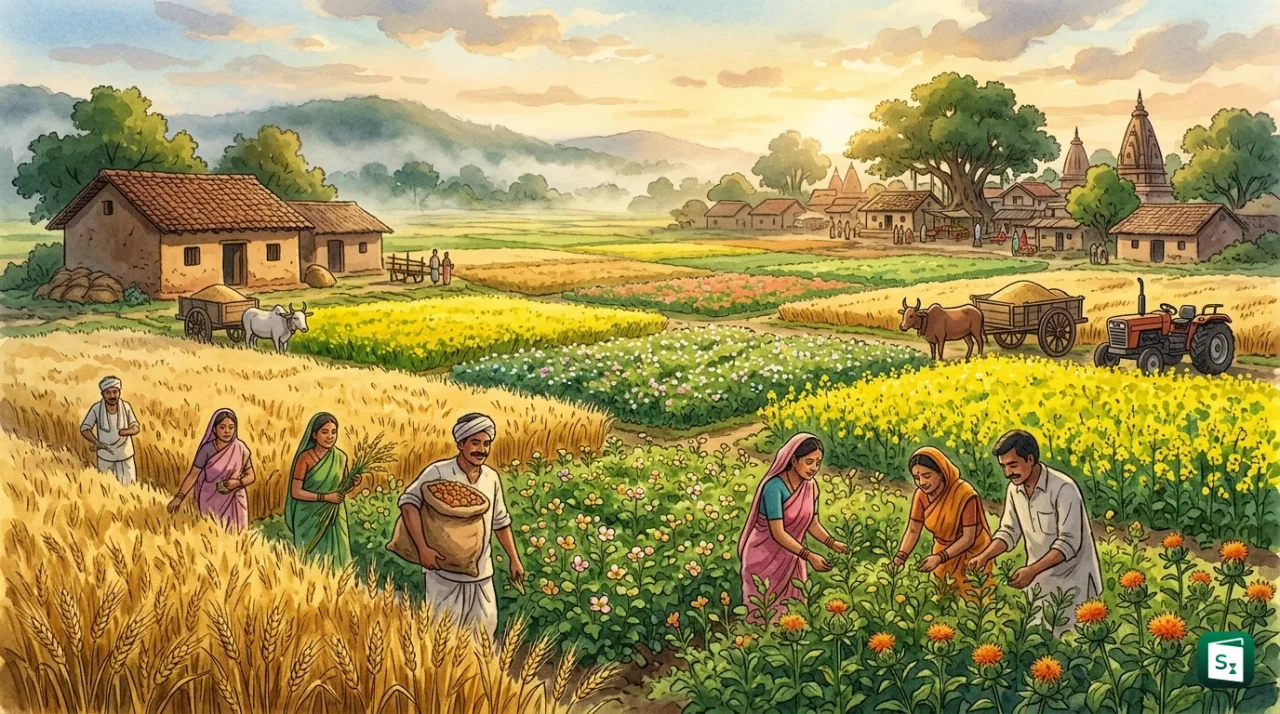
The Cabinet Committee on Economic Affairs approved higher Minimum Support Price for all six mandated Rabi crops for the Rabi Marketing Season 2027-28 on 30 September 2026. The Rabi MSP 2027-28 gives the highest absolute hike to safflower at ₹675 per quintal, followed by rapeseed and mustard at ₹413 per quintal, while wheat MSP rises to ₹2,610 per quintal. The decision assures farmers a profit of at least 50 percent over cost of production and aims to encourage diversification toward pulses and oilseeds.
What Is Minimum Support Price in Agriculture?
Minimum Support Price, or MSP, in agriculture is the guaranteed price at which the government buys specific crops from farmers. MSP full form in agriculture stands for Minimum Support Price. It acts as a price floor and safety net, so even if open market prices fall during a bumper harvest, the farmer can still sell to government agencies at the assured rate.
The MSP system protects growers from distress sales and helps the government procure food grains for public distribution. For example, a wheat farmer can sell wheat to government agencies at the announced MSP for wheat even when mandi prices dip below that level. MSP is announced every year for each cropping season and is not the same as the market price or the Maximum Retail Price. MSP is also not a legally enforceable right in India (as of October 2026), though farmer groups have long demanded a legal guarantee for it.
How Is MSP Decided and Calculated?
The Commission for Agricultural Costs and Prices (CACP) recommends MSP after studying costs, market trends and farm interests, and the Cabinet Committee on Economic Affairs (CCEA) takes the final decision. The CACP calculation starts from the all India weighted average cost of production, adds demand and supply, domestic and global prices, inter crop parity and terms of trade, and ensures at least 50 percent profit margin.
The CACP is an attached office under the Ministry of Agriculture and Farmers Welfare. The body was set up in 1965 as the Agricultural Prices Commission and was renamed the Commission for Agricultural Costs and Prices in 1985. Its headquarters is in New Delhi. The CACP sends its Price Policy Reports to the government after consulting state governments and central ministries. The CCEA, chaired by the Prime Minister, then approves the final MSP. The MSP for Rabi crops is usually announced in September or October, before the October sowing, while the MSP for Kharif crops is usually announced in May or June, before the monsoon sowing.
The cost used for MSP is called A2 plus FL. A2 covers all paid out costs such as hired labour, seeds, fertilisers, manures, irrigation charges, diesel and electricity for pump sets, depreciation on implements and interest on working capital. FL is the imputed value of unpaid family labour. Since the Union Budget 2018-19, the government follows the principle of fixing MSP at a level of at least 1.5 times the all India weighted average cost of production. This means every mandated crop must give a return of at least 50 percent over this cost.
MSP for How Many Crops?
The government fixes MSP for 22 mandated crops every year. The list includes 14 Kharif crops, 6 Rabi crops and 2 commercial crops. In addition, the government fixes MSP for toria based on rapeseed and mustard rates and MSP for de husked coconut based on copra rates.
The 22 crops cover the main cereals, pulses, oilseeds and commercial crops grown across India. Sugarcane is not part of this MSP list. For sugarcane, the government fixes a Fair and Remunerative Price (FRP) instead of MSP. FRP is the minimum price that sugar mills must pay to sugarcane farmers, while MSP is the price at which government agencies themselves buy the crop when market prices fall.
| Category | Number of Crops | Crops Covered |
|---|---|---|
| Kharif crops | 14 | Paddy, jowar, bajra, maize, ragi, tur, moong, urad, groundnut, soyabean, sunflower seed, sesamum, nigerseed and cotton |
| Rabi crops | 6 | Wheat, barley, gram, lentil, rapeseed and mustard, and safflower |
| Commercial crops | 2 | Copra and jute |
Procurement works through different agencies. The Food Corporation of India (FCI) and state agencies buy wheat and paddy for the central pool. The FCI was set up under the Food Corporations Act, 1964 and works under the Department of Food and Public Distribution. Pulses, oilseeds and copra are bought under the Price Support Scheme (PSS) of the umbrella scheme Pradhan Mantri Annadata Aay Sanrakshan Abhiyan (PM-AASHA). The central nodal agencies for this scheme are the National Agricultural Cooperative Marketing Federation of India Ltd. (NAFED) and the National Cooperative Consumers Federation of India Ltd. (NCCF). Cotton and jute are bought by the Cotton Corporation of India (CCI) and the Jute Corporation of India (JCI).
Rabi MSP 2027-28: Crop Wise New Rates and Increase
The Cabinet Committee on Economic Affairs approved the new MSP list for the Rabi Marketing Season 2027-28 on 30 September 2026. The Rabi Marketing Season is the period when winter sown crops are harvested and procured, mainly from April to June. The new rates apply to the crops that farmers will sow in October to December 2026 and harvest in March to April 2027.
Safflower received the largest absolute and percentage hike because its base price and domestic supply need strong support. Rapeseed and mustard, lentil and barley also received relatively higher hikes to promote oilseeds and pulses and to reduce dependence on imports. Wheat and gram received modest hikes because their MSP levels already carry high margins and large procurement volumes.
| Crop | MSP 2027-28 (₹ per quintal) | Cost of Production 2027-28 (₹ per quintal) | Margin Over Cost | MSP 2026-27 (₹ per quintal) | Increase (₹ per quintal) |
|---|---|---|---|---|---|
| Safflower | 7215 | 4810 | 50 percent | 6540 | 675 |
| Rapeseed and Mustard | 6613 | 3367 | 96 percent | 6200 | 413 |
| Lentil (Masur) | 7390 | 3854 | 92 percent | 7000 | 390 |
| Barley | 2286 | 1447 | 58 percent | 2150 | 136 |
| Gram (Chana) | 5958 | 3751 | 59 percent | 5875 | 83 |
| Wheat | 2610 | 1264 | 106 percent | 2585 | 25 |
The margin pattern shows the policy intent clearly. Wheat carries the highest margin of 106 percent over cost, followed by rapeseed and mustard at 96 percent and lentil at 92 percent. Gram gives 59 percent, barley gives 58 percent and safflower gives 50 percent. All six crops meet the norm of at least 50 percent return over the all India weighted average cost of production. The government has stated that this higher MSP list will ensure remunerative prices and encourage crop diversification away from cereals alone.
Rabi Crops Season, Examples and Sowing Period
Rabi crops are winter crops. The word rabi means spring in Arabic, and the crops are sown after the southwest monsoon retreats and harvested in spring. The Rabi season months run from October to March, with sowing in October to December and harvesting in March to April. The crops grow in cool and dry weather and depend largely on irrigation from canals, tubewells and reservoirs. Winter rain from Western Disturbances helps wheat and other Rabi crops in north India.
The main Rabi crop examples are wheat, barley, gram (chana), lentil (masur), rapeseed and mustard (sarson) and safflower. Wheat is the principal Rabi cereal and the second pillar of food security after rice. Barley tolerates drought and salinity and grows in Rajasthan, Uttar Pradesh and Haryana. Gram and lentil are key Rabi pulses grown in Madhya Pradesh, Maharashtra, Rajasthan, Uttar Pradesh and Bihar. Rapeseed and mustard is the leading Rabi oilseed, grown widely in Rajasthan, Madhya Pradesh, Haryana and Uttar Pradesh. Safflower is a drought resistant oilseed grown on black soils in Maharashtra and Karnataka.
Rabi Crops and Kharif Crops: Key Differences
Rabi crops and Kharif crops form the two main cropping seasons of the Indian agricultural year, which runs from July to June. Kharif means autumn in Arabic. Kharif crops are sown with the onset of the southwest monsoon and harvested after the monsoon. The third short season is Zaid, with summer crops grown between April and June.
| Feature | Rabi Crops | Kharif Crops |
|---|---|---|
| Sowing period | October to November | June to July |
| Harvesting period | March to April | September to October |
| Climate | Cool and dry, 10 to 25 degrees Celsius | Warm and humid, 25 to 35 degrees Celsius |
| Water source | Irrigation and winter rain | Southwest monsoon rain |
| Key cereals | Wheat, barley | Rice, maize, jowar, bajra |
| Key pulses | Gram, lentil | Tur, moong, urad |
| Key oilseeds | Mustard, safflower, linseed | Groundnut, soyabean, sunflower |
| Main regions | North and northwest India | Across India, strong in east and south |
Why MSP Increase Matters for Farmers and the Economy
Higher MSP matters because it gives farmers income certainty before sowing begins. A farmer who knows the assured price for mustard or lentil can choose seeds, fertilisers and technology without fear of a price crash at harvest. This is especially important for small holders who depend fully on farm income and face risks from weather and volatile mandi prices. When market prices fall below MSP, government agencies step in to buy the crop, so the farmer avoids a distress sale.
The procurement record shows how this safety net has widened. Procurement of wheat during 2014-15 to 2025-26 reached 3715 lakh metric tonnes, compared to 2254 lakh metric tonnes during 2004-05 to 2013-14. Procurement of all six Rabi crops together reached 3921 lakh metric tonnes, compared to 2302 lakh metric tonnes in the earlier period. The MSP amount paid to wheat farmers rose to ₹7.31 lakh crore from ₹2.56 lakh crore, while the amount paid for all six Rabi crops rose to ₹8.36 lakh crore from ₹2.65 lakh crore. These payments go directly into bank accounts and support rural demand.
The pricing pattern also supports national goals on pulses and edible oils. India still imports large volumes of edible oils and some pulses, so higher MSP for lentil, gram, mustard and safflower encourages farmers to grow more of these crops. The government has announced that 100 percent of tur, urad and masur production will be procured up to 2028-29 to move toward self sufficiency in pulses. This links MSP to crop diversification, lower import dependence and steadier food prices for consumers.
Key Takeaways
- The CCEA approved higher MSP for all six Rabi crops for Marketing Season 2027-28 on 30 September 2026.
- Safflower MSP rose by ₹675 to ₹7,215 per quintal, the highest absolute hike among Rabi crops.
- Wheat MSP rose by ₹25 to ₹2,610 per quintal with the highest margin of 106 percent over cost.
- MSP is fixed for 22 mandated crops (14 Kharif, 6 Rabi and 2 commercial) on the recommendation of the CACP, set up in 1965 and renamed in 1985.
- Since Budget 2018-19, MSP is fixed at 1.5 times cost to ensure at least 50 percent return over A2 plus FL cost.
- Rabi crops are sown in October to December and harvested in March to April, with wheat, barley, gram, lentil, mustard and safflower as key examples.