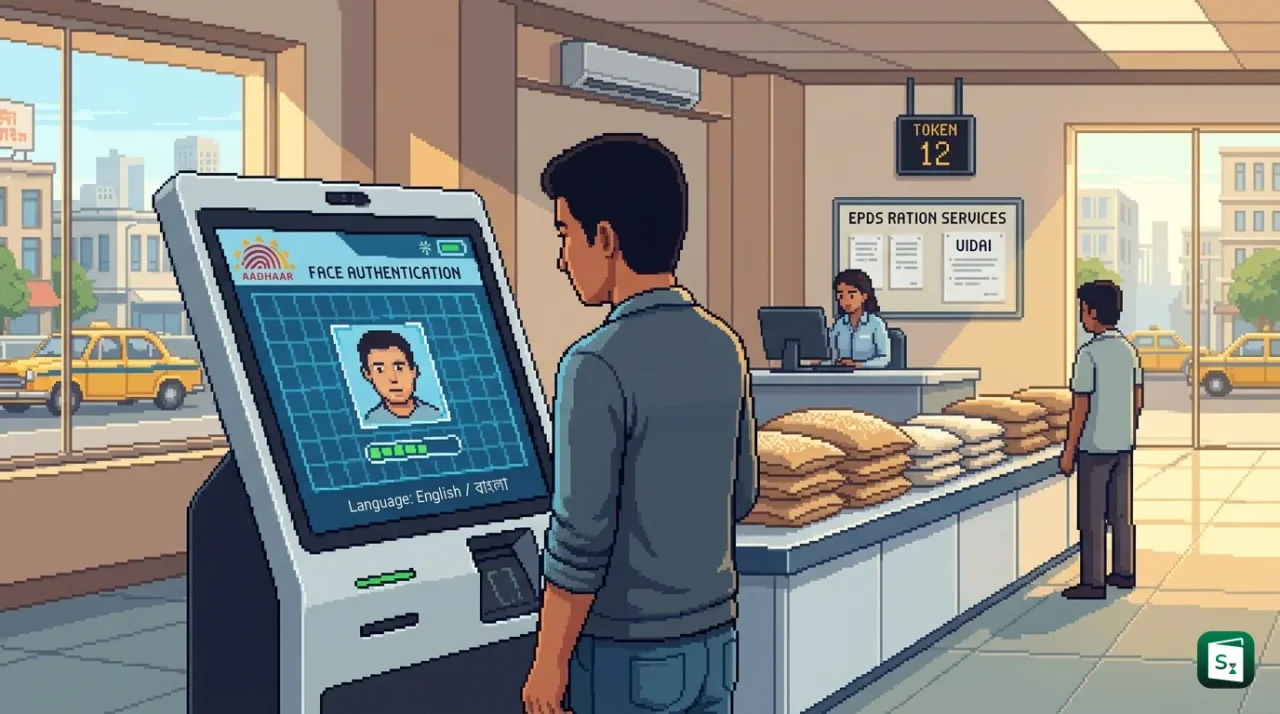
The Unique Identification Authority of India (UIDAI) unveiled five new digital identity initiatives at the fifth Aadhaar Samvaad stakeholders conference in Kolkata, held to mark the 17th Aadhaar Day. The package covers Face Authentication for ration delivery, SWIK Portal 2.0, a Sub-AUA and Sub-KUA LITE framework, a new Token Management System, and a revamped UIDAI website and Career Portal. Together, these tools aim to make Aadhaar verification contactless, simpler for small agencies to adopt, safer for privacy, and easier to use in Indian languages.
What Is UIDAI and What Is Aadhaar?
The Unique Identification Authority of India (UIDAI) is the statutory body that issues Aadhaar and manages its entire life cycle from enrolment to authentication. UIDAI was first created on 28 January 2009 as an attached office of the then Planning Commission, which is now NITI Aayog. Parliament later gave it legal backing through the Aadhaar (Targeted Delivery of Financial and Other Subsidies, Benefits and Services) Act, 2016, and UIDAI was formally established as a statutory authority on 12 July 2016 under the Ministry of Electronics and Information Technology (MeitY). Its head office is in New Delhi.
Aadhaar itself is a 12 digit random number issued to residents of India after collecting demographic details such as name, address and date of birth, along with biometric details such as fingerprints, iris scans and photograph. The first Aadhaar number was issued on 29 September 2010 to a resident of Nandurbar in Maharashtra. By 16 September 2025, UIDAI had generated more than 142.76 crore Aadhaar numbers. All biometric and demographic records are stored in the Central Identities Data Repository (CIDR), which is the central database that UIDAI checks during every authentication request.
Aadhaar works as a proof of identity and address for services such as bank accounts, mobile connections, school admissions and welfare payments. Aadhaar is not a proof of citizenship. It only confirms that the holder is a resident who has enrolled in the system. Residents can access services such as download of eAadhaar, address update, Virtual ID generation, masked Aadhaar and biometric lock through the myAadhaar portal and the new Aadhaar App.
What Happened at Aadhaar Samvaad in Kolkata?
UIDAI organised the fifth national stakeholders conference named Aadhaar Samvaad in Kolkata in late September 2026. The event coincided with the 17th Aadhaar Day, which marks the anniversary of the first Aadhaar issuance in September 2010. Senior officials, state departments, banks, technology partners, Authentication User Agencies and service providers took part to review how Aadhaar authentication is used in daily governance.
At the Kolkata conference, UIDAI unveiled five digital tools focused on three goals of easier access, stronger security and better governance. UIDAI also presented the Aadhaar Samvaad 2026 National Awards for best use of Aadhaar services, with bodies such as the Telangana State Level Police Recruitment Board recognised for using Aadhaar enabled offline verification in recruitment. The Lucknow model of digital tokens and advance slot booking for Aadhaar centres was also showcased as a template for all UIDAI regional offices to cut queues.
Five New Initiatives Launched at a Glance
UIDAI grouped the five launches as parts of one reform package for resident services, business onboarding and internal governance. Each tool solves a different practical problem, from ration shop verification to website language access. The table below gives a quick map before the detailed explanation in the next sections.
| Initiative | What It Does | Main User |
|---|---|---|
| Face Authentication for ePDS | Contactless face check for ration delivery, built with DFPD and NIC | Fair price shops and ration beneficiaries |
| SWIK Portal 2.0 | Upgraded window for onboarding and managing authentication agencies | Authentication User Agencies and partners |
| Sub-AUA and Sub-KUA LITE Framework | Simplified entry route for small entities to use Aadhaar authentication and eKYC | Startups, small banks and local service providers |
| New Token Management System | Replaces stored Aadhaar numbers with agency specific secure tokens | All agencies using authentication and residents |
| Revamped Website and Career Portal | Journey based navigation with BHASHINI multilingual support plus jobs and internship window | Residents, job seekers and researchers |
How Will Face Authentication Strengthen ePDS?
The electronic Public Distribution System (ePDS) is the digital network that manages ration supply through fair price shops under the National Food Security Act, 2013. UIDAI developed the new Face Authentication solution for ePDS jointly with the Department of Food and Public Distribution (DFPD) and the National Informatics Centre (NIC). DFPD is the central department under the Ministry of Consumer Affairs, Food and Public Distribution that handles foodgrain policy and ration management, while NIC is the technology agency under MeitY that builds digital platforms for government.
The need for this tool comes from a field level problem. Fingerprint authentication often fails for elderly persons, farm workers and manual labourers whose fingerprints are worn out, and iris devices are costly for small ration shops. A contactless face check on a basic smartphone or tablet allows the dealer to verify the beneficiary without extra hardware and without physical contact. This helps reduce denial of rations, shortens queues at shops and improves transparency in grain delivery.
How Does Face Authentication Work?
UIDAI Face Authentication is a consent based check where the live face of the Aadhaar holder is matched one to one with the photo stored for that Aadhaar number. UIDAI verifies the image in its central database and returns a yes or no response to confirm identity.
UIDAI clarified that Face Authentication performs a 1:1 match, which means it checks whether the live face matches the stored photo for the claimed Aadhaar number. This is different from face recognition used for surveillance, which performs a 1:N match across many faces. The ePDS version can also work with the SDK and sandbox tools that UIDAI released in September 2026 at the Global Fintech Fest to help banks and service providers test and integrate face checks inside their own apps.
What Is SWIK Portal 2.0 and the Sub-AUA LITE Framework?
What Are AUA and KUA in Aadhaar?
An Authentication User Agency is a registered body that uses UIDAI authentication for yes or no identity checks before delivering services. An eKYC User Agency is approved to also receive demographic details and photo with resident consent for paperless customer onboarding.
In the Aadhaar system, an Authentication User Agency (AUA) is a government or private body registered in India that sends authentication requests to UIDAI to confirm a resident before giving a service. A KYC User Agency (KUA) is an AUA that is also approved for eKYC, which is the electronic sharing of name, address, date of birth, gender, photo and contact details with resident consent. Both work through an Authentication Service Agency (ASA), which provides the secure network link to the CIDR. Smaller bodies that cannot connect directly work as Sub-AUA or Sub-KUA through a parent AUA or KUA.
The SWIK Portal 2.0 is the upgraded online window for this agency ecosystem. It handles onboarding of new AUAs and KUAs, renewal of permissions, compliance filings, audit checklists and monitoring of authentication use. Version 2.0 is designed to reduce paperwork, give clearer dashboards for transaction data and misuse alerts, and help UIDAI track which agency is accessing what data and for what purpose.
The Sub-AUA and Sub-KUA LITE Framework is a lighter entry route for small users such as local cooperatives, small finance firms, educational bodies and startups. Under the regular process, becoming a full AUA involves technical integration, dedicated secure connectivity and detailed audits that small bodies find costly. The LITE route allows such bodies to use Aadhaar authentication and limited eKYC through a parent agency with simpler technical and compliance steps, while UIDAI retains final approval and audit control.
What Is the New Token Management System?
The New Token Management System is a privacy tool that reduces the need to store actual Aadhaar numbers in agency databases. Under this design, UIDAI returns a 72 character UID Token that is unique for each Aadhaar number for a particular agency. The same Aadhaar number gets a different token for a different agency, and the token stays the same for repeat visits to the same agency.
This matters because storage of Aadhaar numbers across many databases increases the risk of leaks and illegal linking of personal records. Agencies are already divided into Global AUAs, which are legally required to store the Aadhaar number, and Local AUAs, which must use only limited eKYC and the token. The new system strengthens this separation by making tokens usable for authentication in place of the Aadhaar number or Virtual ID (VID), which is the temporary 16 digit number that only the holder can generate as a safer substitute for Aadhaar.
For residents, the practical effect is simple. A bank or ration database will identify a person through a code that works only inside that bank or department and has no meaning outside it. Even if one database is exposed, the token cannot be used to trace the same person in another database.
Revamped Website, Career Portal and BHASHINI Support
UIDAI also launched its revamped website and a dedicated Career Portal at the Kolkata event. The new website uses journey based navigation, which means services are grouped by user need such as update address, download card or lock biometrics, instead of by technical menu names. This structure helps first time users complete tasks without knowing department terms.
The website uses BHASHINI for multilingual support. BHASHINI is the National Language Translation Mission launched in July 2022 by the Prime Minister during the Digital India Week and implemented by the Digital India BHASHINI Division under the Digital India Corporation of MeitY. The platform provides AI based translation, speech to text, text to speech and document translation across the 22 scheduled languages and other Indian languages. On the UIDAI site, BHASHINI powers instant translation of pages and help text, so residents can read forms and instructions in their own language.
The Career Portal brings internships, research openings, hackathons and job notices under one window. UIDAI regularly runs internship schemes, data hackathons and biometric benchmarking challenges to involve students, startups and academic bodies in building future identity tools. A single portal with login, application tracking and learning material makes this talent pipeline more open and easier to monitor.
Significance and the Way Forward
The five launches show a shift in Aadhaar policy from enrolment growth to quality of use. With more than 142 crore numbers already issued, the main challenge is to make daily verification easy at ration shops, banks and offices while protecting data. Contactless face checks address exclusion from fingerprint failures, the LITE framework widens legal access for small agencies, and tokenisation reduces the risk from storing Aadhaar numbers everywhere.
For governance, the upgrades tighten oversight without blocking innovation. SWIK Portal 2.0 gives UIDAI clearer audit trails, and the Career Portal builds a steady pool of talent for future identity research. The multilingual website supports the Digital India goal of language inclusive access, where residents can use services in the language they are most comfortable with. The next test will be field rollout, staff training at fair price shops, stable network links through NIC systems, and clear consent and grievance rules so that speed does not weaken privacy.
Key Takeaways
- UIDAI unveiled five new digital initiatives at the fifth Aadhaar Samvaad in Kolkata held to mark the 17th Aadhaar Day.
- Face Authentication for ePDS was built with DFPD and NIC to enable contactless verification at fair price shops.
- UIDAI performs Face Authentication as a 1:1 match against the stored photo for the claimed Aadhaar number with resident consent.
- The Sub-AUA and Sub-KUA LITE Framework gives small agencies a simpler route to use Aadhaar authentication and eKYC through a parent agency.
- The Token Management System replaces stored Aadhaar numbers with a 72 character agency specific UID Token and supports Virtual ID use for privacy.
- UIDAI became a statutory authority on 12 July 2016 under the Aadhaar Act, 2016 and functions under MeitY with headquarters in New Delhi.
- BHASHINI, launched in July 2022 as the National Language Translation Mission, powers multilingual access on the revamped UIDAI website across 22 scheduled languages.