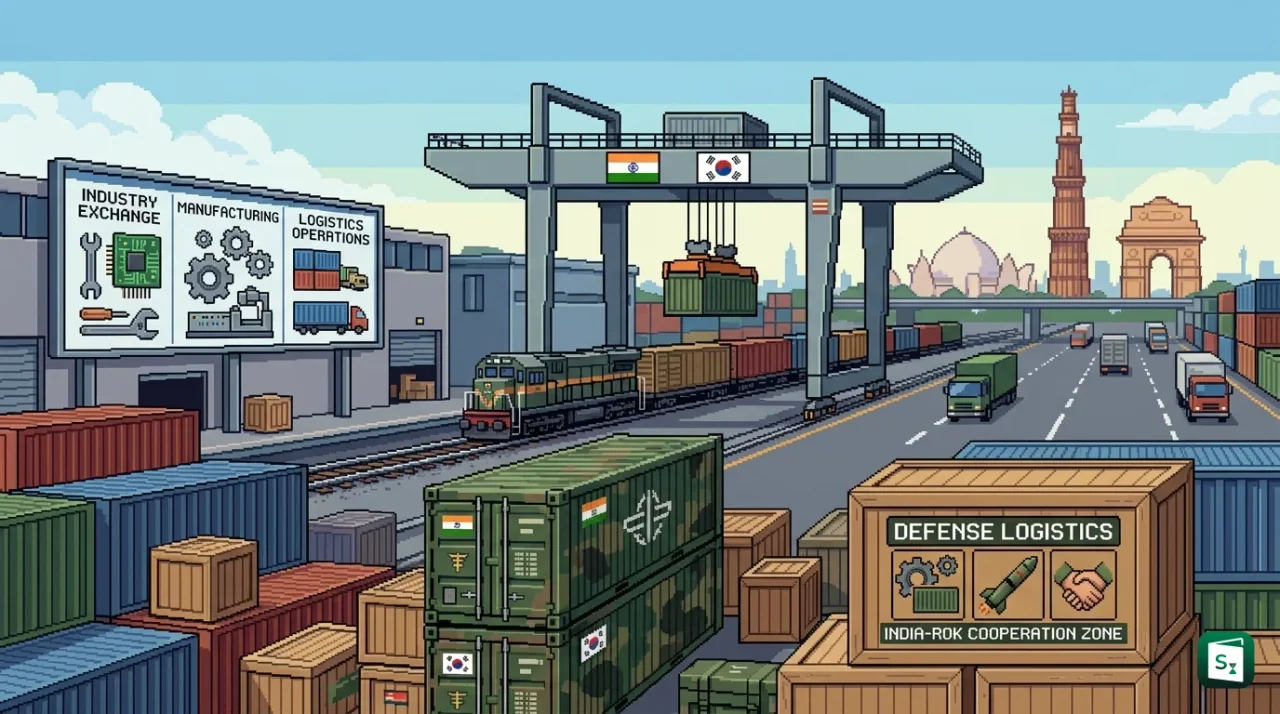
India and South Korea held the 10th Joint Committee Meeting on Defence Industries and Logistics Cooperation in New Delhi on 29 September 2026 to review India South Korea relations in defence production. The meeting reviewed ongoing projects such as the K9 Vajra self propelled howitzer and the proposed Biho air defence system and explored new areas for joint production and logistics support. The talks signal a shift from simple buyer seller deals to co development and local manufacturing in India.
What Happened at the 10th Joint Committee Meeting in New Delhi?
The 10th India Republic of Korea Joint Committee Meeting (JCM) on Defence Industries and Logistics Cooperation was held in New Delhi on 29 September 2026. The Ministry of Defence of India and the Defence Acquisition Program Administration (DAPA) of South Korea led the talks. DAPA is the South Korean government agency that manages defence purchases, arms exports and defence industry promotion.
The meeting was co chaired by Dinesh Mahur, Additional Secretary for Defence Production in the Indian Ministry of Defence, and Kim Il Dong, Vice Minister of DAPA. Officials from both defence ministries took part along with industry representatives. The Indian side included Larsen and Toubro (L and T) and BEML, while the South Korean side included Hanwha Aerospace, Hanwha Systems, Korean Air, Korea Aerospace Industries and DS Navcours.
| Meeting Detail | Fact |
|---|---|
| Meeting name | 10th Joint Committee Meeting on Defence Industries and Logistics Cooperation |
| Date and venue | 29 September 2026, New Delhi |
| Indian co chair | Dinesh Mahur, Additional Secretary (Defence Production) |
| Korean co chair | Kim Il Dong, Vice Minister, DAPA |
| Main agenda | Review of K9 Vajra support, Biho air defence talks, logistics and future co production |
On the sidelines of the JCM, Kim Il Dong called on Sanjay Seth, Minister of State for Defence (as of September 2026). Both sides restated their shared aim to deepen collaboration in defence production and logistics. No new contract or purchase approval was announced at the meeting. The value of the meeting was in regular institutional dialogue and in showing the direction of land systems, aerospace, electronics and maintenance cooperation.
India South Korea Relations: From Korean War to Special Strategic Partnership
The India South Korea defence partnership rests on a long political history. India and the Republic of Korea established consular ties in 1962 and full diplomatic relations on 10 December 1973. The relationship was raised to a Strategic Partnership in 2010 and then to a Special Strategic Partnership in 2015 during the visit of Prime Minister Narendra Modi to Seoul. Both countries marked 50 years of diplomatic ties in 2023.
Defence links grew step by step. The two countries signed a memorandum of understanding on defence industry and logistics in 2005, followed by memorandums on defence cooperation and defence research and development in 2010. These linked the Indian Defence Research and Development Organisation (DRDO), which is India’s main military research agency, with South Korean industry and research bodies. In 2020, both sides adopted a Roadmap for Defence Industries Cooperation covering land, naval, aero and guided weapon systems, along with investment and technology transfer in India’s defence corridors.
Did India Help South Korea in the Korean War?
Yes, India helped both sides end the Korean War through medical support and peacemaking, not through combat troops. India sent the 60th Parachute Field Ambulance medical unit and later chaired the Neutral Nations Repatriation Commission that managed the exchange of prisoners of war after the 1953 armistice.
India played an active role before and during the Korean War of 1950 to 1953. Indian diplomat K P S Menon chaired the United Nations Temporary Commission on Korea in 1947 that was tasked with holding elections in Korea. During the war, India sent an Army medical unit, the 60th Parachute Field Ambulance, commanded by Lieutenant Colonel A G Rangaraj. The unit landed at Busan on 20 November 1950 with 627 personnel and treated more than 220,000 patients, including civilians.
When fighting stopped with the armistice on 27 July 1953, an Indian proposal in the United Nations General Assembly helped shape the settlement. India was asked to chair the five member Neutral Nations Repatriation Commission (NNRC), along with Czechoslovakia, Poland, Sweden and Switzerland. Lieutenant General K S Thimayya became chairman of the commission. India also sent the Custodian Force India, a brigade group of about 5,230 to 5,500 personnel under Major General S S P Thorat, which took charge of more than 25,000 prisoners of war and helped with their return.
Are India and South Korea Friends Today?
Yes, India and South Korea are close partners today with a Special Strategic Partnership covering defence, trade, technology and culture. The two sides hold regular summits, military exchanges and joint exercises and cooperate on manufacturing, shipbuilding, semiconductors, critical minerals and supply chains.
The partnership today is driven by shared democratic values and common interests in the Indo Pacific region. India’s Act East Policy, adopted in 2014 to deepen strategic links with Southeast and East Asia, matches well with South Korea’s outreach to the south. High level visits have kept up the pace, including the state visit of South Korean President Lee Jae Myung to New Delhi on 20 April 2026, his first visit to India and the first by a South Korean president in eight years. Cultural links also add depth, from the legend of Princess Suriratna of Ayodhya marrying King Kim Suro of Gaya in 48 AD to the popularity of Rabindranath Tagore’s poem Lamp of the East in Korean schools.
K9 Vajra: Flagship of India South Korea Defence Cooperation
The K9 Vajra-T is the best known example of India South Korea defence cooperation. It is the Indian version of South Korea’s K9 Thunder, a tracked self propelled howitzer. A self propelled howitzer is an artillery gun mounted on a tracked vehicle, so it can move on its own, fire long range shells and quickly change position to avoid return fire.
The gun was developed by South Korea’s Hanwha Aerospace and is built in India by Larsen and Toubro (L and T) at its Armoured Systems Complex at Hazira in Gujarat. L and T is one of India’s largest private engineering and defence manufacturers. The programme follows the Make in India approach, which aims to build weapons inside India with rising local content and technology transfer instead of importing finished systems.
K9 Vajra Tank: Self Propelled Howitzer Profile
The K9 Vajra is often searched as the K9 Vajra tank, but it is not a battle tank. It is a tracked artillery system designed to give long range fire support to ground troops.
| Feature of K9 Vajra-T | Detail |
|---|---|
| Type | 155 mm, 52 calibre tracked self propelled howitzer |
| Base platform | South Korean K9 Thunder, customised for Indian conditions |
| Weight and armour | About 47 tonnes, all welded steel armour |
| Crew | Five soldiers |
| Firepower | Can fire three rounds in 30 seconds, 15 rounds in three minutes |
| Range | About 30 km with standard shells, up to 38 to 42 km with special long range ammunition, reports of up to 50 km with extended range shells |
| Mobility | Top speed about 67 km per hour, range about 360 km |
| Indian systems added | Fire control system, ammunition handling, air conditioning for desert heat, electronics for high altitude use |
The system can fire both Indian and NATO standard 155 mm shells. Its shoot and scoot ability allows it to fire and move quickly, which keeps it safe from enemy artillery finding its location.
K9 Vajra in the Indian Army: L and T Role and New Orders
The Indian Army selected the L and T and Hanwha team in September 2015 after long trials. The first contract for 100 guns worth ₹4,500 crore was signed in May 2017. The first 10 guns came from South Korea and the remaining 90 were built in India. The 100th gun was flagged off from Hazira in February 2021, ahead of schedule, with more than 50 percent indigenisation by value and over 13,000 local components per system.
After successful use in deserts along the Pakistan border and later trials in high altitude areas of Ladakh after the standoff with China, the Army asked for more guns. The Ministry of Defence signed a second contract in December 2024 for another 100 guns worth ₹7,628.7 crore (about $850 million). Hanwha signed a $253 million component supply deal with L and T in April 2025 to support this batch. Local content in the second batch is targeted at 60 percent. Talks on a possible third batch of 100 to 200 additional guns have been reported, which would further raise scale and lower costs.
Biho Hybrid Air Defence System and Future Defence Deals
The Biho Complex, also called the Biho Hybrid, was a central topic at the 10th JCM. DAPA said both sides discussed steps for stable progress and long term operation and maintenance of this system, which is still under negotiation, along with continued support for the K9 howitzers already in service.
Biho means Flying Tiger in Korean. The K30 Biho is a South Korean self propelled air defence gun developed by the Agency for Defense Development and built by Hanwha Aerospace. It uses a modified K200 tracked chassis and carries twin 30 mm cannons with a surveillance radar, electro optical cameras, laser rangefinder and digital fire control. The guns have a cyclic rate of about 600 rounds per minute per gun and an effective range of about 3 km against low flying aircraft, helicopters and drones. The TPS 830K radar can spot small targets at about 17 km.
The Hybrid version adds KP SAM Chiron missiles, a short range heat seeking missile, with two missiles on each side of the turret. This raises the engagement range to about 7 km and gives the vehicle both gun and missile options. That mix is useful against drones, low flying jets and helicopters, which is a growing need for India.
India has been looking for a Self Propelled Air Defence Gun Missile System (SPAD GMS) to replace old air defence guns. The Biho Hybrid was shortlisted after trials against Russian systems such as the Tunguska. The potential deal has been estimated at about $2.5 billion, but it slowed down as India pushed for higher local manufacturing. The 10th JCM reviewed how to take the project forward with local production, maintenance and spare support rather than a direct import.
Broader talks now cover anti aircraft guns, short range missile systems, cyber security, telecom equipment for defence use and joint procurement. South Korea is a strong partner here because it already makes artillery, armoured vehicles, ships, aircraft electronics and radars at scale. South Korea was the world’s 10th largest arms exporter between 2020 and 2024, with buyers including Poland, the Philippines, Egypt and India. Its defence budget for 2026 was proposed at 66.3 trillion won (about $47.4 billion), an 8.2 percent rise, focused on missile defence, fighter aircraft such as the KF 21, drones and artificial intelligence under its Defence Innovation 4.0 plan.
KIND-X and the 2020 Roadmap: Next Phase of Defence Partnership
The 10th JCM is a follow up to the India South Korea summit held on 20 April 2026 in New Delhi between Prime Minister Narendra Modi and President Lee Jae Myung. At that summit, both leaders agreed to move into a third phase of defence cooperation with more technology transfer, co design and co development of next generation systems. The JCM discussed how to turn that political direction into concrete projects and how to revive the 2020 Roadmap for Defence Industries Cooperation.
The most forward looking outcome of the April summit was the Korea India Defence Accelerator (KIND-X). KIND-X is a joint innovation platform that will connect businesses, incubators, investors, defence start ups and universities from both countries. It is expected to be led by India’s Defence Innovation Organisation (DIO) and South Korea’s DAPA. DIO runs India’s Innovations for Defence Excellence (iDEX), which funds and guides Indian defence start ups.
KIND-X follows the model of INDUS-X with the United States and FRIND-X with France. The idea is to run joint challenges, offer grants, share testing labs, help with certification and standards, and hold workshops on export controls, intellectual property and funding rules. Priority areas include artificial intelligence for military use, autonomous systems and robotics, space based surveillance and communication, critical minerals, defence semiconductors and counter drone technology. It can also link South Korean innovation clusters in Changwon, Daejeon and Gumi with Indian defence corridors in Tamil Nadu and Uttar Pradesh and aerospace hubs in Bengaluru, Chennai and Hyderabad.
India South Korea Trade, CEPA and Defence Industry Link
Defence production cannot be separated from the wider India South Korea trade relationship. The two countries signed the Comprehensive Economic Partnership Agreement (CEPA) on 7 August 2009, which came into force on 1 January 2010. A CEPA is a trade pact that cuts customs duties on most goods and eases rules for services and investment. Under this pact, about 93.1 percent of India’s tariff lines and 83.7 percent of Korea’s tariff lines are under preferential or zero duty treatment.
Trade has grown from about $14 billion when CEPA started to about $27 billion in recent years. At the April 2026 summit, both leaders set a goal to raise bilateral trade to $50 billion by 2030 and agreed to finish CEPA upgrade talks by the first half of 2027. The 12th round of upgrade talks was held in New Delhi from 25 to 27 May 2026. Both sides agreed on an early harvest package in principle in 2018, but it is still awaiting final notification.
The trade balance remains a concern for India. India’s exports to Korea were about $6 billion in 2025-26, while imports were about $21.35 billion, leaving a deficit of about $15.35 billion. India has raised issues such as strict standards and certification rules that make it hard for Indian goods to enter Korea. The two sides have now set up sub groups on digital trade, supply chains and industrial cooperation.
For defence, a fairer and deeper trade pact matters. Easier rules of origin, simpler customs and stronger supply chains will help Korean firms such as Hanwha and Korean Air to make parts in India, build maintenance hubs and export from India to third countries. The plan for a Korean industrial township in India for small and medium firms, plus cooperation in shipbuilding, steel, critical minerals and clean energy from chips to ships, will support this factory link. If defence projects use the same supply chain, both the trade goal and the self reliance goal in defence can move forward together.
Key Takeaways
- The 10th Joint Committee Meeting on Defence Industries and Logistics Cooperation was held in New Delhi on 29 September 2026.
- The meeting was co chaired by Dinesh Mahur of India and Kim Il Dong of South Korea’s Defence Acquisition Program Administration (DAPA).
- The K9 Vajra-T is a 155 mm, 52 calibre tracked howitzer built by L and T with Hanwha Aerospace at Hazira, Gujarat.
- The K30 Biho Hybrid combines twin 30 mm guns with Chiron missiles for a strike range of about 7 km against drones and low flying aircraft.
- India South Korea ties were raised to a Special Strategic Partnership in 2015, after diplomatic relations began on 10 December 1973.
- The India Korea CEPA came into force on 1 January 2010, with a target to raise bilateral trade to $50 billion by 2030.