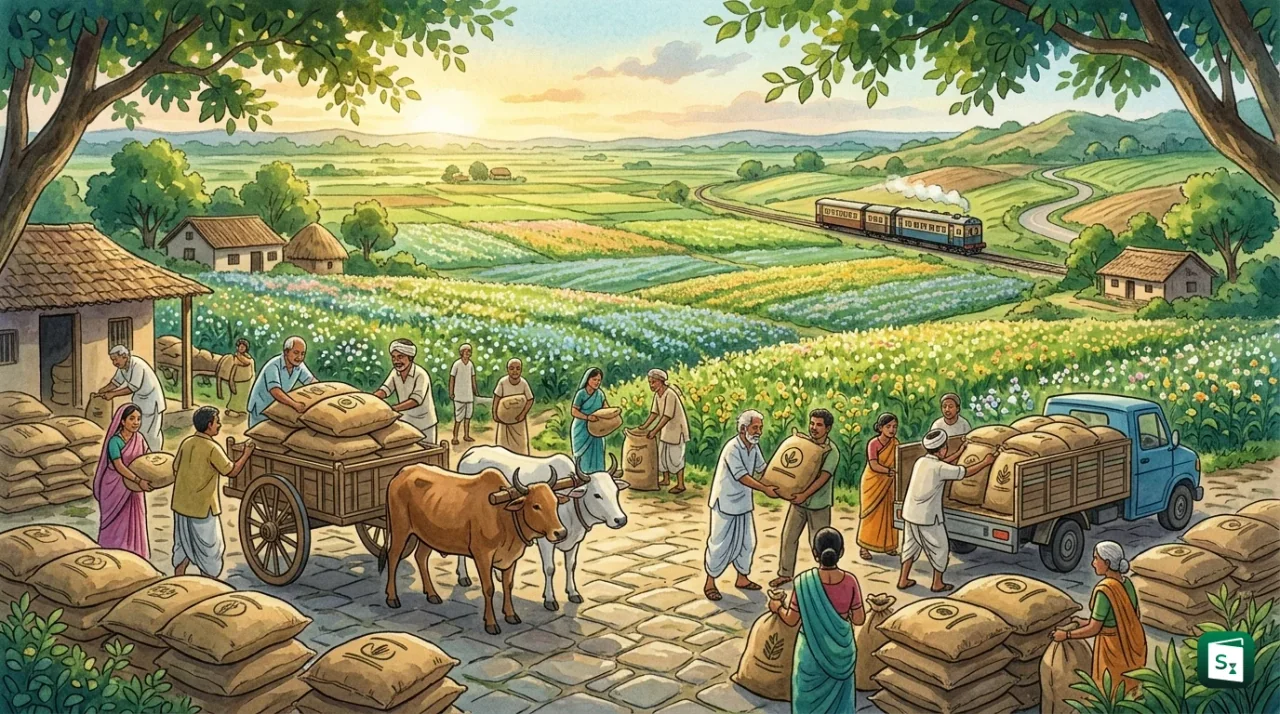
Union Agriculture and Farmers Welfare Minister Shivraj Singh Chouhan has approved procurement worth ₹5,547.99 crore at Minimum Support Price under the Price Support Scheme for the Kharif Marketing Season 2026-27. The approval covers 5.21 lakh tonnes of pulses and 1.90 lakh tonnes of oilseeds in Uttar Pradesh, Karnataka and Telangana. The move assures pulse and oilseed growers of a guaranteed price as fresh kharif arrivals reach mandis.
What Is MSP in Agriculture?
Minimum Support Price (MSP) is the minimum price at which the government offers to buy crops directly from farmers. It works as a price floor and a form of market intervention to protect growers against any sharp fall in farm prices during a bumper harvest. If open market prices drop below this level, government agencies step in and buy the produce at the announced MSP, so farmers avoid distress sales.
The Department of Agriculture and Farmers Welfare announces MSP before the sowing season, so farmers can decide which crop will give a profitable return. The guarantee covers produce that meets Fair Average Quality (FAQ) norms, which are standard specifications for moisture, cleanliness and quality. Farmers remain free to sell in the open market if the market price is higher than MSP. In that case, the government does not force procurement.
MSP for How Many Crops?
The government fixes MSP for 22 mandated crops every year. These include 14 kharif crops, 6 rabi crops and 2 commercial crops. In addition, MSP for toria is fixed on the basis of rapeseed and mustard, and MSP for de husked coconut is fixed on the basis of copra. Sugarcane is not covered under MSP. The government fixes a separate Fair and Remunerative Price (FRP) for sugarcane.
The kharif crops list covers cereals such as paddy, jowar, bajra, maize and ragi, pulses such as tur (arhar), moong and urad, oilseeds such as groundnut, soybean (yellow), sunflower seed, sesamum and nigerseed, and cotton. The rabi crops list covers wheat, barley, gram, masur (lentil), rapeseed and mustard, and safflower. The two commercial crops are jute and copra. This structure explains why searches for MSP for wheat, MSP for paddy and MSP for cotton all point to the same national system, but each crop has a different season and a different procurement agency.
How MSP Is Decided and Calculated?
The Commission for Agricultural Costs and Prices (CACP) recommends MSP for all mandated crops. CACP is the apex advisory body on farm pricing under the Ministry of Agriculture and Farmers Welfare. It traces its roots to the Agricultural Prices Commission set up in 1965 under Professor M L Dantwala, which was renamed as CACP in 1985. The government takes the CACP report, seeks views of state governments and central ministries, and then the Cabinet Committee on Economic Affairs (CCEA) chaired by the Prime Minister gives final approval.
While recommending prices, CACP looks at the cost of production, demand and supply conditions, domestic and international prices, inter crop price parity, terms of trade between agriculture and non agriculture sectors, and the likely effect on the wider economy. The cost considered includes hired labour, machine labour, seeds, fertilisers, irrigation charges, interest on working capital and the imputed value of family labour. This cost concept is called A2 plus FL. Since the Union Budget of 2018-19, the stated principle is to keep MSP at least 1.5 times the all India weighted average cost of production, which means a minimum 50 percent margin over cost.
Kharif MSP List 2026-27 and 2026 Announcement Timeline
The CCEA approved the MSP for 14 kharif crops for Marketing Season 2026-27 on 13 May 2026. The highest absolute increase over 2025-26 was for sunflower seed at ₹622 per quintal, followed by cotton at ₹557 per quintal, nigerseed at ₹515 per quintal and sesamum at ₹500 per quintal. The expected margin over cost is highest for moong at 61 percent, followed by bajra at 56 percent, maize at 56 percent and tur at 54 percent. For all other kharif crops, the margin is estimated at 50 percent.
| Crop | MSP 2026-27 (₹ per quintal) | Increase over 2025-26 (₹) |
|---|---|---|
| Paddy (Common) | 2441 | 72 |
| Paddy (Grade A) | 2461 | 72 |
| Jowar (Hybrid) | 4023 | 324 |
| Bajra | 2900 | 125 |
| Ragi | 5205 | 319 |
| Maize | 2410 | 10 |
| Tur (Arhar) | 8450 | 450 |
| Moong | 8780 | 12 |
| Urad | 8200 | 400 |
| Groundnut | 7517 | 254 |
| Sunflower Seed | 8343 | 622 |
| Soybean (Yellow) | 5708 | 380 |
| Sesamum | 10346 | 500 |
| Nigerseed | 10052 | 515 |
| Cotton (Medium Staple) | 8267 | 557 |
| Cotton (Long Staple) | 8667 | 557 |
MSP is not a legal right in India. It is an administrative price assurance backed by government procurement, not by a statute that farmers can enforce in court. The demand for legal guarantee has been part of public debate, but the present system operates through annual Cabinet approval and procurement operations rather than a law.
State Wise PSS Procurement Approved for Kharif Marketing Season 2026-27
The Ministry of Agriculture and Farmers Welfare approved procurement of pulses and oilseeds worth ₹5,547.99 crore at MSP for Kharif Marketing Season 2026-27. The Kharif Marketing Season generally begins after harvest in October and November, when fresh arrivals put pressure on mandi prices. The approved quantities will be bought by central nodal agencies when market prices fall below MSP. Uttar Pradesh received the largest share because of its large tur allocation.
| State | Crop | Quantity approved (tonnes) | Value (₹ crore) |
|---|---|---|---|
| Uttar Pradesh | Tur | 466000 | 3937.70 |
| Uttar Pradesh | Moong | 6250 | 54.87 |
| Uttar Pradesh total | Pulses | 472250 | 3992.57 |
| Karnataka | Soybean | 115500 | 659.27 |
| Karnataka | Moong | 38250 | 335.83 |
| Karnataka | Sunflower | 13413 | 111.90 |
| Karnataka total | Pulses and oilseeds | 167163 | 1107.00 |
| Telangana | Soybean | 62000 | 353.90 |
| Telangana | Moong | 10766 | 94.52 |
| Telangana total | Pulses and oilseeds | 72766 | 448.42 |
The Ministry said payments will be made directly into farmers bank accounts in a timely manner. Procurement centres will operate with transparent arrangements, and only produce meeting FAQ standards from pre registered farmers will be accepted. The announcement also linked the decision to self reliance in pulses and edible oils, since higher assured procurement encourages farmers to grow more tur, moong, soybean and sunflower at home and reduce dependence on imports.
How the Price Support Scheme Works
The Price Support Scheme (PSS) is the component of the umbrella scheme Pradhan Mantri Annadata Aay Sanrakshan Abhiyan (PM-AASHA) that handles pulses, oilseeds and copra. PM-AASHA brings together PSS, the Price Stabilisation Fund, the Price Deficiency Payment Scheme and the Market Intervention Scheme under one framework. PSS starts when the market price of a notified commodity falls below MSP during the peak arrival period. Procurement is then done at MSP for a maximum period of 90 days in a season, though the period can be extended in exceptional cases.
Two central nodal agencies carry out PSS procurement. These are the National Agricultural Cooperative Marketing Federation of India Ltd (NAFED) and the National Cooperative Consumers Federation of India Ltd (NCCF). The agencies work through state level agencies, Primary Agricultural Credit Societies and Farmer Producer Organisations. Farmers must pre register with Aadhaar, land records, bank details and crop details on the e-Samriddhi portal of NAFED or the e-Samyukti portal of NCCF. From the 2025-26 season, biometric authentication through Aadhaar enabled machines or facial authentication has been made mandatory at procurement centres to ensure only genuine farmers sell under the scheme.
The normal procurement limit under PSS is 25 percent of the actual production of the commodity in that state and season. For tur, urad and masur, the government now permits procurement up to 100 percent of state production to boost domestic output. This special facility, linked to the Mission for Aatmanirbharta in Pulses till 2030-31, means farmers offering these three pulses are assured of full purchase. By contrast, paddy and wheat are bought by the Food Corporation of India (FCI) and state agencies for the central pool, cotton is bought by the Cotton Corporation of India (CCI), and jute is bought by the Jute Corporation of India (JCI). The PM-AASHA budget for 2026-27 is ₹7,200 crore, with a government guarantee of ₹45,000 crore for procurement of pulses, oilseeds and copra.
Why MSP Procurement Matters for Farmers and the Economy
MSP works as a safety net because it assures a minimum income even when supply is high and prices fall. For small growers of pulses and oilseeds, who face high price volatility, this assurance prevents panic selling immediately after harvest. It also helps crop planning, since an attractive MSP for tur, moong, soybean and sunflower encourages diversification away from water heavy cereals. Over time, higher domestic production of pulses and oilseeds can lower import bills and improve food security.
The distinction between related price terms is important for clarity. MSP is the minimum price the government guarantees before sowing. Procurement price is the price at which agencies actually buy for government stocks, which in practice equals MSP during the procurement window. Issue price is the price at which the government releases grain through the public distribution system, which is kept low for consumers. FRP is the minimum price sugar mills must pay to sugarcane growers, and it is governed by a different law and mechanism from MSP.
Key Takeaways
- Procurement worth ₹5,547.99 crore at MSP under PSS for Kharif Marketing Season 2026-27 was approved for Uttar Pradesh, Karnataka and Telangana.
- Uttar Pradesh received ₹3,992.57 crore for 4,66,000 tonnes of tur and 6,250 tonnes of moong, the largest state share.
- Karnataka received ₹1,107 crore for soybean, moong and sunflower, while Telangana received ₹448.42 crore for soybean and moong.
- MSP is fixed for 22 mandated crops on the recommendation of the Commission for Agricultural Costs and Prices, with final approval by the CCEA.
- PSS procurement for pulses and oilseeds is done by NAFED and NCCF under PM-AASHA when market prices fall below MSP.
- Kharif MSPs for 2026-27 include ₹8,450 per quintal for tur, ₹8,780 for moong, ₹5,708 for soybean and ₹8,343 for sunflower seed.