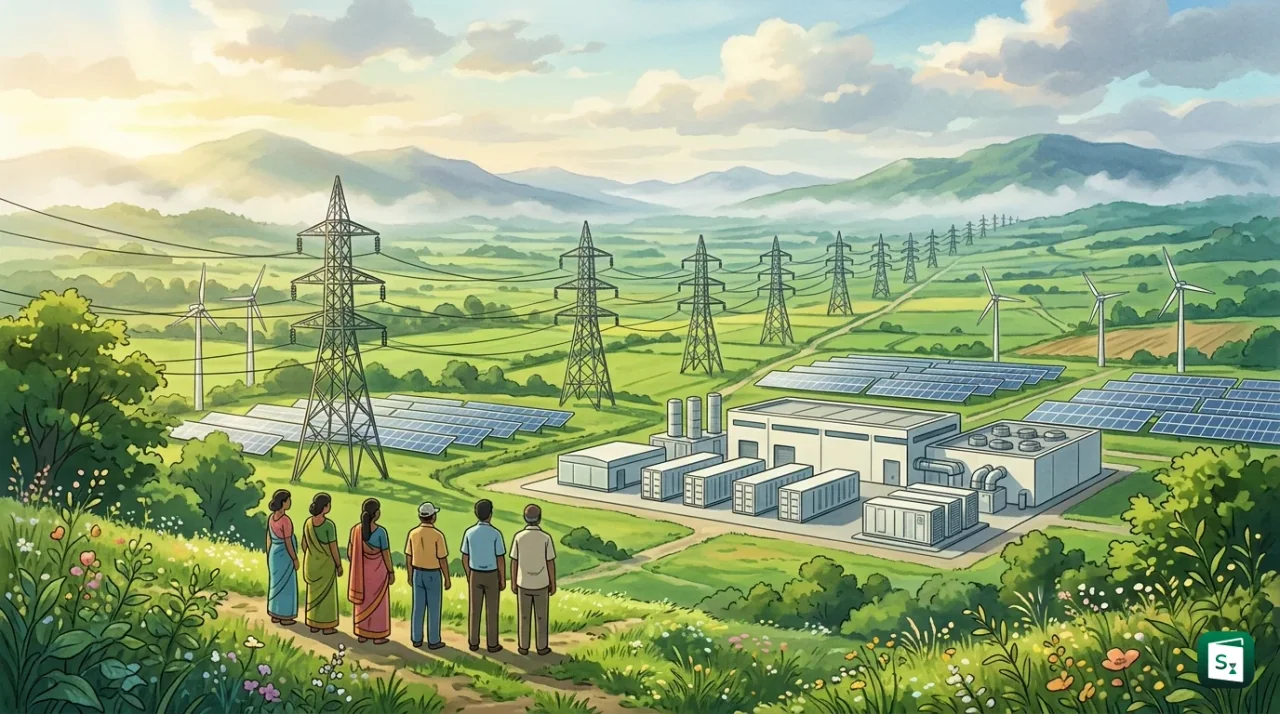
The Union Cabinet, chaired by Prime Minister Narendra Modi, approved the Green Energy Corridor Phase-III (GEC-III) scheme on 30 September 2026 to strengthen the Intra-State Transmission System across states and Union Territories. The scheme will enable evacuation of up to 135 GW of renewable energy and deploy 50 GWh of Battery Energy Storage Systems at the generator end by FY33. With a total outlay of ₹1,86,405 crore, it is the largest transmission push so far for clean power integration in India.
What Is the Green Energy Corridor?
The Green Energy Corridor is a dedicated transmission network built to carry electricity from renewable energy plants to consumption centres. Green energy here means power from non-fossil sources such as solar and wind. Corridor means a planned set of transmission lines, substations and control centres that move this power smoothly into the national grid.
The corridor has two parts. The Inter-State Transmission System (ISTS) carries bulk power across state borders and over long distances. The Intra-State Transmission System (InSTS) distributes and evacuates power within a state from solar parks and wind farms to state substations and load centres. Both parts are supported by Renewable Energy Management Centres (REMCs), which forecast solar and wind output and help grid operators manage sudden changes in supply.
The original Green Energy Corridor report was prepared by the Power Grid Corporation of India (PGCIL) in 2012-13. Implementation started in 2015. The Ministry of New and Renewable Energy (MNRE), the nodal central agency for renewable energy, implements the InSTS component in partnership with states. The Ministry of Power oversees ISTS planning and related grid measures through agencies such as PGCIL and the Central Transmission Utility of India.
Green Energy Corridor Phase-III: Approval, Outlay and Targets
The Union Cabinet approved the Green Energy Corridor Phase-III (GEC-III) scheme on 30 September 2026. The scheme covers the Intra-State Transmission System and adds battery storage for the first time at this scale. It will run across states and Union Territories and is targeted for completion by FY33, which means by 31 March 2033.
The financial size of GEC-III is far larger than earlier phases. The total project outlay is ₹1,86,405 crore. This includes ₹1,36,378 crore for InSTS development and ₹50,000 crore for 50 GWh of Battery Energy Storage Systems. The central government will provide Central Financial Support of ₹54,082 crore.
| Component of GEC-III | Size and Cost |
|---|---|
| Renewable energy evacuation target | 135 GW across states and Union Territories |
| InSTS development | ₹1,36,378 crore for lines, substations and upgrades |
| Battery Energy Storage Systems | 50 GWh with ₹50,000 crore outlay |
| Total project outlay | ₹1,86,405 crore |
| Central Financial Support | ₹54,082 crore to lower transmission charges |
| Completion timeline | FY33 |
The Central Financial Assistance will offset part of the Intra-State transmission charges. This keeps the cost of renewable power lower for distribution companies and for end users. The government has stated that this support will ultimately benefit citizens through more affordable clean electricity.
Intra-State vs Inter-State Transmission System
GEC-III focuses on the Intra-State Transmission System, so it is useful to understand how it differs from the Inter-State system. Both systems form the backbone for moving renewable power, but they operate at different levels and are built by different agencies.
The Intra-State system moves power within a state. A solar park in Rajasthan or a wind farm in Tamil Nadu first feeds into the state grid through InSTS lines and substations. The State Transmission Utilities build and operate this network. GEC-III will strengthen this layer so that large volumes of solar and wind power do not get stuck at the generation point due to congestion or weak local lines.
The Inter-State system moves bulk power over long distances between states and regions. For example, solar power from Ladakh can travel through Himachal Pradesh and Punjab to Kaithal in Haryana before joining the national grid. PGCIL is the main implementing agency for such ISTS links. ISTS projects use high capacity lines, including High Voltage Direct Current links with power flow control for efficient long distance transfer.
| Feature | Intra-State Transmission System | Inter-State Transmission System |
|---|---|---|
| Area covered | Within one state or Union Territory | Across states and regions |
| Main purpose in GEC | Evacuate renewable power to state grid | Transfer bulk renewable power nationally |
| Implementing agency | State Transmission Utilities | Power Grid Corporation of India |
| GEC-III focus | Core focus, with central support | Linked through national grid planning |
India is expanding both layers together. The National Electricity Plan aims to raise the transmission network from about 5.04 lakh circuit km to 6.48 lakh circuit km by 2032. Inter-regional capacity is planned to rise from 120 GW to 168 GW by 2032. GEC-III adds the state-level capacity needed to feed into this larger national network.
Battery Energy Storage System Deployment at Generator End
The most distinctive feature of GEC-III is the large scale deployment of Battery Energy Storage Systems. The scheme provides for 50 GWh of battery storage at the renewable energy generator end or at other locations of importance for grid flexibility. A Battery Energy Storage System is a set of rechargeable batteries with control and safety equipment that stores electricity when supply is high and releases it when demand is high.
Solar power peaks around midday, while household and commercial demand rises in the evening. Wind output also changes with season and weather. Without storage, surplus midday power can go waste and evening demand must be met from other sources. Storage bridges this gap by shifting clean power from hours of plenty to hours of need.
How Battery Storage Supports Renewable Integration
GEC-III places batteries near solar and wind plants to address four specific grid problems. First, it reduces intermittency, which means sudden ups and downs in solar and wind supply. Second, it eases congestion on transmission lines by storing power locally instead of pushing all of it into the grid at once. Third, it reduces curtailment during peak generation hours, when grid operators would otherwise ask plants to cut output. Fourth, it meets non-solar hour demand, especially after sunset.
A typical storage installation has battery modules, a Battery Management System for safety and health monitoring, a Power Conversion System to change direct current to alternating current, and an Energy Management System for intelligent control. Most grid scale projects in India use lithium ion chemistry, while alternative technologies such as vanadium flow batteries and zinc bromide flow batteries are also being studied for long duration use. Falling solar battery costs and central incentives such as viability gap funding and waiver of Inter-State Transmission System charges for co-located storage commissioned till June 2028 have made such projects more viable.
Phase 1 vs Phase 2 vs Phase 3
The Green Energy Corridor has grown in three stages. Each phase expanded coverage and raised the evacuation target to match rising renewable capacity.
Phase-I focused on Intra-State lines for about 24 GW of renewable power. The Cabinet Committee on Economic Affairs approved it in 2015 with a cost of ₹10,141.68 crore. It covered eight renewable rich states, which were Andhra Pradesh, Gujarat, Himachal Pradesh, Karnataka, Madhya Pradesh, Maharashtra, Rajasthan and Tamil Nadu. The plan included about 9,700 circuit km of lines and 22,600 MVA of substation capacity. The funding mix was 40 percent central grant from MNRE, 40 percent loan from KfW Germany and 20 percent equity from states. By mid 2026, over 9,130 circuit km and 22,160 MVA had been commissioned, with Rajasthan, Madhya Pradesh, Karnataka and Tamil Nadu completing their works.
Phase-II has two branches. The Intra-State Phase-II, approved in January 2022, targets about 20 GW across seven states, which are Gujarat, Himachal Pradesh, Karnataka, Kerala, Rajasthan, Tamil Nadu and Uttar Pradesh. Its cost is ₹12,031.33 crore with 33 percent central assistance of ₹3,970.34 crore. It plans about 10,750 circuit km of lines and 27,500 MVA of substations for completion by 2026. The Inter-State Phase-II, approved in October 2023, builds transmission for the 13 GW renewable project in Ladakh, including 12 GWh of storage in Pang. Its cost is ₹20,773.70 crore with 40 percent central assistance, and PGCIL is the implementing agency.
Phase-III is a jump in scale. It targets 135 GW, which is more than three times the combined target of Phase-I and Phase-II. It is also the first Intra-State phase to include a dedicated ₹50,000 crore storage component. The central support of ₹54,082 crore is larger in absolute terms than the full cost of either earlier Intra-State phase.
Implementation Model and Institutional Framework
The Green Energy Corridor Phase-III will be implemented mainly through State Transmission Utilities. These utilities will act as the overall implementing agencies within their states. They will prepare projects, secure land and clearances, and coordinate with the central government for financial support.
All new greenfield projects under the InSTS component will use Tariff Based Competitive Bidding (TBCB). Under this method, private and public developers compete by quoting the lowest transmission tariff, and the winner builds the project. The selected Transmission Service Providers will work on a Build-Own-Operate-Maintain (BOOM) model, which means they build the line, own it, operate it and maintain it for the licence period. Upgradation of existing lines and network strengthening works, known as brownfield works, will follow Cost Plus Basis (CPB), where approved costs plus a regulated return are paid.
This split has a clear logic. Competition in new lines can lower tariffs through transparent bidding. Cost plus treatment for upgrades avoids complex bidding for small works inside live substations and existing corridors. Together, the two routes aim to speed up construction while keeping tariffs under check. Earlier phases faced delays from land acquisition, right of way issues and forest clearances, so early resolution of these bottlenecks will be critical for meeting the FY33 timeline.
Significance for 500 GW by 2030 and 900 GW by 2035 Goals
India has set a target of 500 GW of non-fossil fuel capacity by 2030. As on 31 July 2026, installed non-fossil capacity had crossed 300.50 GW, which includes solar power of 164.59 GW, wind power of 58.14 GW, hydro power of 57.24 GW, bio power of 11.75 GW and nuclear power of 8.78 GW. This is over 60 percent of the 2030 target. GEC-III is designed to ensure that transmission does not become a bottleneck as the remaining capacity is added.
The government has also linked GEC-III to the larger goal of 900 GW of non-fossil capacity by 2035. Transmission for over 500 GW by 2030 has already been planned at the national level. Dedicated renewable corridors in states such as Rajasthan, Gujarat, Tamil Nadu, Andhra Pradesh, Karnataka and Madhya Pradesh will feed solar and wind power from resource rich districts to demand centres. For example, the Rajasthan corridor connects high solar potential zones such as Bikaner to the state and national grid.
Storage adds a second layer of significance. The Central Electricity Authority has estimated that India will need 411.4 GWh of storage by 2031-32, with 236.22 GWh from batteries and the rest from pumped hydro storage. The 50 GWh under GEC-III will directly serve renewable plants, while separate viability gap funding schemes for about 43.8 GWh of batteries and production linked incentives for battery manufacturing support the wider storage ecosystem. This combination improves grid stability, reduces dependence on fossil backup during evening peaks, and supports long term energy security with lower carbon emissions.
The Way Forward
The success of GEC-III will depend on timely execution in states. Tendering of transmission packages, land handover, and forest and right of way clearances must move ahead of renewable plant commissioning. The use of competitive bidding for greenfield lines and cost plus execution for upgrades provides a clear framework, but coordination between State Transmission Utilities, Transmission Service Providers and central agencies will need close monitoring.
Battery deployment will need parallel progress on manufacturing, safety standards and operation skills. Domestic battery production, skilled jobs in operation and grid management, and reliable maintenance of storage assets will decide whether the 50 GWh capacity delivers full value during non-solar hours. If these links hold, GEC-III can turn surplus midday solar and seasonal wind into firm round the clock supply and move India closer to its 2030 and 2035 clean capacity goals.
Key Takeaways
- The Union Cabinet approved the Green Energy Corridor Phase-III on 30 September 2026 to evacuate up to 135 GW of renewable energy.
- GEC-III has a total outlay of ₹1,86,405 crore, with ₹1,36,378 crore for Intra-State Transmission System and ₹50,000 crore for storage.
- The scheme will deploy 50 GWh of Battery Energy Storage Systems at the generator end by FY33 to manage intermittency and evening demand.
- The central government will provide Central Financial Support of ₹54,082 crore to offset Intra-State transmission charges.
- New greenfield lines will use Tariff Based Competitive Bidding on a Build-Own-Operate-Maintain model, while upgrades will use Cost Plus Basis.