India has unveiled JAL-YAAN, the country’s first compact, solar integrated and self powered mobile water purification van, showcased in Nagpur, Maharashtra in July 2026. Jointly developed by the Council of Scientific and Industrial Research-Central Salt and Marine Chemicals Research Institute (CSIR-CSMCRI) and Rite Water Solutions (India) Limited, the vehicle carries a full water treatment plant on wheels. It can turn water from virtually any source, including seawater, into safe drinking water and also function as an emergency power station where grid power has failed.
What Is JAL-YAAN?
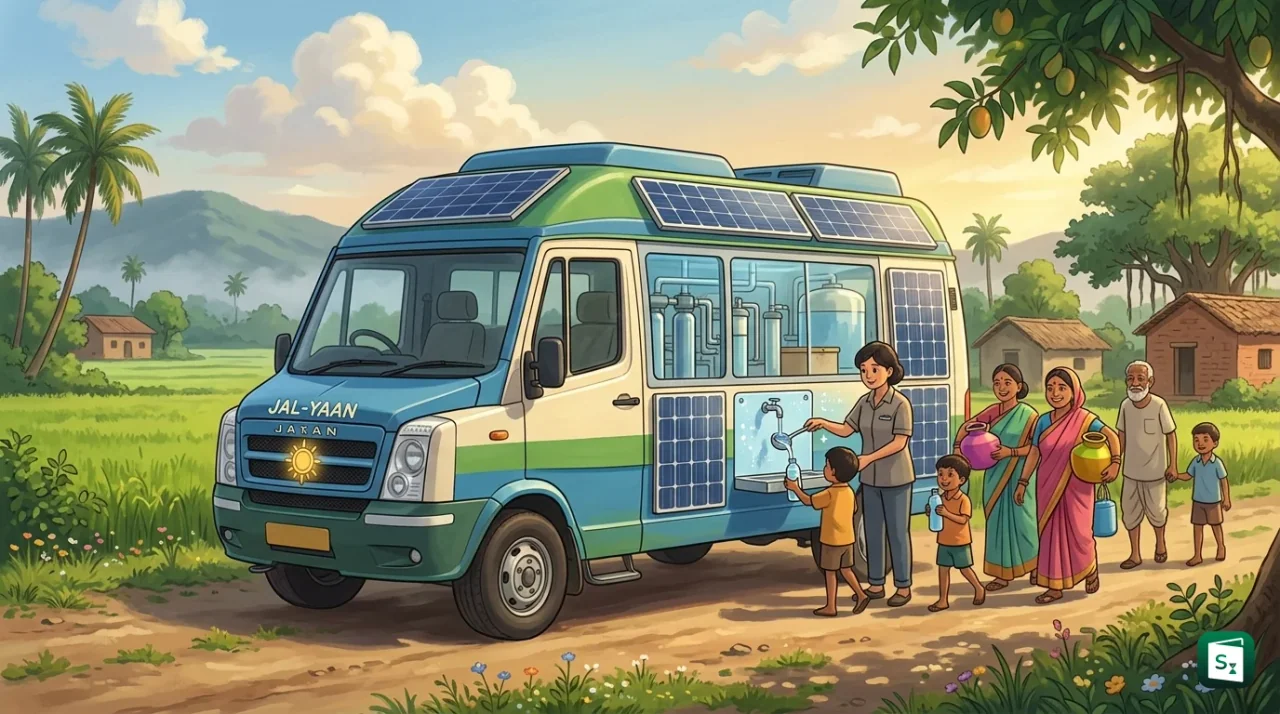
JAL-YAAN is India’s first compact, solar integrated, self powered, multi source mobile water purification van. The name combines Jal, meaning water, with Yaan, meaning vehicle. The van was fabricated by Rite Water Solutions (India) Limited, Nagpur, as a licensee of CSIR-CSMCRI, using technology know how licensed from the institute, and was demonstrated in Nagpur in July 2026.
The core idea is simple. Instead of taking water to a treatment plant, the treatment plant is taken to the water. The entire system is mounted on a single rapidly deployable vehicle that can be driven to any location in the country during natural disasters, humanitarian emergencies, water scarcity events, or large public gatherings. It has already been field tested, including at mass congregation events where it supplied safe drinking water to the public.
Unlike fixed plants that serve one area, JAL-YAAN is designed for flexibility. It can operate in remote villages, coastal settlements, flood affected camps, drought prone regions, or urban areas where existing pipelines are disrupted. Its compact chassis and self contained design allow it to reach locations where conventional infrastructure is limited or completely unavailable.
How the Van Purifies Water: Three Systems on One Platform
JAL-YAAN integrates three advanced water treatment technologies on a single mobile platform. This allows it to handle virtually any available water source, from freshwater ponds and rivers to groundwater and seawater. The choice of system depends on the quality and salinity of the source water.
| System | Full Form | What It Removes | Capacity on JAL-YAAN | When It Is Used |
|---|---|---|---|---|
| UF | Ultrafiltration | Suspended solids, bacteria, some viruses and large particles using a membrane with fine pores of about 0.01 microns. It retains essential minerals and uses low pressure | up to 4,000 litres per hour (LPH) | Fresh surface water or low turbidity water where dissolved salts are not high |
| BWRO | Brackish Water Reverse Osmosis | Dissolved salts, heavy metals and high Total Dissolved Solids (TDS) from brackish water where TDS is typically 1,000 to 10,000 parts per million. Uses a semi permeable membrane with very fine pores of about 0.0001 microns under high pressure | up to 2,500 LPH | Groundwater and inland water with moderate salinity, the most common source in water stressed inland areas |
| SWRO | Seawater Reverse Osmosis | High concentration salts from seawater where TDS is 15,000 to 45,000 parts per million. Requires much higher pressure, 50 to 80 bar, and specialised membranes | 300 to 400 LPH | Seawater and highly saline coastal or estuarine water, including desalination during coastal emergencies |
Reverse Osmosis (RO) is a process where water is forced under pressure through a thin semi permeable membrane that blocks salts and impurities. Ultrafiltration (UF) is a filtration process that uses a slightly larger pore membrane to block particles and pathogens but lets dissolved salts pass. By combining both, JAL-YAAN avoids over treatment of easy water and ensures full purification of difficult water.
The treatment train also includes multi stage filtration and disinfection modules that remove contaminants, suspended particles and harmful microorganisms to produce water that meets prescribed drinking water safety standards. The van can switch between sources without needing a separate plant, which is critical when the nature of available water changes quickly after a flood or cyclone.
Self Powered and Solar Integrated: How It Runs Without the Grid
The term self powered means JAL-YAAN does not depend on external electricity. The term solar integrated means solar energy is built into its power system, not added as an afterthought.
The van carries two power sources. An onboard 30 kVA power generation system provides main power and a 2 kW solar power generation unit provides clean supplementary power. This dual arrangement allows autonomous operation even in locations with no grid supply. According to the developers, the RO systems can be powered directly by the vehicle’s engine, while the UF system can also operate on solar power alone, giving operational flexibility.
This matters in the field. In disaster zones, grid power is often the first service to fail. A conventional mobile purifier that needs diesel or external power can stand idle. JAL-YAAN can keep purifying water and simultaneously supply electricity to support essential services, such as lighting for relief camps, charging of communication equipment, or operation of medical support units. By using solar energy instead of only fossil fuel, it also lowers running cost and carbon emissions while extending its endurance away from fuel supply lines.
The design thus doubles the van’s role. It is both a water treatment unit and a mobile emergency power station on wheels.
Who Built It: CSIR-CSMCRI and Rite Water Solutions
JAL-YAAN is an example of lab to field translation of indigenous technology.
CSIR-CSMCRI
The Council of Scientific and Industrial Research (CSIR) is India’s largest publicly supported research and development organisation. Established on 26 September 1942 as an autonomous body under the Department of Scientific and Industrial Research, Ministry of Science and Technology, its President is the Prime Minister of India. It now runs 37 laboratories, 39 outreach centres and 3 innovation centres across the country and is headquartered at Anusandhan Bhawan, Rafi Marg, New Delhi. Its current Director General is Dr. N. Kalaiselvi.
The Central Salt and Marine Chemicals Research Institute (CSIR-CSMCRI) is one of its constituent laboratories. Founded in 1954 and located on Gijubhai Badheka Marg, Bhavnagar, Gujarat, its mandate covers salt and marine chemicals, membranes for desalination and water treatment, marine biotechnology, and sustainable coastal development. The institute is headed by Director Dr. Arup Ghosh. The Mobile Water Purification Van Technology was led by Dr. Sanjay Patil, Team Lead at CSIR-CSMCRI, who noted that combining multiple treatment technologies with independent power on one mobile platform creates a dependable solution for safe water and emergency power whenever and wherever required.
Rite Water Solutions
Rite Water Solutions (India) Limited, Nagpur is the industrial partner and licensee. Originally incorporated as Nagpur Aquatech Private Limited on 24 September 2004, the company has grown into an ISO 9001:2015 certified clean tech company working across three verticals, water solutions, solar agriculture solutions and Internet of Things (IoT) based monitoring. It has supplied decentralised purification systems, community water plants, solar powered supply schemes and mobile water ATMs for more than 18 years. As of late 2024, it reported projects in 21,807 villages, and it filed a Draft Red Herring Prospectus for an Initial Public Offering in February 2025. Its Managing Director and Chief Executive Officer is Abhijeet Gaan, who highlighted the flexible powering options that let RO run on engine power and UF on solar.
Together, CSIR-CSMCRI provided the technology know how and Rite Water Solutions engineered it into a compact, factory fabricated, field deployable van.
Why It Matters: Disaster Response, Water Security and Sustainability
India faces a sharp water challenge. The country holds about 4 percent of the world’s freshwater while supporting about 18 percent of the global population. Much of the drinking water need depends on the southwest monsoon, and climate change is making rainfall more erratic, with long dry spells broken by intense downpours. Groundwater, which supplies a large share of drinking and irrigation needs, is under stress, with more than a thousand administrative blocks classified as over exploited where withdrawal exceeds recharge.
Safe water is also the most urgent need after a disaster. Floods often contaminate wells and pipelines with silt and sewage. Cyclones damage coastal treatment plants and push seawater into freshwater sources. Droughts dry up regular sources but leave brackish groundwater that needs treatment. The National Disaster Response Force (NDRF) and state agencies need tools that can reach affected people in the first 24 to 72 hours. JAL-YAAN fits that gap. It can be mobilised quickly, treat whatever water is at hand, and keep running without grid power.
For everyday water security, the van complements fixed infrastructure. Fixed plants are efficient for settled demand but cannot move when demand shifts. A mobile unit can cover seasonal scarcity in remote hamlets, pilgrimage routes, construction sites, or island communities, then return to base. Its ability to produce up to 4,000 LPH from UF for relatively clean water and 2,500 LPH from BWRO for brackish groundwater means a single van can serve thousands of people per day if operated continuously in relief mode.
From a sustainability view, the solar integration reduces diesel dependence and operational emissions. It also demonstrates decentralised infrastructure, where services are brought closer to users instead of building longer pipelines. For rural and off grid India, decentralised and movable solutions often deliver faster results at lower cost than extending centralised networks.
Aligning With National Water Goals
JAL-YAAN supports several ongoing national programmes. The Jal Jeevan Mission, launched on 15 August 2019 by the Ministry of Jal Shakti, aims to provide tap water to every rural household. By 1 February 2025, it had connected 15.44 crore rural households, or 79.74 percent of all rural households, up from 3.23 crore (17 percent) at launch. Yet source sustainability, water quality monitoring, and last mile service during source failure remain key concerns. Mobile purifiers can act as an interim safety net when piped supply is disrupted.
It also links to Atal Bhujal Yojana for community led groundwater management, the National Disaster Management Authority (NDMA) framework for preparedness, and India’s broader push for solar energy and clean technology. By using solar power for a critical service like drinking water, the van shows how renewable energy and public health can be coupled in a single product.
The innovation also strengthens coastal resilience. CSMCRI’s long work on membrane desalination, including low cost RO technologies for rural areas, now finds application in villages where coastal groundwater has turned saline due to seawater intrusion.
The Way Forward
The success of JAL-YAAN will depend on scaling and standard deployment. Director Arup Ghosh has suggested that such mobile water purification vans should become as common as fire trucks, with every city and major village equipped with one to ensure timely access to safe water in emergencies. For that to happen, state disaster management authorities, urban local bodies, public health engineering departments and corporate social responsibility funds will need to adopt the model.
Key steps include clear protocols for deployment during floods, cyclones and heat induced water scarcity, training of local operators, integration with the Jal Jeevan Mission’s water quality testing network, and regular maintenance of membranes and solar units. Linking the van’s location and output data to IoT monitoring, an area where Rite Water Solutions already works, can help authorities track water quality, quantity supplied and power usage in real time.
Cost, recovery rates and waste management will also matter. BWRO systems typically recover 50 to 85 percent of input water, while SWRO recovers 35 to 50 percent. Proper disposal or further treatment of the concentrated brine, especially when desalinating seawater, will be important to avoid local soil and water damage. With these systems in place, a solar powered, self contained water van can move from a demonstration to a standard part of India’s emergency and rural water toolkit.
Key Takeaways
- JAL-YAAN, India’s first compact solar integrated and self powered mobile water purification van, was showcased in Nagpur, Maharashtra in July 2026.
- It was jointly developed by CSIR-Central Salt and Marine Chemicals Research Institute (CSIR-CSMCRI), Bhavnagar (established 1954) and Rite Water Solutions (India) Limited, Nagpur.
- The van integrates three systems on one platform: UF up to 4,000 LPH, BWRO up to 2,500 LPH and SWRO 300 to 400 LPH, allowing treatment of virtually any source including seawater.
- It carries an onboard 30 kVA power generation system and a 2 kW solar power unit, can run RO on engine power and UF on solar, and can supply emergency electricity where grid power is unavailable.
- CSIR was established on 26 September 1942 as an autonomous body under the Ministry of Science and Technology, headquartered in New Delhi and headed by the Prime Minister as President.
- The technology is already field proven at large public gatherings and is envisioned for disaster response, humanitarian emergencies and remote water stressed areas, complementing the Jal Jeevan Mission which had reached 79.74 percent rural tap water coverage by 1 February 2025.