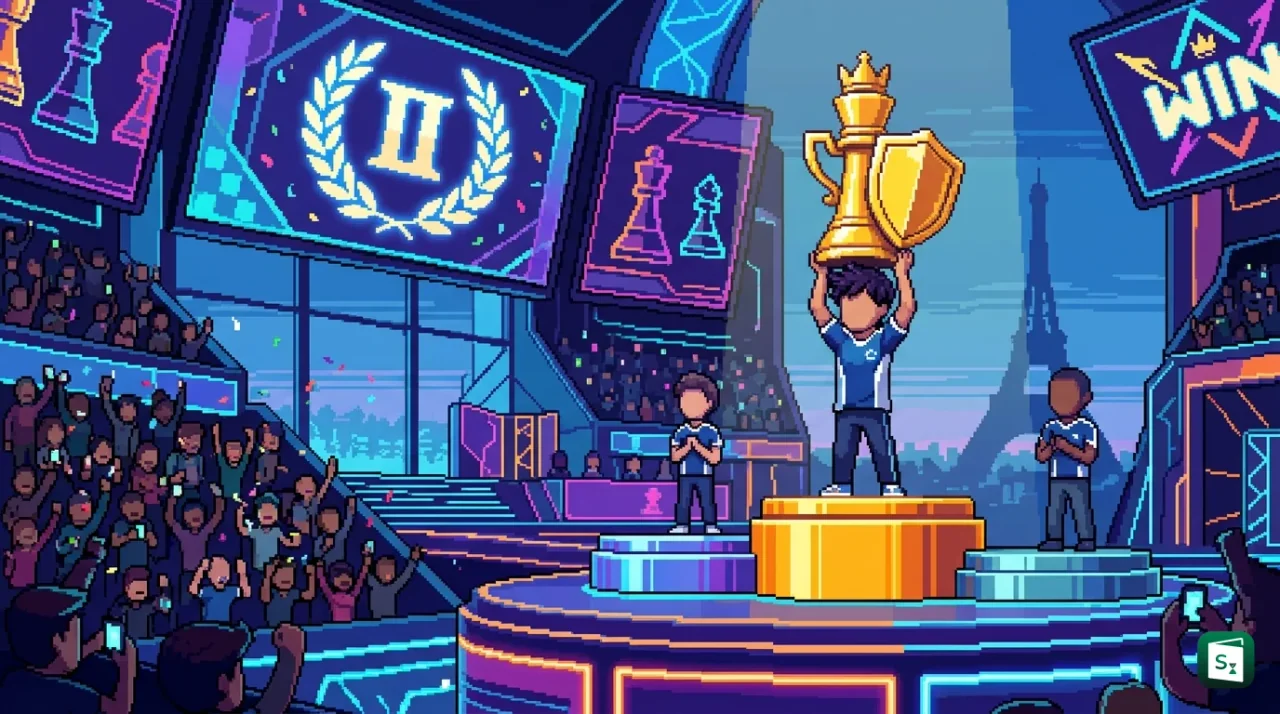
Norwegian world number one Magnus Carlsen retained his Esports World Cup (EWC) Chess title in Paris on 15 August 2026, defeating 19-year-old Belarusian Grandmaster Denis Lazavik 2-0 in the Grand Final. Representing Team Liquid, Carlsen won both sets 3-1 without losing a single game in the tournament and claimed the top prize of $250,000. The victory gave him a second straight EWC Chess crown after his inaugural win in 2025.
The 2026 Final: How Carlsen Retained His Title
The Esports World Cup Chess Finals 2026 were held from 11 to 15 August 2026 at the Paris Expo Porte de Versailles in Paris, France. The event featured 22 players from 15 esports teams and carried a total prize pool of $1.5 million, with $250,000 reserved for the champion. All games were played in a rapid format with a time control of 10 minutes per player with no increment, known as 10+0, and a single Armageddon game was used to break ties.
In the Grand Final on 15 August, Carlsen faced Denis Lazavik of AG.AL, a 19-year-old Grandmaster from Belarus who had reached the final after beating world number three Hikaru Nakamura in the semi-finals. The final was played as a best-of-three sets contest. The first two sets consisted of four games each, and a deciding third set of two games would be played only if the players split the first two sets. Carlsen did not need the decider.
He won the first set 3-1 with two wins and two draws, and repeated the same score in the second set. Across the eight games of the final, Carlsen scored four wins and four draws, while Lazavik did not win a single game. Carlsen finished the entire tournament unbeaten, with 11 wins and nine draws and without losing a single game, a run he later described as part of a tight and patient strategy that focused on rook endgames.
Lazavik, who had been unbeaten until the final, finished runner-up and earned $190,000 along with 750 Club Championship points for AG.AL. In the third-place match, Hikaru Nakamura of Team Falcons beat fellow Team Falcons player Alireza Firouzja 4-1 to take $145,000. Firouzja, who forfeited the final game of that match after technical disruptions, finished fourth with $100,000.
Who Is Magnus Carlsen
Sven Magnus Oen Carlsen was born on 30 November 1990 in Tonsberg, Norway. He learned chess at age five from his father and became a Grandmaster (GM) in 2004 at age 13, making him one of the youngest Grandmasters in history. A Grandmaster is the highest title awarded by the International Chess Federation (FIDE), the world governing body for chess headquartered in Lausanne, Switzerland.
Carlsen became World Chess Champion in 2013 at age 22 after defeating Viswanathan Anand in Chennai, and he defended the classical world title in 2014 against Anand, in 2016 against Sergey Karjakin, in 2018 against Fabiano Caruana, and in 2021 against Ian Nepomniachtchi. He chose not to defend the title in 2023. He has also been dominant in faster formats, winning the World Rapid Chess Championship six times and the World Blitz Chess Championship nine times, and he won the Chess World Cup in 2023 and the FIDE Freestyle Chess World Championship in 2026.
Carlsen has held the world number one ranking on the FIDE rating list continuously since 1 July 2011, the longest unbroken run in the modern era. His peak classical rating of 2882, achieved in May 2014, remains the highest rating ever recorded. He also holds the record for the longest unbeaten streak at elite classical level with 125 games without defeat between July 2018 and October 2020. As of August 2026, his rating stood at 2823, still well clear of his nearest rivals. Carlsen has served as Global Ambassador for Chess at the Esports World Cup since the game was added to the event in 2025.
Understanding the Esports World Cup Chess Tournament
The Esports World Cup (EWC) is organized by the Esports World Cup Foundation (EWCF), a Saudi Arabian non-profit foundation established to host the world’s largest multi-title esports festival. The EWC builds on the earlier Gamers8 festival in Riyadh and brings together more than 2,000 players from top esports clubs to compete across over 20 game titles for a combined prize pool of more than $75 million. A central feature of the EWC is the Club Championship, a points race where clubs earn points from placements across all games. The top club at the end of the festival wins a separate prize of $7 million.
Chess was added to the EWC for the first time in 2025 through a three-year partnership between the EWCF and Chess.com, the world’s largest online chess platform with nearly 200 million members. Magnus Carlsen was announced as Global Ambassador at that time and helped promote the game’s inclusion. The inaugural chess event in Riyadh from 29 July to 1 August 2025 was won by Carlsen, who beat Alireza Firouzja in the final and helped Team Liquid briefly top the Club Championship before Team Falcons overtook them.
For 2026, chess returned as an official title with a move to Paris. While the overall EWC festival still offers tens of millions in team prizes, the dedicated chess prize fund remained at $1.5 million. The shift from Riyadh to Paris marked the first time the chess finals were held in Europe and signalled the organisers’ effort to take the event to a wider global audience.
Team Liquid and Carlsen’s Role
Team Liquid is a global esports organisation founded in 2000 and headquartered in the Netherlands, with major operations in the United States and Europe. It is one of the most successful organisations in esports history, with more than $54 million in cumulative prize winnings. In February 2025, Team Liquid signed Carlsen and fellow elite Grandmaster Fabiano Caruana on multi-year contracts, backed by primary sponsor IMC Trading, to build its chess division ahead of the EWC.
Carlsen’s win in Paris earned 1,000 Club Championship points for Team Liquid, strengthening the club’s position in the overall standings. Lazavik’s second place gave 750 points to AG.AL, while Nakamura’s third place added 500 points for Team Falcons.
Tournament Format and Prize Distribution
The 2026 chess tournament used a three-stage format designed to blend traditional chess skill with the fast pace expected in esports.
| Stage | Players | Format | Games per Match |
|---|---|---|---|
| Play-In | 8 players (4 from DreamHack Atlanta, 4 from Last Chance Qualifier) | Double elimination bracket | 2 games, Armageddon if tied |
| Group Stage | 16 players (2 qualifiers from Play-In plus 14 direct seeds including Carlsen) | Two groups of 8, double elimination | 2 games, Armageddon if tied |
| Playoffs | 8 players (top 4 from each group) | Single elimination knockout | Quarter-finals 4 games, Semi-finals 6 games, Grand Final best-of-3 sets (4+4+2) |
The time control for every game was 10+0. This means each player had 10 minutes for the entire game with no extra time added per move. If a match was tied after the scheduled games, a single Armageddon game was played, where the player with the black pieces could win the match even with a draw.
Qualification for the 22-player field came through several paths: defending champion Magnus Carlsen (1 slot), the Speed Chess Championship 2025 (2 slots), the Chess.com Open 2026 (1 slot), the Champions Chess Tour 2025-2026 standings (9 slots across multiple events), Road to EWC India Rising (1 slot), DreamHack Atlanta (3 slots), and the Last Chance Qualifier held in Paris from 4 to 6 August 2026 (5 slots). The Play-In on 11 August reduced the field to 16 for the Group Stage on 12 to 13 August, with the Playoffs concluding on 14 to 15 August.
The $1.5 million prize fund was distributed across all participants:
| Placement | Prize per Player |
|---|---|
| 1st | $250,000 |
| 2nd | $190,000 |
| 3rd | $145,000 |
| 4th | $100,000 |
| 5th to 8th | $72,500 each |
| 9th to 12th | $52,500 each |
| 13th to 16th | $40,000 each |
| 17th | $32,000 |
| 18th | $27,000 |
| 19th to 20th | $25,000 each |
| 21st to 22nd | $23,000 each |
All 22 players were already guaranteed at least $23,000, and those reaching the Play-In from the Last Chance Qualifier earned a minimum of $50,000 from the overall pool.
Why This Win Matters
Carlsen’s second straight title underlines his continued dominance in rapid chess and the growing place of chess within global esports. The EWC partnership with Chess.com has brought traditional chess audiences together with younger esports fans who follow the action on platforms like Twitch and YouTube, with live commentary and interactive broadcasts.
For competitive chess, the EWC format offers a new model. Unlike classical chess championships governed by FIDE, where world titles are decided over weeks in slow time controls, the EWC uses a short, viewer-friendly 10+0 format that rewards quick calculation and clock management. This has encouraged major esports clubs such as Team Liquid, Team Falcons, Natus Vincere, Gen.G, and AG.AL to sign Grandmasters as full-time esports athletes.
For India and the wider chess world, the event also highlighted new talent. Indian Grandmasters Arjun Erigaisi, Nihal Sarin, Aravindh Chithambaram and Pranesh M were among the qualifiers, with Nihal and Erigaisi reaching the quarter-finals. The inclusion of an India Rising qualifier, won as part of the Road to EWC pathway, created a direct route for Indian players to the world stage.
The broader significance is commercial and cultural. Chess, which has more than 600 million players worldwide, is being repositioned from a board game to a certified esport with multi-million dollar team contracts, global sponsorships, and Club Championship stakes. Carlsen’s unbeaten defence, achieved even while he reported feeling unwell during the early rounds, reinforces the link between elite chess mastery and esports success and sets a high bar for the next edition expected in 2027.
Key Takeaways
- Magnus Carlsen of Norway, representing Team Liquid, won the Esports World Cup Chess title 2026 in Paris on 15 August 2026 for the second year in a row.
- He beat Denis Lazavik of Belarus (AG.AL) 2-0 in the Grand Final, winning both sets 3-1 without losing a single game in the tournament.
- The tournament offered a total prize pool of $1.5 million, with $250,000 for the champion and $190,000 for the runner-up.
- The event featured 22 players from 15 teams, played in a 10+0 rapid format with an Armageddon tie-break, across Play-In, Group Stage and Playoffs from 11 to 15 August 2026.
- Carlsen is a five-time classical World Chess Champion (2013 to 2023), holds a peak rating of 2882, and has been world number one since 1 July 2011.
- Hikaru Nakamura finished third with $145,000 after beating Alireza Firouzja in the third-place match, with both players representing Team Falcons.