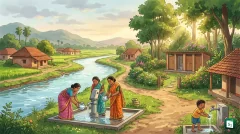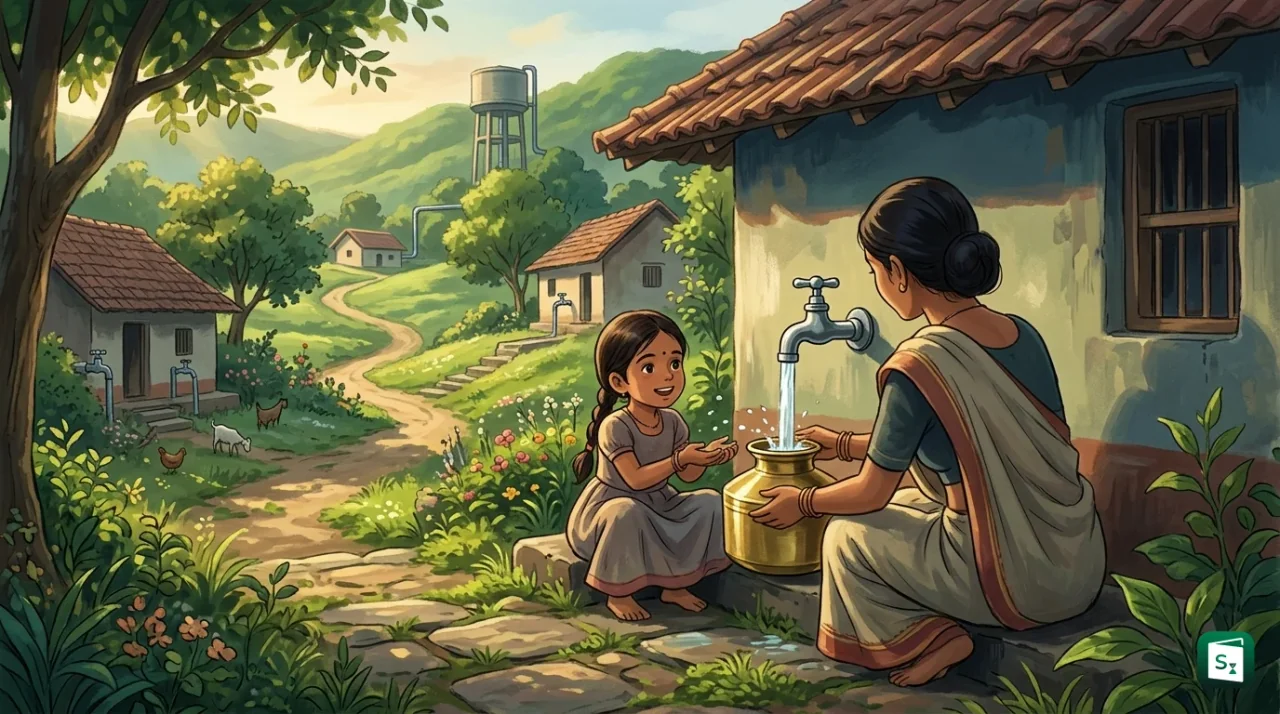
The Jal Jeevan Mission has completed seven years since Prime Minister Narendra Modi launched it on 15 August 2019, transforming rural drinking water access from a distant promise to a household reality. The mission has now connected more than 15.91 crore rural households with tap water, up from just 3.23 crore (17 percent) at its start, while over 2 lakh villages have earned the ‘Har Ghar Jal’ certified status. To close the remaining gap, the Union Cabinet on 10 March 2026 has extended the deadline to December 2028 under a restructured Jal Jeevan Mission 2.0.
What Is the Jal Jeevan Mission?
The Jal Jeevan Mission (JJM), also called Har Ghar Jal, is the central government’s flagship programme to provide a Functional Household Tap Connection (FHTC) to every rural household in India. An FHTC means a tap that supplies water of prescribed quality, in adequate quantity, on a regular and long-term basis. The service norm under JJM is 55 litres per person per day (lpcd) of drinking water that meets BIS:10500 quality standards set by the Bureau of Indian Standards.
The mission was announced by Prime Minister Narendra Modi from the Red Fort on 15 August 2019 with an original target of universal coverage by 2024. It restructured and subsumed the earlier National Rural Drinking Water Programme (NRDWP), which had been launched in 2009. The NRDWP itself had evolved from the Accelerated Rural Water Supply Programme started in 1972-73 as the first major central assistance for rural water supply.
JJM is a Centrally Sponsored Scheme implemented by the Department of Drinking Water and Sanitation (DDWS) under the Ministry of Jal Shakti. The Ministry of Jal Shakti was formed on 31 May 2019 by merging the Ministry of Water Resources, River Development and Ganga Rejuvenation and the Ministry of Drinking Water and Sanitation. This merger brought all water related subjects, from river management to drinking water and sanitation, under one umbrella. Drinking water, however, remains a State subject under the Constitution, so states plan, approve, execute and maintain the schemes while the Centre provides technical and financial support.
The mission’s objectives go beyond laying pipes. They include priority coverage for quality affected habitations, drought prone and desert areas, and villages under Sansad Adarsh Gram Yojana, ensuring tap connections in schools, Anganwadi centres, health centres and Gram Panchayat buildings, monitoring functionality, promoting community ownership through contribution in cash, kind or labour (shramdaan), and ensuring sustainability of sources and systems.
Cost sharing between the Centre and states is fixed by category:
| Category | Centre : State sharing |
|---|---|
| Himalayan and North-Eastern states | 90:10 |
| Union Territories without legislature | 100 percent Centre |
| Other states | 50:50 |
At launch, the total project outlay was estimated at ₹3.60 lakh crore, with the central share at ₹2.08 lakh crore.
Seven Years of Progress: From 3.23 Crore to 15.91 Crore Connections
At the time JJM began in August 2019, only 3.23 crore rural households (16.7 to 17 percent) out of about 19.36 crore rural households had a tap connection. The rest depended on handpumps, wells, rivers, or tankers, with women and girls often spending hours each day fetching water.
By mid-August 2026, the picture has changed sharply. More than 15.91 crore households (about 82.24 percent) now have tap connections, meaning over 12.68 crore additional households have been connected in seven years. This is one of the fastest expansions of rural infrastructure ever undertaken in India, with an average of more than 87,000 connections per day during peak implementation periods.
Progress is tracked on three levels on the JJM Integrated Management Information System (IMIS) and the public dashboard at ejalshakti.gov.in. The first level is IMIS reported, which records connections physically provided as per state reports. The second level is Reported as Har Ghar Jal, where the implementing department confirms that every household and institution in a village has tap supply. The third level is Certified as Har Ghar Jal, where the Gram Sabha has passed a resolution after reading out the work completion report in its meeting and verification by the community, along with a short video record. Only then does the village appear as certified.
According to the latest update, more than 2 lakh villages have been formally certified as Har Ghar Jal. As of August 2024, 188 districts, 1,838 blocks and 1,09,996 Gram Panchayats had reported Har Ghar Jal status, showing how the certification builds from village to block to district.
State progress has been uneven:
| Coverage status | Examples |
|---|---|
| 100 percent households covered | Goa, Telangana, Haryana, Gujarat, Himachal Pradesh, Punjab, Puducherry, Andaman and Nicobar Islands, Dadra and Nagar Haveli and Daman and Diu, Arunachal Pradesh, Mizoram (11 states and UTs as of 2024-25) |
| More than 90 percent | Bihar, Punjab in earlier phases, now moving closer to saturation |
| Lagging states | Uttar Pradesh, Rajasthan, Jharkhand, Chhattisgarh, West Bengal, Kerala and several North-Eastern states still below the national average, due to terrain, large population and late start |
Coverage in public institutions has also grown. By late 2024, about 9.32 lakh schools and 9.69 lakh Anganwadi centres had tap water supply, bringing safe water directly to children where they study and receive nutrition support.
What ‘Har Ghar Jal’ Certification Really Means
Certification is not a claim by engineers alone. A village is considered Har Ghar Jal only when every household receives water in adequate quantity and prescribed quality through a tap. The department hands over a completion certificate to the Gram Panchayat, the Gram Sabha then verifies each household and formally passes a resolution. This community declaration, not just a number on a dashboard, is what makes the tag credible and useful for long term accountability.
Water quality assurance runs alongside coverage. Under JJM, states can use up to 2 percent of their annual allocation for Water Quality Monitoring and Surveillance. A network of more than 2,100 water quality testing laboratories at state, district and block levels has been set up, many with National Accreditation Board for Testing and Calibration Laboratories (NABL) accreditation. For grassroots monitoring, over 24.8 lakh women have been trained to use Field Testing Kits (FTKs) and H2S vials to test for chemical, bacteriological, arsenic and fluoride contamination at the Gram Panchayat level, with results uploaded to the Water Quality Management Information System (WQMIS) portal.
Why the Deadline Was Extended to December 2028
The original deadline of 2024 was missed. By August 2024, coverage was around 75 to 78 percent, not 100 percent. States sought more time and funds, citing large gaps in difficult terrain, source sustainability issues and delays in utilisation of funds.
Finance Minister Nirmala Sitharaman announced in the Union Budget 2025-26 that JJM would be extended to December 2028 with an enhanced total outlay. On 10 March 2026, the Union Cabinet chaired by the Prime Minister formally approved the extension and restructuring as Jal Jeevan Mission 2.0.
The financial revision is substantial:
| Component | Amount |
|---|---|
| Total revised outlay (2019-28) | ₹8.69 lakh crore |
| Central assistance | ₹3.59 lakh crore (up from ₹2.08 lakh crore in 2019) |
| Additional central share | ₹1.51 lakh crore |
| State share | About ₹5.10 lakh crore |
The Budget continued to back the mission with large annual allocations: ₹67,000 crore in 2025-26 and ₹67,600 crore retained for 2026-27, even as revised spending in earlier years was lower due to slow fund use by some states.
Jal Jeevan Mission 2.0: From Pipes to Service Delivery
JJM 2.0 marks a clear shift from an infrastructure creation approach to a citizen centric, utility based service delivery model. The goal is to certify all Gram Panchayats as Har Ghar Jal by providing tap connections to the full 19.36 crore rural households by 31 December 2028, and then ensure that water actually flows regularly, safely and at the right pressure.
Three new pillars define this phase:
1. Sujalam Bharat: A National Digital Framework
A uniform digital platform called Sujalam Bharat is being instituted. Every village will get a unique Sujal Gaon or Service Area ID that digitally maps the entire supply chain from source to tap. The system links to a GIS based asset registry, tracks supply hours, quality test results and complaint redressal, and generates a village level service scorecard. By March 2026, about 1,77,156 Sujal Gaon IDs linked to 1,13,849 Sujalam Bharat IDs had been generated. All schemes will now require validation against this registry and compliance with Central Public Health and Environmental Engineering Organisation (CPHEEO) design norms before funds are released.
2. Nal Jal Mitra Programme: Skilled People in Every Village
To fix the operation and maintenance gap, the Nal Jal Mitra Programme (NJMP) is being scaled up in partnership with the Ministry of Skill Development and Entrepreneurship. Local youth, with priority for women from Self Help Groups, are trained as village level plumbers, electricians, pump operators and water quality testers. In Karnataka, for example, 11,904 trainees from 5,952 Gram Panchayats are being trained through Government Tool Room and Training Centres and Industrial Training Institutes, with 21 days of on the job training and a toolkit on successful completion. The national target is to create a pool of up to 25 lakh Nal Jal Mitras.
3. Jal Arpan and Financial Reforms
Schemes will be formally handed over to Gram Panchayats and Village Water and Sanitation Committees (VWSCs), also called Pani Samitis, through a process called Jal Arpan after a 15 to 30 day trial run. Each VWSC has 10 to 15 members with at least 50 percent women. The committee then operates the system, collects user charges where notified, and files monthly service reports.
Fund release is now compliance linked. States must sign reform linked Memorandums of Understanding (MoUs), complete GIS validation, certify CPHEEO compliance, reconcile accounts and strengthen audit readiness. Under JJM 2.0, funds for operations are also provided to VWSCs, which was missing in the first phase. The first such performance linked release in March 2026 gave ₹1,561.53 crore to Uttar Pradesh, Maharashtra, Chhattisgarh, Odisha and Madhya Pradesh after they met the new conditions.
Other innovations include Jal Seva Aankalan, a citizen feedback survey at Gram Panchayat level reflected on the Meri Panchayat application, and mandating aquifer based planning, seasonal source reviews and village water budgets for sustainability.
Benefits and Wider Impact on Health and Rural Life
JJM is not just about pipes. Its effects cut across health, gender, education and employment.
Health gains: The World Health Organization (WHO) has estimated that safely managed drinking water for all could prevent close to 400,000 deaths from diarrhoeal diseases and save about 14 million Disability Adjusted Life Years (DALYs) in India. Research cited by Nobel laureate Prof. Michael Kremer suggests safe water access could reduce under five mortality by nearly 30 percent, potentially saving about 1,36,000 children’s lives each year. In 61 Japanese Encephalitis and Acute Encephalitis Syndrome (JE-AES) affected districts across five states, tap coverage rose from 2.71 percent to 70.82 percent, directly improving public health in vulnerable belts. Arsenic and fluoride affected habitations reported as of 1 August 2019 have also been provided with safe water sources.
Women and girls: Before JJM, rural women spent long hours fetching water. Studies estimate the mission now saves about 5.5 crore hours every day that was earlier spent collecting water. The State Bank of India’s research noted that about 9 crore women have been freed from the daily drudgery, with more time for education, paid work and care, and greater dignity and safety. At least 50 percent of members of VWSCs are women, and women lead water quality testing with FTKs in their own villages.
Employment: The mission is a large job creator. The Indian Institute of Management Bangalore (IIM Bangalore) and the International Labour Organization (ILO) estimated 59.9 lakh person years of direct employment and 2.2 crore person years of indirect employment during the construction phase, with another 13.3 lakh person years expected during operation and maintenance. IoT based sensors in more than 6 lakh villages, geo tagging of assets and a real time dashboard have also created demand for technical skills.
Education and institutions: Tap supply in schools and Anganwadi centres means children drink safe water during the day and mid day meals are cooked hygienically, reducing absenteeism.
Ease of living and trust: Household taps reduce the rural urban gap and create a sense of service entitlement similar to electricity, where a family expects water as a service, not as a favour from a tanker.
Persistent Challenges and the Way Forward
Despite the scale, several gaps remain that JJM 2.0 is designed to address.
Source sustainability: Many schemes draw on groundwater that is depleting at about 0.3 metres per year in parts of India. Without recharge, rainwater harvesting, greywater reuse and aquifer planning, taps may run dry after the monsoon. Convergence with Mahatma Gandhi National Rural Employment Guarantee Scheme (MGNREGS) and Atal Bhujal Yojana for recharge structures is now mandatory in planning.
Water quality and the tap but no water problem: Coverage numbers do not always equal regular supply. Studies show that while about 82 percent of households have connections, a smaller share uses them as the primary source due to intermittent supply or quality doubts from fluoride, arsenic, iron and salinity. Continuous monitoring through labs, FTKs and IoT sensors is being expanded to close this gap.
Operation and maintenance: Earlier programmes failed because assets broke down after handover. VWSCs often lacked funds, functions and skilled functionaries. The three Fs remain critical: clear funds for electricity and repairs, defined functions for daily operation, and trained functionaries like Nal Jal Mitras. The Comptroller and Auditor General (CAG) performance audits in states such as Karnataka and Kerala in 2025 flagged gaps in planning, financial management, contract execution and water quality surveillance, reinforcing the need for stronger local capacity.
Financial pressure: States must provide matching funds (50 percent for most states) and manage viability gap funding for O&M. Delays in state releases, parked funds and under utilisation, noted by the CAG, have slowed progress in some high burden states.
Regional unevenness: Hilly, forested and tribal habitations need single village and multi village schemes with robust pumping and treatment, which cost more and take longer.
The way forward under JJM 2.0 is therefore framed around three ideas: source sustainability through water budgets and decision support systems, service assurance through digital monitoring and citizen feedback, and local ownership through empowered Pani Samitis and Nal Jal Mitras. The mission is now aligned with the vision of Viksit Bharat @2047, which aims for 24x7 assured rural drinking water supply as a utility service, moving from counting connections to guaranteeing delivery.
Key Takeaways
- The Jal Jeevan Mission (JJM) was launched by Prime Minister Narendra Modi on 15 August 2019 under the Ministry of Jal Shakti to provide a Functional Household Tap Connection (FHTC) of 55 litres per person per day meeting BIS:10500 standards.
- At launch only 3.23 crore households (about 17 percent) had tap connections, coverage has now risen to more than 15.91 crore households (about 82.24 percent) out of 19.36 crore rural households, with over 12.68 crore additional connections in seven years.
- More than 2 lakh villages have been certified as ‘Har Ghar Jal’ after verification and a Gram Sabha resolution, while 11 states and UTs including Goa, Telangana and Haryana have achieved 100 percent rural household coverage.
- The Union Cabinet on 10 March 2026 extended JJM to December 2028 as Jal Jeevan Mission 2.0, raising total outlay to ₹8.69 lakh crore with central assistance of ₹3.59 lakh crore.
- JJM 2.0 shifts from infrastructure to service delivery through Sujalam Bharat digital framework with Sujal Gaon IDs, the Nal Jal Mitra Programme for village level operation and maintenance, and the Jal Arpan handover to Village Water and Sanitation Committees with at least 50 percent women members.
- Impact studies cited by WHO and IIM Bangalore and ILO estimate savings of 5.5 crore hours daily in water collection, potential prevention of 400,000 diarrhoeal deaths and generation of 59.9 lakh direct and 2.2 crore indirect person years of employment.