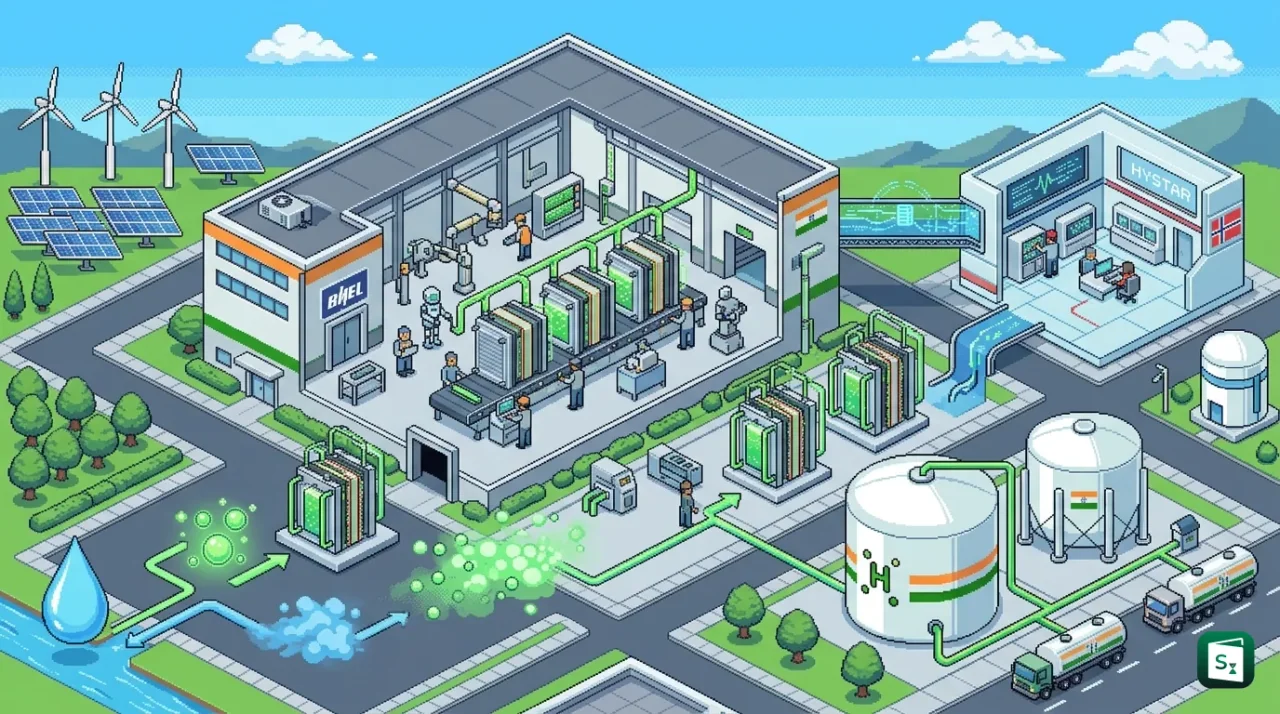
Bharat Heavy Electricals Limited (BHEL) signed a Strategic Collaboration Agreement with Norway-based Hystar AS on 13 August 2026 at its corporate office in New Delhi for the phased indigenisation and local manufacturing of Proton Exchange Membrane (PEM) electrolyser systems. The partnership will combine Hystar’s patented high-efficiency PEM technology with BHEL’s engineering and manufacturing strength to build cost-competitive systems for green hydrogen projects in India. The move strengthens BHEL’s position as one of the few Indian firms offering both PEM and alkaline solutions and directly supports the National Green Hydrogen Mission and the Make in India initiative.
What Does the BHEL Hystar Agreement Cover?
The Strategic Collaboration Agreement (SCA) was signed on 13 August 2026 at BHEL House, New Delhi. It was signed by Y. Srinivas Rao, Executive Director of BHEL’s Heavy Power Equipment Plant in Hyderabad, and Sutripto De, General Manager and Head of New and Renewable Energy Business, on behalf of BHEL, and by Fredrik Mowill, Chief Executive Officer of Hystar, on behalf of Hystar AS. The signing took place in the presence of a delegation from the Royal Norwegian Embassy led by Arvinn Eikeland Gadgil, Chargé d’Affaires.
Under the agreement, BHEL and Hystar will work together on the phased indigenisation and localisation of PEM electrolyser systems in India. Hystar will bring its patented PEM stack and system design, while BHEL will provide engineering, manufacturing and project execution capabilities. The goal is to establish domestic manufacturing capacity that can supply complete electrolyser systems for green hydrogen projects, rather than importing them.
The partnership does not disclose specific investment figures, planned manufacturing capacity or a commercial production timeline. What is clear is the intent to make systems that are cost-competitive for the Indian market and to strengthen BHEL’s ability to bid for and execute green hydrogen projects. The collaboration also builds on BHEL’s earlier strategic tie-up with thyssenkrupp nucera India on 7 July 2026 for alkaline electrolyser systems. With both technologies now in its portfolio, BHEL becomes one of the very few Indian companies capable of offering both alkaline and PEM solutions.
Understanding PEM Electrolyser Technology
An electrolyser is a device that uses electricity to split water into hydrogen and oxygen. This process is called electrolysis. When the electricity comes from renewable sources such as solar or wind, the hydrogen produced is called green hydrogen, because it is made with near-zero carbon emissions. The same molecule can also be grey (made from natural gas), blue (grey with carbon capture) or other colours, but green is the cleanest form.
A Proton Exchange Membrane or Polymer Electrolyte Membrane (PEM) electrolyser is one type of electrolyser. It uses a solid polymer membrane, also called a proton exchange membrane, to separate the anode and the cathode. Water is split at the anode into oxygen, protons and electrons. Protons pass through the membrane to the cathode, where they combine with electrons to form hydrogen. PEM systems work at relatively low temperatures of around 50 to 80 degrees Celsius and can operate under pressure.
PEM electrolysers have several features that make them important for the energy transition. They can start up quickly, respond very fast to changes in power supply, and operate across a wide load range from 0 to 100 percent. This makes them well suited to variable renewable power from solar and wind, where supply fluctuates through the day. They also produce very high purity hydrogen, often up to 99.999 percent, which is needed for fuel cells and for industries such as semiconductors and pharmaceuticals.
How Hystar’s Technology Stands Out
Hystar’s patented design rethinks the standard PEM process. Conventional PEM electrolysers feed water to the anode side and use a relatively thick membrane to prevent hydrogen from crossing over to the oxygen side, where the mixing of the two gases could create a safety risk. The thick membrane, however, increases electrical resistance and reduces efficiency.
Hystar changes the water feed to the cathode side and circulates ambient air on the anode side to dilute any crossing hydrogen. This allows the company to use an ultra-thin membrane that is up to 90 percent thinner than conventional membranes. A thinner membrane means much lower electrical resistance, so more of the input electricity is converted into hydrogen. Hystar reports that this gives industry-leading efficiency. Its commercial products quote a system efficiency of around 51.1 kWh per kg of hydrogen at 100 percent load, and about 47.5 kWh per kg at stack level, which is among the best available. Lower electricity use per kilogram directly lowers the cost of hydrogen, which is critical because electricity is the largest cost driver.
Safety is built into the same design. By diluting hydrogen on the anode with ventilated air, the system avoids the build-up of explosive gas mixtures. Hystar also emphasises circular design and mass manufacturing, with modular products such as Eos (the stack), Vega (a 5 MW containerised plug-and-play unit) and Orion (a 20 MW cluster for large industrial plants), all built on the same patented cell architecture.
PEM vs Alkaline: How They Differ
India’s green hydrogen market uses both alkaline and PEM technologies. The two differ in electrolyte, cost, response and use cases.
| Feature | Alkaline Electrolyser | PEM Electrolyser |
|---|---|---|
| Electrolyte | Liquid alkaline solution, usually potassium hydroxide (KOH) | Solid polymer membrane with acidic environment |
| Maturity | Most mature, in use for more than 100 years | Newer generation, commercial for a few decades |
| Cost | Lower capital cost | Higher capital cost due to precious metals such as platinum and iridium |
| Efficiency | Good | Better, especially at high current density |
| Startup and Response | Slower, longer startup time | Fast startup, rapid response to load changes |
| Hydrogen Purity | Good, may need extra purification | Better, very high purity directly |
| Operating Temperature | Around 60 to 90 degrees Celsius | Around 50 to 80 degrees Celsius |
| Footprint | Larger | More compact |
| Best Use | Large-scale, steady industrial operations where cost matters more than flexibility | Mobility, distributed generation, and projects linked directly to variable renewables |
Why This Partnership Matters for India
The importance of this deal lies in three linked goals, domestic manufacturing, cost reduction, and energy security.
First, it advances Atmanirbhar Bharat and Make in India. Today, much of the world’s electrolyser manufacturing is concentrated in a few countries. Global manufacturing capacity was only about 2 to 4 GW per year a few years ago, and in 2023 China accounted for about 60 percent of global capacity. India needs to build its own supply chain to avoid import dependence as demand grows. The BHEL Hystar agreement aims to create a local production base for an advanced technology that India does not yet make at scale. By localising PEM systems, it helps build resilience and keeps more value within the country.
Second, it targets cost. India needs 60 to 100 GW of electrolyser capacity by 2030 to meet its target of producing 5 million metric tonnes (MMT) of green hydrogen per year. The cost of electrolysers and the cost of renewable electricity are the two main drivers of green hydrogen price. Domestic manufacturing, especially of a high-efficiency design like Hystar’s, can bring down both capital and operating costs. Even a 10 percent improvement in efficiency can meaningfully reduce electricity needed per kilogram of hydrogen, helping Indian green hydrogen become competitive with grey hydrogen, which is made from natural gas.
Third, it fits India’s decarbonisation needs. India already consumes about 6 MMT of hydrogen each year, mostly grey hydrogen used in fertilisers and petroleum refining. Hard-to-abate sectors such as steel, chemicals, long-haul transport, shipping and aviation cannot easily switch to batteries. Green hydrogen offers a clean alternative. PEM electrolysers, with their ability to follow variable solar and wind power and produce high-purity hydrogen, are well suited for refuelling stations for buses and trucks, for green ammonia plants, and for storage of surplus renewable energy.
For BHEL, the deal also has a strategic business logic. The company is broadening beyond its traditional power equipment base into renewables and clean fuels. Adding PEM capability alongside alkaline capability allows it to address different customer needs and compete for upcoming tenders under the National Green Hydrogen Mission, including those managed by the Solar Energy Corporation of India (SECI).
Bharat Heavy Electricals Limited: A Profile
Bharat Heavy Electricals Limited (BHEL) is India’s largest power equipment manufacturer and a Maharatna Central Public Sector Enterprise. It was established on 13 November 1964 and is headquartered at BHEL House, Siri Fort, New Delhi. It operates under the administrative control of the Ministry of Heavy Industries.
BHEL has a pan-India presence with 16 manufacturing units, 2 repair units, 4 regional offices, 8 service centres, 15 regional marketing centres and more than 140 project sites in India and abroad, with a workforce of about 29,000 to 41,000 employees. It designs, engineers, manufactures, constructs and services products and systems across thermal, hydro, gas, nuclear and solar power, as well as transmission, transportation, defence, aerospace, oil and gas, battery energy storage and electric vehicle chargers.
The company’s installed base of power generating equipment supplied worldwide exceeds 197,000 MW, and it holds about 55 percent share of India’s utility power installed capacity excluding renewables. It has supplied equipment for about 12,000 MW of overseas capacity across 89 countries in six continents. In strategic sectors, BHEL has been a long-term supplier to India’s nuclear programme covering all three stages, and to defence and aerospace, including the Super Rapid Gun Mount (SRGM) naval gun for the Indian Navy.
BHEL was granted Maharatna status on 1 February 2013 after meeting criteria that include Navratna status, listing, and thresholds for turnover, net worth and profit over three years. The status allows its board to approve investments of up to ₹5,000 crore without prior government approval, compared with ₹1,000 crore for Navratna firms. In recent years, BHEL has pursued diversification into clean energy. It was awarded Maharatna in 2013 after reporting a turnover of ₹49,510 crore and net profit of ₹7,040 crore in 2011-12, and it received the final dividend for FY 2024-25 of ₹109.98 crore to the Government in December 2025.
Hystar AS: The Norwegian Partner
Hystar AS is a clean technology company based in Høvik, outside Oslo, Norway. It was founded in 2020 as a spin-out from SINTEF, one of Europe’s largest independent research organisations. The company specialises in PEM electrolysers for large-scale green hydrogen production and describes its mission as making green hydrogen economically viable.
Hystar is headquartered at Veritasveien 5, 1363 Høvik, with a mailing address at Postbox 553, 1328 Høvik. Its current Chief Executive Officer is Fredrik Mowill, and its Chief Technology Officer and co-founder is Alejandro Barnett.
The company’s key differentiator is efficiency and safety, achieved through its thinner membrane and air-dilution design. Hystar claims to have the world’s most efficient PEM electrolyser, already exceeding the Clean Hydrogen for Europe 2030 targets. In recent years it has scaled quickly. It launched its HyPilot project, a 1 MW containerised plant at the Kårstø gas processing plant near Stavanger in partnership with Equinor, Gassco, Yara and ABB, to run for 10,000 hours and validate performance, including dynamic operation linked to wind power. It has supplied a 5 MW system to Polenergia in Poland, a pilot to Fortum in Finland, and PEM stacks to Techwin and Sunbo Unitech in South Korea for hydrogen bus refuelling projects.
In October 2025, Hystar took a Final Investment Decision for a GW-scale factory at Høvik with an initial capacity of 4 GW per year, later expandable. In December 2025, it announced a collaboration with McDermott to develop a 100 MW reference plant design, and in May 2026 it launched Orion, a 20 MW cluster solution for industrial-scale production. In June 2026, it was ranked 81st in the TIME and Statista GreenTech ranking, up from 142nd the previous year.
India’s Green Hydrogen Push: National Green Hydrogen Mission and SIGHT
The BHEL Hystar partnership sits within a larger policy framework. The National Green Hydrogen Mission was approved by the Union Cabinet on 4 January 2023 and formally launched on 13 January 2023. The Ministry of New and Renewable Energy (MNRE) is the nodal ministry, with implementation support from the Solar Energy Corporation of India (SECI).
The mission’s initial outlay is ₹19,744 crore and its targets for 2030 are ambitious. It aims to produce 5 MMT of green hydrogen per year, add about 125 GW of renewable energy capacity to power electrolysers, attract about ₹8 lakh crore in investments, create over 6 lakh jobs, and cut about 50 MMT of carbon dioxide emissions per year. India has also stated an export ambition of capturing around 10 percent of global green hydrogen trade, with potential buyers in Europe, Japan, Korea and the Gulf.
A central instrument is the Strategic Interventions for Green Hydrogen Transition (SIGHT) programme, which has two parts. Component I supports electrolyser manufacturing and Component II supports green hydrogen production. The total SIGHT outlay is about ₹17,490 crore, split into ₹4,440 crore for electrolyser manufacturing and ₹13,050 crore for hydrogen production.
Under Component I, SECI invites bids for electrolyser manufacturing capacity. Tranche I awarded 1,500 MW of capacity to eight companies including Reliance Electrolyser Manufacturing, John Cockerill, Jindal India, Ohmium, Advait Infratech, Larsen and Toubro, Homihydrogen and Adani New Industries. Tranche II, with guidelines issued on 16 March 2024, also covers 1,500 MW, with incentives paid as rupees per kW of capacity over five years from 2025-26 to 2029-30. Technical standards require a specific energy consumption of less than 56 kWh per kg, a guaranteed life of at least 60,000 hours, and a minimum Local Value Addition of 40 percent for alkaline and 30 percent for other technologies including PEM in the first year.
Under Component II, incentives are paid as rupees per kg of green hydrogen for three years, capped at ₹50 per kg in year one, ₹40 in year two and ₹30 in year three. Tranche I awarded 412,000 tonnes per annum of production capacity to ten companies in January 2024, and Tranche II offers 410,000 tonnes under technology-agnostic pathways and 40,000 tonnes under biomass-based pathways.
Together, these incentives aim to build both supply (factories that make electrolysers) and demand (plants that buy and use them), so that a domestic ecosystem can emerge instead of relying on imports.
The Way Forward
For the BHEL Hystar collaboration to translate into results, phased localisation will need to move from agreement to actual factory output. Key tests will be whether BHEL can absorb Hystar’s thin-membrane technology, achieve the required Local Value Addition, and keep system costs low enough to win SECI tenders and private sector projects.
The broader challenges for India’s green hydrogen rollout also apply. Green hydrogen still costs about $4 to $5 per kg, and the mission aims to bring it down to $2 to $2.5 per kg by 2030. This depends on continued falls in renewable power prices, electrolyser capital costs and balance-of-plant expenses. Storage and transport remain difficult, with the country still lacking dedicated hydrogen pipelines, large-scale storage and export terminals for hydrogen and ammonia. Competition is intense from programmes such as the European Union’s Hydrogen Bank and the US Inflation Reduction Act.
If these hurdles are addressed, the partnership could help India become a competitive producer and exporter, support hard-to-abate industries, and give BHEL a new growth engine. The combination of alkaline capacity with thyssenkrupp nucera for steady, large-scale industrial use and PEM capacity with Hystar for flexible, high-purity and renewable-linked use allows BHEL to cover a wide range of emerging demand, from fertiliser and refining to steel, heavy transport and energy storage.
Key Takeaways
- BHEL signed a Strategic Collaboration Agreement with Hystar AS, Norway on 13 August 2026 at BHEL House, New Delhi for phased indigenisation and local manufacturing of PEM electrolyser systems.
- Hystar’s patented PEM technology uses an ultra-thin membrane up to 90 percent thinner than conventional membranes, achieving system efficiency of about 51.1 kWh per kg and enabling safer operation through anode air dilution.
- The tie-up follows BHEL’s 7 July 2026 agreement with thyssenkrupp nucera India for alkaline electrolysers, making BHEL one of the few Indian firms offering both alkaline and PEM solutions.
- BHEL, established on 13 November 1964 and headquartered in New Delhi, is a Maharatna CPSE under the Ministry of Heavy Industries with 16 manufacturing units and equipment base exceeding 197,000 MW.
- Hystar AS, founded in 2020 as a SINTEF spin-out and based in Høvik, Norway, is led by CEO Fredrik Mowill and is building a 4 GW per year GW-scale factory with products including Eos, Vega (5 MW) and Orion (20 MW).
- The partnership supports the National Green Hydrogen Mission, launched in January 2023 with an outlay of ₹19,744 crore and a target of 5 MMT of green hydrogen per year and 125 GW of renewable capacity by 2030, implemented by MNRE and SECI through the SIGHT programme.