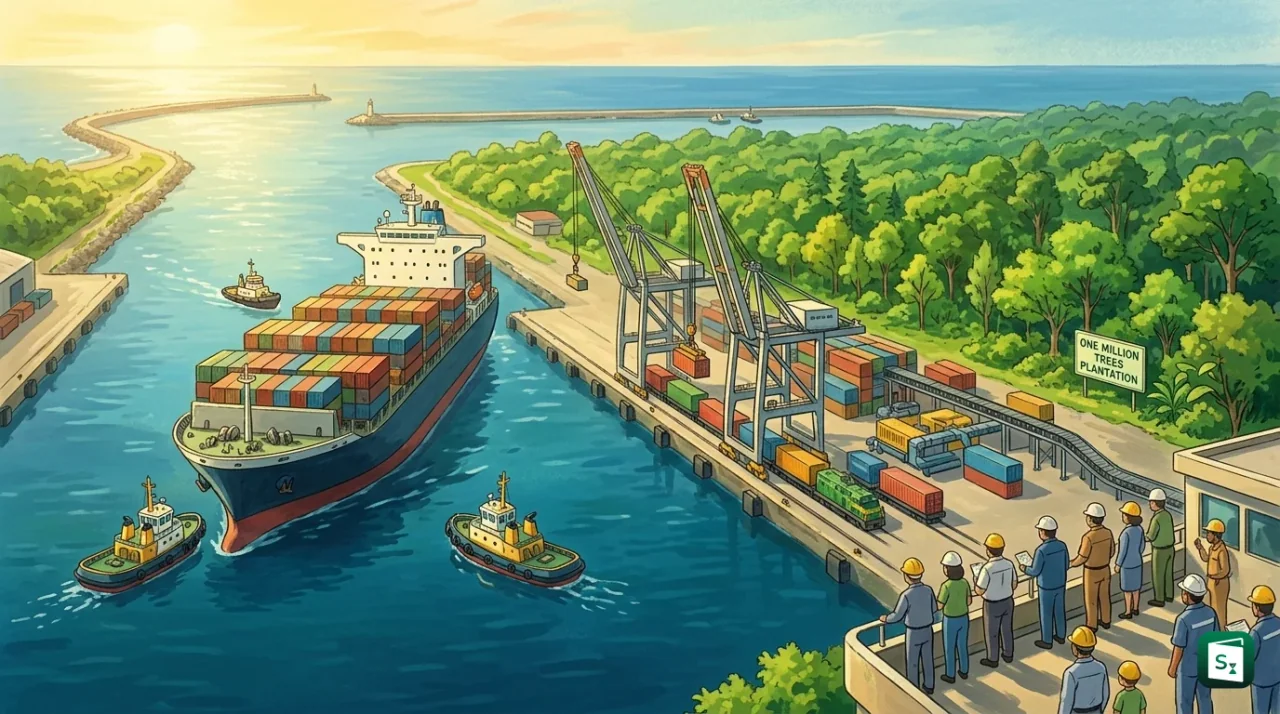
Union Minister for Ports, Shipping and Waterways Sarbananda Sonowal inaugurated seven infrastructure projects worth ₹427.80 crore at the Paradip Port Authority (PPA) in Odisha on 21 August 2026. The package gives Paradip an 18.5-metre deep-draft in its inner harbour so it can now handle fully laden Capesize vessels, the largest bulk carriers in global trade. On the same day, Sonowal witnessed the signing of three mechanisation concession agreements worth ₹1,580.36 crore and planted Paradip’s one-millionth tree, combining capacity expansion with a clear green signal.
Seven Infrastructure Projects Worth ₹427.80 Crore
The ₹427.80 crore package covers navigation, road connectivity, safety, residential services and community support. Together the projects are valued at more than ₹2,008 crore when added to the mechanisation agreements signed the same day. Sonowal was joined by Odisha Minister Sampad Chandra Swain, Jagatsinghpur MP Bibhu Prasad Tarai, PPA Chairman P. L. Haranadh, Deputy Chairman T. Venu Gopal and senior officials of the Ministry of Ports, Shipping and Waterways (MoPSW).
| Project | Cost | What It Does |
|---|---|---|
| Capital dredging for 18.5-metre deep draft | ₹352 crore | Deepens inner harbour to handle fully laden Capesize vessels, improves economies of scale and lowers logistics and turnaround costs |
| Atharbanki Second New Bridge | ₹24.89 crore | 500-metre, three-lane bridge with footpaths and a dedicated pipeline corridor across Atharbanki Creek, eases congestion on a route used by nearly 3,000 trucks daily |
| Advanced Vessel Traffic Management and Information System (VTMS) | ₹15.50 crore | Integrates solid-state radar, Artificial Intelligence, AIS, CCTV, oil-spill monitoring and 3D visualisation to track vessels up to 20 nautical miles, built with National Technology Centre for Ports, Waterways and Coasts at IIT Madras |
| Piped Natural Gas (PNG) supply to Madhuban township | ₹20 crore | In partnership with Bharat Petroleum Corporation Ltd (BPCL), connects 546 residential quarters, expected to cut household gas bills by up to 40 percent |
| Façade redevelopment of Administrative Office Building | ₹12.18 crore | Executed by NBCC (India) Ltd, upgrades building front, parking and circulation areas |
| Sports Hostel | ₹2.10 crore | Provides accommodation and training support for young athletes |
| Other community and safety works | part of package | Covers residential infrastructure and sustainability related upgrades |
The deep-draft project is the centrepiece. Deep draft is the vertical distance between a ship’s waterline and the bottom of its hull, it decides how large a vessel a port can receive without tidal help. At 18.5 metres, Paradip’s inner harbour can now receive Capesize bulk carriers, which are typically more than 100,000 deadweight tonnes (DWT) and up to 300 metres long. Till now such ships could only be handled with lighterage or at outer anchorages, which raised cost and time.
The VTMS adds a modern control layer. Its ATC-style signal station gives controllers a real-time picture of vessel movement, improves safety, helps manage dense traffic and supports quicker response to incidents such as oil spills.
The PNG project makes Paradip the first major port in India to provide piped natural gas to its residential township. Piped Natural Gas reaches homes through an underground pipeline network and removes the need to handle LPG cylinders, offering continuous supply at a lower and more stable price.
How the Seven Projects Were Chosen
The projects were selected to fix three linked bottlenecks that the port had flagged in recent performance reviews. First, draft limitation that prevented full use of large vessels. Second, road congestion that slowed evacuation of cargo to the hinterland. Third, old traffic management and residential systems that added to operating cost and safety risk. Each of the seven investments targets one of these areas so that gains in one part are not cancelled by weakness in another.
Three Mechanisation Projects Worth ₹1,580.36 Crore
Alongside the inaugurations, PPA signed three concession agreements on a Build-Operate-Transfer (BOT) basis with private operators. Under BOT, the private partner builds and operates the facility for a fixed concession period and then transfers it back to the port authority. The total investment is ₹1,580.36 crore and the aim is to move cargo faster, more safely and with lower dust and pollution.
| Project | Capacity | Operator | Investment | Model |
|---|---|---|---|---|
| South Quay (SQ) mechanisation | 5 MTPA | Yogayatan Paradip SQB Terminal Pvt. Ltd. | ₹498.69 crore | BOT |
| Multipurpose Berth mechanisation | 8 MTPA | Kalinga Bulk Terminal Paradip Pvt. Ltd. | ₹630.67 crore | BOT |
| Central Quay-III (CQ-III) captive berth mechanisation | 10 MTPA | M/s AMNS Paradip Logistics Pvt. Ltd. | ₹451 crore | BOT for 30 years |
Berth mechanisation means replacing manual or semi-mechanised loading with closed conveyors, stackers, reclaimers and high-capacity ship loaders that move cargo directly between yard and ship. This cuts loading time, reduces cargo loss, lowers dust emission and improves safety for workers.
The CQ-III project will handle iron ore pellets from the 12 MTPA pellet plant of AMNS India at Paradip through a fully mechanised conveying and ship-loader system. The berth is 270 metres long with a dredged depth of 14.5 metres. The South Quay and Multipurpose Berth projects will handle other dry bulk and multi-cargo, adding flexibility to shift between commodities such as coal, fertiliser raw material and limestone.
Target: 100 Percent Berth Mechanisation by 2030
At present about 80 percent of Paradip’s berths are mechanised. The three new concessions are part of a larger plan to reach 100 percent mechanisation by 2030. PPA has stated that it wants to become the first fully mechanised bulk port in India well before 2030. Faster and cleaner handling reduces vessel turnaround time, the total time a ship spends at port, which is a key measure of port efficiency and directly affects freight cost for industries in the hinterland.
Paradip Port Authority: Background and National Importance
Paradip Port is the only major port in Odisha and one of 12 major ports governed by the central government through the Major Port Authorities Act, 2021. Major ports are centrally administered seaports notified under this Act, while more than 200 non-major ports are managed by states or private operators. All major ports together handled 855 million tonnes in FY 2024-25 and 915.17 million tonnes in FY 2025-26, about 54 percent of India’s total maritime cargo of around 1,594 million tonnes.
The port was envisioned by Biju Patnaik, then Chief Minister of Odisha and regarded as its founder father. The foundation stone was laid by Prime Minister Jawaharlal Nehru on 3 January 1962 at the confluence of the Mahanadi river and the Bay of Bengal. The Government of India took over management from the Government of Odisha on 1 June 1965, the first ship INS Investigator berthed on 12 March 1966, and the port was declared open the same day by Peter Stambolic, then Prime Minister of Yugoslavia. On 18 April 1966 it was notified as the eighth major port of India and the first major port on the east coast commissioned after independence. It lies about 210 nautical miles south of Kolkata and 260 nautical miles north of Visakhapatnam, in Jagatsinghpur district.
It is an artificial lagoon-type harbour protected by two rubble-mound breakwaters and linked to the sea by a 2.2 kilometre approach channel. The port operates 21 to 22 berths, three Single Point Moorings (SPMs) located about 20 kilometres offshore in about 30 metres water depth for crude oil, and one Ro-Ro jetty. It is owned by the Government of India and operated by the Paradip Port Authority (PPA), headed by Chairman P. L. Haranadh (IRTS, 1994 batch) with T. Venu Gopal as Deputy Chairman. It functions under the Ministry of Ports, Shipping and Waterways, currently led by Union Minister Sarbananda Sonowal.
Paradip serves the mineral-rich hinterland of Odisha, Jharkhand, Chhattisgarh and parts of West Bengal and Madhya Pradesh, handling coal, iron ore, fertilisers, POL and other bulk cargo. It first became India’s largest major port by cargo volume in FY 2023-24 with 145.38 MMT, surpassing Deendayal Port in Gujarat, and retained the lead with a record 156.45 MMT in FY 2025-26, a 4.01 percent growth and its highest ever throughput. In January 2026 it handled 14.44 MMT, its best January performance. In FY 2025-26 its net surplus crossed ₹2,000 crore for the first time and its operating ratio improved to 31 percent, the best among major ports. Current capacity is about 289 MMTPA and the port is working toward more than 400 MMTPA by 2030 and 500 MMTPA by 2047 under the Maritime India Vision 2030 and Maritime Amrit Kaal Vision 2047.
Its development is aligned with the Sagarmala Programme, approved by the Union Cabinet on 25 March 2015 and launched with the National Perspective Plan on 14 April 2016 at the Maritime India Summit. Sagarmala aims at port-led development, coastal connectivity, industrialisation and logistics cost reduction. As of April 2026, it is implementing 845 projects worth ₹6.06 lakh crore, with 315 projects worth ₹1.57 lakh crore completed, and Sagarmala 2.0 proposes ₹85,482 crore of budgetary support to catalyse ₹3.6 lakh crore of investment. Major upcoming works at Paradip include the 25 MMTPA Western Dock Project, expected to be completed in 2026 at an estimated cost of about ₹3,004.63 crore, and future plans for a green hydrogen and ammonia export jetty costing about ₹797 crore.
Sustainability Push and the One-Millionth Tree
Sonowal planted Paradip’s one-millionth tree during the visit, marking a green-cover milestone that has been pursued since the recovery after the 1999 Super Cyclone. PPA has intensified plantation in the last four years, planting nearly one lakh trees annually with participation from employees, stakeholders and local communities. Green belts inside and around the port help control dust from bulk cargo, reduce noise, support biodiversity and act as a buffer against coastal winds and cyclones, a recurring risk on the Odisha coast.
The port follows a sustainability approach that links economic, environmental and social goals. Under its Environment, Health and Safety (EHS) framework it monitors air, water and noise quality, expands solar power use, recycles water, segregates waste and runs health camps, safety training and fire drills. In FY 2025-26 it also supported social programmes that extend beyond the port gates. It provided placement-linked skill training to 168 unemployed youth from Odisha through the Centre of Excellence in Maritime and Shipbuilding (CEMS), Visakhapatnam under MoPSW, covering roles such as inventory clerk, courier associate and supply chain executive. It also supported Marine Products Export Development Authority (MPEDA) programmes for fishing communities around Paradip Fishing Harbour, focusing on fish quality and hygienic handling, responsible fishing, distribution of square-mesh cod-ends and bio-toilets, and awareness on turtle excluder devices. These steps link port growth with livelihood security along the coast.
Why This Expansion Matters for Eastern India
Paradip is not just a berth for Odisha, it is the sea gate for a large economic zone that produces much of India’s coal, iron ore and steel. If bulk moves more cheaply through Paradip, factories in the interior save on freight, exports become more competitive and the benefit travels along rail, road and inland waterway links. Sonowal described the expansion as a growth multiplier for eastern India, saying deeper drafts, modern handling, better connectivity and greater mechanisation would help Paradip drive trade, logistics, industry and employment and contribute to India becoming a globally competitive maritime economy.
Three effects are most direct. First, lower logistics cost. Allowing fully laden Capesize ships inside the harbour cuts the need to split cargo into smaller ships or use shuttle vessels, so fuel and charter cost per tonne falls. Second, faster turnaround and higher throughput. Mechanised berths with closed conveyors can load and unload at higher rates, keep berths free for the next ship and raise daily berth productivity, which at Paradip is already the highest among major ports at about 35,059 tonnes per day per berth compared with a national average near 18,000 tonnes. Third, cleaner and safer operations. Enclosed systems and modern VTMS reduce spillage, dust and accident risk while improving monitoring up to 20 nautical miles.
In the wider picture, the projects fit the national push to bring logistics cost down as a share of GDP, raise the share of coastal shipping and prepare ports for future fuels. Paradip has signed agreements with four investors for green hydrogen and green ammonia plants worth about ₹50,800 crore in its vicinity and is planning a dedicated export berth for these fuels. A new satellite port at Bahuda in Ganjam district, planned with the Odisha Maritime Board and Sagarmala Finance Corporation Limited with a capacity near 150 MMTPA and investment of about ₹21,500 crore, would work in tandem with Paradip to decongest the coast. If these links connect with the Western Dock and full mechanisation by 2030, eastern India will have a deeper, faster and greener gateway to global bulk trade, directly supporting the long-term goal of Viksit Bharat 2047.
Key Takeaways
- Union Minister Sarbananda Sonowal inaugurated seven projects worth ₹427.80 crore at Paradip Port Authority in Odisha on 21 August 2026.
- Capital dredging of ₹352 crore gave Paradip an 18.5-metre deep-draft in its inner harbour, allowing fully laden Capesize vessels to berth directly.
- The ₹24.89 crore Atharbanki Second New Bridge is a 500-metre, three-lane bridge across Atharbanki Creek easing a route used by about 3,000 trucks daily.
- Three BOT-based mechanisation concession agreements worth ₹1,580.36 crore were signed for 5 MTPA South Quay, 8 MTPA Multipurpose Berth and 10 MTPA captive CQ-III, taking Paradip toward 100 percent berth mechanisation by 2030.
- Paradip became the first major port in India to provide PNG to its township, with a ₹20 crore BPCL project connecting 546 quarters in Madhuban and cutting gas bills by up to 40 percent.
- Paradip planted its one-millionth tree, with nearly one lakh trees planted annually in the last four years since the plantation drive intensified after the 1999 Super Cyclone.
- Paradip Port, founded with the vision of Biju Patnaik and foundation stone laid by Jawaharlal Nehru on 3 January 1962, was declared the eighth major port on 18 April 1966 and handled a record 156.45 MMT in FY 2025-26 as India’s top major port.