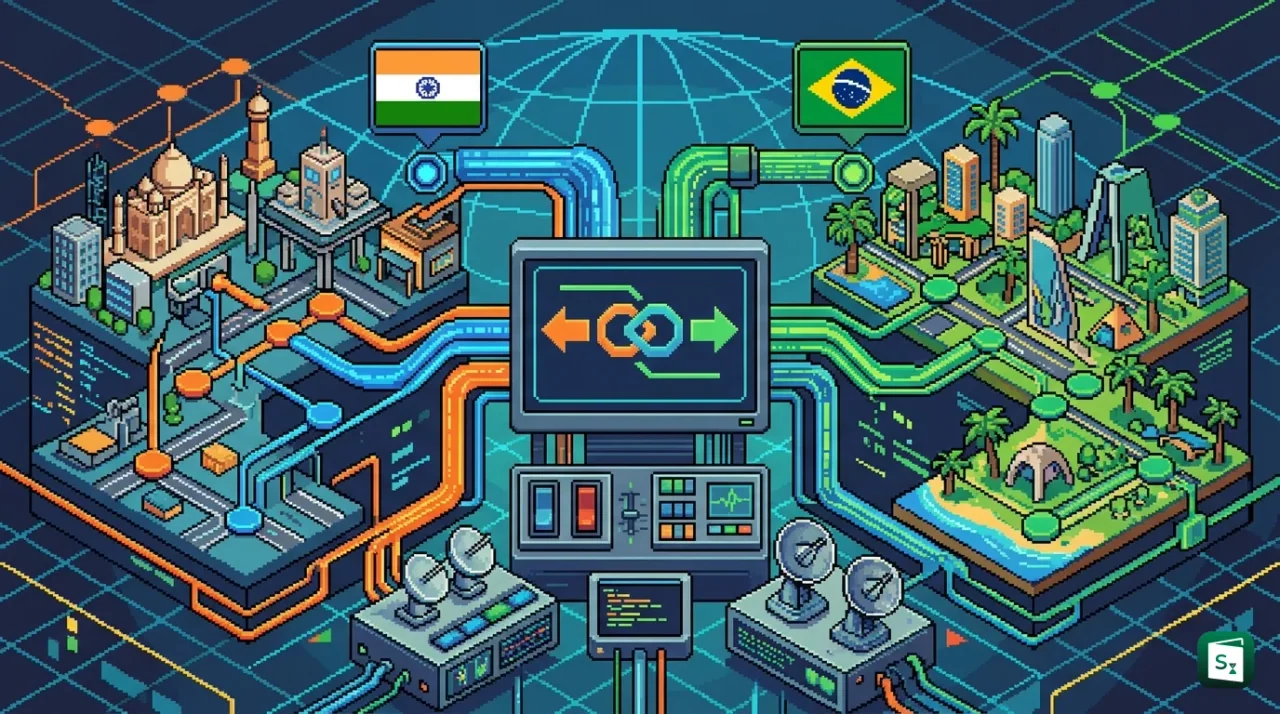
India and Brazil signed a Memorandum of Understanding (MoU) on 21 August 2026 in Pune, Maharashtra to deepen cooperation in Telecommunications and Information and Communication Technologies (ICT). The agreement was signed by Union Minister of Communications Jyotiraditya M. Scindia and Brazilian Minister of Communications Frederico de Siqueira Filho on the sidelines of the 12th BRICS Communications Ministers Meeting. It creates a formal framework for the two large democracies to work together on universal connectivity, cybersecurity, digital public infrastructure and next generation technologies.
What Does the New MoU Cover?
The Memorandum of Understanding (MoU) is not a commercial contract for a specific project. It is a formal statement of intent that sets up a structure for regular cooperation between the Department of Telecommunications (DoT) of India, which functions under the Ministry of Communications, and the Ministry of Communications of Brazil.
According to the Department of Telecommunications, the agreement will help both countries exchange information, policy experiences and best practices on the basis of equality and mutual benefit. It covers a wide set of priority areas rather than a single technology.
The core areas identified include universal and affordable connectivity, cybersecurity and trusted networks, Digital Public Infrastructure (DPI), capacity building and skill development, and exchange of technical knowledge. On the technology side, the MoU specifically lists cooperation in Artificial Intelligence (AI), 5G and 6G, Open RAN (Open Radio Access Network), Internet of Things (IoT), Direct-to-Device (D2D) connectivity, Low Earth Orbit (LEO) satellites, Non-Terrestrial Networks (NTNs), spectrum management and satellite communications.
It also extends to physical and institutional infrastructure such as optical fibre and submarine cable networks, data centres, private communication networks, digital inclusion, consumer protection and environmentally sustainable ICT solutions. The partnership will include joint research, sharing of information through conferences and seminars, and exploration of joint work in third countries where relevant.
The BRICS ICT Track Meeting in Pune
The MoU was signed on the sidelines of the BRICS ICT Track hosted by India in Pune, Maharashtra from 17 to 21 August 2026. India is the Chair of BRICS for 2026, and the Department of Telecommunications is the nodal agency for the ICT Track.
BRICS now comprises 11 members, which are Brazil, Russia, India, China, South Africa, Egypt, Ethiopia, Iran, Saudi Arabia, United Arab Emirates and Indonesia. The ICT Track is the platform where Communications Ministers and senior officials discuss digital cooperation. During this edition, three main events were held, which included the 7th BRICS Working Group Meeting for ICT Cooperation, a BRICS Digital Innovation Forum involving government, industry, academia and startups, and the 12th BRICS Communications Ministers Meeting on 21 August.
The Pune meeting focused on three themes. The first was Trustworthy ICTs and cybersecurity, including child online protection, privacy and safety for vulnerable users. The second was Sustainable and Resilient Digital Ecosystems, which covered universal and affordable connectivity, energy efficient infrastructure and the role of satellite and non-terrestrial systems. The third was Innovation and Entrepreneurship, covering startups, digital skilling and capacity building.
The BRICS ICT Track was institutionalised at the 7th BRICS Communications Ministers Meeting hosted by India in 2021. It provides the multi-stakeholder framework that continues to guide digital collaboration among members. India has used its 2026 chairship to promote digital transformation, trusted technologies and its own experience with large scale public digital systems as models for sharing within the group.
Why India and Brazil Are Natural Digital Partners
India and Brazil are both continental sized democracies with a similar connectivity challenge. Reaching remote and low income communities is not just a development goal but a practical necessity for inclusive growth. Both governments have invested heavily in public funded networks to close that gap.
India’s Push for Universal Connectivity
India’s approach rests on two pillars. The first is BharatNet, one of the world’s largest rural broadband projects. It was approved as the National Optical Fibre Network (NOFN) in 2011 and later renamed BharatNet. It aims to provide high speed broadband through optical fibre to all Gram Panchayats across the country. As of mid 2026, nearly 2.14 lakh Gram Panchayats out of about 2.56 lakh have been made service ready in Phase I and Phase II at a cost of about ₹42,000 crore. The Amended BharatNet Programme, approved on 4 August 2023, is a $16.9 billion or about ₹1.39 lakh crore publicly funded programme to complete the remaining network, upgrade Phase I from linear to ring topology for better resilience, connect about 47,000 remaining Gram Panchayats and provide on demand connectivity to about 3.8 lakh non-Gram Panchayat villages. The programme also supports 1.5 crore rural fibre connections and ten years of operation and maintenance. Implementation is led by Bharat Sanchar Nigam Limited (BSNL) as the Project Management Agency, with Digital Bharat Nidhi (DBN) as the funding body.
Digital Bharat Nidhi, earlier known as the Universal Service Obligation Fund (USOF), was given statutory backing through the Indian Telegraph (Amendment) Act, 2003 and now operates under the Telecommunications Act, 2023. It is funded through a Universal Access Levy, which is a percentage of telecom revenue, currently 5 percent of Adjusted Gross Revenue (AGR) contributed by telecom operators. DBN funds rural mobile towers, submarine cables and the Amended BharatNet rollout.
The second pillar is Digital Public Infrastructure, often called India Stack. It includes Aadhaar, the biometric identity system launched in 2009, Unified Payments Interface (UPI), launched in 2016 by the National Payments Corporation of India (NPCI) under the guidance of the Reserve Bank of India, and consent based data sharing frameworks like Account Aggregator. UPI now handles about 85 percent of India’s digital retail transactions and, by March 2025, processed more than 18 billion transactions in a single month. India has also established 100 5G use case laboratories across the country to promote industry and academia collaboration. With one of the world’s fastest 5G rollouts completed in 22 months, India reported about 40 crore 5G users by early 2026.
Brazil’s Amazon Fibre and PIX Experience
Brazil faces a comparable challenge in the Amazon region, where dense forest and scattered communities make connectivity expensive. The Brazilian side shared its $500 million programme to lay about 40,000 km of optical fibre in the Amazon to improve digital inclusion. Brazil is also active in satellite and submarine cable connectivity to link its vast territory.
In digital payments, Brazil’s success with PIX offers a direct parallel to India’s UPI. PIX is an instant payment system launched in November 2020 by the Central Bank of Brazil (Banco Central do Brasil). By design it is open and interoperable, allows 24/7 transfers using a phone number or email as an address, and requires mandatory participation by larger banks. Within a year, it enrolled more than 65 percent of adults and now accounts for about 15 percent of global instant payment transactions, while UPI accounts for about 48 percent. Together, the two systems handle nearly two thirds of global instant payments and show how public digital infrastructure can expand financial inclusion at low cost. The MoU reflects interest on both sides in studying each other’s models, from DBN funding and BharatNet design to PIX governance and Brazil’s fibre rollout.
| Area | India | Brazil |
|---|---|---|
| Rural connectivity programme | BharatNet with DBN funding, 5 percent AGR levy | 40,000 km Amazon fibre programme, $500 million |
| Instant payments | UPI, launched 2016, about 85 percent of digital transactions | PIX, launched 2020, covers more than 65 percent of adults |
| 5G ecosystem | 100 5G use case labs, 40 crore users | Rapidly expanding 5G subscriber base |
| Space connectivity | Push for satcom for remote areas and disaster management | Focus on LEO satellites and submarine cables |
India-Brazil Relations: From 1948 to Strategic Partnership
Diplomatic relations between India and Brazil were established in 1948, when both countries opened embassies in the same year. India initially opened its embassy in Rio de Janeiro, the then capital, and moved it to Brasilia in 1971. The relationship was elevated to a Strategic Partnership in 2006, based on shared democratic values, a common vision for inclusive growth and commitment to multilateral reform.
Both nations coordinate closely in plurilateral and multilateral forums such as BRICS, IBSA (India, Brazil and South Africa Dialogue Forum, formed in 2003), G20, G4 (India, Brazil, Germany and Japan, which jointly seek permanent membership in the UN Security Council), BASIC, the International Solar Alliance (ISA) and the Global Biofuel Alliance, which was launched during India’s G20 Summit in New Delhi in September 2023.
Institutional mechanisms include the Joint Commission Meeting at Foreign Minister level, Strategic Dialogue between National Security Advisers, Foreign Office Consultations at Secretary level, Trade Monitoring Mechanism (TMM), Economic and Financial Dialogue, Joint Defence Committee established under the Defence Cooperation Agreement of 2003, and the Joint Committee on Science and Technology. The 9th Joint Commission Meeting was co-chaired by External Affairs Minister S. Jaishankar and Brazilian Foreign Minister Mauro Vieira on 27 August 2024 in New Delhi.
In trade, Brazil is India’s largest trading partner in Latin America. Bilateral trade reached $12.20 billion in 2024-25 and grew to $15.21 billion in 2025, an increase of more than 25 percent. Major Indian exports include processed petroleum products, agrochemicals, pharmaceuticals and engineering goods. Major Brazilian exports to India include crude oil, soya oil, raw sugar, cotton and iron ore. Total Indian investments in Brazil are estimated at more than $15 billion, while Brazilian companies such as Vale, Stefanini and Embraer have presence in India. The two sides also hold cooperation frameworks in space, including a framework agreement for peaceful use of outer space signed in 2004 and India’s launch of Brazil’s Amazonia-1 satellite in 2021, the investment cooperation and facilitation treaty signed in 2020, and MoUs on cybersecurity between CERT-In and its Brazilian counterpart signed in January 2020, bioenergy cooperation signed in January 2020, and digital solutions for large scale transformation signed in July 2025.
The current telecom MoU builds on this history and adds a dedicated digital pillar at a time when both countries have identified technology and connectivity as core to their development strategies.
How the Cooperation Will Work
The MoU provides a forward looking framework rather than immediate financial commitments. Implementation will be driven through regular official level consultations, development of a joint work plan and identification of nodal stakeholders on both sides to ensure the outcomes are tracked and executed.
Modes of cooperation include exchange of information on policy and regulation, joint research and studies, conferences, visits and seminars, capacity building and training programmes, and sharing of best practices in areas such as spectrum management, telecom standards and testing, security of infrastructure, secure networks and fraud prevention, and digital skilling.
Recent bilateral exchanges have already shown this approach in action. During the visit of Brazil’s President Luiz Inacio Lula da Silva to India in July 2025 for the 17th BRICS Summit and again in February 2026 to New Delhi, the two sides signed six agreements including cooperation on renewable energy, large scale digital solutions, intellectual property, agriculture, cyber security and classified information protection. During the February 2026 visit, the leaders also adopted a Joint Declaration and Action Plan on a Digital Partnership for the Future and discussed expansion of the India-MERCOSUR Preferential Trade Agreement, which has been in force since 2009. The telecom MoU signed in Pune now gives that digital partnership a formal telecom track with ministers as the signing authorities.
Who Are the Signatories
Jyotiraditya M. Scindia is the 43rd Union Minister of Communications and 10th Minister of Development of North Eastern Region since June 2024. He is a six term Member of Parliament and has earlier served as Minister of State for Communications and Information Technology from 2007 to 2009, Minister of State for Commerce and Industry, and Minister for Power with independent charge. He holds a degree in Economics from Harvard University and an MBA from Stanford University.
Frederico de Siqueira Filho is Brazil’s Minister of Communications since April 2025 in the government of President Luiz Inacio Lula da Silva. A civil engineer from the University of Pernambuco, he has more than 26 years of experience in telecommunications and IT, including 21 years at the operator Oi in leadership roles for operations, planning and regulatory affairs. From May 2023 to May 2025, he served as President of Telebras, Brazil’s state owned telecom company that implements public telecom policies and works on remote connectivity including in the Amazon.
Significance and the Way Forward
For India, the agreement helps project its Digital Public Infrastructure model as a global public good. Sharing UPI, Aadhaar linked systems and DBN funded connectivity offers a template for other developing countries while also creating opportunities for Indian technology firms and know how in Brazil, a market of more than 200 million people with a large digital economy.
For Brazil, access to India’s experience in low cost, large scale digital deployment, 100 5G labs and BharatNet’s public funding design can inform its Amazon inclusion programme and 5G expansion. For both, deeper cooperation in cybersecurity, secure networks and telecom fraud prevention is critical as they digitise government services and finance.
At the multilateral level, the MoU strengthens the Global South voice within BRICS and the International Telecommunication Union, as well as the Universal Postal Union. With India holding the BRICS chair in 2026 and both countries pushing for reform of global governance institutions including the UN Security Council, a common stance on trusted and resilient technology standards adds weight to their broader reform agenda.
The next steps will be watched for concrete outcomes. These include preparation of a joint work plan, identification of nodal agencies such as DoT and NPCI on India’s side and the Ministry of Communications and Banco Central do Brasil on Brazil’s side, and translation of the framework into specific pilot projects. The MoU itself does not set timelines or funding, but it establishes the institutional channel to move from dialogue to delivery. For India and Brazil, the test will be whether shared platforms in payments and connectivity can turn into joint innovation in 6G, quantum communications and inclusive digital ecosystems over the coming years.
Key Takeaways
- India and Brazil signed an MoU on Telecommunications and ICT on 21 August 2026 in Pune during the 12th BRICS Communications Ministers Meeting.
- The MoU was signed by Jyotiraditya M. Scindia and Frederico de Siqueira Filho on the sidelines of the BRICS ICT Track (17 to 21 August 2026) held under India’s BRICS Chairship for 2026.
- Cooperation covers universal connectivity, cybersecurity, Digital Public Infrastructure, AI, 5G and 6G, Open RAN, LEO satellites, spectrum management, optical fibre and submarine cables, and sustainable ICT solutions.
- India highlighted BharatNet and Digital Bharat Nidhi (5 percent AGR levy) while Brazil shared its $500 million, 40,000 km Amazon fibre programme and PIX instant payments system launched in November 2020.
- India and Brazil have been Strategic Partners since 2006 with diplomatic ties since 1948, and both are members of BRICS (11 members) and IBSA (formed in 2003).