The Ministry of Environment, Forest and Climate Change (MoEFCC) conferred the Gaj Gaurav Awards 2026 on 13 August 2026 during the national celebrations of World Elephant Day in Visakhapatnam, Andhra Pradesh. The awards were presided over by Union Minister of State Kirti Vardhan Singh, with Andhra Pradesh Deputy Chief Minister Konidala Pawan Kalyan as Guest of Honour. Among the recipients, seven mahouts and elephant handlers from Jaldapara National Park in West Bengal were honoured for showing exceptional courage during severe flash floods that struck North Bengal in October 2025.
What Are the Gaj Gaurav Awards?
The Gaj Gaurav Awards are India’s national honour for frontline service in elephant conservation and management. Instituted by the MoEFCC in 2022 during the 30-year commemoration of Project Elephant, the awards recognise the often unseen work that keeps both wild and captive elephants safe.
The award is presented every year as part of the national World Elephant Day celebrations on 12 August, though the formal ceremony is often held on the adjoining days. It is conferred by the Project Elephant Division of the MoEFCC, which operates from Indira Paryavaran Bhawan in New Delhi and works closely with the Wildlife Institute of India (WII) in Dehradun.
Who Is Honoured
The awards specifically recognise grassroots workers rather than senior officials alone. Eligible categories include field officers, frontline forest staff, mahouts, elephant handlers (kavadi or prabhutva), trackers, veterinarians, captive elephant owners, and members of tribal and local communities living alongside elephant habitats. Criteria include rescue of distressed elephants, mitigation of human-elephant conflict (HEC), protection of corridors, anti-poaching efforts, and care of captive elephants.
A mahout is a traditional elephant handler who trains, feeds, and guides a captive elephant, often forming a lifelong bond with the animal. A kumki, from the Persian word kumak meaning help, is a trained captive elephant used by forest departments to patrol, rescue, and manage wild elephants. Without skilled mahouts, kumkis cannot be deployed safely, which is why the handler and animal are honoured together.
The first awards were presented on 12 August 2022 at Periyar Tiger Reserve in Kerala, where members of the Malasar community of the Anamalai Hills in Tamil Nadu, along with mahouts from Kerala and Assam, were felicitated. Since then the award has become an annual feature, highlighting stories from across India’s 33 Elephant Reserves.
World Elephant Day 2026: National Celebrations in Visakhapatnam
The national celebrations for World Elephant Day 2026 were held on 13 August 2026 in Visakhapatnam, a coastal city in Andhra Pradesh. World Elephant Day itself is observed every year on 12 August. It was co-founded in 2012 by Canadian filmmaker Patricia Sims and the Elephant Reintroduction Foundation of Thailand, an initiative of Queen Sirikit of Thailand, to draw global attention to the threats facing both Asian and African elephants.
In India the day has become a platform for reviewing policy, releasing scientific publications, and honouring frontline staff. For 2026, the MoEFCC chose Visakhapatnam as the host city, bringing together central and state officials, scientists, and community representatives.
The event was presided over by Kirti Vardhan Singh, Minister of State for Environment, Forest and Climate Change, and was attended as Guest of Honour by Konidala Pawan Kalyan, Deputy Chief Minister of Andhra Pradesh. Senior officials present included Tanmay Kumar, Secretary, MoEFCC, Sushil Kumar Awasthi, Director General of Forests and Special Secretary, and Ramesh Pandey, Additional Director General (Wildlife), along with officers from the Ministry of Railways, state forest departments, and scientific institutions.
In his address, Singh said India is combining artificial intelligence, remote sensing, and geospatial mapping with traditional knowledge to protect elephant habitats. He noted that human-elephant conflict requires cross-sectoral and community-based solutions backed by ground validated scientific data. He underlined that India holds about 60 percent of the world’s wild Asian elephant population, with 33 Elephant Reserves and 150 scientifically identified elephant corridors across 14 states.
Pawan Kalyan said Andhra Pradesh follows a “Conflict to Coexistence” approach. He highlighted the state’s H.A.N.U.M.A.N. initiative, short for Healing And Nurturing Units for Monitoring, Aid and Nursing of Wildlife, which uses monitoring units, veterinary support, community engagement, and capacity building of frontline staff to handle conflict cases beyond administrative boundaries.
Several major releases marked the occasion. A publication titled “30 Giant Steps” documented milestones under Project Elephant from 2020 to 2026. A Regional Action Plan for Comprehensive Understanding and Management of Human-Elephant Conflict in Southern India, covering Karnataka, Kerala, Andhra Pradesh, and Tamil Nadu, was also launched with central support of ₹500 crore. The plan adopts a landscape level approach focused on habitat connectivity, corridor conservation, early warning systems, rapid response mechanisms, and interstate coordination.
Other releases included a Special Issue of the Journal of Wildlife Science marking three decades of elephant conservation, a monograph titled “Asian Elephants in Central India Before 1947”, the 23rd Steering Committee Meeting of Project Elephant, and the launch of The Trumpet Volume VI Issue 1. Project Elephant, in coordination with the National Museum of Natural History, also ran a nationwide awareness campaign that engaged more than 20 lakh students across 21,450 schools through painting competitions, rallies, street plays, and pledge ceremonies.
Seven Jaldapara Mahouts Honoured for Flood Bravery
The most moving part of the 2026 ceremony was the recognition of seven mahouts and handlers from the Jaldapara Wildlife Division in West Bengal. This is the first time personnel from West Bengal have received the Gaj Gaurav award, making it a milestone for the state.
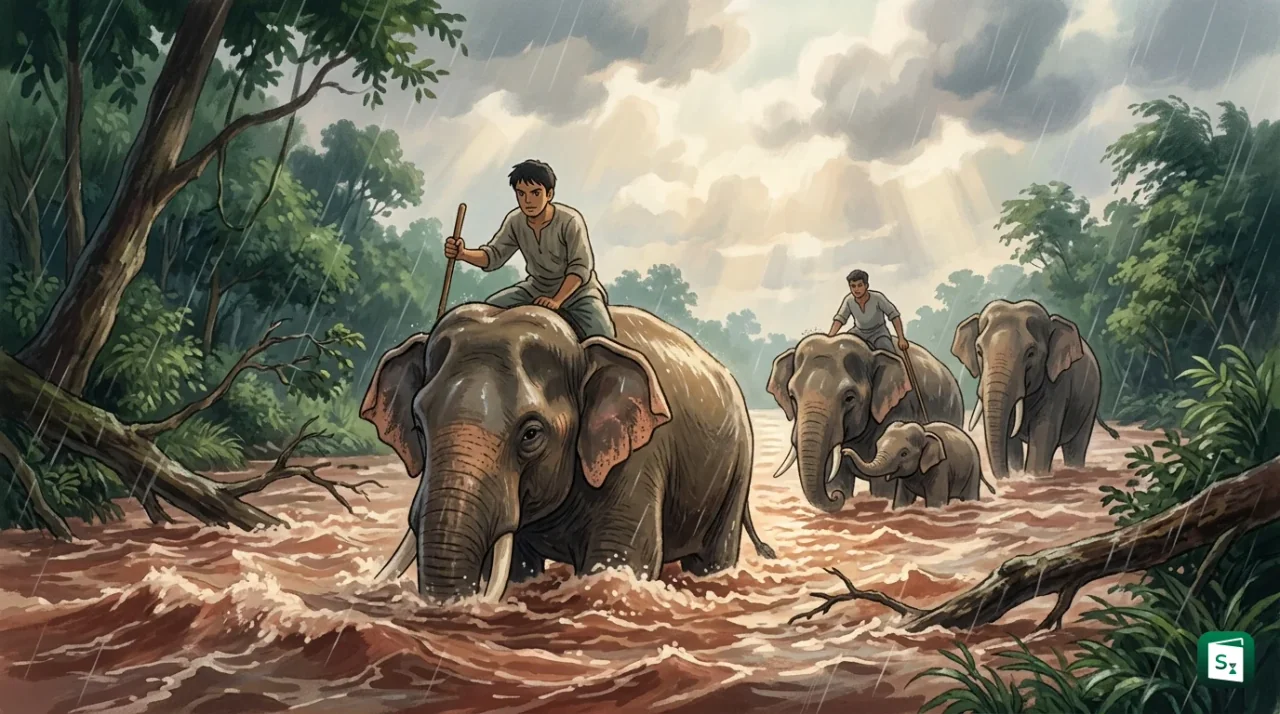
The awardees were identified as Bikash Kharia and Rajiv Oraon, who rescued five stranded kumki elephants from the flooded Torsa and Malangi rivers, and Ajibul Haque, Ajit Gabur, Mamtaj Alam, Amasur Kheriya, and Dilip Munda, who were part of the team that rescued Indian one-horned rhinoceroses swept away by the swollen Torsa River.
What Happened in the 2025 Floods
In October 2025, unprecedented and continuous rain triggered devastating flash floods across the Dooars region of North Bengal. The Torsa, Jaldhaka, Mahananda, and Teesta rivers flowed above danger levels, submerging large parts of Jaldapara National Park. Forest officials reported elephants, rhinoceroses, deer, gaur, and bison fleeing submerged grasslands. Within Jaldapara alone, 13 Indian one-horned rhinoceroses were swept away from the core area and scattered into villages, paddy fields, and degraded riverine patches, with some animals traced as far as Pundibari, Patlakhawa, and Putimari in neighbouring Cooch Behar district.
The forest department launched what officials described as India’s largest coordinated rhino rescue operation. More than 200 forest personnel, assisted by 19 trained kumki elephants including Balaram, Sundarmani, Amba, Karna, and Joy, were deployed along with drones, camera traps, and satellite phones. A temporary pilkhana, or elephant stable, was set up at a local primary school to house and care for the kumkis throughout the 55-day mission.
The operation unfolded in difficult conditions. Heavy rain, strong currents, debris, and the need to use boats on the Torsa slowed movement and made tracking risky. Initially teams tried to guide rhinos back to the forest using kumkis, but the animals repeatedly returned to riverbanks. The strategy then shifted to locating each rhinoceros individually by following footprints. According to range officers involved, it took five days to rescue the first rhino. Each animal was later tranquilised from atop a kumki elephant and transported back to Jaldapara. By the end of the mission, all 13 displaced rhinos were safely recovered, an outcome forest officials hailed as a rare conservation success after a natural disaster.
In parallel, Bikash Kharia and Rajiv Oraon waded with their elephants into the flooded Torsa and Malangi channels to reach five kumki elephants that had become stranded while on duty. Their calm handling prevented the animals from panicking and ensured no human or animal casualties in that phase of the rescue.
The seven mahouts were publicly felicitated earlier at a Bagh Divas event in Kolkata hosted by the Society for Heritage and Ecological Researches (SHER) before being formally honoured with the Gaj Gaurav awards in Visakhapatnam. Their work exemplifies the dependence of modern wildlife management on traditional mahout knowledge combined with modern technology.
Jaldapara National Park: A Crucial Landscape in the Dooars
Jaldapara National Park lies in the Alipurduar district of West Bengal, in the Dooars region at the foothills of the Eastern Himalayas. It stretches across about 216.51 square kilometres on the banks of the Torsa River, with the Holong, Malangi, and Chirakhawa rivers also flowing through it. The park sits at an altitude of around 61 metres and consists of tall savannah grasslands interspersed with riverine forests and wetlands.
Originally declared a wildlife sanctuary in 1941 to protect the Indian one-horned rhinoceros, it was upgraded to a national park in 2012. Today Jaldapara holds the largest population of one-horned rhinoceros in West Bengal and the second largest in India after Kaziranga National Park in Assam. Census records have placed its rhino numbers at more than 160 individuals.
Beyond rhinos, the park is known for wild Asian elephants, gaur, sambar, barking deer, spotted deer, hog deer, and leopards. It is one of the few places in India where the critically endangered Bengal florican is still sighted, and more than 240 bird species have been recorded, including hornbills, eagles, and weavers. The nearby Chilapata Forest forms an elephant corridor between Jaldapara and the Buxa Tiger Reserve, while Gorumara National Park lies close by, creating a continuous habitat mosaic in northern West Bengal.
The park is part of the Eastern Dooars Elephant Reserve, notified in 2002 with an area of 977.5 square kilometres. This reserve is one of two in West Bengal, the other being Mayurjharna Elephant Reserve also notified in 2002. The habitat faces frequent pressure from annual flooding of the Torsa basin, which makes flood preparedness and trained elephant teams essential for both animal and human safety. Jaldapara therefore offers elephant safari experiences managed by the state forest department, and the Hollong Tourist Lodge at Madarihat remains the main base for such operations.
Project Elephant and India’s Elephant Conservation Framework
Project Elephant was launched in 1992 by the Ministry of Environment, Forest and Climate Change as a Centrally Sponsored Scheme to protect the Asian elephant (Elephas maximus), the largest land mammal in Asia. The elephant is listed as Endangered on the IUCN Red List and is protected under Schedule I of the Wildlife (Protection) Act, 1972, which gives it the highest level of legal protection in India. In 2010, the Government of India declared the elephant as the National Heritage Animal of India.
The project has three core objectives: to protect elephants, their habitats and corridors, to address human-elephant conflict, and to ensure the welfare of captive elephants. It provides financial and technical support to elephant range states for habitat management, research, and mitigation infrastructure.
| Fact | Detail |
|---|---|
| Launch year | 1992 by MoEFCC as Centrally Sponsored Scheme |
| Nodal agency | Project Elephant Division, MoEFCC with Wildlife Institute of India and state forest departments |
| Elephant Reserves | 33 reserves across 14 states, covering about 80,000 square kilometres |
| Largest reserve | Singhbhum Elephant Reserve, Jharkhand at about 13,440 square kilometres, notified in 2001 as India’s first |
| Newest reserve | Terai Elephant Reserve, Uttar Pradesh notified in 2022 |
| Corridors | 150 scientifically validated elephant corridors across 15 states as per the Elephant Corridors of India Report 2023; West Bengal has the highest number with 26 |
| Population | About 29,964 elephants as per the 2017 Elephant Census (the most recent all-India estimate); Karnataka (6,049), Assam (5,719), and Kerala (3,054) have the highest numbers; India hosts nearly 60 percent of the world’s wild Asian elephants |
| Legal protection | Wildlife (Protection) Act, 1972 Schedule I, CITES Appendix I, IUCN Endangered |
Unaddressed threats include habitat loss and fragmentation due to agriculture, mining, roads, and railway lines, poaching for ivory, electrocution, and train collisions on vulnerable stretches. To address this, the MoEFCC and WII have published guidelines on land use and land cover mapping of elephant reserves, management effectiveness evaluation, tusk trimming advisories, and standard operating procedures for capturing and translocating elephants in distress.
Technology is now central to the strategy. Tools such as LiDAR based habitat mapping, the Gaj Suraksha and Surakshya early warning portals, AI assisted monitoring, and geospatial corridor mapping are being expanded, alongside community participation, interstate coordination, and restoration of degraded corridors identified in the 2023 report.
The Way Forward
The Gaj Gaurav Awards highlight that elephant conservation in India depends as much on frontline personnel as on policy and technology. Recognising mahouts publicly helps give visibility to a profession that often operates on low pay and high personal risk, and encourages younger workers to stay in the service.
For Jaldapara, the 2025 floods underlined both vulnerability and preparedness. Annual monsoon flooding of the Torsa basin is becoming more intense, and the rescue mission showed that pre-positioned kumki teams, trained handlers, and rapid communication saved both wildlife and human lives. Strengthening early warning systems, higher ground shelters for captive elephants, veterinary support units, and corridor connectivity to Buxa and beyond will be critical ahead of future extremes.
At the national level, the releases in Visakhapatnam signal a shift toward landscape level management. The Regional Action Plan for Southern India backed by ₹500 crore, the push to restore at least 10 critical corridors, and the wider engagement of the Railways, scientific institutions, and 20 lakh school students point to an approach that blends science, community stewardship, and habitat protection. If implemented consistently, these steps can reduce conflict, secure the long-term viability of India’s 30,000 strong wild elephant population, and preserve the forest ecosystems that depend on this keystone species.
Key Takeaways
- The Gaj Gaurav Awards 2026 were conferred on 13 August 2026 in Visakhapatnam, Andhra Pradesh, during the national celebrations of World Elephant Day, which is observed annually on 12 August.
- The awards were instituted by the Ministry of Environment, Forest and Climate Change (MoEFCC) in 2022 during the 30-year commemoration of Project Elephant, which was launched in 1992 as a Centrally Sponsored Scheme.
- Seven mahouts from Jaldapara National Park, West Bengal, were honoured in 2026, the first Gaj Gaurav awards for West Bengal, for rescuing five stranded kumki elephants and 13 displaced one-horned rhinoceroses during the October 2025 flash floods on the Torsa River.
- Jaldapara National Park, spread over 216.51 square kilometres in Alipurduar district on the Torsa River, was declared a sanctuary in 1941 and a national park in 2012 and holds West Bengal’s largest one-horned rhinoceros population.
- India has 33 Elephant Reserves across 14 states and 150 scientifically validated elephant corridors as per the 2023 report, holds nearly 60 percent of the world’s wild Asian elephant population, and protects elephants under Schedule I of the Wildlife (Protection) Act, 1972 with Endangered status on the IUCN Red List.