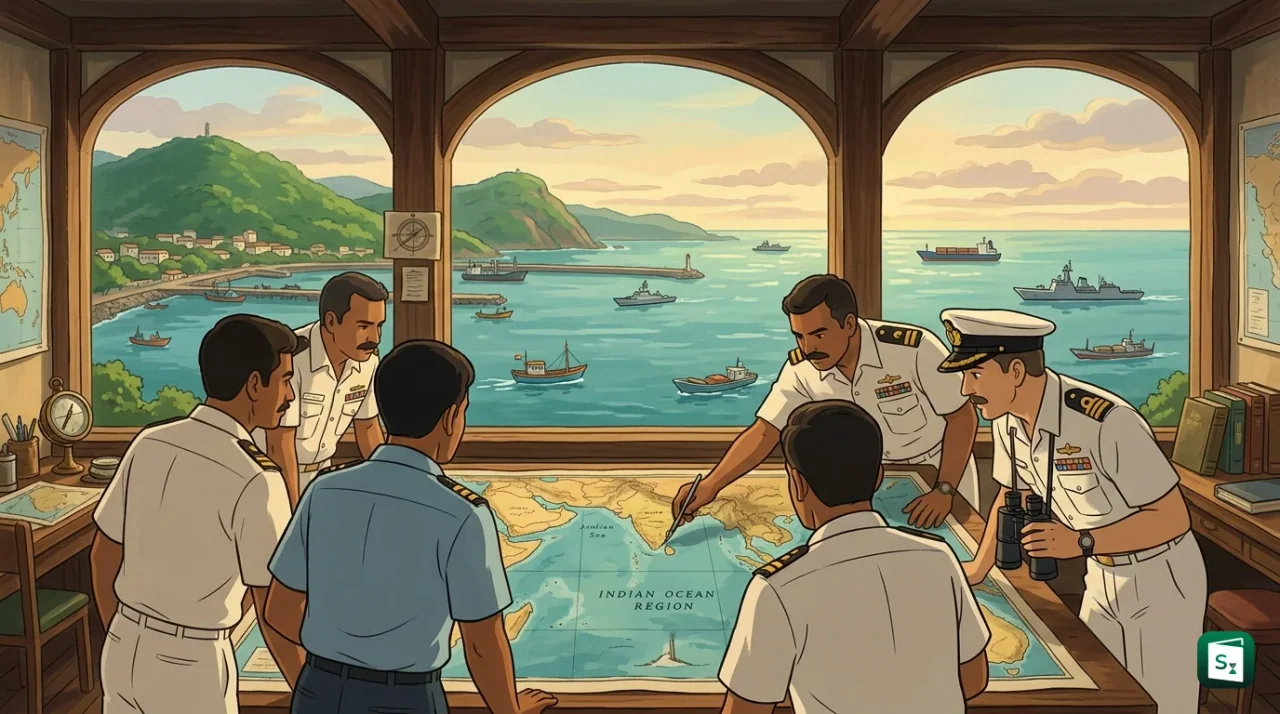
The three-day Table Top Exercise under the Colombo Security Conclave concluded on 11 September 2026 at the Eastern Naval Command in Visakhapatnam, Andhra Pradesh. The exercise brought together delegations and maritime experts from member and observer nations to game coordinated responses to illegal activities at sea. Hosted by the Indian Navy, it focused on building shared procedures to secure the Indian Ocean Region.
What Is a Table Top Exercise?
A Table Top Exercise, often called a TTX, is a discussion based simulation where participants sit around a table and walk through a realistic scenario step by step without deploying ships, aircraft or field forces. The Colombo Security Conclave uses the TTX format to test decision making, coordination and legal procedures for maritime emergencies in a low cost, controlled classroom environment.
The TTX derives from military wargaming, a practice first systematised in Prussia in the early 19th century to train officers in course of action analysis. In the maritime context, a TTX presents a scenario, such as a vessel suspected of smuggling narcotics or engaged in illegal fishing, and then injects new information through facilitators. Teams drawn from navies, coast guards, and law enforcement must decide how to share intelligence, coordinate interdiction, and handle legal procedures, all through discussion rather than live action.
Unlike a field exercise or a full scale simulation that involves actual movement of assets, a TTX focuses on thinking, communication and process. There is no real action on the ground or at sea, which makes it inexpensive, independent of weather, and flexible enough to test almost any scenario. The TTX format can improve emergency preparedness by exposing gaps in Standard Operating Procedures, clarifying roles and responsibilities, and building habits of inter agency and multinational coordination before a real crisis occurs.
The Colombo Security Conclave TTX followed this model. Facilitators presented evolving illicit maritime scenarios, and delegations debated national mandates, regional information sharing, and operational handovers. The goal was to align policies and procedures so that a future real world response at sea is faster and more legally robust.
What Is the Colombo Security Conclave?
The Colombo Security Conclave is a sub regional maritime security grouping of Indian Ocean littoral and island states that coordinates action on maritime safety, terrorism, trafficking, cyber security and disaster relief. The Colombo Security Conclave operates at the level of National Security Advisers and is anchored by a permanent secretariat in Colombo, Sri Lanka.
When Was the Colombo Security Conclave Started and How Has It Evolved?
The roots of the Colombo Security Conclave lie in the Trilateral NSA Meeting on Maritime Security launched in 2011 by India, Sri Lanka and Maldives. The initiative, proposed by Sri Lanka, aimed to address shared vulnerabilities in Indian Ocean waters. After a period of dormancy between 2014 and 2020 caused by political shifts in the region, the mechanism was revived and rebranded as the Colombo Security Conclave in 2020.
Institutional growth accelerated after the revival. Mauritius joined as the fourth full member at the fifth NSA level meeting in Male in March 2022. Bangladesh became the fifth member in 2024, welcomed at the Deputy NSA level meeting hosted by Mauritius. In August 2024, the founding members signed a Charter and a Memorandum of Understanding to establish the CSC Secretariat in Colombo. On 19 April 2026, India announced the upgradation of the CSC into a more formal international organisation, with a headquarters agreement being finalised and the first Secretary General expected to be an Indian national, reportedly a former Vice Chief of the Indian Navy.
| Year | Milestone |
|---|---|
| 2011 | Trilateral NSA dialogue on maritime security begins with India, Sri Lanka and Maldives |
| 2014 to 2020 | Mechanism remains dormant due to strained bilateral ties |
| 2020 | Revival and renaming as Colombo Security Conclave |
| 2022 | Mauritius becomes fourth member |
| 2024 | Charter and MoU for CSC Secretariat signed in Colombo, Bangladesh joins as fifth member |
| 2025 | Seventh NSA level meeting in New Delhi welcomes Seychelles as sixth full member |
| 2026 | Announcement of upgradation to formal international organisation |
How Many Members Are in the Colombo Security Conclave?
The Colombo Security Conclave currently has six full members. India is a founding member and the largest partner in the grouping, so the answer to whether India is a member is yes. Seychelles, earlier an observer, acceded as a full member in late 2025, so Seychelles is now a full member. Bangladesh, earlier an observer alongside Seychelles, became a full member in 2024. The grouping also engages additional partners as observers when needed.
| Status | Countries |
|---|---|
| Founding members (2011) | India, Sri Lanka, Maldives |
| Later full members | Mauritius (2022), Bangladesh (2024), Seychelles (2025) |
| Secretariat | Colombo, Sri Lanka, established through Charter and MoU signed August 2024 |
Five Pillars of Cooperation
The Colombo Security Conclave organizes its work around five thematic pillars, adopted formally in March 2022, which provide a common framework for capacity building, information exchange and joint exercises.
| Pillar | Focus Area |
|---|---|
| 1 | Maritime Safety and Security |
| 2 | Countering Terrorism and Radicalisation |
| 3 | Combating Trafficking and Transnational Organised Crime |
| 4 | Cyber Security and Protection of Critical Infrastructure and Technology |
| 5 | Humanitarian Assistance and Disaster Relief |
These pillars distinguish the Colombo Security Conclave from purely naval forums such as the Indian Ocean Naval Symposium, which was launched by India in 2008, or the Indian Ocean Rim Association. The Colombo Security Conclave is deliberately narrow, operational and centred on India’s immediate maritime neighbourhood, complementing India’s wider vision of SAGAR, or Security and Growth for All in the Region, launched in 2015, and its expanded form MAHASAGAR, or Mutual and Holistic Advancement for Security and Growth Across Regions, articulated in 2025.
Eastern Naval Command at Visakhapatnam: India’s Eastern Maritime Hub
The Eastern Naval Command is one of three command level formations of the Indian Navy and is headquartered at Visakhapatnam on the east coast of Andhra Pradesh. The Eastern Naval Command is responsible for all naval forces in the Bay of Bengal, parts of the Indian Ocean and naval establishments along India’s eastern seaboard.
Where Is the Eastern Naval Command Located?
The Eastern Naval Command has its headquarters at Visakhapatnam, Andhra Pradesh, centred on INS Circars and the naval dockyard complex. The command was formally established on 1 March 1968 and is headed by a Flag Officer Commanding in Chief of the rank of Vice Admiral. As of late 2025, Vice Admiral Sanjay Bhalla is the Flag Officer Commanding in Chief, Eastern Naval Command.
The Eastern Naval Command is one of three Indian Navy commands, alongside the Western Naval Command at Mumbai and the Southern Naval Command at Kochi. A fourth tri service command exists at Andaman and Nicobar Islands at Port Blair. The Eastern Naval Command controls the Eastern Fleet, submarine squadrons under Commodore Commanding Submarines (East), naval air squadrons at INS Dega in Visakhapatnam and INS Rajali at Arakkonam, and a network of shore establishments.
Visakhapatnam Naval Base and Visakhapatnam Naval Dockyard
Visakhapatnam is the principal base of the Eastern Naval Command and its most strategic asset on the east coast. The city’s natural harbour, industrial base and proximity to the Bay of Bengal made it the logical choice for the headquarters when the naval planners selected it in 1968. The base traces its origins to HMIS Circars, commissioned on 12 December 1939 during British rule, later expanded with an ordnance depot after the Japanese bombardment in 1942.
Today, the Visakhapatnam Naval Base houses the headquarters of the Eastern Naval Command, the Visakhapatnam Naval Dockyard, submarine bases INS Virbahu, commissioned on 19 May 1971, and INS Satavahana, commissioned on 21 December 1974 as the submarine training centre, and the air station INS Dega. The dockyard supports surface ships, submarines including Arihant class nuclear powered units, and fleet maintenance. Due to congestion and commercial traffic, a new dedicated naval base INS Varsha spread over about 20 square kilometres is being developed about 50 kilometres south of Visakhapatnam for exclusive naval use.
The command’s operational footprint stretches from West Bengal and Odisha to Tamil Nadu and the Andaman and Nicobar chain, with forward assets at Kolkata, Paradip, Chennai, Tuticorin and Kakinada. This geography places Visakhapatnam opposite the sea lanes that converge on the Strait of Malacca and Sunda Strait, through which a major share of India’s trade and energy flows move. The Eastern Naval Command therefore functions as the operational core of India’s Act East policy and as a hub for humanitarian assistance, joint exercises such as MILAN, and regional groupings including the Indian Ocean Naval Symposium and the Colombo Security Conclave.
Table Top Exercise at Visakhapatnam: Coordinated Response to Illegal Maritime Activities
The Colombo Security Conclave Table Top Exercise at Visakhapatnam ran for three days from 9 to 11 September 2026 and successfully culminated at the Eastern Naval Command. The exercise was opened on 9 September by Rear Admiral Manoj Jha, Chief Staff Officer (Operations), Eastern Naval Command. Some reports place the formal conclusion on 12 September, but the official Press Information Bureau release records the culmination on 11 September.
The theme for this edition was Coordinated Response to Illicit Maritime Activities in the Indian Ocean Region. Over more than 72 hours, delegations and maritime security experts from Colombo Security Conclave member states and observer nations worked through intensive simulated operational scenarios. Unlike a live exercise at sea, the TTX used a classroom based war gaming environment to test procedures without deploying ships.
| Scenario Theme | Nature of Illicit Activity Simulated |
|---|---|
| Maritime terrorism | Use of sea routes for movement of operatives and material |
| Narcotics smuggling | Trafficking of drugs via fishing and merchant vessels, notably synthetic drugs such as methamphetamine from regional routes |
| Human trafficking and irregular migration | Trafficking and smuggling of persons across maritime borders |
| Illegal, Unreported and Unregulated (IUU) fishing | Foreign vessels operating unlawfully in Exclusive Economic Zones, often as cover for other crimes |
Participants reviewed existing Standard Operating Procedures for joint action and streamlined information sharing arrangements to enhance collective Maritime Domain Awareness. Discussions covered real time sharing of intelligence, vessel tracking data from systems such as Automatic Identification System and Long Range Identification and Tracking, legal coordination for interdiction at sea, and coordination of distress alerts and maritime rescue mechanisms.
The Indian Navy hosted the exercise at the Maritime Warfare Centre framework of the Eastern Naval Command, building on earlier Colombo Security Conclave tabletop exercises such as the fourth such exercise organised by the Indian Coast Guard in Kolkata from 14 to 16 March 2023. The Visakhapatnam edition reaffirmed the resolve of Colombo Security Conclave nations to foster peace, stability and prosperity in the Indian Ocean and was explicitly aligned with the vision of MAHASAGAR. India’s role as a Preferred Security Partner and First Responder in the Indian Ocean, earlier described as Net Security Provider, was reinforced by hosting the exercise at Visakhapatnam and by linking coastal surveillance radars in partner nations to India’s information fusion architecture.
Why Maritime Security in the Indian Ocean Region Matters
What Is Maritime Security?
Maritime security is the protection of seas, shipping and coastal interests from threats such as piracy, armed robbery, terrorism, smuggling and illegal fishing while ensuring freedom of navigation and lawful use of the sea. The Eastern Naval Command TTX focused on this broader meaning, linking enforcement at sea with intelligence sharing, legal coordination and sustainable use of marine resources.
The Indian Ocean Region stretches from the east coast of Africa to the west coast of Australia and from the southern coast of Eurasia to the northern coast of Antarctica, and it contains some of the world’s busiest shipping lanes and largest Exclusive Economic Zones. The ocean carries about 80 per cent of the world’s sea borne oil and a large share of container traffic, and for India it carries almost 95 per cent of external trade by volume. Stability in this region is therefore directly linked to energy security, trade flows and livelihoods.
Illegal maritime activities undermine that stability in several connected ways. Illegal, Unreported and Unregulated fishing depletes fish stocks, harms marine ecosystems and threatens the income of coastal communities, and vessels engaged in such fishing are increasingly used as logistics platforms for narcotics trafficking, arms smuggling, human trafficking, forced labour and money laundering. Recent seizures illustrate the scale. In November 2024 the Indian Coast Guard intercepted a vessel near the Andaman and Nicobar Islands carrying about 6,000 kilograms of methamphetamine valued at about ₹36,000 crore, or about $4 billion, routed from Myanmar. Assessments by the Information Fusion Centre Indian Ocean Region, or IFC IOR, at Gurugram, which was established in 2018, regularly report interdictions of narcotics across the northern Arabian Sea and western Indian Ocean where fishing vessels are exploited by trafficking networks.
India has responded by investing in Maritime Domain Awareness through coastal surveillance infrastructure, satellite monitoring, the Information Management and Analysis Centre, White Shipping Agreements that exchange data on commercial vessels, and links with partner radars in Maldives, Sri Lanka, Mauritius and Seychelles. The Colombo Security Conclave TTX tested how such tools can be turned into faster joint action. By improving near real time intelligence exchange and harmonising legal procedures, member states reduce the governance gaps that allow criminal networks to operate across national jurisdictions with low risk of prosecution.
The Way Forward
The Visakhapatnam TTX points to the next phase of the Colombo Security Conclave, which is operationalisation rather than further expansion. The political framework is now largely in place with a Charter, a Colombo based secretariat and six full members. The priority ahead is to convert exercises into permanent habits of cooperation.
Concrete steps include formalising updated Standard Operating Procedures validated during the TTX, institutionalising faster information sharing between the Information Fusion Centre Indian Ocean Region and partner fusion centres such as the Regional Maritime Information Fusion Centre, and conducting regular TTXs and field exercises that include coast guards, fisheries authorities, customs and law enforcement, not only navies. Stable financing, dedicated working groups on terrorism, trafficking and cyber security, and shared capability programmes in hydrography, oceanography and maritime law will be needed to give the Conclave lasting operational depth.
India will need to balance deepening with widening. Reports suggest interest from additional Indian Ocean states, but the Conclave’s strength has been its limited membership, geographic proximity and high trust. Placing institutional depth before geographic widening will help preserve coherence while engaging other partners as observers. If implemented effectively, the upgraded Colombo Security Conclave can serve as the inner security ring of India’s MAHASAGAR vision, linking bilateral surveillance partnerships into a networked regional response system for the Indian Ocean.
Key Takeaways
- The Colombo Security Conclave Table Top Exercise concluded on 11 September 2026 at the Eastern Naval Command in Visakhapatnam after three days from 9 to 11 September 2026.
- The exercise was opened by Rear Admiral Manoj Jha, Chief Staff Officer (Operations), Eastern Naval Command, and focused on a Coordinated Response to Illicit Maritime Activities in the Indian Ocean Region.
- The Colombo Security Conclave was started as a trilateral NSA dialogue in 2011 by India, Sri Lanka and Maldives, revived as the Conclave in 2020, and now has six full members including Mauritius, Bangladesh and Seychelles.
- The Conclave’s permanent Secretariat in Colombo was formalised through a Charter and MoU signed in August 2024, and it works through five pillars, namely maritime safety and security, counter terrorism, trafficking and transnational crime, cyber security, and humanitarian assistance and disaster relief.
- The Eastern Naval Command is headquartered at Visakhapatnam, Andhra Pradesh, was established on 1 March 1968, and operates with the Visakhapatnam Naval Dockyard, submarine bases INS Virbahu and INS Satavahana, and air station INS Dega.
- The TTX reviewed Standard Operating Procedures and enhanced Maritime Domain Awareness through shared vessel tracking and linkage with the Information Fusion Centre Indian Ocean Region at Gurugram, aligning with India’s MAHASAGAR vision.