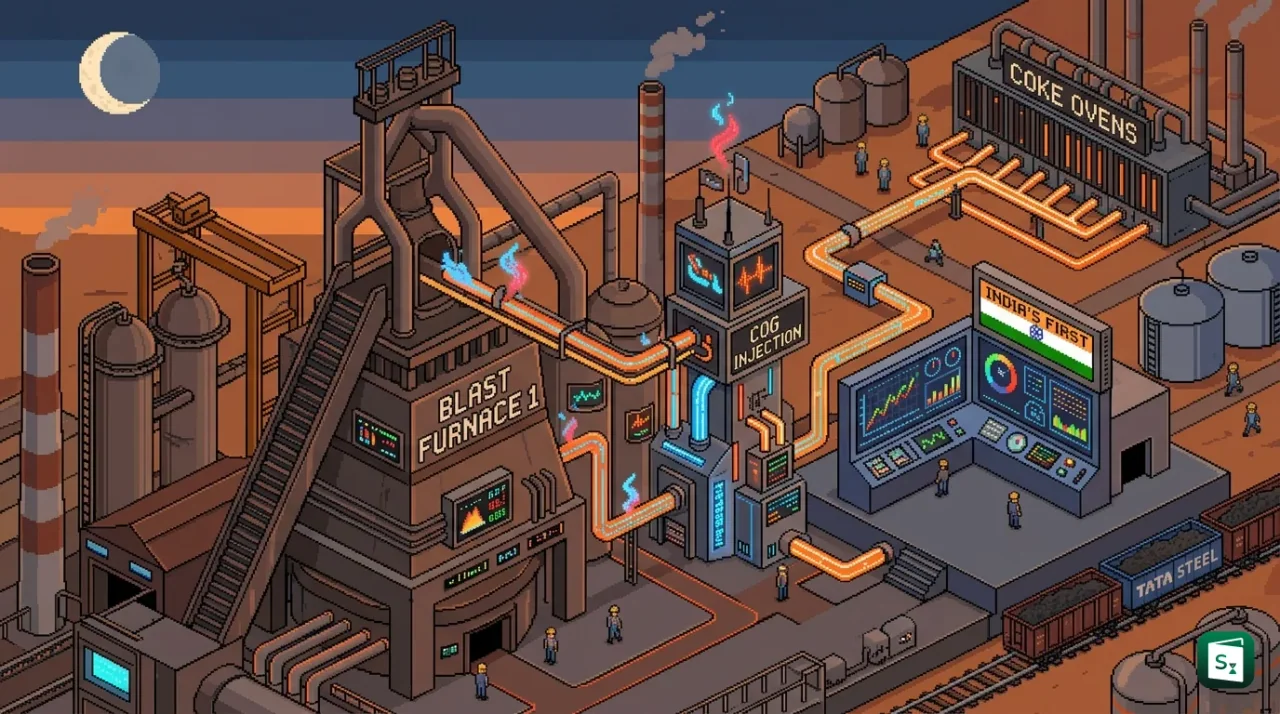
Tata Steel Ltd commissioned India’s first Coke Oven Gas injection project at Blast Furnace 1 of its Meramandali plant in Odisha on 10 September 2026. The project injects hydrogen-rich coke oven gas directly into the blast furnace through tuyeres, replacing part of the coke and coal used as fuel. It marks a new step in low-carbon ironmaking and supports Tata Steel’s target to achieve Net Zero by 2045.
What Did Tata Steel Commission at Meramandali?
Tata Steel Meramandali commissioned its Coke Oven Gas (COG) Injection Project at Blast Furnace 1 on 10 September 2026, a first of its kind in the Indian steel industry. The announcement was made from Mumbai and was described by Tata Steel as a breakthrough technology for low-carbon iron and steel production.
The core idea is simple and powerful. Tata Steel now injects COG, a hydrogen and hydrocarbon-rich by-product gas from coke making, directly into the blast furnace as a reductant and fuel. In an integrated steel plant, COG is usually used for power generation, heating, or is simply flared when supply exceeds demand. Tata Steel has now found a productive use for this surplus gas inside the furnace itself.
The project was implemented with technology partner Paul Wurth-SMS, part of the SMS group, and equipment supplier Kobelco. Tata Steel placed the order for this technology in 2024, and the system was designed to lower the blast furnace coke rate by using the chemical potential of COG. Company leaders Subodh Pandey, Vice President for Technology, R&D, NMB and Graphene, and Sudhir Kumar Mehta, Vice President for Operations at Tata Steel Meramandali, said the initiative shows how maximising the use of process gases can cut dependence on external fossil fuels while making operations leaner and cleaner.
Where Is Meramandali and What Is the Plant’s Scale?
Tata Steel Meramandali is located at Narendrapur, Shibapur, Meramandali in Dhenkanal district of Odisha, about 60 kilometres from Angul and around 120 kilometres from Bhubaneswar. The plant was originally built as Bhushan Steel and was acquired by Tata Steel through the Corporate Insolvency Resolution Process in 2018. It was later renamed Tata Steel BSL and amalgamated with Tata Steel Ltd in FY 2021-22.
Meramandali is today one of India’s largest flat steel production plants, with an annual crude steel capacity of about 5.6 million tonnes per annum (MTPA). Tata Steel has reported plans to expand this capacity to about 7.1 MTPA as part of its growth in Odisha. In the wider Tata Steel group, crude steel capacity stands at 36 MTPA globally and about 21.6 MTPA in India, spread across Jamshedpur and Gamharia in Jharkhand and Kalinganagar and Meramandali in Odisha. The group recorded a consolidated turnover of about $26 billion in FY 2025-26 and employs more than 77,000 people across five continents. The plant falls under the oversight of Tata Steel’s integrated operations, with corporate headquarters of Tata Steel Ltd in Mumbai and the historic base of the Tata group at Jamshedpur, founded in 1907.
Tata Steel Meramandali holds ResponsibleSteel certification, and more than 90% of Tata Steel’s steel production in India now comes from ResponsibleSteel certified sites, including Jamshedpur and Kalinganagar. This background helps explain why Meramandali was chosen as the pilot site for a breakthrough decarbonisation project that can later be scaled to Jamshedpur and Kalinganagar.
What Is Coke Oven Gas and How Does Injection Work?
What is coke oven gas? Coke oven gas (COG) is a hydrogen and hydrocarbon-rich by-product gas released when coking coal is heated at around 1,000 to 1,100 degrees Celsius in the absence of air to make coke. Tata Steel’s COG typically contains about 55 to 60 percent hydrogen, 25 to 30 percent methane, plus carbon monoxide and other hydrocarbons, with a calorific value of about 4,200 to 4,500 kcal per cubic metre.
In Tata Steel’s new system at Meramandali, Tata Steel cleans COG to remove impurities like tar, ammonia, naphthalene and sulphur, compresses it to about 8 bar in a two-stage screw compressor, and transports it through a main pipe to a distributor near the blast furnace. The gas is then split into smaller lances and injected through the 29 tuyeres, the hot-blast nozzles at the base of the furnace. Each kilogram of COG can substitute about 0.65 kg of coke or 0.78 kg of coal, while hydrogen in the gas also helps remove oxygen from iron ore more efficiently.
What Is a Blast Furnace?
What is a blast furnace? A blast furnace is a tall, refractory-lined shaft furnace, typically 30 to 35 metres high, that reduces iron ore to liquid hot metal at about 1,500 degrees Celsius. Tata Steel’s blast furnaces use iron ore, coke and limestone from the top while hot air at 1,150 to 1,300 degrees Celsius is blown in from tuyeres at the bottom to drive chemical reduction.
The Tata Steel Meramandali furnace produces hot metal containing about 94 percent iron and 4 percent carbon, which is then converted to steel in a Basic Oxygen Furnace. Modern furnaces run continuously for 10 to 15 years between relines and produce 8,000 to 12,000 tonnes per day while consuming 300 to 330 kg of coke per tonne of hot metal. Injection of auxiliary fuels like pulverised coal, natural gas and now COG through tuyeres reduces this coke rate and lowers emissions.
What Is a Coke Oven Plant?
What is a coke oven plant? A coke oven plant is a battery of ovens that converts coking coal into metallurgical coke for ironmaking by heating coal without air. Tata Steel’s coke oven plants also recover by-products such as coke oven gas, coal tar, benzene and ammonia, and produce 0.4 to 1.5 MTPA of coke along with 30 to 40 kg of chemicals per tonne of coke.
In India, coke oven plants are a core part of the integrated BF-BOF route, which accounts for about 70 percent of global steel output. Tata Steel operates coke plants at Jamshedpur, Kalinganagar and Meramandali. Up to 75 percent of the coal energy in an integrated plant is used in the blast furnace, while the remaining 25 percent fuels sinter and coking plants and supplies co-product gases for downstream heating and power generation.
Why Is COG Injection Significant for Sustainable Steelmaking?
Tata Steel’s COG injection project matters because it tackles the most carbon-intensive step in steelmaking without building a completely new plant. Ironmaking in a blast furnace relies on carbon to strip oxygen from iron ore, which inevitably releases carbon dioxide. Any reduction in coke and coal use therefore directly cuts emissions.
The project delivers three clear gains. First, lower fossil fuel consumption. By using COG as a partial substitute for coke and pulverised coal, Tata Steel reduces the need to buy and burn external fossil fuels. Second, lower CO2 emissions. The hydrogen in COG acts as a reductant, so less carbon is needed per tonne of hot metal. Experience from Japan’s COURSE50 project at Nippon Steel’s Kimitsu works shows that injecting 190 normal cubic metres of COG per tonne of hot metal can achieve about 5.7 percent carbon reduction, while ArcelorMittal’s Gijon plant in Spain has demonstrated similar savings by co-injecting COG with coal.
Third, better energy use and less flaring. In many plants, surplus COG that cannot be used for heating or power is flared, which wastes energy and still emits CO2. Tata Steel’s project turns this waste gas into useful heat and chemical energy inside the furnace. The blast furnace gas that leaves the top of the furnace also becomes richer in hydrogen, which raises its calorific value. This extra energy can then replace natural gas in reheating furnaces or generate electricity, creating both Scope 1 and Scope 2 emission cuts.
How Does the Three-Fuel System and Technology Work?
Tata Steel Meramandali’s system is notable because it allows Blast Furnace 1 to operate with a three-fuel injection system. In addition to the existing coke and pulverised coal injection (PCI), Tata Steel now adds COG injection as a third fuel stream through the same tuyeres but via dedicated lances.
Tata Steel found that injecting COG alongside coal does not harm coal combustion, as oxygen is managed carefully and combustion simulations support stable co-injection. Tata Steel compresses the gas and injects it at controlled flow rates using two parallel valves that respond to furnace pressure and pressure losses in the circuit. The gas is kept within a specific temperature range to avoid clogging or corrosion from compounds that can form if the gas cools or overheats.
The technology comes from Paul Wurth-SMS, a leading ironmaking technology provider within the SMS group that has equipped more than 80 blast furnaces worldwide with advanced PCI systems and now offers COG injection. Kobelco (Kobe Steel) supplied key equipment for the installation. Tata Steel’s own R&D teams worked with these partners to adapt the system for safe and stable operation in Indian conditions, where high ambient temperatures and dust levels add to operating challenges.
For Tata Steel, Tata Steel’s contract history shows the order was placed in 2024, and the detailed design focused on reducing naphthalene, ammonia and sulphur before injection and on storing gas in a gasholder when furnace demand varies. This flexibility helps match gas production from coke ovens, which is continuous, with blast furnace consumption, which fluctuates.
How Does This Fit Into Tata Steel’s Net Zero Roadmap?
Tata Steel has committed to achieving Net Zero emissions by 2045 across its operations in India, Europe and Thailand, an early target for a large global steelmaker and aligned with the 1.5 degrees Celsius trajectory of the Paris Agreement. Tata Steel Meramandali’s COG project is part of a phased decarbonisation plan that stretches to 2045.
Tata Steel’s strategy up to 2030 focuses on cutting coal use by switching to lower-carbon fuels such as biochar, natural gas and coke oven gas, increasing scrap use, raising renewable electricity share and improving energy efficiency. Beyond 2030, Tata Steel plans larger shifts including greater use of Direct Reduced Iron (DRI) with hydrogen or natural gas, more Electric Arc Furnace (EAF) capacity, and pilots for Carbon Capture, Utilisation and Storage (CCUS) and hydrogen-based steelmaking.
The Meramandali COG project follows a series of pioneering trials. Tata Steel has already demonstrated:
| Technology Trial | Location | Key Details |
|---|---|---|
| Coal-bed methane injection | Jamshedpur and Meramandali blast furnaces | Tested use of methane-rich gas as tuyere injectant |
| Hydrogen injection | Jamshedpur | Injected hydrogen gas to reduce coke rate |
| Biochar injection | Jamshedpur, starting January 2023 | Replaced about 30,000 tonnes of fossil coal with biomass-based charcoal, with potential to cut more than 50,000 tonnes of CO2 annually |
| Coke oven gas injection | Meramandali Blast Furnace 1, September 2026 | First in India, three-fuel operation with hydrogen-rich COG |
Tata Steel is also building a 0.75 MTPA scrap-based EAF plant at Ludhiana in Punjab, runs a steel scrap recycling plant at Rohtak, and is transitioning its Port Talbot plant in the UK to a 3.2 MTPA EAF by 2027 to cut 50 million tonnes of CO2 over a decade. In the Netherlands, Tata Steel Nederland plans to replace blast furnaces with DRI and EAF technology in two phases. These steps show that Tata Steel sees COG injection not as a final solution, but as a bridge technology that delivers immediate emission cuts while deeper transformation is built.
How Does a Blast Furnace Compare With an Electric Arc Furnace?
India uses both blast furnaces and electric furnaces for steelmaking, and the comparison helps explain why blast furnace innovations still matter.
| Feature | Blast Furnace with Basic Oxygen Furnace (BF-BOF) | Electric Arc Furnace (EAF) |
|---|---|---|
| Raw material | Iron ore, coke, limestone, plus sinter | Largely steel scrap and Direct Reduced Iron (DRI) |
| Fuel and energy | About 89 percent coal, 7 percent electricity, 3 percent natural gas; co-product gases provide more than 60 percent of plant energy | Electricity from graphite electrodes reaching 3,000 degrees Celsius; can use natural gas or hydrogen for DRI |
| Typical scale | 8,000 to 12,000 tonnes per day per furnace; 150 to 350 tonnes per heat in BOF | 100 to 400 tonnes per heat; 45 to 90 minutes per heat; induction furnaces in India often less than 20 tonnes |
| Carbon footprint | Higher, due to carbon-based reduction; needs coke ovens and sinter plants | Lower if powered by scrap and renewable electricity; favoured for decarbonisation |
| India’s share | Around 43 percent of production in 2016 was through BF-BOF, rest through electric routes; India is the world’s largest DRI producer using coal-based DRI | About 57 percent of India’s steel in 2016 was via electric routes, with nearly half of that from induction furnaces |
Tata Steel operates both routes. Tata Steel runs large BF-BOF complexes at Jamshedpur, Kalinganagar and Meramandali, while Tata Steel also operates EAFs in Thailand, is building new EAFs in India and is converting UK operations to EAF. The Meramandali COG project strengthens the BF-BOF route by making it cleaner, while EAF expansion builds the longer-term, low-carbon pathway.
Coke Oven Gas vs Blast Furnace Gas
Tata Steel’s plants generate two distinct by-product gases. Coke oven gas is rich in hydrogen and methane, with high calorific value (about 4,200 kcal per cubic metre), while blast furnace gas is lean, rich in carbon monoxide and nitrogen, with low calorific value (about 700 to 900 kcal per cubic metre). Tata Steel uses COG for its high hydrogen content as a reductant, while blast furnace gas, after dust cleaning to less than 0.05 grams per cubic metre, is typically used for power generation or in stoves. The new project raises the hydrogen and energy content of the outgoing blast furnace gas, improving its reuse value.
Key Takeaways
- Tata Steel commissioned India’s first Coke Oven Gas Injection Project at Blast Furnace 1 of its Meramandali plant in Dhenkanal district, Odisha on 10 September 2026.
- The project injects hydrogen-rich COG through blast furnace tuyeres, substituting coke and coal and enabling a three-fuel system alongside pulverised coal injection.
- Technology partner was Paul Wurth-SMS (SMS group) and equipment supplier was Kobelco, with the order placed in 2024.
- Tata Steel Meramandali has a capacity of about 5.6 MTPA (expanding to 7.1 MTPA) and was originally Bhushan Steel, acquired by Tata Steel in 2018.
- The initiative supports Tata Steel’s group target of Net Zero by 2045, and follows earlier trials of coal-bed methane, hydrogen and biochar injection in blast furnaces.
- Tata Steel group has a global crude steel capacity of 36 MTPA, with about 21.6 MTPA in India, and is headquartered in Mumbai, with its flagship plant at Jamshedpur founded in 1907.