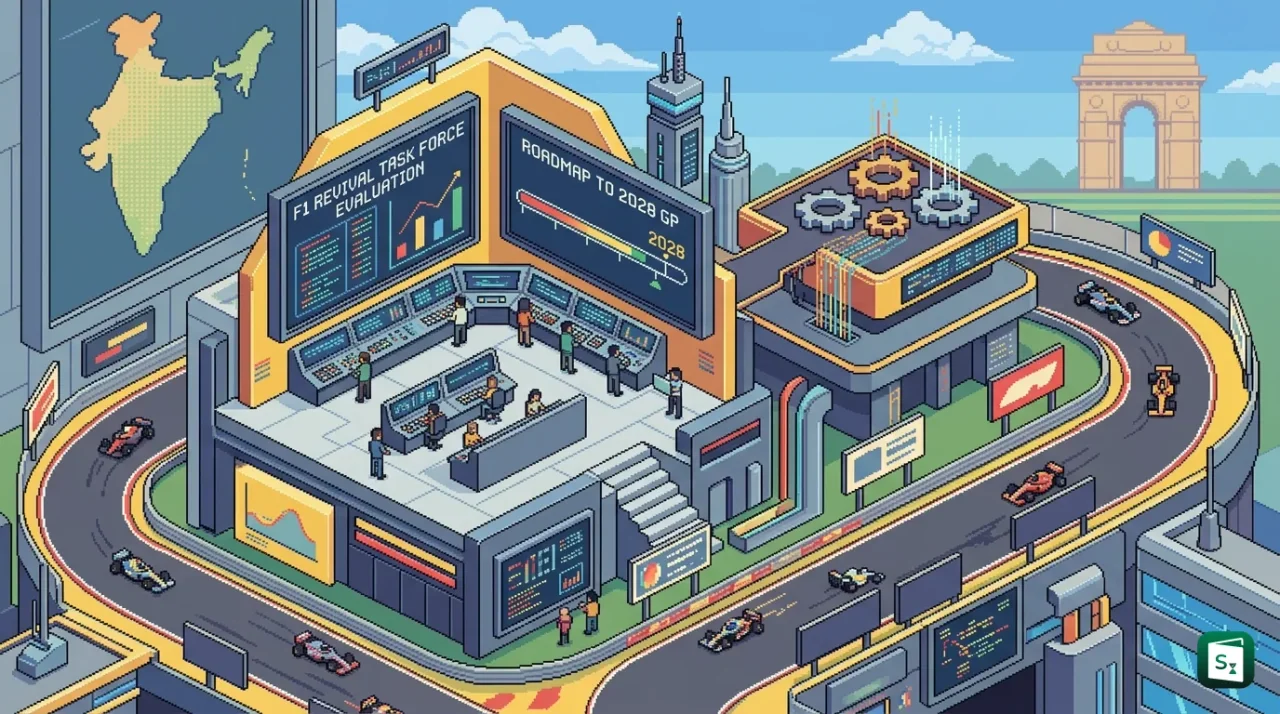
Union Minister for Youth Affairs and Sports Dr. Mansukh Mandaviya on 15 September 2026 announced a 10-member Task Force to assess the revival of Formula 1 in India, chaired by Yugal Kishore Joshi, Programme Director and Adviser at NITI Aayog. The panel will prepare a holistic roadmap to host an Indian Grand Prix in 2028 at the Buddh International Circuit in Greater Noida and to drive sustainable growth of motorsports nationally. The move comes 13 years after India last hosted an F1 race in 2013 and signals a fresh push to resolve taxation, infrastructure and policy hurdles that forced the sport out.
Is F1 Coming Back to India in 2028?
The Government of India is actively exploring the return of Formula 1 in 2028, and the newly formed 10-member Task Force chaired by Yugal Kishore Joshi of NITI Aayog will decide if it is feasible. The Task Force will prepare a detailed roadmap for hosting an Indian Grand Prix in 2028 at Buddh International Circuit and submit recommendations on policy, infrastructure, funding and taxation to the Ministry of Youth Affairs and Sports.
The announcement was made on 15 September 2026 in New Delhi. The Ministry of Youth Affairs and Sports said the panel will not only look at a single race but at the entire motorsports ecosystem. Early indications in June 2026 had pointed to a 2028 target after an initial idea of 2027 was pushed back to allow more time for policy reform and circuit preparation.
Will F1 return to India depends on three factors now under the Task Force’s review. First, the commercial agreement with Formula One Management (FOM), the commercial rights holder owned by Liberty Media, which charges hosting fees. Second, government support on taxation and customs duties. Third, readiness of the Buddh International Circuit to meet current Fédération Internationale de l’Automobile (FIA) Grade 1 homologation standards after limited use since 2013. Formula 1 President Stefano Domenicali has publicly said there is strong interest in India but stressed the need for the right promoter, collaboration and timing, suggesting a 2028 window is realistic if reforms move quickly.
Search interest in F1 India 2028 has surged by 100 percent year on year and peaked in July 2026, the traditional window for calendar speculation, reflecting growing public anticipation around the Task Force announcement.
What Is Formula 1 Racing and How Does It Work?
Formula 1 racing is the highest class of international single-seater motor racing, governed by the Fédération Internationale de l’Automobile (FIA) and commercially managed by Formula One Management under Liberty Media since 2017. The FIA Formula One World Championship features 10 teams and 20 drivers competing in around 24 Grand Prix races each season for Drivers’ and Constructors’ titles, with points awarded to the top 10 finishers and additional points in Sprint events.
A Grand Prix weekend now spans three days. In a standard weekend, there are three free practice sessions, a three-stage knockout qualifying (Q1, Q2, Q3) to set the grid, and a race on Sunday of about 305 km. In a Sprint weekend, introduced in 2021 and expanded to six events, Friday has one practice and Sprint Qualifying (SQ1, SQ2, SQ3), Saturday has the 100 km Sprint that awards points to the top eight (8 points for first down to 1 for eighth) and Grand Prix qualifying, and Sunday hosts the main race. The Sprint result does not decide the Grand Prix pole, Friday qualifying does.
Key technical ideas are simple to grasp. DRS or Drag Reduction System is a movable flap on the rear wing that drivers can open on designated straights when within one second of the car ahead, cutting air drag and boosting speed to help overtaking. Concorde Agreement is the confidential commercial contract between FIA, FOM and teams that governs prize money sharing. Points are awarded as 25-18-15-12-10-8-6-4-2-1 for places 1 to 10, plus fastest lap point if in top 10 and Sprint points.
The 2026 generation of Formula 1 cars uses 1.6 litre V6 turbo hybrid Power Units that then split power almost equally between combustion and electric energy, running on fully sustainable fuels, a core part of Formula 1’s sustainability push. For 2027 and 2028, the FIA has approved a phased rebalance toward more combustion power to make qualifying flat out again, with the internal combustion output rising from 400 kW to 420 kW in 2027 and 450 kW in 2028 while electric deployment falls, shifting the split from near 50:50 toward 60:40 by 2028.
How F1 Qualifying Works
F1 qualifying is a three-stage knockout session held on Saturday, or Friday in Sprint weekends, that decides the starting order for the Grand Prix. In Q1 (18 minutes) the five slowest cars are eliminated and placed 16 to 20, in Q2 (15 minutes) another five are eliminated for positions 11 to 15, and in Q3 (12 minutes) the remaining 10 fight for pole position. Drivers must respect parc ferme rules that limit car changes after qualifying, and lap times are set on low fuel and soft tyres for maximum performance.
History of the Indian Grand Prix: Three Seasons and Why F1 Left India
The Indian Grand Prix was held at the Buddh International Circuit (BIC) in Greater Noida, Uttar Pradesh, from 2011 to 2013 under a five-year contract between Jaypee Sports International Limited (JPSI) and Formula One Management. The inaugural race on 30 October 2011 was won by Sebastian Vettel of Red Bull Racing, who went on to win all three editions. The circuit was celebrated globally for its fast, flowing layout and elevation changes, and the 2011 debut drew a large crowd and international praise.
| Year | Winner | Team | Pole Position | Circuit |
|---|---|---|---|---|
| 2011 | Sebastian Vettel | Red Bull Racing Renault | Sebastian Vettel | Buddh International Circuit |
| 2012 | Sebastian Vettel | Red Bull Racing Renault | Sebastian Vettel | Buddh International Circuit |
| 2013 | Sebastian Vettel | Red Bull Racing Renault | Sebastian Vettel | Buddh International Circuit |
The 2013 race on 27 October 2013 was the last. Vettel also set the official race lap record of 1:27.249 in 2011.
Why Did F1 Stop in India?
Why F1 left India is explained by a mix of taxation and financial disputes rather than sporting quality. The Government of Uttar Pradesh classified Formula 1 as entertainment, not sport, and levied high entertainment taxes and luxury taxes, while central authorities imposed heavy customs duties on imported equipment and engines. This classification denied promoters tax breaks available to other sports, adding tens of millions of dollars in costs.
Promoter Jaypee Sports International had invested an estimated $400 million to build the circuit and paid annual hosting fees of between $20 million and $60 million to Formula 1, without government funding support that hosts in many other countries receive. When the FIA initially scheduled a gap year in 2014 with a return in 2015, negotiations failed to resolve the tax burden and bureaucratic hurdles. The 2015 and 2016 planned returns were cancelled, and India dropped off the calendar. Related questions such as why F1 was banned in India, why F1 was cancelled in India, and when F1 left India all point to this same 2013 to 2014 exit window driven by policy classification, not a sporting ban.
Buddh International Circuit: India’s Only Grade 1 F1 Track
The Buddh International Circuit remains India’s flagship F1 venue and its only circuit with FIA Grade 1 homologation, the mandatory certification to host a Formula One Grand Prix, along with FIM Grade A for motorcycle racing.
| Feature | Detail |
|---|---|
| Location | Jaypee Sports City, Sector 25, Yamuna Expressway, Greater Noida, Gautam Buddh Nagar, Uttar Pradesh |
| Opened | 18 October 2011 |
| Construction Cost | About ₹1,000 crore, about $400 million reported |
| Architect | Hermann Tilke, Germany’s most used F1 track designer |
| Length | 5.125 km (3.192 miles), 16 corners, clockwise, 13 m to 14 m elevation change, longest straight about 1.06 km |
| Capacity | About 110,000 spectators |
| Lap Record | 1:27.249 by Sebastian Vettel, Red Bull RB7, 2011 |
| Owner / Operator | Built by Jaypee Group through Jaypee Sports International; now associated with the Adani Group as new circuit owner linked to recent discussions |
| Certification | FIA Grade 1, re-homologation checks needed after years of limited international use |
The layout blends a long main straight into a dramatic uphill braking zone at Turn 1 to Turn 3, followed by the high-speed sequence of Turns 10 to 12 that drivers praised for its rhythm. The track has two DRS zones, wide run-off areas and a surface built with graywacke aggregate for consistent grip. Search interest in Buddh International Circuit peaked at 49,500 searches in February 2026, and terms such as buddh circuit f1 have grown more than 84 percent, reflecting renewed focus on the venue.
After Formula 1 left, the circuit hosted domestic championships, MotoGP Bharat in September 2023 which drew more than 100,000 fans over three days, and was slated to host MotoGP from 2025 to 2027 under a contract with Invest UP and Dorna Sports. However, the 2024 MotoGP race was cancelled due to weather and payment issues, the 2025 race was dropped for operational circumstances, and the provisional 2026 MotoGP calendar also omits India, leaving the BIC underutilised. Any F1 comeback thus requires fresh FIA inspection, updated paddock, media centre, safety fencing, and pit complex upgrades to meet 2028 technical and broadcast standards.
India’s other homologated tracks underline why BIC remains central. The Madras International Circuit in Chennai (3.717 km, FIA Grade 2), Kari Motor Speedway in Coimbatore (2.1 km, FIA Grade 3), and the street circuits in Hyderabad and Chennai illustrate a growing network, but none meet the Grade 1 standard needed for Formula 1. That makes revival of the BIC a national rather than state project.
Inside the 10-Member Task Force: Members, Mandate and Policy Roadmap
The 10-member Task Force was constituted by the Ministry of Youth Affairs and Sports under NITI Aayog Programme Director and Adviser Yugal Kishore Joshi as chair. Joint Secretary (Sports) Kunal is the second confirmed member. The full composition draws from across government, industry and sport.
| Role / Representation | Detail |
|---|---|
| Chair | Yugal Kishore Joshi, Programme Director and Adviser, NITI Aayog |
| Convener | Joint Secretary (Sports), Ministry of Youth Affairs and Sports (Kunal) |
| Central Ministries | Joint Secretaries from Ministry of Commerce and Industry and Ministry of Tourism |
| State Governments | Representatives from Uttar Pradesh and Maharashtra |
| Motorsport Regulator | President or Secretary General of Federation of Motor Sports Clubs of India (FMSCI) (incumbent President Arindam Ghosh, with elections due at the AGM) |
| Circuit Stakeholders | Representatives of Buddh International Circuit and Madras International Circuit, with Adani Group as new BIC owner at the table |
| Technical and Other Experts | One technical expert and representatives from tourism and related departments; three-month reporting timeline indicated in June, with full recommendations to shape policy by 2027 |
NITI Aayog, formed on 1 January 2015 as the successor to the Planning Commission and chaired by the Prime Minister, is headquartered in New Delhi. The FMSCI, founded in 1973 and headquartered in Chennai, is the national governing body for motor sports, recognised as the National Sports Federation. It is affiliated to the FIA since 1987 and to the FIM, and it governs two and four-wheeler championships in India.
What the Task Force Will Do
The Terms of Reference, as stated by Minister Mandaviya, are threefold. First, suggest comprehensive ways for sustainable growth of motorsports in India, including infrastructure and operational needs, grassroots centre development and talent pathways. Second, prepare a holistic coordinated roadmap for revival of Formula 1 so India can host a race in 2028, covering commercial terms, promoter models and circuit readiness. Third, carry out a detailed assessment of challenges that have blocked motorsports, especially taxation-related issues, and identify policy interventions, including possible Public-Private Partnership (PPP) models, customs relief, and reclassification of motorsport as sport rather than entertainment.
The panel will also evaluate international, economic, tourism and investment benefits of hosting major events, learn from the experience of MotoGP Bharat and Formula E in Hyderabad which exited after one race in 2023 when state support was withdrawn, and align recommendations with the broader push to place India among leading sporting nations by 2036.
Hosting a Grand Prix: Ticketing, Commercial Fees and Economic Benefits
Hosting a modern Formula 1 Grand Prix is a major commercial undertaking. Formula One Management charges promoters an annual hosting fee that industry estimates place between $20 million and $60 million, depending on race stature and market. Monaco, for context, pays about $20 million a year, the lowest on the 24-race calendar, while hosts such as Saudi Arabia and Bahrain pay more than $50 million. These fees, together with media rights and sponsorship income, form the bulk of Formula 1’s $3.9 billion revenue in 2025, of which hosting fees are a key share.
Costs extend beyond the fee. Promoters must fund logistics, FIA safety infrastructure, hospitality, freight, broadcasting facilities, and circuit upgrades. In India’s case, early estimates of BIC construction were about $240 million to $400 million, and recent assessments note that re-homologation, resurfacing, and expanded fan zones, paddock clubs and media centres will add further capital needs.
Revenue streams to offset costs are significant if managed well.
| Revenue / Impact Area | Why It Matters for India |
|---|---|
| Formula 1 tickets and hospitality | Global Formula 1 ticket searches peak at 135,000 in July, and Indian ticket price queries show strong demand; a 110,000 capacity BIC can generate large gate receipts |
| Tourism and city branding | A Grand Prix brings 100,000+ visitors over three days, as seen at MotoGP Bharat 2023, filling hotels, restaurants and transport along the Yamuna Expressway corridor |
| Broadcasting and streaming in India | Queries such as f1 on which channel in India, f1 streaming India, f1 tv india and f1 india how to watch show high digital viewership; Indian broadcast growth would raise media rights value |
| Sponsorship and investment | Exposure to 400 million global viewers in 2016 and over 6.75 million fan attendance in 2025 underlines brand value for Indian companies |
| Technology spillover | Hybrid power units and sustainable fuels developed for Formula 1 can feed into Indian automotive innovation |
The Task Force will examine whether a government-backed guarantee combined with a professional sports management company holding the circuit on a two to three year mandate, as the minister suggested to the Adani-owned BIC, can make the economics viable without over-reliance on public funds. The choice of Public-Private Partnership is seen as crucial after the Jaypee Group’s solo funding model proved unsustainable.
For fans, the practical question is formula 1 ticket price in India and ticket price in rupees. While no 2028 prices are set, the promoter will need to balance affordability for a price-sensitive market with the high fixed fee paid to Formula 1. Formula 1’s global average ticket pricing and tiered hospitality, from general admission to Paddock Club, will likely be adapted to Indian purchasing power to ensure sell-out crowds.
Indian Drivers and the Force India Legacy: Building a Talent Pipeline
A Formula 1 return would also reignite debate on India’s driver and team pipeline.
Narain Karthikeyan, born 14 January 1977 in Coimbatore, Tamil Nadu, remains India’s first Formula 1 driver, debuting at the 2005 Australian Grand Prix for Jordan Grand Prix and later driving for HRT in 2011 and 2012. He started 46 races and scored 5 championship points, with a best finish of fourth at the 2005 United States Grand Prix. Karun Chandhok, born in Chennai, raced for HRT and Lotus in 2010 and 2011.
The most visible Indian identity on the grid was the team Force India Formula One Team Limited, commonly known as Force India and later Sahara Force India. Formed in October 2007 when a consortium led by businessman Vijay Mallya and Michiel Mol bought the Spyker F1 team for €88 million, the team was based in Silverstone, United Kingdom, and raced with an Indian licence. Between 2008 and 2018, Force India scored no wins but secured a pole position and five podiums, peaking at fourth in the Constructors’ Championship in 2016 and 2017 with drivers Sergio Perez, Nico Hulkenberg and Esteban Ocon. Financial difficulties led to its sale in 2018, after which it became Racing Point and later Aston Martin F1.
| Team | Period | Base | Best Championship Finish | Notable Drivers |
|---|---|---|---|---|
| Force India / Sahara Force India | 2008 to 2018 | Silverstone, UK (Indian licence) | 4th in 2016, 2017 | Giancarlo Fisichella, Adrian Sutil, Paul di Resta, Nico Hulkenberg, Sergio Perez, Esteban Ocon |
At junior level, Jehan Daruvala, a winner of Force India’s One in a Billion talent hunt in 2011, became the first Indian to win a Formula 2 race at the 2020 Sakhir Grand Prix and later served as a reserve driver for Mahindra Racing before racing full-time in Formula E with Maserati MSG Racing. His journey illustrates the gap the Task Force seeks to close. The panel will recommend support for regional and grassroots motorsport centres, karting championships such as the JK Tyre FMSCI National Rotax Max Karting Championship, and feeder series to create a clearer path from Indian karting to global single-seaters.
The question formula 1 indian driver draws 6,600 searches a month, showing sustained public interest in when the next Indian will reach the grid. A home Grand Prix, paired with affordable streaming access and school-level karting, is seen as a catalyst for that talent pipeline.
The Global F1 Context: Calendar, Regulations and the 2028 Window
The FIA Formula One World Championship now runs 24 races across five continents, from March to November, with classic venues such as Monaco, Silverstone and Monza alongside newer hosts like Miami, Las Vegas and Jeddah. The 2026 calendar retained 24 events, and Liberty Media has expanded fan experiences through F1 TV, F1 Experiences and dedicated race promotion.
Formula 1’s commercial model is highly selective. With many countries bidding for slots, incumbents pay rising fees and must demonstrate strong governance, tourism appeal and broadcast reach. India must compete with proposals from Africa, Southeast Asia and new street circuits. The 2028 target therefore aligns with a natural contract renewal window rather than an immediate expansion.
Regulatory timing also matters. The 2026 regulations introduced fully sustainable fuels and a near 50:50 split between combustion and electric power. Driver feedback pointed to heavy energy management, prompting the FIA World Motor Sport Council in Macau on 23 June 2026 to ratify a phased rebalance. Internal combustion output rises to 420 kW in 2027 and 450 kW in 2028, electric deployment falls from 350 kW to 300 kW, and the effective power split moves to 58:42 in 2027 and 60:40 in 2028. Fuel energy flow rises by 5 percent then 13 percent, with larger energy harvesting limits. Pre-season testing will also grow from three to four days in 2027. These changes should deliver faster qualifying laps and reduce yo-yo racing, making the sport more attractive for a new Indian audience tuning in at prime time.
| Season | Power Split (Combustion : Electric) | Internal Combustion Max | MGU-K Max Deployment |
|---|---|---|---|
| 2026 | About 53:47 to 50:50 | 400 kW | 350 kW |
| 2027 | 58:42 | 420 kW | 300 kW |
| 2028 | 60:40 | 450 kW | 300 kW, harvesting up to 400 kW |
For India, the 2028 window offers three advantages. First, time to resolve the entertainment versus sport taxation anomaly through legislative clarity. Second, time to complete BIC upgrades, negotiate promoter terms, and align the race with India’s tourism season in late October, the slot that hosted all three earlier Indian Grands Prix. Third, time to secure a broadcast partner that can deliver free-to-air reach alongside paid streaming, answering frequent queries such as f1 on which channel in India and f1 race on which channel in India, currently served in India via FanCode and F1 TV.
The Way Forward for Sustainable Motorsports in India
The Task Force’s final report will shape more than a single Grand Prix. The Ministry of Youth Affairs and Sports has said special emphasis will be placed on sustainable, inclusive motorsports growth rather than a one-off spectacle.
To succeed, the panel must recommend clear actions. Reclassification of motorsport as sport under tax law would remove the entertainment tax and allow customs duty exemptions on imported hybrid power units, chassis and safety equipment. A single-window clearance for FIA homologation, visas for teams and freight movement, and environmental clearances would cut bureaucratic delays. A Public-Private Partnership where the circuit owner partners with an experienced international promoter, with viability gap funding linked to tourism targets, could share risk. Investment in Madras International Circuit and regional karting centres would spread opportunity beyond Greater Noida, ensuring the Uttar Pradesh and Maharashtra representation translates into wider state infrastructure.
Lessons from recent exits are instructive. Formula E’s Hyderabad E-Prix, launched in 2023, was dropped after one edition when state support was withdrawn, and MotoGP Bharat has been absent from the 2024, 2025 and even provisional 2026 calendars due to weather and operational funding gaps despite a three-year deal with the Uttar Pradesh government through 2027. Both cases underline that without a binding funding and governance framework, world-class tracks alone cannot retain championships.
If the Task Force delivers by mid-2027, as officials hope, the government could lock in a framework next year and present a commercial bid to Formula One Management for 2028. A successful Indian Grand Prix in 2028 would place India back among the select group of Asian hosts alongside Singapore, Japan, China and Bahrain, and would test whether policy reform plus private capital can revive motorsports for Indian fans, manufacturers and young drivers alike.
Key Takeaways
- The 10-member Task Force for F1 revival in India was announced on 15 September 2026 by Union Minister Dr. Mansukh Mandaviya of the Ministry of Youth Affairs and Sports.
- The Task Force is chaired by Yugal Kishore Joshi, Programme Director and Adviser at NITI Aayog, which was established on 1 January 2015 and is headquartered in New Delhi.
- The panel targets a roadmap to host an Indian Grand Prix in 2028 at the Buddh International Circuit in Greater Noida, Uttar Pradesh, and to ensure sustainable growth of motorsports.
- The Indian Grand Prix was held from 2011 to 2013 at the 5.125 km Buddh International Circuit designed by Hermann Tilke, with Sebastian Vettel winning all three races and setting the lap record of 1:27.249 in 2011.
- Formula 1 left India after 2013 due to classification of the sport as entertainment by the Uttar Pradesh government, leading to high entertainment tax and customs duties on imported equipment.
- The Buddh International Circuit holds FIA Grade 1 and FIM Grade A certification but requires fresh homologation and upgrades, while the FMSCI, founded in 1973 and headquartered in Chennai, is the national regulator affiliated to the FIA and FIM.