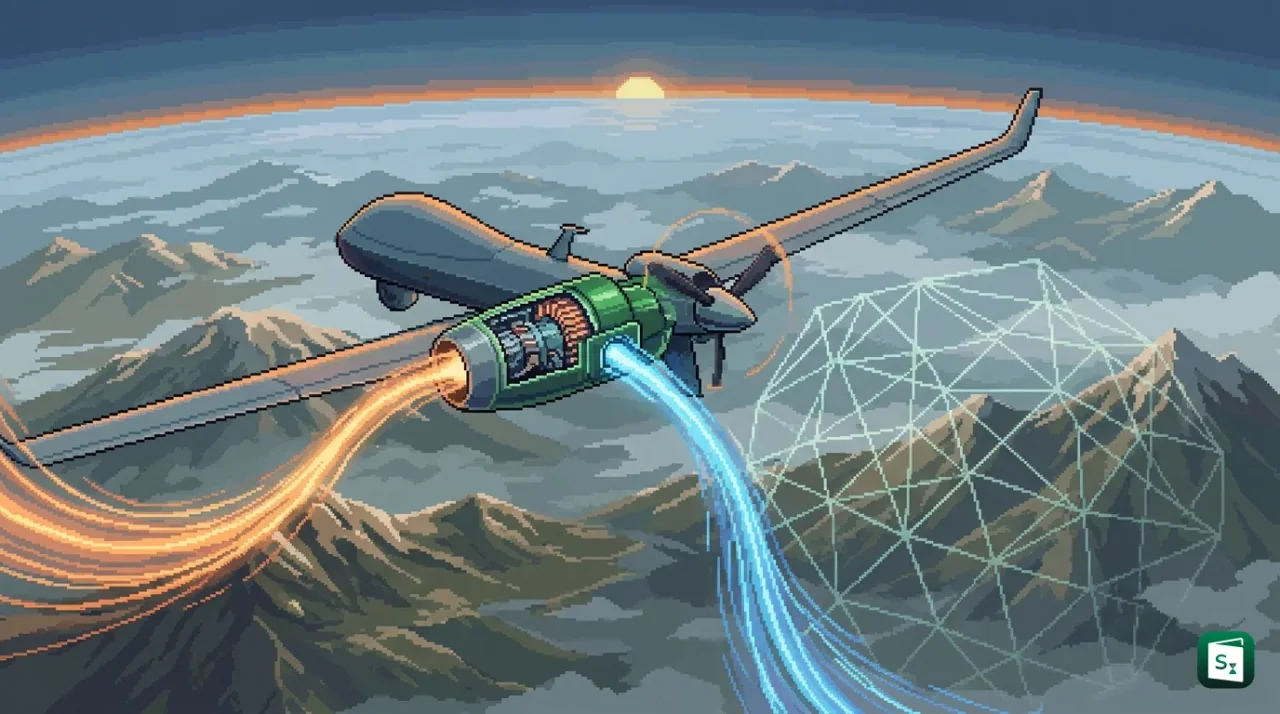
Bharat Forge Ltd and Pratt & Whitney Canada announced on 15 September 2026 that they will jointly assess the integration of advanced turboprop engines into the High Altitude Long Endurance Unmanned Aerial Vehicle being developed by the Defence Research and Development Organisation. Pratt & Whitney Canada will evaluate engine compatibility, performance and installation requirements while Bharat Forge will lead engine to airframe integration and systems interfaces. The collaboration supports India’s indigenous unmanned aerial systems push under the Aatmanirbhar Bharat initiative and aims to deliver a long endurance platform for surveillance across land and sea.
What Is a HALE UAV?
HALE UAV stands for High Altitude Long Endurance Unmanned Aerial Vehicle. An Unmanned Aerial Vehicle (UAV) is an aircraft that flies without a pilot on board and is controlled remotely or flies autonomously using onboard systems. A HALE class UAV is designed to operate at very high altitudes, generally above 15,000 metres or more than 45,000 feet, and to stay airborne for more than 24 hours at a stretch.
The long endurance allows a single HALE platform to monitor large areas, track movements, and relay communications for extended periods. Its high altitude gives it a wider field of view and keeps it above most weather systems and many surface to air threats. In military use, HALE UAVs are primarily assigned to Intelligence, Surveillance, Target Acquisition and Reconnaissance (ISTAR) roles, and they can also provide signals intelligence and battlefield monitoring.
How Does HALE Differ From MALE UAV?
MALE UAV stands for Medium Altitude Long Endurance Unmanned Aerial Vehicle. The distinction between MALE and HALE lies mainly in altitude and mission profile, with overlap in endurance.
| Feature | MALE UAV | HALE UAV |
|---|---|---|
| Full form | Medium Altitude Long Endurance | High Altitude Long Endurance |
| Operating altitude | About 3,000 to 9,000 metres (10,000 to 30,000 feet) | Above 9,100 metres, typically 15,000 to 18,000 metres (above 45,000 to 60,000 feet) |
| Endurance | 24 to 36 hours | More than 24 hours, often 25 to 40 hours, some solar variants can fly for weeks |
| Typical payload | 300 to 400 kg for platforms like TAPAS BH 201, also carries weapons on some models | 1,300 to 2,000 kg for strategic HALE platforms |
| Key Indian examples | TAPAS BH 201 (Rustom 2) developed by ADE, Archer NG | DRDO HALE UAV under development, Global Hawk and MQ 4C Triton internationally |
| Primary role | Tactical surveillance and armed reconnaissance at medium range | Strategic, long range surveillance and persistent monitoring over large land and maritime areas |
In simple terms, MALE UAVs cover medium altitudes for tactical tasks closer to the battlefield, while HALE UAVs fly much higher and longer to watch vast regions such as border areas and ocean zones.
What Is the DRDO HALE UAV Programme?
What is DRDO?
DRDO stands for Defence Research and Development Organisation. The Defence Research and Development Organisation is the research and development wing of the Ministry of Defence, Government of India, formed in 1958. From headquarters in New Delhi, it runs about 41 laboratories and five Young Scientist Laboratories to develop cutting edge defence technologies and achieve self reliance.
The HALE UAV programme is being led by the Aeronautical Development Establishment (ADE), a Bengaluru based laboratory of the Defence Research and Development Organisation. The Aeronautical Development Establishment was established in January 1959 at High Grounds, Bengaluru, and now functions at New Thippasandra, Bengaluru. It serves as the design house for unmanned aerial vehicles, flight simulators, target aircraft and flight control systems. Recent projects include Lakshya (aerial target), Nishant and TAPAS BH 201 (earlier Rustom 2), and the Archer NG. The current director is Shri Y. Dilip, who has held the post since 1 January 2022.
The HALE UAV being developed by the Defence Research and Development Organisation is a strategic platform meant for Intelligence, Surveillance, Target Acquisition and Reconnaissance (ISTAR) operations over land and maritime domains. The Aeronautical Development Establishment has informed the Parliamentary Standing Committee on Defence that the programme is advancing with two parallel configurations. One uses a turboprop engine and the other a turbofan engine, to meet different mission needs.
Key design targets reported for the turboprop variant are a 5 tonne class platform with a payload capacity of about 2 tonnes, an operating ceiling above 35,000 feet (with a growth goal above 40,000 feet), and endurance of more than 25 hours. The turbofan variant, which is of interest to the Indian Navy for maritime operations in the Indian Ocean Region, is designed for 50,000 feet and endurance beyond 24 hours, flying above many surface to air missile envelopes and allowing persistent watch over chokepoints such as the Malacca, Sunda and Lombok straits.
| Attribute | HALE UAV (Turboprop Configuration) | HALE UAV (Turbofan Configuration) |
|---|---|---|
| Lab and partner | Aeronautical Development Establishment with Hindustan Aeronautics Ltd as production partner | Aeronautical Development Establishment with Navy backed interest |
| Propulsion | TPE331 10 turboprop with about 940 horsepower, future class 1,000 to 1,200 horsepower | Turbofan likely derived from AL 55I or Kaveri derivative |
| Altitude | Above 35,000 feet, design aim above 40,000 feet | Up to 50,000 feet |
| Endurance | More than 25 hours | More than 24 hours |
| Weight and payload | 5 tonnes total, 2 tonnes payload | Similar heavy class with flexible combat system integration |
| Tail design options under study | Y Tail and Single Engine Twin Boom (SETB) variants | Under evaluation for high speed and stealth aspects |
The programme has moved into the Development cum Production Partner (DcPP) model, which brings private industry into prototype building and future production. Companies such as Tata Advanced Systems Ltd, Larsen and Toubro, and Adani Group have been mentioned as potential partners for an initial batch of five prototypes. The first prototype was projected for late 2025, with design configuration to be frozen thereafter. The Aeronautical Development Establishment is also working with General Atomics of the United States in a limited consultant role to validate certain systems. For early flights, the platform is expected to use imported Honeywell TPE331 10 turboprop engines, the same family used on the MQ 9 Reaper. At the same time, the Defence Research and Development Organisation is pursuing an indigenous engine in the 1,000 to 1,200 horsepower class, with adaptation work on a turboshaft core that delivers about 1,200 kilowatts.
The armed forces have indicated a need for nearly 100 HALE class UAVs, separate from the 87 MALE UAVs already projected, and this is distinct from the 31 MQ 9B Sky and Sea Guardian platforms being acquired from General Atomics for about $3.5 billion. At present India also leases HALE type UAVs from General Atomics, which the new indigenous platform is intended to complement and eventually replace for sustained, cost effective surveillance.
How Will Bharat Forge and Pratt & Whitney Canada Collaborate on Turboprop Engines?
Bharat Forge Ltd and Pratt & Whitney Canada announced the collaboration on 15 September 2026 in Pune and New Delhi through a joint statement. The collaboration will assess the feasibility of integrating advanced turboprop engines into the Defence Research and Development Organisation’s High Altitude Long Endurance Unmanned Aerial Vehicle. The work is at the feasibility and integration assessment stage and will determine whether globally proven propulsion can be adapted to the indigenous airframe for high altitude, long endurance missions.
The division of responsibility is clear. Pratt & Whitney Canada will evaluate engine compatibility, performance and installation requirements, including how its engines behave at high altitude and during long loiter. Bharat Forge will lead engine to airframe integration, covering installation design and systems interfaces, drawing on its engineering, manufacturing and aerospace systems capabilities.
Role of Bharat Forge Ltd
Bharat Forge Ltd (BFL) is the flagship company of the Kalyani Group, a $3.5 billion multinational with headquarters in Pune, Maharashtra. The company was established in 1961 and is led by Baba N. Kalyani as Chairman and Managing Director and Amit Kalyani as Vice Chairman and Joint Managing Director. It began as a forging company and now provides safety critical components and systems for automotive, railways, power, construction, mining, defence, aerospace and marine sectors.
In defence, Bharat Forge operates through its wholly owned subsidiary Kalyani Strategic Systems Ltd (KSSL), which was set up as the dedicated defence vertical. The group has reorganised its defence investments under this subsidiary, including the transfer of its stake in Aeron Systems and identified defence assets worth up to ₹500 crore through optionally convertible redeemable preference shares in 2025. Kalyani Strategic Systems also runs joint ventures such as Kalyani Rafael Advanced Systems and subsidiaries like Agneyastra Energetics for energetics and ammunition, and its portfolio includes artillery guns such as the MArG series (39, 45 and 52 calibre) on 4 by 4 chassis, armoured vehicles, ammunition and defence electronics. The aerospace business focuses on design, development and manufacture of aerospace structures and systems, and maintains engineering and testing capabilities used for integration tasks such as those required for the HALE UAV.
For the HALE UAV, Bharat Forge Aerospace stated that it will combine its systems integration expertise with advanced manufacturing to support installation design and to ensure that the propulsion system works reliably with airframe, fuel, electrical and avionics systems.
Role of Pratt & Whitney Canada
Pratt & Whitney Canada is a business unit of RTX Corporation (formerly Raytheon Technologies), the US based aerospace and defence group headquartered in Arlington, Virginia. Pratt & Whitney Canada itself is headquartered in Longueuil, Quebec, Canada, with its PT6 engine centre of excellence in Lethbridge, Alberta. In India the company is represented by Pratt & Whitney Country Head Ashish Saraf, who is Vice President and Country Head for India.
The company is known for the PT6 engine family, a turboprop and turboshaft family first designed in 1958, which first flew on 30 May 1961 and entered service in 1964. The PT6 has powered more than 155 different aircraft types and has logged more than 500 million flight hours. Modern versions such as the PT6E Series, which powers the Pilatus PC 12 NGX and Daher TBM 960, feature a dual channel integrated electronic propeller and engine control system that allows single lever control and optimises power and fuel flow across altitudes and temperatures. Pratt & Whitney notes that the current PT6 is up to four times more powerful than the original, with a 50 percent better power to weight ratio and up to 20 percent better specific fuel consumption.
For the Indian HALE programme, Pratt & Whitney Canada brings this legacy of reliability in demanding environments, including operations that require high cycle and high power performance. The company highlighted that its turboprop engines have proven reliability in harsh conditions, which is essential for a platform that must loiter above 35,000 feet for more than a day while carrying heavy sensors and payloads.
What Is a Turboprop Engine and How Does It Work?
A turboprop engine is a gas turbine engine that drives a propeller through a gearbox. Air is compressed, mixed with fuel and burned, then expands through turbines that turn the compressor and propeller. Most thrust comes from the propeller, with a small exhaust contribution. This design is highly efficient for medium speed, high altitude flight.
The PT6 is a classic example of a reverse flow turboprop. Air enters at the rear, moves forward through the compressor and combustor, then turns back to drive the turbines before exiting. A reduction gearbox slows the high turbine speed to an efficient propeller speed. The electronic control system in the newer PT6E Series constantly monitors more than 100 parameters, including temperature and torque, and adjusts fuel flow and propeller blade angle to hold optimal power from takeoff to loiter at high altitude. This efficiency is valuable for HALE missions where fuel consumption directly determines how long the aircraft can stay airborne while carrying heavy payloads such as electro optical sensors, synthetic aperture radar and signals intelligence suites.
Turboprop Engine vs Turbofan and Jet Engine
| Feature | Turboprop Engine | Turbofan Engine | Turbojet or Jet Engine |
|---|---|---|---|
| How it produces thrust | Propeller driven by turbine through gearbox provides most thrust, plus small jet exhaust | Large fan driven by turbine pushes bypass air around core for thrust, plus core exhaust | All thrust from high speed jet exhaust |
| Best speed range | Up to about 700 km per hour, efficient at medium speeds | Efficient at high subsonic speeds, around 800 to 900 km per hour | Most efficient at very high speeds and altitudes |
| Best altitude | Excellent up to about 35,000 to 40,000 feet with good fuel economy | Excellent at 35,000 to 50,000 feet with higher speed | Best at very high altitude and speed, but higher fuel burn at loiter |
| Fuel efficiency for long loiter | Very high, suitable for long endurance surveillance | Good at high altitude transit, less efficient for slow loiter with heavy payload | Lower for long endurance loiter missions |
| Use in UAVs | Preferred for HALE turboprop variant, Archer, TAPAS, MQ 9 Reaper | Preferred for jet powered HALE and combat UAVs such as the Navy backed variant | Used in older high speed targets and some combat platforms |
For the High Altitude Long Endurance Unmanned Aerial Vehicle, the Aeronautical Development Establishment has chosen to evaluate both a turboprop for fuel efficient loiter and a turbofan for faster transit and higher ceiling. The choice affects runway needs, endurance, speed and survivability, and the feasibility study will help match the propulsion system to the intended operational profile.
Why Does the Collaboration Matter for India?
The collaboration matters because India has a recognised gap in persistent high altitude surveillance. Long endurance unmanned platforms can remain over a target area for more than a day without risk to a pilot, providing continuous intelligence along the Line of Actual Control (LAC), the Line of Control (LoC) and the Indian Ocean Region (IOR). With ongoing requirements to monitor borders after the stand off in eastern Ladakh and growing maritime activity near the Malacca and Sunda straits, a HALE platform that can fly above 35,000 feet and carry a 2 tonne payload of sensors and communication equipment would strengthen ground and maritime situational awareness.
At present India leases HALE type UAVs and is acquiring 31 MQ 9B SkyGuardian and SeaGuardian systems from the United States for about $3.5 billion. These systems, while capable with 40 hour endurance and 1,746 kg payload for the SeaGuardian, involve dependence on imported platforms and support chains. An indigenous HALE UAV with an Indian airframe and adapted propulsion would reduce lifecycle costs, allow faster induction of additional units, and support the Aatmanirbhar Bharat and Make in India goals in defence production.
The partnership also deepens the Development cum Production Partner model, which moves defence projects from a laboratory only approach to one where private firms build prototypes and later series production units. Bharat Forge brings six decades of metallurgy, precision forging and systems integration, while Pratt & Whitney Canada provides proven propulsion performance. This mix of Indian manufacturing scale and global engine experience can shorten development timelines and create domestic expertise in engine to airframe integration, a complex skill needed for future aerospace programmes.
For the defence industrial base, success would support the wider plan to build about 100 HALE and 87 MALE UAVs for the three services, creating work for Indian suppliers in sensors, avionics, composites and ground control systems. It also aligns with Andhra Pradesh and other states emerging as aerospace hubs, such as the Agneyastra Energetics campus near Madakasira in Sri Sathya Sai District, which reflects the expansion of domestic energetics and ammunition capacity.
In comparison with global systems, the European Union and the United States have operated HALE platforms such as the RQ 4 Global Hawk at costs that are high for continuous use. India’s approach of offering both a turboprop variant for efficient loiter and a turbofan variant for higher and faster flight seeks to tailor cost and capability to Indian conditions rather than adopting a single imported design.
The Way Forward
The immediate next step under the Bharat Forge and Pratt & Whitney Canada agreement is the feasibility assessment. Pratt & Whitney Canada will complete evaluation of compatibility, performance and installation, while Bharat Forge will finalise installation design and interface definitions. If the assessment is positive, the work will move to detailed engineering, ground integration and then flight testing on a prototype airframe.
The Aeronautical Development Establishment has indicated that the design configuration for the HALE UAV will be frozen in the near term, with the first prototype targeted for late 2025 timelines now moving into 2026 for system integration and testing. Five initial prototypes are planned under the Development cum Production Partner model before series production decisions are taken. Early prototypes will fly with imported Honeywell TPE331 10 class engines, while the longer term plan is to adapt a 1,000 to 1,200 horsepower class turboshaft core, delivering about 1,200 kilowatts, into a turboprop tailored for HALE needs. The feasibility study with Pratt & Whitney Canada will inform whether a proven international engine family can serve as the baseline or interim solution while the indigenous engine matures.
For the services, clear milestones will include ground testing of the integrated propulsion unit, high altitude performance trials, endurance flights beyond 25 hours, and user trials for surveillance payloads such as electro optical infrared sensors, synthetic aperture radar and signals intelligence suites. Success would allow the Indian Air Force, Navy and Army to induct a common heavy class HALE platform configured for both land border monitoring and maritime domain awareness, reducing lease dependence and strengthening continuous coverage with lower operating costs.
Key Takeaways
- Bharat Forge Ltd and Pratt & Whitney Canada announced on 15 September 2026 a feasibility assessment for advanced turboprop engines for the DRDO HALE UAV.
- HALE UAV stands for High Altitude Long Endurance Unmanned Aerial Vehicle, designed to fly above 35,000 feet for more than 25 hours with a 2 tonne payload on a 5 tonne platform.
- DRDO stands for Defence Research and Development Organisation, formed in 1958 under the Ministry of Defence, and the HALE UAV is led by its Aeronautical Development Establishment (ADE) in Bengaluru, established in January 1959.
- Pratt & Whitney Canada will assess engine compatibility, performance and installation, while Bharat Forge will lead engine to airframe integration including installation design and systems interfaces.
- The PT6 turboprop family, in service since 1964, has powered more than 155 aircraft types and logged more than 500 million flight hours, with modern PT6E variants using a dual channel integrated electronic propeller and engine control system.
- The collaboration supports Aatmanirbhar Bharat and the Development cum Production Partner model, with an initial plan for five prototypes using Honeywell TPE331 10 class engines and a tri service requirement for about 100 HALE and 87 MALE UAVs.