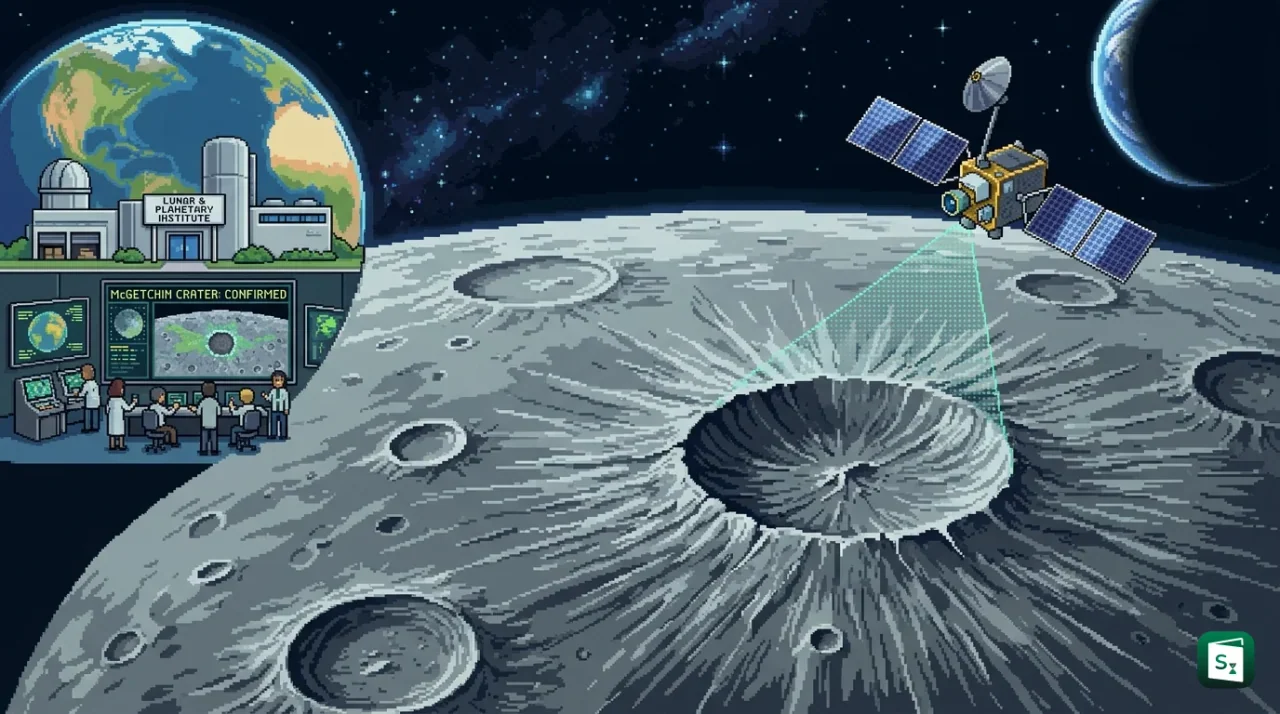
NASA scientists have confirmed the discovery of McGetchin crater on the Moon using imagery from the Lunar Reconnaissance Orbiter (LRO). The 222 metre wide crater formed on the Moon’s eastern edge between 11 April and 22 May 2024 after an asteroid or comet the size of a three to six storey building struck the surface. NASA describes it as the largest newly formed impact crater ever identified in the solar system, an event expected only once in about 132 years.
What Is McGetchin Crater and Why Is It Significant?
McGetchin crater is a 222 metre wide and 43 metre deep lunar impact crater that formed on the Moon in spring 2024 and was confirmed by NASA in September 2026. NASA identifies McGetchin crater as the largest newly formed crater ever found in the solar system during the space age, more than three times wider than the previous record holder of 70 metres found by the Lunar Reconnaissance Orbiter since 2009. Scientists estimate that an impact of this scale occurs on the Moon only once in about 132 years, making it a once in a century event.
The crater is classified as a lunar crater, which is a roughly circular depression created when an asteroid, meteoroid or comet collides with the Moon at high speed. The Moon preserves such craters exceptionally well because it has almost no atmosphere, no water and no plate tectonics to erase them. McGetchin crater is therefore scientifically valuable as a fresh, pristine example that shows the immediate effects of impact cratering before space weathering and later bombardment alter its shape.
NASA formally adopted the name McGetchin on 4 May 2026 through the International Astronomical Union (IAU), the global body that approves names for planetary surface features. The crater is located at 1.3536°N, 67.1765°E, just inside the outer ring of the Mare Crisium basin on the Moon’s eastern edge as seen from Earth, about 330 kilometres north of the Apollo 17 landing site. In images the crater itself appears as a sharp bowl, but the most visible sign in wide angle views is a bright ejecta halo about 38 miles wide, created by pulverised rock flung outward during the explosion.
How Was McGetchin Crater Discovered by NASA’s Lunar Reconnaissance Orbiter?
McGetchin crater was discovered during a routine data quality check on 24 October 2025 by Robert Wagner, an image processing specialist working with the Lunar Reconnaissance Orbiter Camera (LROC) system. NASA launched the Lunar Reconnaissance Orbiter (LRO) on 18 June 2009 aboard an Atlas V rocket, and the spacecraft has orbited the Moon at 50 to 200 kilometres altitude for more than 17 years, making it the longest lived lunar orbiter ever.
The discovery method relied on temporal comparison. Wagner used the Wide Angle Camera (WAC), which captures broad views with pixels about the size of an American football field, to stack hundreds of before and after images taken months apart. Software highlighted change by turning unchanged terrain grey and showing differences as bright or dark patches. McGetchin stood out immediately as an unusually large bright spot circled by a dark halo. Wagner noted it was by far the most obvious impact debris pattern he had seen in such images.
At the time of detection, the LROC team found existing Narrow Angle Camera images taken before the impact but none taken after. Over the next six months the team targeted the site whenever orbital geometry allowed, only a few days each month. On 5 December 2025 the Narrow Angle Camera (NAC), which images at about 0.5 metre per pixel or roughly 3 feet per pixel over a 5 kilometre swath, captured the decisive close up. Those images revealed the crater’s size, wall slopes averaging 24 degrees and reaching nearly 40 degrees, a rim rising 8 metres above the surrounding plain, and the extent of disturbed terrain. The discovery and analysis were reported in two companion papers published on 16 September 2026 in Science Advances, led by Mark Robinson of Intuitive Machines and the LROC science team.
Where Is McGetchin Crater Located and How Big Is It?
McGetchin crater lies on the eastern limb of the Moon at 1.3536°N, 67.1765°E, on the transitional boundary between highlands and mare material inside the outer ring of the Crisium basin. The region is scientifically interesting because the thin mare lava layer there may have limited the size of excavated boulders, and the ejecta contains a mix of bright highland rock and darker mare material.
NASA gives the crater’s dimensions as 222 metres in diameter (728 feet) and 43 metres deep (141 feet). To visualise its scale, NASA compares the width to two American football fields placed end to end, and the depth to three yellow school buses stacked vertically. The crater walls slope at about 24 degrees on average, and the rim is elevated about 8 metres above the pre impact surface. The topographic profile matches models derived from other lunar craters and laboratory experiments.
The timing of formation is precisely bounded. Comparison of LRO images shows no crater in spring 2011 images but a clear new feature in summer 2025 images, narrowing formation to between 11 April and 22 May 2024. The impactor is estimated to have been the size of a three to six storey building. It struck at many kilometres per second, vaporised on contact, and excavated more than 10 times its own diameter in rock. Scientists have not yet published a final energy calculation, but additional detailed modelling is expected in a future paper.
Why Does the Moon Have Craters?
The Moon has craters because it has been bombarded by asteroids, meteoroids and comets for 4.5 billion years without effective erasure. The Moon has almost no atmosphere to burn up impactors, no running water or wind to erode craters, and no active plate tectonics to recycle its crust, so almost every impact scar remains preserved for billions of years.
Unlike Earth where about 80 percent of the surface is less than 200 million years old due to weathering, volcanism and tectonic recycling, more than 99 percent of the lunar surface is older than 3 billion years. Earth experiences the same bombardment and even attracts more impactors due to its larger gravity and area, but erosion, vegetation and new rock formation quickly erase most craters. Only about 180 confirmed impact structures survive on Earth, compared with more than 9,000 recognised craters and over 2 million craters larger than 1 kilometre mapped on the Moon.
What Causes Moon Craters?
A moon crater is caused when a space rock collides with the lunar surface at speeds faster than the speed of sound, typically more than 10 kilometres per second, and explodes on impact. The kinetic energy, controlled by the impactor’s size, density, speed and angle, is transferred into shock waves and heat that vaporise the projectile and excavate a cavity many times larger than the impactor itself.
How Are Moon Craters Formed?
Moon craters form in three rapid phases after a high velocity impact. During the compression phase the projectile vaporises and a shock wave fractures the target rock. During the excavation phase material flows outward along curved paths, throwing debris called ejecta over the rim and forming a transient bowl. During the modification phase the steep walls collapse inward, the floor rebounds and the ejecta blanket settles, leaving a final crater with a raised rim, flat floor and sometimes a central peak for larger impacts.
Why Are Moon Craters Circular and Why Are They So Shallow?
Moon craters are circular because they are explosion craters, not punch holes. At orbital speeds the impact releases enormous energy at a single point, like a bomb detonation, and ejecta is thrown equally in all directions regardless of the impactor’s shape or approach direction. Only extremely shallow impacts at less than about 5 degrees from horizontal produce elliptical or double craters, such as Messier and Messier A.
Larger impact craters appear shallow compared with their width because of modification. Rebound of the floor and inward slumping of walls widens the crater and reduces depth. Smaller, simple craters keep a deeper bowl shape, while larger, complex craters develop terraced walls and a flattened floor.
What Did Scientists Learn from the Cold Spot Around McGetchin Crater?
McGetchin crater revealed an unexpectedly large cold spot, a zone of anomalously low nighttime temperature caused by impact loosened soil. NASA’s Diviner Lunar Radiometer Experiment, one of seven instruments on the Lunar Reconnaissance Orbiter, maps lunar surface temperature at about 300 metre resolution, and it found a 6.5 kilometre wide (about 4 mile) area around McGetchin that is roughly 9 degrees Celsius (16 degrees Fahrenheit) or about 8 to 9 Kelvin cooler at night than surrounding terrain, with debris effects traceable more than 120 kilometres from the crater.
A cold spot forms because an impact fluffs up the upper few centimetres of regolith, the loose dust and broken rock that covers the Moon. The loosened, less dense material has lower thermal inertia, so it retains less heat and cools faster after sunset. Diviner sees such features as irregular bluish patches that rapidly lose heat, while the camera sees almost no change in visible light. McGetchin’s cold spot is about 500 crater radii across in its faint outer rays and about 30 radii in its continuous core, far larger than the crater itself.
The finding is significant for two reasons. First, cold spots were previously known from more than 2,200 examples between 50°N and 50°S, but most are older and already fading. McGetchin provides the first large, virtually unaltered cold spot with well characterised before and after conditions, allowing scientists to calibrate how quickly cold spots fade, generally within 100,000 years to 2 million years, and to estimate ages of other young craters. Second, the scale shows that even a 222 metre crater can physically modify regolith at distances exceeding 1,000 crater radii, a factor that matters for rover traffic, dust accumulation on equipment and estimates of how quickly the top 2 centimetres of lunar soil is overturned, currently estimated at every 80,000 years based on LRO crater counts.
Who Was Thomas McGetchin and Why Was the Crater Named After Him?
McGetchin crater is named after Thomas R. McGetchin (1936 to 1979), an American geologist, volcanologist and planetary scientist honoured by the International Astronomical Union on 4 May 2026. Thomas McGetchin was born on 31 July 1936 in La Jolla, California, earned his PhD at the California Institute of Technology (Caltech) in 1968 working with Gene Shoemaker, a founder of planetary geology, and became a leading investigator of kimberlite pipes, volcanic ejecta dynamics and impact mechanics.
In 1977, Thomas McGetchin was appointed Director of the Lunar Science Institute (LSI) in Houston, adjacent to what is now the Johnson Space Center. Under his leadership the institute broadened its focus from solely lunar studies to the entire solar system and was renamed the Lunar and Planetary Institute (LPI), now operated by the Universities Space Research Association (USRA). He also launched the institute’s Summer Intern Program in Planetary Science in 1977, which continues to train students. A model of impact crater ejecta developed by McGetchin and colleagues in 1973, describing radial thickness variation in ejecta, remains a core framework for interpreting crater deposits on the Moon and other bodies.
Thomas McGetchin resigned in 1979 after illness and died on 22 October 1979 at age 43. He had previously received NASA’s Public Service Award. An asteroid, (2891) McGetchin, discovered in 1980, was also named in his memory. LROC scientists proposed the lunar crater name to the International Astronomical Union because McGetchin crater itself is now revealing new details of exactly the ejecta processes he studied.
How Does McGetchin Compare with Other Famous Craters?
McGetchin crater stands out not for absolute size, but for freshness and recurrence interval. The largest lunar craters are ancient basins thousands of kilometres wide, while the largest craters on Earth survive only where erosion has not erased them. McGetchin is the largest crater known to have formed and been observed in real time in the solar system.
| Feature | McGetchin Crater (Moon, New) | Lonar Crater (Earth, India) | Tycho Crater (Moon, Ancient) | Vredefort Crater (Earth, Largest Known) |
|---|---|---|---|---|
| Location | Moon eastern limb, Mare Crisium | Buldhana, Maharashtra, India | Southern highlands, Moon | Free State, South Africa |
| Diameter | 222 metres | 1.83 kilometres | 85 kilometres | About 300 kilometres original |
| Depth | 43 metres | About 150 metres | 4.8 kilometres | Deeply eroded |
| Age | Formed April to May 2024 | About 570,000 years | About 108 million years | About 2.02 billion years |
| Origin | Asteroid or comet impact, observed by LRO | Meteorite impact in basalt | Asteroid impact | Asteroid impact |
| Recognition | Largest newly formed crater seen in solar system, once in 132 years | Only hypervelocity impact crater in basaltic rock on Earth, contains Lonar Lake | Prominent ray crater visible with small telescopes | Largest confirmed impact structure on Earth, UNESCO World Heritage Site |
In India, Lonar crater and Lonar Lake in Maharashtra, formed about 570,000 years ago in Deccan basalt, remains the only known hypervelocity impact crater in basaltic terrain on Earth and is often studied alongside lunar craters for comparison. Like lunar craters, Lonar preserves ejecta and impact breccia, but Earth weather and water have filled it with a saline lake. McGetchin, by contrast, shows the immediate, unweathered structure that scientists use to calibrate crater formation models.
Among lunar craters, the record for largest overall belongs to the South Pole Aitken basin, about 2,500 kilometres wide, while the brightest large young crater is Tycho, 85 kilometres wide and visible to the naked eye. McGetchin differs from these ancient giants because it was observed as it formed, allowing direct study of ejecta distribution and thermal effects.
What Is the Lunar Reconnaissance Orbiter and How Does It Map the Moon?
The Lunar Reconnaissance Orbiter (LRO) is NASA’s robotic lunar orbiter that has studied the Moon since 2009 to pave the way for human and commercial exploration and to identify safe landing sites and resources near the lunar South Pole.
| Detail | Information |
|---|---|
| Full form | Lunar Reconnaissance Orbiter |
| Operator | National Aeronautics and Space Administration (NASA), United States |
| Launch date | 18 June 2009 on Atlas V from Cape Canaveral |
| Orbit | Polar orbit, 50 to 200 kilometres altitude |
| Mission duration | Planned for 14 months, now in extended mission for more than 17 years, the longest lived lunar orbiter |
| Managing centre | Goddard Space Flight Center, with LROC operations at Arizona State University |
| Instruments | Seven instruments including LROC (Lunar Reconnaissance Orbiter Camera), LOLA (Lunar Orbiter Laser Altimeter), Diviner (Diviner Lunar Radiometer Experiment), LEND, LAMP, CRaTER, Mini-RF |
The Lunar Reconnaissance Orbiter Camera (LROC) consists of two Narrow Angle Cameras (NACs) providing 0.5 metre panchromatic images over a 5 kilometre swath and one Wide Angle Camera (WAC) providing 100 metre images in seven colour bands over a 60 to 105 kilometre swath. The WAC builds global morphology base maps and polar illumination maps, while the NAC resolves metre scale hazards for landing site certification and monitors change. By comparing repeat images taken months apart, LRO has identified more than 1,000 new impact craters and over 100,000 surface changes from impacts and debris movement.
Another key payload is Diviner, which measures temperature across the surface at about 300 metre resolution, allowing detection of cold spots, potential ice deposits in permanently shadowed regions and thermal inertia of regolith. Together with altimetry from LOLA, LRO data help NASA and partners select sites with sunlight, water and stable terrain for future Artemis missions.
Why Does This Discovery Matter for Future Lunar Exploration?
The McGetchin impact highlights that the Moon remains a dynamic landscape, not a static museum. For planned sustained human presence under NASA’s Artemis programme, understanding how frequently medium size impacts occur and how far their effects reach is critical for habitat design, solar panel placement and spacesuit and rover durability. The observation that ejecta and decompacted regolith can create hazards more than 100 kilometres away means that long lived assets must be engineered to withstand high velocity small particle impacts from distant events.
Scientifically, the crater provides a natural laboratory. Because the impact was captured so soon after formation, researchers can measure pristine crater shape, ejecta thickness and the initial thermal properties of a cold spot before fading begins. These measurements improve models of impact physics from first contact to crater collapse and refine estimates of the recent impact rate, which appears to overturn the upper regolith faster than earlier calculations suggested. Future papers are expected to quantify the impactor energy more precisely using the new Narrow Angle Camera topography.
Key Takeaways
- McGetchin crater is a 222 metre wide, 43 metre deep crater formed on the Moon between 11 April and 22 May 2024, the largest newly formed impact crater ever observed in the solar system.
- NASA confirmed the crater in September 2026 using the Lunar Reconnaissance Orbiter (LRO), with discovery by Robert Wagner on 24 October 2025 and close up imaging on 5 December 2025.
- The impact was caused by an asteroid or comet about three to six storeys in size, an event estimated to occur only once in about 132 years on the Moon.
- McGetchin crater is located at 1.3536°N, 67.1765°E on the eastern limb inside the Mare Crisium basin and was named on 4 May 2026 after Thomas R. McGetchin (1936 to 1979), former Director of the Lunar and Planetary Institute (1977 to 1979).
- NASA’s Diviner instrument found a 6.5 kilometre wide cold spot around the crater that is about 9 degrees Celsius cooler at night, caused by fluffed up regolith with lower thermal inertia.
- The Lunar Reconnaissance Orbiter, launched on 18 June 2009, carries LROC with two Narrow Angle Cameras (0.5 m per pixel) and one Wide Angle Camera (100 m per pixel) and has operated for more than 17 years.