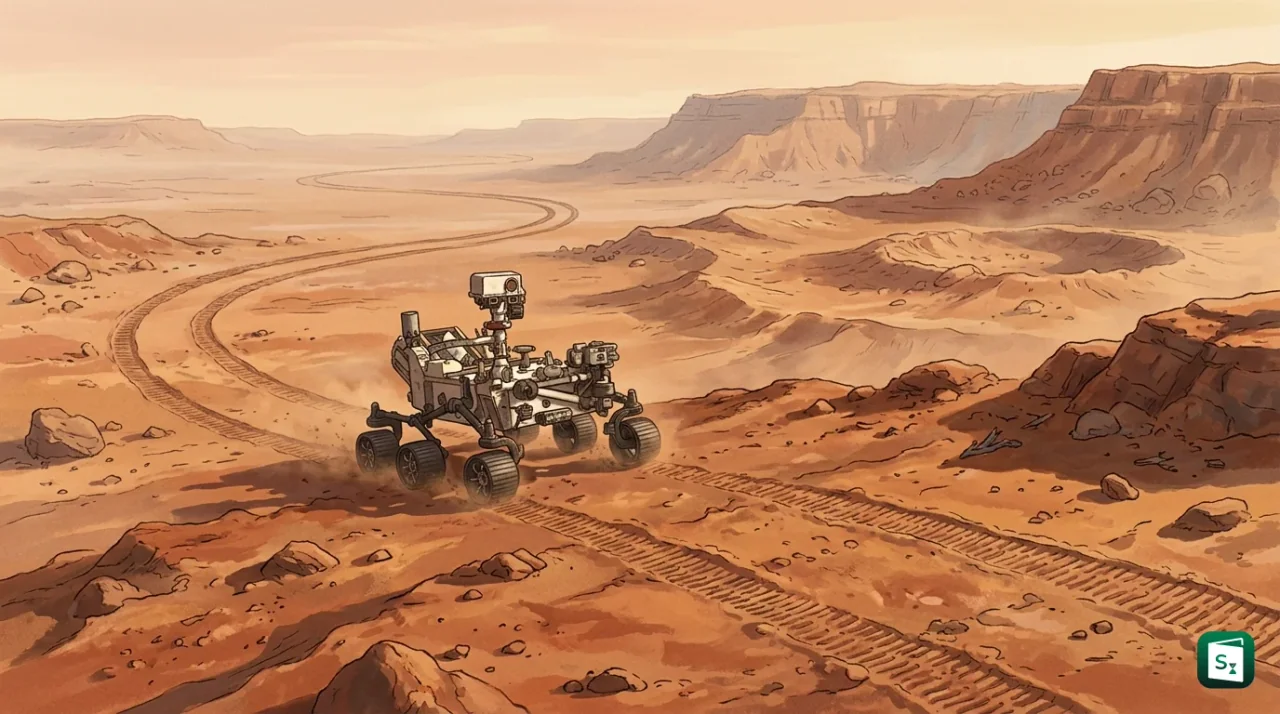
NASA’s Perseverance rover set a new off world driving record on 11 October 2026 when its odometer reached 45.22 km on Mars. The six wheeled laboratory passed the 45.16 km mark held by NASA’s Opportunity rover since its 2004 to 2018 mission. The feat relied mainly on autonomous navigation and came as Perseverance explored ancient rocks outside Jezero Crater.
What Is the Perseverance Rover
The Perseverance rover is NASA’s car sized Mars laboratory under the Mars 2020 mission to search for signs of past microbial life and collect rock samples for future return to Earth. It landed in Jezero Crater on 18 February 2021 after launching from Cape Canaveral on 30 July 2020. It also tests new technologies for future human missions to Mars.
Perseverance weighs about 1,025 kg, measures about 3 metres long, 2.7 metres wide and 2.2 metres tall, and carries 23 cameras and seven science instruments. Its key tools include the SuperCam laser and camera system for rock chemistry, the SHERLOC and PIXL instruments for detecting organic matter and minerals, the MEDA weather station, and a coring drill with 43 sample tubes for sealing rock cores.
The rover also carried two technology demonstrations. The Ingenuity helicopter, a 1.8 kg rotorcraft, became the first aircraft to make powered and controlled flights on another world and completed 72 flights before retirement. The MOXIE experiment, short for Mars Oxygen In Situ Resource Utilization Experiment, converted carbon dioxide from the thin Mars air into oxygen and produced 122 grams of oxygen in 16 runs before finishing in September 2023.
How Perseverance Set the New Mars Driving Record
NASA confirmed that Perseverance reached 45.22 km (28.10 miles) on 11 October 2026, on the 2,006th Martian day or sol of its mission. A short 91.31 metre drive that sol pushed its total past Opportunity’s 45.16 km (28.06 miles). The new mark was achieved in about five and a half years, while Opportunity needed almost 15 years.
The record drive took place in a region nicknamed Lac de Charmes on the western rim of Jezero Crater. Perseverance was travelling toward a target area called Idubi where scientists hope to find traces of ancient hydrothermal systems, which are hot water mineral zones that can preserve clues to early life. Mission planners said the rover had waited about two months near scientifically rich outcrops before moving on, then sailed past the record once driving resumed.
NASA noted that Perseverance had already passed its original design goal of about 20 km of driving long ago. Its engineering twin on Earth received a plaque from Guinness World Records for the longest drive on another world. NASA has also approved the first extended mission for Perseverance, which began in October 2026 and will continue crater rim exploration through about the end of 2028.
Where Is Perseverance Rover Now
Perseverance is operating outside the western rim of Jezero Crater in the Lac de Charmes terrain, an area that may hold some of the oldest rocks ever studied in place in the solar system. The zone sits beyond the crater floor where the rover landed and climbed out in December 2024. Unlike Earth, Mars has no tectonic plates to recycle its crust, so these ancient highland rocks survive in a form long erased on Earth.
How Autonomous Navigation Lets Perseverance Drive Itself
Perseverance drives itself with a system called AutoNav. While rolling, the rover takes stereo pictures, builds a three dimensional map of hazards, and picks a safe path between waypoints set by human planners on Earth. Engineers call this ability thinking while driving because the rover can judge terrain at or near its top speed.
The difference from earlier rovers is large. Perseverance has covered more than 90 percent of its distance using AutoNav, compared with about 5 percent for Opportunity and its twin Spirit and about 23 percent for Spirit in its best phases. Where the first Mars rover Sojourner judged the path ahead with 20 measurement points, Perseverance processes 600,000 points with every look. Its best single sol drive reached 411.7 metres on 19 June 2025, breaking its own earlier record of 347.7 metres. It can now cover up to 412 metres in one sol.
Mars is on average about 225 million km from Earth, so radio signals take many minutes to travel one way. Live joystick control is impossible. Human drivers therefore send waypoint plans through the Deep Space Network, and the rover executes them alone. A second computer called the Vision Compute Element speeds up image processing for hazard detection and Visual Odometry, which tracks how far the rover has actually moved by comparing images and estimating wheel slip on sand.
Climbing out of Jezero forced upgrades. The team raised the allowed tilt to 24 degrees, lowered the required belly clearance to 20 cm, improved braking and steering limits, and added slip prediction tables for rocky slopes. In early 2026 the team also tested Global Localization, which compares ground pictures with orbital maps to fix the rover position without human help, and completed its first drives planned with generative AI waypoints in December 2025, covering 210 metres and 246 metres on two sols.
Perseverance vs Opportunity: Two Generations of Mars Rovers Compared
Opportunity, also called MER-B or Oppy, was one of two small rovers in NASA’s Mars Exploration Rover program. It launched on 7 July 2003 and landed in Meridiani Planum on 24 January 2004 for a planned 90 sol mission to look for past water. It worked for 5,352 sols until a severe global dust storm cut power on 10 June 2018, and NASA declared the mission complete on 13 February 2019.
The design gap explains the speed of the new record. Opportunity weighed 185 kg, ran on solar panels giving about 140 watts at landing, and depended on sunlight and clean panels. Perseverance weighs 1,025 kg, uses nuclear power, and can work through dust, winter and night. Opportunity drove cautiously and used autonomy rarely. Perseverance drives long stretches alone between sample sites.
| Feature | Perseverance | Opportunity |
|---|---|---|
| Program | Mars 2020, landed 18 Feb 2021 | Mars Exploration Rover, landed 24 Jan 2004 |
| Landing site | Jezero Crater, 45 km wide basin | Meridiani Planum, Eagle crater |
| Mass | 1,025 kg, car sized | 185 kg, golf cart sized |
| Power | MMRTG nuclear battery, about 110 watts plus two lithium ion batteries | Solar panels, about 140 watts, plus lithium batteries |
| Planned life | At least one Mars year, about 687 Earth days | 90 sols |
| Actual life so far | Active since 2021, extended to 2028 | 14 years and 138 days, ended 2019 |
| Total distance | 45.22 km on 11 Oct 2026, still growing | 45.16 km |
| Time to record distance | About 5.5 years | Almost 15 years |
| Autonomy share | More than 90 percent with AutoNav | About 5 percent |
The table also fits the wider fleet. Curiosity, NASA’s 899 kg nuclear rover in Gale Crater since August 2012, remains active. Spirit, Opportunity’s twin in Gusev Crater, drove 7.73 km before contact ended in 2010. Sojourner, the 10.6 kg rover of the 1997 Pathfinder mission, drove about 100 metres. On the Moon, the Apollo 17 crewed rover drove 35.74 km in 1972 and the Soviet Lunokhod 2 drove about 39 km in 1973, both now behind Perseverance.
Why Jezero Crater Holds Clues to Ancient Life on Mars
Jezero Crater is a 45 km wide impact basin near the western edge of Isidis Planitia, just north of the Martian equator at about 18 degrees north and 77 degrees east. Scientists believe a river flowed into the crater more than 3.5 billion years ago and formed a lake about the size of Lake Tahoe in the United States. The word Jezero means lake in several Slavic languages.
The ancient river built a fan shaped delta of mud, sand and clay. On Earth, deltas trap organic molecules quickly and preserve them in fine layers. NASA chose Jezero after reviewing more than 60 candidate sites over five years because its delta, shoreline and clay minerals offered the best chance to find preserved signs of past microbial life.
Perseverance landed on the crater floor in 2021, studied fractured floor rocks and the sandy Seitah unit, then climbed the western rim on 14 December 2024. The rim rocks outside the crater are older than the lake beds inside. By sampling both young lake sediments and old highland crust, the rover builds a timeline from molten beginnings to wet conditions to dry Mars today.
How Is Perseverance Rover Powered
Perseverance gets steady power from a Multi Mission Radioisotope Thermoelectric Generator (MMRTG), a nuclear battery supplied by the United States Department of Energy. It converts heat from the natural decay of 4.8 kg of plutonium dioxide into about 110 watts of electricity. The unit also keeps the rover warm at night.
The generator works like a hot rock that never cools quickly. Heat flows through thermocouples, which are solid state devices that turn a temperature difference into electric current. The system holds no moving parts, so it is compact and reliable. It recharges two lithium ion batteries of 43 amp hours each for short peaks up to 900 watts during driving, drilling and communications.
The design frees Perseverance from the limits that stopped Opportunity. Solar rovers lose power in winter, at high latitudes and during dust storms. The MMRTG works day and night, has a design life of 14 years, and allows operation across seasons and latitudes. Excess heat runs through a fluid loop to protect electronics when night temperatures fall toward minus 120 degrees Celsius.
Is Perseverance Still Working on Mars
Yes. Perseverance remains fully active on Mars in October 2026 and has started its first extended mission through 2028. It continues to drive, drill sample cores, photograph terrain, record weather, and search for organic matter along the Jezero rim. Its fellow NASA rover Curiosity is also still active in Gale Crater.
The rover now focuses on sample science. It has sealed multiple rock cores in sterile tubes and left witness tubes to track contamination from Earth. A future Mars Sample Return effort aims to bring selected tubes to Earth for detailed study, though timelines and design remain under review. Each new core adds geologic variety, which is why long drives matter.
Major finds so far include diverse volcanic and lakebed rocks, clay minerals carried by water, and organic carbon signals in Jezero sediments that need careful checks for non living sources. MOXIE proved oxygen can be made on Mars. Ingenuity proved flight can scout ahead. Together, these steps test the tools needed for human missions while hunting for past life.
Key Takeaways
- Perseverance set a new off world driving record of 45.22 km on 11 October 2026, on sol 2006 of its mission.
- The previous record of 45.16 km was held by NASA’s Opportunity rover, which operated from 2004 to 2018.
- Perseverance uses AutoNav autonomous navigation for more than 90 percent of its driving and can cover up to 412 metres in one sol.
- The Mars 2020 rover landed in Jezero Crater on 18 February 2021 to search for past life and cache samples for return to Earth.
- Perseverance is powered by an MMRTG nuclear battery giving about 110 watts, unlike solar powered Opportunity.