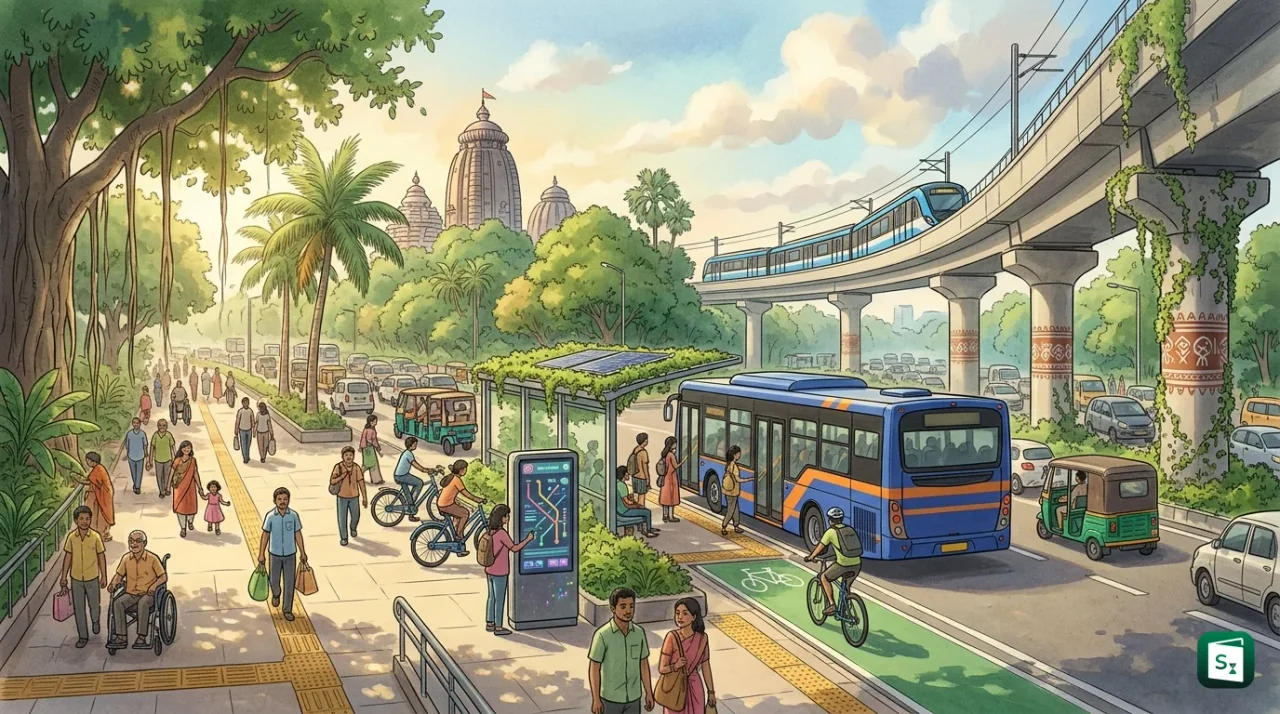
The Ministry of Housing and Urban Affairs organised the 19th Urban Mobility India Conference and Exhibition on 23 and 24 October 2026 and the second National Urban Conclave on 24 and 25 October 2026 at Hotel Mayfair Sanctuary in Bhubaneswar with support from the Government of Odisha. The Urban Mobility India Conference 2026 focused on urban accessibility and liveability in the digital age, while the National Urban Conclave discussed rethinking urban systems, solutions and delivery. Together, the two meets brought policymakers, city leaders and experts to one platform to shape cleaner transport and better managed cities.
What Is Urban Mobility and Why Does It Matter for India?
Urban mobility is the movement of people within cities to reach jobs, education, health care and daily needs. It covers walking, cycling, buses, metro rail, auto rickshaws and private vehicles, along with footpaths, roads and stations. Sustainable urban mobility means this movement is safe, affordable, inclusive and low in pollution.
An integrated transport system connects these modes into one easy journey with good interchanges, common tickets and reliable information. For India, this idea is central because cities carry a large share of jobs and economic output, while road space is limited. Poor mobility raises travel time and cost, increases road injuries and air pollution, and hurts low income commuters the most. The National Urban Transport Policy (NUTP) of 2006 therefore set the goal of moving people rather than vehicles, with priority to public transport and non motorised travel.
19th Urban Mobility India Conference and Exhibition 2026 in Bhubaneswar
The 19th Urban Mobility India (UMI) Conference and Exhibition 2026 was held on 23 and 24 October 2026 at Hotel Mayfair Sanctuary in Bhubaneswar. The Ministry of Housing and Urban Affairs organised the meet through the Institute of Urban Transport (India), with support from the Government of Odisha. About 1,500 delegates including national and international speakers were expected to take part.
Union Minister of State for Housing and Urban Affairs Tokhan Sahu inaugurated the conference. Odisha Housing and Urban Development Minister Krushna Chandra Mahapatra, Odisha Chief Secretary Anu Garg, Urban Development Secretary Satendra Singh and Odisha Additional Chief Secretary Usha Padhee attended the opening session. Senior officers of the central and state governments, heads of metro rail companies and transport undertakings, technology providers, researchers and academicians also joined.
Theme of Urban Accessibility and Liveability in Digital Age
The theme for 2026 was Urban Accessibility and Liveability in Digital Age. Accessibility here means that all residents, including the elderly and persons with disabilities, can reach jobs and services without difficulty. Liveability refers to clean air, safe streets, reliable services and a good quality of daily life in cities.
The theme linked these two goals to digital tools. Discussions focused on real time passenger information, GPS based bus tracking, common ticketing, data based planning and safety systems. The idea was that digital systems can cut waiting time, improve last mile links and reduce the need for some physical trips.
Exhibition and Annual Background of the Conference
An exhibition was held along with the conference to show best practices, new vehicles, signalling systems and service models in urban transport. The UMI Conference is an annual event held under the NUTP since 2008. Eighteen editions had been held before 2026, with the 18th edition in Gurugram in 2025 on the theme of urban development and mobility links. The conference also presents annual awards for excellence in urban transport in revised categories such as green transport initiatives and best practice projects.
How Digital Technologies Are Reshaping Integrated Transport
The Ministry of Housing and Urban Affairs placed sustainable and low carbon public transport at the centre of the 2026 discussions. The talks covered seamless connection between metro, bus, walking and cycling routes, better first and last mile links, lower congestion and cleaner air. Mobility as a Service (MaaS) was discussed as a model where a single mobile application helps a commuter plan, book and pay for a full trip using more than one mode.
| Conference Discussion | What It Covered |
|---|---|
| Data governance and intelligent transport | Use of travel data, GPS tracking and control centres for better bus and traffic management |
| Safe and secure transport with AI | Use of cameras, analytics and alerts to improve road and passenger safety |
| Transport, air quality and public health | Link between vehicle emissions, pollution and health, and the case for clean buses and metro |
| Land use and transit oriented development | Building homes, jobs and shops near transit stops to cut travel distance |
| People centric streets | Continuous footpaths, safe crossings, cycling tracks and school zones |
| Metro led multimodal network | Connecting metro stations with buses, e rickshaws and walking paths |
Two practical examples drew special attention. The Bhubaneswar model of Capital Region Urban Transport (CRUT), which runs the Mo Bus service started in November 2018, was presented as a technology led bus reform with GPS tracking, electronic tickets and gross cost contracts where operators are paid per kilometre for quality service. The PM e-Bus Sewa scheme, which plans to deploy 10,000 electric buses in smaller cities through public private partnership with depots, charging points and common card ticketing, was discussed as the national push to expand this model.
Second National Urban Conclave 2026 on Urban Rising
The second National Urban Conclave 2026 was held on 24 and 25 October 2026 at the same venue in Bhubaneswar. The Ministry of Housing and Urban Affairs organised the conclave with support from the Government of Odisha. The National Institute of Urban Affairs (NIUA) acted as the knowledge partner, while the Housing and Urban Development Corporation (HUDCO) and the National Buildings Construction Corporation (NBCC) were the principal sponsors.
Union Minister of State Tokhan Sahu inaugurated the conclave. More than 1,200 participants attended, including state urban development ministers, mayors, officers of urban local bodies and development authorities, researchers, industry members and civil society groups. The theme was Urban Rising: Rethinking Urban Systems, Solutions and Delivery. The focus was on stronger institutions, clear responsibilities, better finances and tools that help cities plan and deliver services. A meeting of state and Union Territory urban development ministers was also held to review earlier decisions and set new priorities.
Seven Priority Areas Discussed at the Conclave
| Priority Area | Main Issue Discussed |
|---|---|
| Right to Walk | Continuous footpaths, safe crossings, school zones and last mile links |
| Water, waste and resource efficiency | Cut water losses, reuse treated water and recover value from waste |
| Affordable housing | Need for rental housing, easier approvals, land and finance access, and climate safe building methods |
| Integrated development and infrastructure delivery | Better coordination among agencies, joint utility planning and GIS based mapping |
| New models for service delivery | Clear roles for municipalities, stronger revenues, procurement reform and private participation |
| Model building bye laws | Simpler approvals, safety, accessibility and rules for new materials and climate risks |
| Model municipal law | Stronger autonomy for cities and clear powers for elected leaders and officers |
The conclave built on the first National Urban Conclave 2025, which was held on 8 and 9 November 2025 at Yashobhoomi in New Delhi on sustainable urban development and governance. That first meet had drawn more than 2,500 participants and launched the Dumpsite Remediation Accelerator Programme and the Urban Invest Window. The Bhubaneswar edition added new tools such as the Used Water Marketplace under AMRUT 2.0, which lets urban bodies list treated used water for sale to industry, and an online municipal finance data hub to track income and spending of cities in real time. Street food hubs under PM SVANidhi, a digital system to track public works projects, and a cooperation pact between the Japan International Cooperation Agency (JICA) and the Central Public Health and Environmental Engineering Organisation on reuse of treated water were also announced.
Policy Roots: National Urban Transport Policy, Smart Cities Mission and Metro Growth
The Bhubaneswar meets rest on a policy base built over two decades. The National Urban Transport Policy was issued in April 2006 to guide central support for city transport, including funds under the Jawaharlal Nehru National Urban Renewal Mission. It called for linking land use with transport plans, giving more road space to people than to cars, expanding public transport and walking and cycling links, using intelligent systems for traffic control, improving safety and raising money through land based tools and private participation. A review in 2014 added the approach of avoiding long trips, shifting users to public transport and improving vehicle and fuel technology.
City investment under the Smart Cities Mission created the digital base for this shift. The mission was launched on 25 June 2015 for 100 cities and closed on 31 March 2025. About 8,064 projects worth ₹1,64,811 crore were taken up, of which 7,790 projects worth ₹1,56,257 crore were completed, using nearly the full central share of ₹48,000 crore. All 100 cities set up Integrated Command and Control Centres with CCTV cameras, GPS tracking of waste vehicles, air sensors, emergency call boxes and Intelligent Traffic Management Systems. A Ministry advisory of June 2025 asked states to keep these centres running and to use the city special purpose vehicles for new urban tasks.
Metro rail growth shows the scale of public transport expansion. The operational metro and RRTS network grew from 248 km in 5 cities in 2014 to about 1,095 km in 26 cities in 2025, making India the third largest metro network in the world. Daily ridership is about one crore trips. Tools such as the National Common Mobility Card for one nation one card travel, QR tickets, driverless train operations on parts of Delhi Metro and regenerative braking with rooftop solar are now part of this system.
Ministry of Housing and Urban Affairs and Its Urban Institutions
The Ministry of Housing and Urban Affairs is the central nodal ministry for housing, urban development and urban transport, headquartered in New Delhi. The Institute of Urban Transport (India) was set up in May 1997 under the Ministry as a non profit professional body and is housed at Anand Vihar Metro Station in Delhi. It manages the UMI Conference and supports states and cities with planning, research and training.
The National Institute of Urban Affairs was set up in 1976 under the Ministry as an autonomous think tank for urban research and policy. It is located at India Habitat Centre on Lodhi Road in New Delhi and bridges research with practice for central, state and local governments. HUDCO, a government company for housing and urban finance, and NBCC, a public sector construction company, support project funding and delivery and sponsored the 2026 conclave.
Key Takeaways
- The 19th Urban Mobility India Conference and Exhibition 2026 was held on 23 and 24 October 2026 in Bhubaneswar under the theme Urban Accessibility and Liveability in Digital Age.
- The second National Urban Conclave 2026 was held on 24 and 25 October 2026 in Bhubaneswar under the theme Urban Rising: Rethinking Urban Systems, Solutions and Delivery.
- The UMI meet was organised by the Ministry of Housing and Urban Affairs through the Institute of Urban Transport (India), set up in 1997, while the Conclave had NIUA as knowledge partner and HUDCO and NBCC as principal sponsors.
- The National Urban Transport Policy of 2006 guides the UMI Conference, which has been held every year since 2008 with the goal of moving people rather than vehicles.
- The Smart Cities Mission, launched on 25 June 2015 for 100 cities, completed 7,790 projects by March 2026, while the metro network grew from 248 km in 2014 to 1,095 km in 2025 across 26 cities.