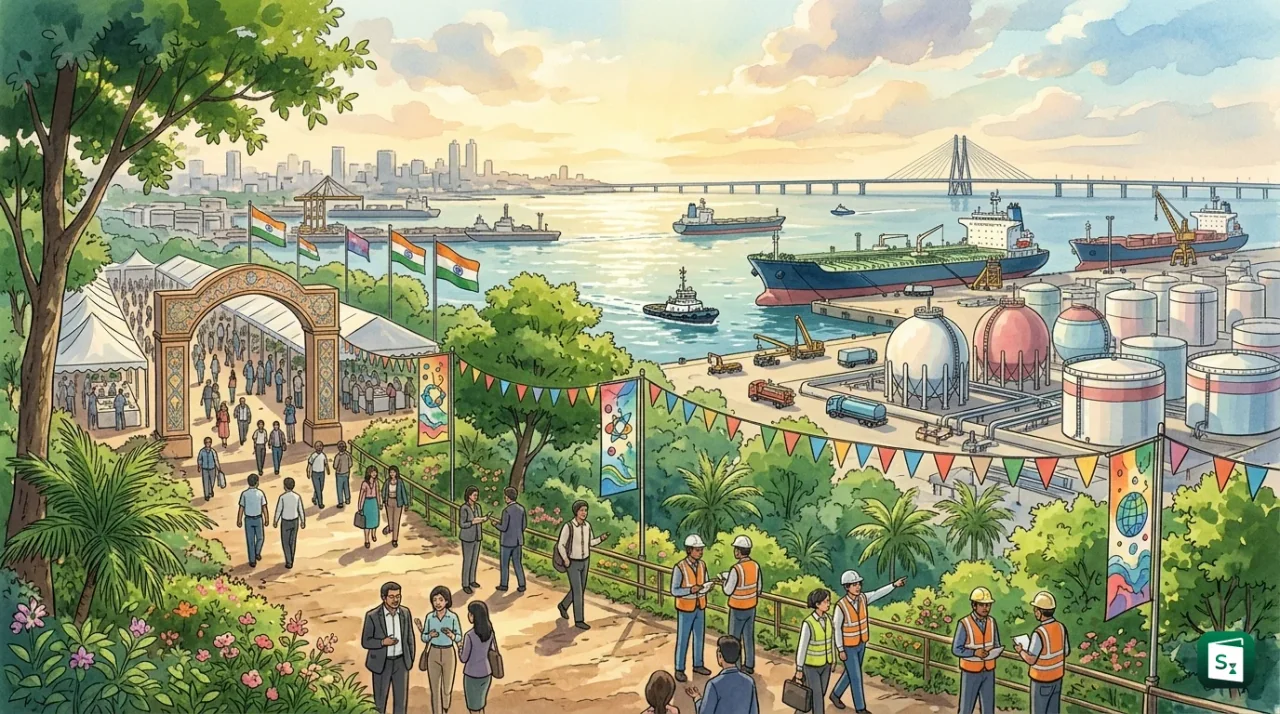
The 14th edition of India Chem 2026 was held from 22 to 24 October 2026 at NESCO in Mumbai under the theme Advantage Bharat: An Emerging Global Chemicals Hub. Union Minister for Chemicals and Fertilizers Jagat Prakash Nadda inaugurated the biennial exhibition and conference organised by the Department of Chemicals and Petrochemicals with industry body FICCI. The event spotlighted the BHAVYA Rasayan chemical parks scheme and the national targets of $300 billion in chemicals by 2030 and $1 trillion by 2040.
What Is India Chem 2026?
India Chem 2026 is the flagship biennial exhibition and conference for the chemicals and petrochemicals sector. The 14th edition was held from 22 to 24 October 2026 at the Bombay Exhibition Centre, NESCO, in Mumbai.
The theme for this edition was Advantage Bharat: An Emerging Global Chemicals Hub. The theme signals the aim to present India as a manufacturing and sourcing destination for global chemical supply chains.
The three day programme combined an international exhibition with a conference. The exhibition displayed products, technologies and services across chemicals, petrochemicals and process plant machinery. The conference included a Global CEOs Forum, conclaves on specialty chemicals, petrochemicals, agrochemicals, infrastructure and environment, and country forums with Japan, the United States and the European Union.
A new feature in 2026 was the India Chem Youth Innovation Challenge. Students worked on live problem statements given by industry and presented solutions before an industry jury. The first prize went to Soumya Bhole and Sarthak Kale of the Institute of Chemical Technology, Mumbai, while teams from VNIT Nagpur and IIT Gandhinagar took the second and third prizes.
Who Organises India Chem and Who Took Part in Mumbai?
The Department of Chemicals and Petrochemicals organises India Chem. The Department, known as DCPC, works under the Ministry of Chemicals and Fertilizers. The Ministry has three departments, which are Chemicals and Petrochemicals, Fertilizers, and Pharmaceuticals. DCPC handles planning and growth of chemicals, petrochemicals, plastics, synthetic fibres and synthetic rubber.
FICCI is the industry partner for the event. FICCI, or the Federation of Indian Chambers of Commerce and Industry, is an industry body founded in 1927 and headquartered in New Delhi. It works with the government to host the exhibition, the conference and business meetings.
Union Minister for Chemicals and Fertilizers and Health and Family Welfare Jagat Prakash Nadda inaugurated the 2026 edition. Minister of State Anupriya Patel and the Chief Ministers of Maharashtra, Madhya Pradesh and Odisha were present. DCPC Secretary Tejveer Singh outlined the conference agenda and the focus on business to business meetings.
The scale of participation in Mumbai was large:
| Participation at India Chem 2026 | Detail |
|---|---|
| Venue and dates | Bombay Exhibition Centre, NESCO, Mumbai, 22 to 24 October 2026 |
| Exhibitors | More than 200 Indian and international exhibitors |
| Business visitors | More than 8,000 expected, with over 5,000 footfalls recorded across three days |
| CEOs | More than 50 leading Indian and international CEOs at the Global CEOs Forum |
| Partner Country | Japan |
| Partner States | Maharashtra, Gujarat, Odisha, Madhya Pradesh, Bihar, Andhra Pradesh and Uttar Pradesh |
| International presence | Japan, the United States, Canada, the United Kingdom, the European Union, Latin America, Republic of Korea and ASEAN nations |
Japan joined as Partner Country. This reflects strong trade ties between India and Japan in chemicals and petrochemicals and opens scope for joint ventures, technology transfer and contract manufacturing. The presence of seven Partner States showed how states now compete to attract chemical investments through land, ports and industrial corridors.
What Is the BHAVYA Rasayan Scheme?
The BHAVYA Rasayan Scheme is a central scheme to set up three dedicated chemical parks with shared infrastructure for chemical makers. BHAVYA stands for Bharat Audyogik Vikas Yojana. The chemical parks part is called BHAVYA Rasayan. It works under the Ministry of Chemicals and Fertilizers.
The Union Cabinet approved the scheme on 24 July 2026. It was announced in the Union Budget for 2026-27 and notified on 10 August 2026. The scheme will run for five years from 2026-27 to 2030-31.
The financial design is simple. The total outlay is ₹3,030 crore. Of this, ₹3,000 crore is for common infrastructure inside the parks and ₹30 crore is for administration. The Centre will give a grant of up to ₹1,000 crore per park. Each selected state must add at least ₹500 crore per park. Any extra cost will be paid by the state.
Each park must have at least 8 sq. km of contiguous and encumbrance free land, which is about 2,000 acres. States will provide the land and bear the land cost. States will be picked through a competitive Challenge Route based on readiness, viability, finances and long term sustainability.
The parks will offer plug and play facilities. Plug and play means a company can start production quickly without building basic services on its own. Common facilities will include:
- Common Effluent Treatment Plant
- Treatment, Storage and Disposal Facility for hazardous waste
- Water supply and distribution system
- Solvent recovery and distillation plant
- Steam generation and distribution network
- Interconnected pipeline network
- Logistics, warehousing, testing laboratory, emergency response and technical support centres
How BHAVYA Rasayan Fits Into the Larger Industrial Plan
BHAVYA Rasayan is the chemical sector part of the larger BHAVYA initiative. The main BHAVYA programme has an outlay of ₹33,660 crore to develop 100 plug and play industrial parks over six years from 2026-27 to 2031-32. Chemical parks need special safeguards because chemicals involve pollution, safety and hazardous waste. So the government created a separate chemical parks window with common effluent and waste systems.
The idea builds on earlier cluster models. The three operating Petroleum, Chemicals and Petrochemicals Investment Regions at Dahej in Gujarat, Visakhapatnam-Kakinada in Andhra Pradesh and Paradip in Odisha have drawn ₹3.4 lakh crore in investment, created 3.7 lakh jobs and host over 2,200 units. The government has also approved Plastic Parks and Bulk Drug Parks. BHAVYA Rasayan extends this cluster approach to the full chemical value chain, from upstream inputs to downstream and ancillary units.
How Is the Chemical Industry in India Placed Today?
The chemical industry makes chemicals that become raw materials for other goods such as medicines, textiles, cars, paints, fertilisers, plastics and electronics. It covers bulk chemicals, specialty chemicals, petrochemicals, polymers, agrochemicals and fertilisers. In India the sector spans more than 80,000 commercial products.
India is the sixth largest producer of chemicals in the world and the third largest in Asia. The sector contributes about 7 percent to national GDP and provides direct and indirect work to about 2 million people. The domestic market was valued at about $220 billion in 2023 and 2024. Exports of chemicals and allied products were about $46.12 billion in 2025-26, which was nearly 10.44 percent of total merchandise exports. India ranks 14th in global chemical exports and eighth in imports when pharmaceuticals are excluded.
Growth is driven by rising home demand, low per capita use of chemicals, a young workforce, and demand from food processing, personal care, construction, automotives and phones. Yet India holds only 3 to 4 percent of global chemical sales by value. Imports were about $75 billion against exports of about $44 billion in 2023, leaving a trade deficit of about $31 billion. India imports 30 to 35 percent of its chemical imports from China, mainly petrochemical intermediates and specialty chemicals.
The table below captures the current profile in brief:
| Indicator | India position |
|---|---|
| Market size | About $220 billion in 2023 to 2024 |
| Global rank | Sixth in world, third in Asia |
| Share in GDP | About 7 percent |
| Product base | More than 80,000 commercial products |
| Employment | About 2 million directly and indirectly |
| Trade balance | Net importer with deficit of about $31 billion in 2023 |
| Key gap | Heavy import of intermediates, feedstock limits, logistics and compliance costs |
This gap explains the push for chemical parks, shared pipelines, solvent recovery and common waste plants. Shared systems cut logistics cost, improve safety and help small and mid sized units meet pollution norms.
What Targets Has India Set for Chemicals by 2047?
The government has set three milestone targets for the chemical industry. The industry should reach $300 billion by 2030, $1 trillion by 2040 and $1.6 trillion by 2047. Minister Nadda linked these goals to Viksit Bharat by 2047, the national aim of becoming a developed country by the centenary of independence.
Prime Minister Narendra Modi, in a message to India Chem 2026, said the event would lead to partnerships that support long term growth of the sector. Minister Nadda said the government is providing the most supportive environment for chemicals and called BHAVYA Rasayan a game changer for cost competitiveness, exports and import substitution.
A FICCI and Ernst and Young knowledge paper was released at the inaugural session. Ernst and Young, known as EY, is a global professional services firm. The paper maps strategies for global integration, specialty chemicals growth, green processes and circular use of plastics. FICCI Senior Vice President Vijay Sankar stressed integrated chemical parks, global partnerships and strong state support.
To move from $220 billion today to $1 trillion by 2040, production must grow about 14 percent a year and consumption about 10 to 11 percent a year. Policy reports point to four levers. First, secure feedstock for intermediates instead of converting most ethylene, propylene and benzene into basic polymers. Second, raise specialty chemical exports in dyes, agrochemicals, coatings and fragrances. Third, cut approval time through ready land and common utilities. Fourth, build skills for safe handling of hazardous chemicals across the 2,393 Major Accident Hazard units covered under the training plan.
Key Takeaways
- The 14th India Chem 2026 was held from 22 to 24 October 2026 at NESCO, Mumbai under the theme Advantage Bharat: An Emerging Global Chemicals Hub.
- India Chem is organised by the Department of Chemicals and Petrochemicals with FICCI as industry partner, and Japan joined the 2026 edition as Partner Country.
- The BHAVYA Rasayan Scheme, approved on 24 July 2026 with an outlay of ₹3,030 crore, will set up three chemical parks with central help of up to ₹1,000 crore per park.
- Each BHAVYA Rasayan park needs at least 8 sq. km (2,000 acres) of contiguous land and will run from 2026-27 to 2030-31 through a Challenge Route.
- India targets a chemical market of $300 billion by 2030, $1 trillion by 2040 and $1.6 trillion by 2047 from a base of about $220 billion.