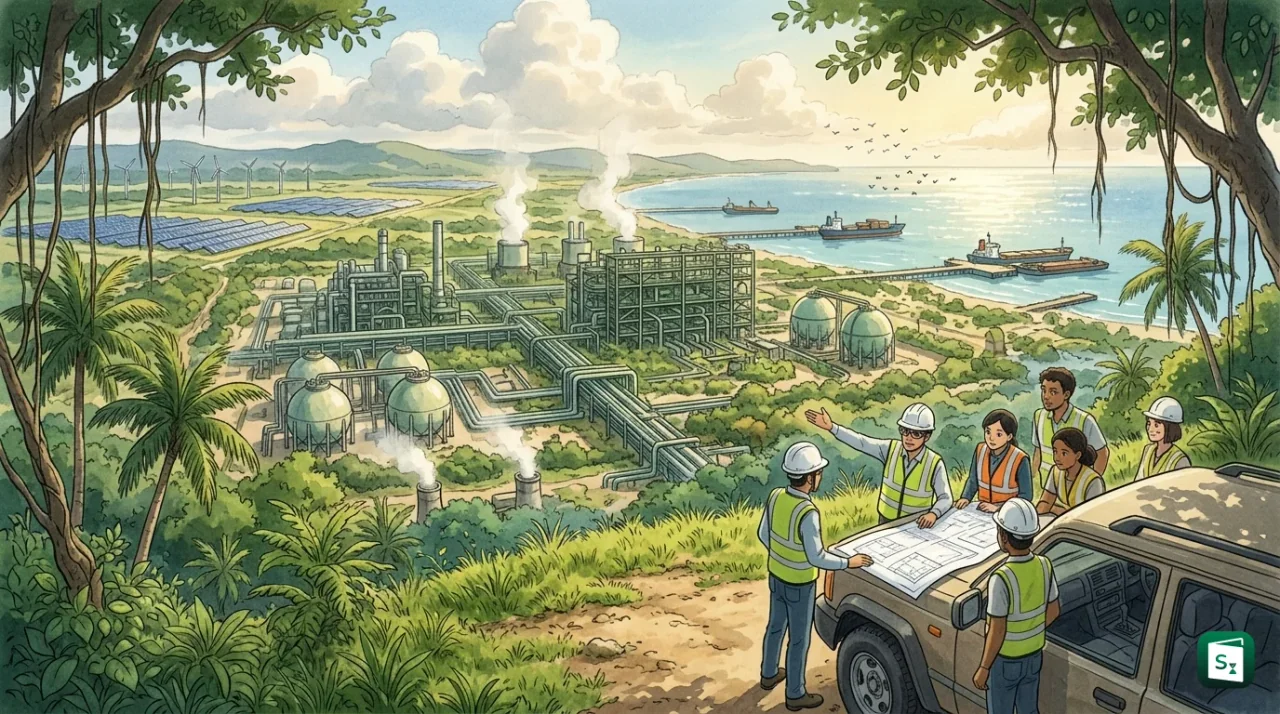
The Asian Development Bank (ADB) and the Government of Japan have signed financing agreements with Hyderabad based AM Green Ammonia (India) Private Limited to build one of the world’s largest renewable powered green ammonia plants in Kakinada, Andhra Pradesh. The plant will produce about 1.1 million tonnes of green ammonia every year using renewable electricity instead of natural gas. The deal marks the first investment under the Action for Creating Energy Security for Long-term Resilience (ACCEL), a joint initiative launched by ADB and Japan in May 2026.
What Is Green Ammonia
Green ammonia is ammonia with the chemical formula NH3 that is made without using fossil fuels. Conventional ammonia uses hydrogen taken from natural gas or coal, which releases large amounts of carbon dioxide. Green ammonia replaces that fossil hydrogen with hydrogen made from water using renewable electricity, so the final product carries almost no carbon emissions.
At normal room temperature, ammonia is a sharp smelling gas. It becomes a clear liquid when cooled slightly or stored under mild pressure, which makes it easy to store in tanks and move in ships. Green ammonia is not a biofuel, because biofuels come from plants or animal waste. It is a renewable fuel and an energy carrier, because it stores renewable power in a chemical form that can be moved over long distances.
The difference between types of ammonia lies in how the hydrogen is produced:
| Type | How Hydrogen Is Made | Carbon Emissions |
|---|---|---|
| Grey ammonia | From natural gas through steam reforming | High, released into air |
| Blue ammonia | From natural gas with carbon capture and storage | Lower, part of carbon is captured |
| Green ammonia | From water through electrolysis powered by solar, wind or hydro | Very low or near zero |
India already uses large amounts of grey ammonia to make urea fertilisers. Replacing it with green ammonia cuts emissions from fertiliser plants while creating a product that can be exported to countries seeking clean fuels.
How Is Green Ammonia Produced
Green ammonia is produced in two main steps. First, renewable electricity splits water into hydrogen and oxygen inside a machine called an electrolyser. This hydrogen is called green hydrogen because no fossil fuel is used to make it. Second, nitrogen separated from air is mixed with this green hydrogen to form ammonia.
The mixing step uses the Haber Bosch process. This is a mature industrial method developed in the early 20th century. Nitrogen and hydrogen are combined at high temperature (around 450 to 600 degrees Celsius) and high pressure (100 to 250 bar) over an iron based catalyst to form ammonia. In a green plant, the electricity for electrolysis, air separation and the Haber Bosch unit comes from renewable sources.
The Kakinada project will use about 5 gigawatts (GW) of renewable capacity, including solar, wind and pumped hydro storage. Pumped hydro works like a giant battery. Water is pumped uphill when solar and wind power is surplus, then released downhill to generate steady power when the sun is not shining. This round the clock supply keeps the electrolyser and ammonia unit running without breaks, which is critical because the Haber Bosch unit works best with a stable feed.
What Is Green Ammonia Used For
Green ammonia is used for fertilisers, shipping fuel, power generation and energy storage. Fertilisers account for the largest use today, since ammonia is the base for urea and other nitrogen fertilisers. By switching to green ammonia, fertiliser makers can cut the carbon footprint of food production.
As a fuel, green ammonia has a clear advantage over green hydrogen. Hydrogen is very light and needs extreme cooling to minus 253 degrees Celsius to become liquid. Ammonia liquefies at minus 33 degrees Celsius, so it is cheaper to store and ship. Ships can burn ammonia directly in engines or split it back into hydrogen at the destination. Japan, South Korea and Germany plan to use imported green ammonia for co-firing in power plants, which means mixing it with coal or gas to lower emissions, and as marine fuel.
Green ammonia also works as long duration energy storage. Surplus solar power in summer can be stored as ammonia and used in winter. Global buyers handle it with care because ammonia is toxic in high concentrations, so plants follow strict safety rules for storage, transport and bunkering, which refers to fuelling of ships.
The Kakinada Plant: Capacity, Location and Status
The Kakinada green ammonia plant is located at the site of a former natural gas based ammonia and urea complex in Kakinada, Andhra Pradesh, on the east coast. AM Green Ammonia (India) Private Limited acquired the old complex and is converting it into a renewable powered facility. The coastal location helps because ammonia can be loaded directly onto ships for export to East Asia and Europe.
The plant will have a total capacity of about 1.09 million tonnes per annum, reported as 1.1 million tonnes. It will be built in two equal phases, with each phase holding one ammonia train of 547,500 tonnes per annum. Phase 1 includes the first train plus shared utilities for both phases and will be financed and commissioned first.
| Feature | Detail |
|---|---|
| Location | Kakinada, Andhra Pradesh, former gas based urea complex |
| Developer | AM Green Ammonia (India) Private Limited, Hyderabad |
| Total capacity | About 1.1 million tonnes per year |
| Phase design | Two trains of 547,500 tonnes per year each |
| Power source | About 5 GW solar, wind and pumped hydro storage |
| Final investment decision | August 2024, with project cost of about ₹12,500 crore |
| Construction target | First supply expected from 2028 |
The facility has received pre-certification from CertifHy for meeting European Union rules for Renewable Fuels of Non-Biological Origin (RFNBO). This tag means the ammonia qualifies as truly renewable under EU law, with hourly matching of renewable power and proof of additional clean capacity. This certification is vital for sales to Europe.
How the Project Will Be Financed
The financing package was signed on 14 October 2026 and announced by ADB from Manila on 15 October 2026. The Asian Development Bank (ADB) approved support under project number 58517-001, described as ADB’s first financing of a green ammonia facility and one of the largest such financings globally.
The package includes a loan of up to $100 million from the Leading Asia’s Private Infrastructure Fund 2 (LEAP2). LEAP2 is an ADB managed fund financed by the Japan International Cooperation Agency (JICA) with a commitment of up to $1.5 billion. JICA provides the money for high quality private infrastructure, while ADB selects and supervises the projects. JICA support came through its Private Sector Investment Finance window.
ADB assistance is non-sovereign, which means the loan goes directly to the private company and not to the Government of India. This structure helps large climate projects raise long term foreign capital without adding to public debt. ADB has stated that the Kakinada project will support a new export industry for India while cutting emissions from fertiliser and industrial supply chains.
What Is ACCEL
ACCEL stands for Action for Creating Energy Security for Long-term Resilience. ADB and Japan launched ACCEL on 4 May 2026 at the ADB Annual Meeting in Samarkand, Uzbekistan. The initiative helps countries and businesses in Asia and the Pacific cope with rising energy prices and build stronger energy systems.
ACCEL follows a two track approach. In the short term, it provides liquidity support and technical assistance to firms facing fuel price shocks, with special attention to small and medium enterprises in energy supply chains. In the medium to long term, it funds investments that diversify energy sources and speed up the clean transition. Japan backs ACCEL through its trust funds and development finance bodies, while ADB channels the money into projects.
The Kakinada green ammonia plant is the first investment approved under ACCEL. ADB leaders have presented it as a model for turning energy security into practical investment. It shows how funds meant for resilience can create new markets and jobs instead of only meeting emergency needs.
Who Owns and Builds the Project
AM Green Ammonia (India) Private Limited is based in Hyderabad. The company is controlled by the founders of the Greenko Group, Anil Chalamalasetty and Mahesh Kolli, who set up Greenko in 2004. Greenko is one of India’s largest renewable power producers, with large wind, solar and hydro assets and pumped storage projects under construction.
AM Green is the energy transition platform of the Greenko founders. It is developing a portfolio of green ammonia plants in Kakinada, Tuticorin and Kandla, with a long term goal of 5 million tonnes per annum by 2030. Strategic partners in the ammonia business include Gentari, the clean energy arm of Malaysia’s Petronas, Singapore’s sovereign fund GIC, and the Abu Dhabi Investment Authority (ADIA). AM Green has also tied up with Belgium’s John Cockerill for electrolyser manufacturing in India.
The Asian Development Bank itself was established in 1966 and is headquartered in Manila, Philippines. ADB is owned by 69 members, with 50 from Asia and the Pacific. The Japan International Cooperation Agency (JICA) is Japan’s bilateral aid agency and a key financier of infrastructure in India, including freight corridors and metro projects.
Export Deals and Market Outlook
The Kakinada plant is designed mainly for export. AM Green has already signed a long term binding offtake agreement with Germany’s Uniper Global Commodities SE for up to 500,000 tonnes per year of RFNBO certified renewable ammonia. The agreement was exchanged in January 2026, the first of its kind for an Indian company. First shipment from Kakinada is expected as early as 2028. ADB project records also list a signed contract for 125,000 tonnes per annum with Uniper for Phase 1 capacity.
Other buyers are in the pipeline. Contracts are expected with Japanese firms JERA, Mitsui and Marubeni for the remaining Phase 1 output in 2026 and 2027. In September 2026, AM Green won the Asia lot in Germany’s second H2Global auction round. The implementing agency Hintco awarded a 10 year purchase agreement worth at least €585 million for supply from the second phase of Kakinada, with deliveries expected from 2029.
Global demand for green hydrogen and its derivatives such as green ammonia is projected to cross 100 million tonnes by 2030. Prices remain higher than grey ammonia today, often quoted per kg or per tonne, but long term offtake deals and carbon pricing in Europe are narrowing the gap. For India, exports of green ammonia fetch foreign exchange and position coastal Andhra Pradesh as a green fuel hub.
How the Project Fits Into India’s Green Hydrogen Mission
The National Green Hydrogen Mission is the nodal policy for this sector. The Union Cabinet approved the Mission on 4 January 2023 with an outlay of ₹19,744 crore. The Ministry of New and Renewable Energy is the nodal ministry. The Mission targets production of 5 million metric tonnes (MMT) of green hydrogen per year by 2030, with an associated renewable capacity addition of about 125 GW.
The Mission includes the Strategic Interventions for Green Hydrogen Transition (SIGHT) programme for electrolyser manufacturing and green hydrogen production, pilot projects, research support and skill development. Expected outcomes by 2030 include abatement of nearly 50 MMT of annual greenhouse gas emissions, creation of over 6 lakh jobs and reduction of fossil fuel imports worth more than ₹1 lakh crore. India also aims for about 10 percent of the global market, with potential exports of about 10 MMT of green hydrogen or green ammonia per year.
The Mission supports replacement of fossil hydrogen in ammonia production and petroleum refining. It also backs tenders by the Solar Energy Corporation of India (SECI) and NTPC for green ammonia supply. In addition, India has notified a Green Ammonia Certification Scheme and a domestic standard to verify carbon savings. Projects like Kakinada prove that policy, certification and foreign finance can combine to deliver large plants.
The Way Forward
Phase 1 of the Kakinada plant will be commissioned first, using secured offtake to repay lenders and prove operations. Phase 2 will move ahead once additional long term buyers are tied up, including Japanese utilities and European importers. Timely completion of the 5 GW renewable and pumped hydro linkage will be crucial to keep costs low and supply steady.
For ACCEL, success in Kakinada will set the template for future deals in fertilisers, shipping fuel and power co-firing across Asia and the Pacific. For Andhra Pradesh, the plant brings port led industry, construction jobs and ancillary demand for equipment and services. For India’s climate goals of energy independence by 2047 and net zero by 2070, large green ammonia capacity at home lowers fertiliser emissions while building an export edge in clean fuels.
Key Takeaways
- The ADB and Japan signed financing pacts on 14 October 2026 with AM Green Ammonia (India) Private Limited for a 1.1 million tonne plant in Kakinada, Andhra Pradesh.
- The Kakinada plant will use two trains of 547,500 tonnes per annum each and about 5 GW of solar, wind and pumped hydro power.
- The package includes a $100 million loan from LEAP2, a fund financed by JICA and administered by ADB.
- The deal is the first investment under ACCEL, launched by ADB and Japan on 4 May 2026 in Samarkand for energy security.
- AM Green is controlled by Greenko founders Anil Chalamalasetty and Mahesh Kolli and targets 5 million tonnes of green ammonia capacity by 2030.
- The National Green Hydrogen Mission, approved on 4 January 2023 with ₹19,744 crore, targets 5 MMT of green hydrogen per year by 2030.