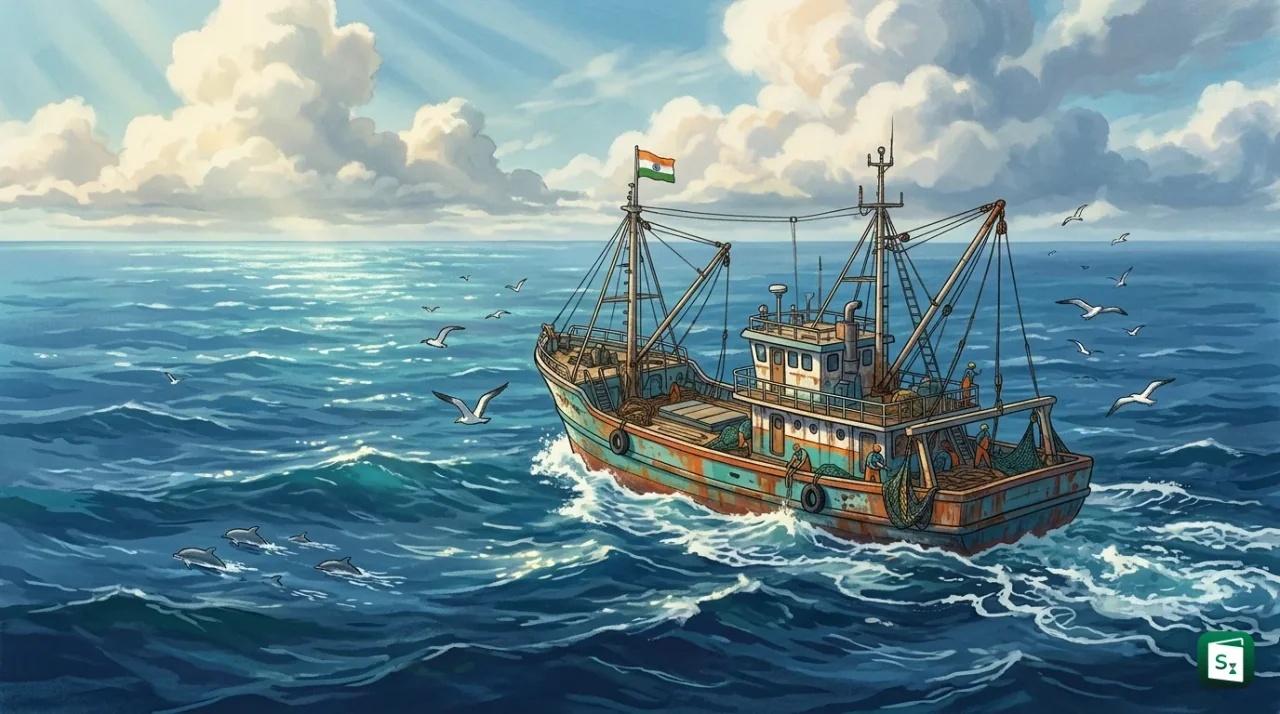
The Central Government approved India’s accession to the Southern Indian Ocean Fisheries Agreement (SIOFA) on 14 October 2026. The decision allows Indian flagged fishing vessels to fish legally in the southern Indian Ocean high seas for high value stocks such as squid, toothfish and alfonsino. The move upgrades India from a limited observer role to a full voting member in southern high seas governance.
What Is the Southern Indian Ocean Fisheries Agreement?
The Southern Indian Ocean Fisheries Agreement (SIOFA) is an international fisheries pact that ensures the long term conservation and sustainable use of fishery resources in the southern Indian Ocean high seas through cooperation among its members. The Agreement promotes sustainable development of fisheries while recognising the special needs of developing coastal states, least developed countries and small island developing states in the region.
SIOFA was signed in Rome on 7 July 2006 and entered into force in June 2012. The Food and Agriculture Organization (FAO), a United Nations agency headquartered in Rome, Italy and established in 1945, acts as the legal depositary of the Agreement. SIOFA functions as a Regional Fisheries Management Organisation (RFMO). An RFMO is a group of countries that jointly sets binding catch rules, gear controls and inspection systems for fish stocks in international waters where no single country has jurisdiction.
SIOFA covers fish, molluscs, crustaceans and other sedentary species in its area. It excludes two categories. It does not cover highly migratory species listed in Annex I of the United Nations Convention on the Law of the Sea (UNCLOS), such as tunas, because those are managed by tuna bodies. It also does not cover sedentary species that fall under the sovereign rights of coastal states under Article 77(4) of UNCLOS, such as corals and oysters fixed to a coastal continental shelf.
The Agreement works through three main organs. The Meeting of the Parties is the decision making body where members adopt conservation measures by consensus. The Scientific Committee assesses fish stocks and advises on catch limits and ecosystem impact. The Compliance Committee checks whether members follow the rules and acts against illegal fishing. A small Secretariat supports administration and keeps records and data.
Before October 2026, SIOFA had ten Contracting Parties including Australia, China, the Cook Islands, the European Union, France (for its Indian Ocean territories), Japan, South Korea, Mauritius, Seychelles and Thailand, along with one participating fishing entity, Chinese Taipei, and two cooperating non contracting parties, Comoros and India. India had held the status of Cooperating Non Contracting Party (CNCP) since 2022. A CNCP cooperates with the rules and shares data but has limited say in decisions. Accession now makes India a full Contracting Party with voting rights and access to scientific assessments, research programmes and compliance decisions.
Geography: Where SIOFA Applies and What Is the Southern Indian Ocean?
The southern Indian Ocean is the vast stretch of the Indian Ocean that lies south of the equator and extends toward the Southern Ocean waters around Antarctica. It includes deep ocean basins, underwater ridges and plateaus, and island zones around Mauritius, Seychelles, the French Southern and Antarctic Lands, and Heard Island near Australia. These seamounts and plateaus attract aggregations of deep water fish, which makes the region important for high value bottom and mid water fisheries.
The SIOFA area of competence covers high seas waters roughly between eastern Africa and western Australia. In simple terms, it starts at 10 degrees North latitude off the east African coast, runs east and south across the equator, and extends down to 55 degrees South latitude, touching the edge of Southern Ocean management zones. The area excludes all waters under national jurisdiction. That means coastal territorial seas (up to 12 nautical miles) and Exclusive Economic Zones (up to 200 nautical miles) of coastal states remain outside SIOFA control.
SIOFA divides its area into eight subareas for science and management. Deep water fisheries for orange roughy and alfonsino cluster around underwater features in subareas 1 to 6 in the western and central parts. Patagonian toothfish fisheries concentrate in the colder southern subareas 3b and 7. The shallow Saya de Malha Bank in subarea 8 supports snappers, emperors and groupers. This zoning helps scientists link catch data to specific stocks and habitats rather than treating the whole ocean as one unit.
What Changes for India After Joining SIOFA?
The SIOFA decision builds on the Guidelines for Sustainable Harnessing of Fisheries in the High Seas by Indian Flagged Fishing Vessels, issued by the Ministry of Fisheries, Animal Husbandry and Dairying in December 2025. The Guidelines created a domestic permit system for high seas operations. Every Indian flagged vessel must obtain a vessel specific and non transferable Letter of Authorisation (LOA) through the ReALCraft portal, register with the relevant RFMO, obtain an International Maritime Organization (IMO) number, and carry an operational Vessel Monitoring System (VMS) and Automatic Identification System (AIS) with position reporting. SIOFA membership now gives those authorised vessels a regional legal framework in which to actually fish.
The practical gain is fishing access. Indian flagged vessels and companies can now take up authorised fishing for non migratory stocks under SIOFA Conservation and Management Measures (CMMs). CMMs are binding rules on catch limits, gear, closed areas, data reporting and bycatch control. Fish caught legally on the high seas by Indian vessels and landed in India is treated as being of Indian origin, so it does not attract import duty. Catch landed abroad is treated as export and needs certification from the Marine Products Export Development Authority (MPEDA), which was established in 1972 and headquartered in Kochi, Kerala.
The institutional gain is equally large. As a CNCP, India could attend meetings but had limited influence in the Scientific Committee and Compliance Committee. As a Contracting Party, India can vote at the Meeting of the Parties, propose measures, join stock assessments and access survey data and research cruises. That access will help Indian institutes build evidence based rules on sustainable yields and avoid overfishing of fragile deep sea stocks.
| Status in SIOFA | What India Could Do | What Changes After Accession |
|---|---|---|
| Cooperating Non Contracting Party (2022 to 2026) | Follow voluntary cooperation, share some data, attend meetings with limited voice | No voting right, limited role in science and compliance decisions |
| Contracting Party (from October 2026) | Fish under quota, propose and vote on CMMs, join inspections | Full voting, full access to assessments, vessel list and research programmes |
Accession also strengthens monitoring at sea. SIOFA has adopted a High Seas Boarding and Inspection (HSBI) scheme for checking vessels in its area. Under the scheme, authorised inspectors can board a fishing vessel, verify its flag, licence, logbook, gear and catch, and report suspected violations. For India, participation supports two goals at once. It helps curb Illegal, Unreported and Unregulated (IUU) fishing, which is fishing without permission, without reporting or in breach of rules. It also improves maritime awareness and coastal security in the southern Indian Ocean, a region where distant water fleets are highly active.
High Value Species Managed Under SIOFA
The SIOFA area supports a small number of commercially important deep water fisheries. Indian operators will focus on authorised stocks such as squid, toothfish and alfonsino, along with related species taken under the same rules. Toothfish refers mainly to Patagonian toothfish (Dissostichus eleginoides), with small quantities of Antarctic toothfish (Dissostichus mawsoni). Toothfish are large, long lived demersal fish found in deep cold waters, often below 1,000 metres. They command very high prices in export markets for premium white fish. SIOFA manages the high seas portion of the stock, while much of the population around Australia’s Heard Island and McDonald Islands falls inside Australia’s national zone.
Orange roughy (Hoplostethus atlanticus) is another prized stock. It is a long lived and slow growing fish that lives at 400 to 900 metres around seamounts and plateaus. It is caught mainly by bottom trawl. Alfonsino, mainly splendid alfonsino (Beryx splendens), is a mid water species found at 400 to 600 metres that forms spawning aggregations over rocky features. Recent SIOFA science estimated alfonsino stocks at about 60 percent of pre fishing levels, a relatively healthy status. Other SIOFA fisheries include deep water snappers, hapuka, oilfish and light seine fisheries for squid and mackerel like species. All these fisheries require careful effort control because deep sea species mature late and recover slowly if depleted.
Maritime Zones Context: High Seas Versus Exclusive Economic Zone
India has a coastline of 11,099 km and an Exclusive Economic Zone (EEZ) of about 2.4 million sq km. The EEZ is the sea zone up to 200 nautical miles from the coast where the coastal state has sovereign rights to explore, exploit, conserve and manage natural resources, including fish. This regime comes from the United Nations Convention on the Law of the Sea (UNCLOS), adopted in 1982, and India’s Territorial Waters, Continental Shelf, Exclusive Economic Zone and Other Maritime Zones Act, 1976. Fishing beyond territorial waters is a Union subject under Entry 57 of List I of the Seventh Schedule of the Constitution, so the Central Government regulates high seas fishing.
Waters beyond any EEZ are called the high seas. The high seas cover about 65 percent of the global ocean. Under UNCLOS, all states enjoy freedom of navigation and the right to fish on the high seas, but that right is conditioned by treaty duties to conserve shared stocks and follow RFMO measures, the UN Fish Stocks Agreement of 1995, the FAO Code of Conduct for Responsible Fisheries of 1995, and port and safety standards. In practice, five fleets dominate high seas catches, with China (21 percent), Taiwan (13 percent), Japan (11 percent), South Korea (11 percent) and Spain (8 percent) accounting for the largest shares.
India has remained a coastal operator so far. Most Indian fishing vessels work within 60 to 80 nautical miles of shore, well inside the EEZ. High seas catches contribute less than 1 percent of India’s total marine catch. With coastal stocks under pressure and deep sea resources inside the EEZ still partly untapped, the government sees regulated high seas expansion as a way to raise production, earn foreign exchange and reduce crowding near shore. The SIOFA route and the December 2025 LOA system together give that expansion a legal and monitored path.
How Far Does India’s Exclusive Economic Zone Extend?
The Exclusive Economic Zone of India extends up to 200 nautical miles from the baselines used to measure the territorial sea. The EEZ of India covers about 200 nautical miles, which equals about 370.4 km, since one nautical mile equals 1.852 km. Within this 200 nautical mile belt, India has sovereign rights over marine living and non living resources, while other states retain freedoms of navigation and overflight. The territorial sea itself extends only up to 12 nautical miles, where India enjoys full sovereignty subject to innocent passage of foreign ships.
Global High Seas Governance and the BBNJ Link
The high seas treaty is the popular name for the Agreement on the Conservation and Sustainable Use of Marine Biological Diversity of Areas Beyond National Jurisdiction, or the BBNJ Agreement. The BBNJ Agreement is a new treaty under UNCLOS that sets global rules for conserving marine life in international waters. It was adopted in New York on 19 June 2023 and entered into force on 17 January 2026 after more than 60 countries ratified it. The treaty creates tools for area based management including marine protected areas, mandatory environmental impact assessments for major high seas activities, fair sharing of benefits from marine genetic resources, and support for capacity building and technology transfer.
SIOFA and the BBNJ Agreement work at different levels but point in the same direction. SIOFA is a regional body that manages specific fish stocks in one ocean region through quotas and inspections. The BBNJ Agreement is a global framework that protects overall biodiversity beyond national jurisdiction. For India, joining SIOFA shows how regional compliance can prepare the country for wider global duties, such as conducting impact assessments, sharing scientific data and respecting protected zones, once broader ocean treaties apply.
Has India Signed or Ratified the High Seas Treaty?
India signed the BBNJ Agreement, or high seas treaty, on 25 September 2024. India has signed the high seas treaty but India had not ratified it as of October 2026. Signature signals intent to join, while ratification makes the treaty legally binding at home and requires domestic laws and institutions to carry out its duties. The Ministry of Earth Sciences set up a drafting committee in September 2025 to study alignment with laws such as the Biological Diversity Act, 2002 and the Environment Protection Act, 1986, and held consultations with scientists and legal experts in early 2026. SIOFA membership helps India build that practical experience in high seas reporting, assessment and enforcement even before a final decision on BBNJ ratification.
Regional Fisheries Bodies: SIOFA and the Indian Ocean Tuna Commission
Regional Fisheries Management Organisations are the main rule makers for high seas fishing. No global police force patrols the high seas, so groups of fishing nations form RFMOs to set science based limits, maintain vessel lists, run satellite tracking through VMS, and authorise inspections. Their measures bind members and put pressure on non members to cooperate. The Indian Ocean has two major RFMOs with different mandates.
The Indian Ocean Tuna Commission (IOTC) manages highly migratory tuna and tuna like species across the Indian Ocean. IOTC was established under Article XIV of the FAO Constitution through an agreement approved in November 1993, which entered into force on 27 March 1996. It is headquartered in Victoria, Seychelles. India has been a Contracting Party to IOTC since the mid 1990s and participates in its compliance and science processes for yellowfin, skipjack, bigeye and swordfish fisheries. The Southwest Indian Ocean Fisheries Commission (SWIOFC), by contrast, is only an advisory body for coastal fisheries and does not set binding high seas quotas.
| Feature | SIOFA | IOTC |
|---|---|---|
| Full name | Southern Indian Ocean Fisheries Agreement | Indian Ocean Tuna Commission |
| Established | Signed 2006, in force 2012 | Agreement 1993, in force 1996 |
| Headquarters and depositary | Secretariat in Reunion, depositary is FAO in Rome | Headquarters in Victoria, Seychelles, under FAO framework |
| What it manages | Demersal and non migratory high seas stocks like toothfish, orange roughy, alfonsino, squid | Highly migratory tuna and tuna like species |
| India’s status (as of October 2026) | New Contracting Party after CNCP period since 2022 | Long standing Contracting Party since the 1990s |
Together, SIOFA and IOTC give India near complete coverage in the Indian Ocean. IOTC covers the fast moving tuna swimming across EEZs and high seas. SIOFA covers the slow growing bottom stocks fixed to southern seamounts and plateaus. Joint membership also strengthens India’s stand in global talks on fisheries subsidies. The World Trade Organization Agreement on Fisheries Subsidies, adopted in June 2022, seeks to ban subsidies that support IUU fishing and fishing of overfished stocks. India has argued for protection of small scale and artisanal fishers while supporting discipline on large distant water fleets that dominate high seas catches.
Why SIOFA Matters for India’s Blue Economy and Marine Fisheries
Marine fisheries in India form a large employment and export base. India is the second largest fish producing country in the world, accounting for about 8 percent of global fish production. Marine production supports about 5 million marine fishers across 13 coastal states and union territories, along with many more workers in processing, cold chains, boat building and trade. Fisheries exports rose from ₹46,663 crore in 2019-20 to ₹73,890 crore in 2025-26, which shows growing global demand for Indian seafood, especially shrimp, squid, cuttlefish and tuna.
Yet deep sea potential remains underused. The marine fisheries potential inside India’s EEZ is estimated at 5.31 million metric tonnes (as of 2018), with a broader exploitable estimate of 7.16 million tonnes when deep and oceanic resources are included. More than 90 percent of India’s marine catch still comes from near shore waters. Deep sea fishing in India refers to fishing beyond the continental shelf in waters deeper than about 200 metres, using larger vessels, longlines, trawls and squid jigging systems. It targets high value resources such as oceanic tuna, billfish, oceanic squid and deep water shrimp. Without regulated access to the high seas, Indian operators could not build viable distant water fleets or compete with established fleets.
SIOFA accession links directly to the Blue Economy agenda. The Blue Economy means sustainable use of ocean resources for growth, jobs and ecosystem health, covering fisheries, ports, shipping, tourism, renewable energy and seabed minerals. India’s draft Blue Economy policy framework and the Deep Ocean Mission, launched by the Ministry of Earth Sciences in 2021, support deep sea science, resource mapping and technology for sustainable harvesting. The Pradhan Mantri Matsya Sampada Yojana, launched in 2020 with an outlay of ₹20,050 crore, funds harbour modernisation, cold chains and vessel support. Training of traditional fishers, cooperatives and Fish Farmer Producer Organisations (FFPOs) for high seas operations, as envisaged in the 2025 Guidelines, can spread those benefits to coastal communities rather than limiting them to large companies.
Strategic stakes add weight. A recognised Indian presence in the southern high seas, with Indian flagged vessels on the SIOFA vessel list and Indian inspectors in joint patrol concepts, improves domain awareness along sea lanes that connect India to Antarctica operations, the Mozambique Channel and the waters off Australia. It also gives India data and voice to oppose overfishing that would harm shared stocks and to shape future rules on effort allocation and area closures.
The Way Forward
The Ministry of Fisheries, Animal Husbandry and Dairying will now complete formal accession formalities with FAO as depositary and notify Indian rules for SIOFA operations. The immediate tasks include listing eligible Indian vessels on the SIOFA authorised vessel list, aligning LOA conditions with SIOFA CMMs on catch reporting and VMS transmission, and designating base ports for landing and inspection. Coordination among the Department of Fisheries, the Directorate General of Shipping, MPEDA and port authorities will decide how fast the first Indian voyages can start.
Science and capacity will decide long term gains. India will need stock specific research on squid, toothfish and alfonsino, observer training, and bycatch mitigation for seabirds, sharks and vulnerable marine ecosystems. Support for cooperatives and small operators to charter or jointly operate compliant vessels, along with finance for onboard freezing and safety upgrades, will determine whether high seas fishing creates broad based jobs. If implementation stays science led and transparent, SIOFA can become a steady pillar of India’s Blue Economy rather than a one time diplomatic entry.
Key Takeaways
- The Central Government approved India’s accession to the Southern Indian Ocean Fisheries Agreement (SIOFA) on 14 October 2026.
- SIOFA was signed in Rome in 2006 and entered into force in 2012, with the FAO as depositary.
- India was a Cooperating Non Contracting Party since 2022 and now becomes a full Contracting Party with voting rights.
- Indian vessels gain authorised access to squid, toothfish, alfonsino and other non migratory high seas stocks under binding conservation measures.
- India remains a long standing member of the Indian Ocean Tuna Commission (IOTC), headquartered in Victoria, Seychelles, which manages tuna and tuna like species.
- India signed the BBNJ high seas treaty on 25 September 2024 but had not ratified it as of October 2026, while the treaty entered into force on 17 January 2026.