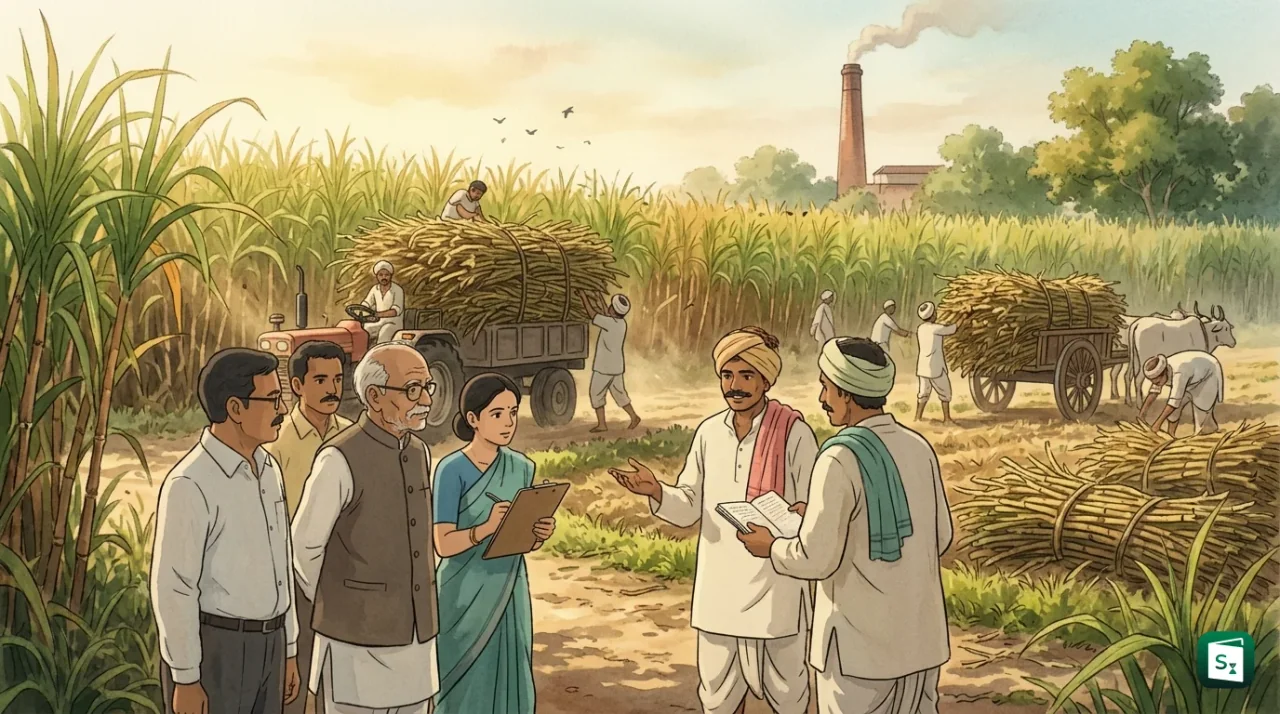
The Union Government constituted a four member committee on 13 October 2026 under former NITI Aayog member Ramesh Chand to examine sugarcane price demands and the revision of the ex-mill Minimum Selling Price of sugar. The move followed a meeting of sugarcane farmers from Karnataka and Maharashtra with Union Agriculture Minister Shivraj Singh Chouhan and Food Minister Pralhad Joshi. With sugar MSP frozen at ₹31 per kg since February 2019 while cane costs have climbed every year, the panel must balance farmer income with the survival of mills.
What Is FRP for Sugarcane?
The Fair and Remunerative Price (FRP) is the minimum price that sugar mills must legally pay to sugarcane farmers for every quintal of cane. The Union Government fixes the FRP each sugar season under the Sugarcane (Control) Order, 1966, which draws its power from the Essential Commodities Act, 1955. No mill can buy cane below this floor price.
The Commission for Agricultural Costs and Prices (CACP), an expert body under the Ministry of Agriculture and Farmers Welfare, recommends the FRP after studying cultivation costs, recovery rates and market conditions. The Cabinet Committee on Economic Affairs (CCEA), chaired by the Prime Minister, then approves it after consulting state governments. The concept replaced the earlier Statutory Minimum Price (SMP) from the 2009-10 sugar season.
For the 2026-27 sugar season (October to September), the government fixed FRP at ₹365 per quintal for a basic sugar recovery rate of 10.25%. Sugar recovery means the quantity of sugar produced from a given quantity of cane. It is the central link between cane price and mill income. A higher recovery means more sugar from the same cane.
The pricing formula rewards efficiency. For every 0.1 percentage point rise in recovery above 10.25%, farmers get a premium of ₹3.56 per quintal. A similar cut applies for lower recovery. To protect farmers supplying low recovery cane, the government fixed a floor of ₹338.3 per quintal where recovery falls below 9.5%, with no further deduction. The production cost (A2 plus family labour) for 2026-27 was estimated at ₹182 per quintal, so the FRP gives a margin of 100.5% over cost. The new FRP is 2.81% higher than the ₹355 per quintal fixed for 2025-26.
Some states fix a higher cane price of their own. Punjab, Haryana, Uttar Pradesh, Uttarakhand and Tamil Nadu announce a State Advised Price (SAP) under state law. Where SAP is declared, it becomes the ruling price that mills must pay. This dual system is at the heart of the present dispute, because SAP keeps rising in states like Uttar Pradesh while the sugar sale price has stayed frozen at the national level.
| Sugar Season | FRP (per quintal) | Basic Recovery | Change Over Previous Year |
|---|---|---|---|
| 2017-18 | ₹255 | 9.5% | Base for comparison |
| 2018-19 | ₹275 | 10.0% | Up ₹20 |
| 2025-26 | ₹355 | 10.25% | Reference year |
| 2026-27 | ₹365 | 10.25% | Up ₹10 (2.81%) |
Sugarcane supports about 5 crore farmers and their dependents, along with around 5 lakh workers directly employed in sugar mills. Farm labour, transport and ancillary work add many more jobs. That scale explains why any change in sugarcane price carries national weight.
FRP vs MSP: How the Two Prices Differ
The FRP is the price of sugarcane paid by mills to farmers, while the MSP of sugar is the ex-mill floor price at which mills can sell finished sugar. The FRP protects farmer income at the farm gate, and the sugar MSP protects mill cash flow at the factory gate so mills can pay cane dues on time.
Confusion arises because MSP usually means Minimum Support Price for grains. In the sugar industry, MSP means Minimum Selling Price. Sugarcane does not have a Minimum Support Price with government procurement. Farmers must sell perishable cane to the designated mill in their reserved area, and the mill must crush it quickly. The FRP plays the role of assured price in this tied relationship.
The sugar MSP was introduced in June 2018 at ₹29 per kg when cane FRP stood at ₹255 per quintal. In February 2019, the government raised cane FRP to ₹275 per quintal and sugar MSP to ₹31 per kg. Since then sugar MSP has not changed for more than seven years, even as cane FRP rose from ₹275 to ₹365 per quintal in 2026-27. Industry bodies say FRP has risen by about ₹900 per tonne over seven years with no matching rise in sale realisation.
The logic behind sugar MSP was simple. Mills face high fixed costs and must sell sugar through the year after a short crushing season of about 160 days. When market prices crash in a surplus year, mills cannot cover production costs and cane arrears pile up. The law requires mills to pay farmers within 14 days of cane delivery. A floor sale price gives mills a minimum realisation to clear those dues without budget support from the government.
| Price Term | Full Form in Sugar Sector | Who Pays Whom | Current Level |
|---|---|---|---|
| FRP | Fair and Remunerative Price | Mill pays farmer for cane | ₹365 per quintal (2026-27, 10.25% recovery) |
| SAP | State Advised Price | Mill pays farmer in SAP states | Higher than FRP, varies by state (for example Uttar Pradesh) |
| MSP of sugar | Minimum Selling Price (ex-mill) | Buyer pays mill for sugar | ₹31 per kg since February 2019 |
The Ramesh Chand panel must study this mismatch. It will test whether production costs, market realisation and repeated FRP hikes now justify a higher sugar MSP, and whether that higher MSP can flow back to farmers as timely payments.
Four Member Ramesh Chand Committee: Composition and Mandate
The Department of Food and Public Distribution constituted the committee on 14 October 2026 through a formal order. The decision followed a meeting on 12 October 2026 at the Pusa campus in New Delhi, where about 80 to 90 farmers from Karnataka and Maharashtra met Union Agriculture Minister Shivraj Singh Chouhan and Food Minister Pralhad Joshi along with state ministers.
The panel is headed by Prof. Ramesh Chand, agricultural economist and former member of NITI Aayog (2015 to 2026). NITI Aayog is the apex policy think tank of the Government of India, chaired by the Prime Minister. Chand holds a PhD in Agricultural Economics from the Indian Agricultural Research Institute, New Delhi and earlier served as Director of the National Institute of Agricultural Economics and Policy Research and as member of the Fifteenth Finance Commission. He is known for work on farm income, food policy and agricultural markets.
The three other members are senior officials who handle the exact subjects under review. The Agriculture Commissioner in the Ministry of Agriculture and Farmers Welfare brings the farming cost perspective. The Joint Secretary (Sugar) in the Department of Food and Public Distribution brings the mill economics and sugar control perspective. The Joint Secretary (Legal Metrology) in the Department of Consumer Affairs brings the weighing and measurement enforcement perspective. This mix signals that the government sees the dispute as part price issue and part measurement issue.
The order gives the committee five clear tasks. First, it will examine the demand for higher remunerative returns to farmers, looking at cultivation costs, input costs and other relevant factors. Second, it will examine the demand to revise the ex-mill sugar MSP, weighing sugar production costs, market realisation, past FRP increases and the financial viability of mills. Third, it will review how sugar recovery is tested and reported, and suggest ways to ensure independent verification and transparency.
Fourth, it will study cane weighment practices at mill gates, including calibration of weighbridges, inspection and verification systems. Fifth, it will examine deductions made on the weight of mechanically harvested cane, assess whether actual weight loss occurs in such harvesting, and measure the financial impact on the cane price paid to farmers. The committee can take up any other related matter it finds necessary.
The panel will consult farmers, sugar mill associations, state governments, scientists and other experts. It held its first meeting within a week of formation and decided on wide consultations. The order sets no fixed deadline. It directs the panel to submit findings and actionable recommendations at the earliest for consideration by the competent authority. The recommendations alone will not change prices. Any change will need a separate government notification.
Sugar Price Today and the Ex-Mill MSP Question
The sugar MSP question has gained urgency because market prices have moved sharply in 2026. Ex-mill prices, which are the factory gate prices before transport and retail margins, had surged to ₹65 to ₹67 per kg on tight stock fears ahead of the festive season. After government quota releases and regulatory steps and an early start to crushing for the 2026-27 season from 1 October, ex-mill prices fell to around ₹43 to ₹44 per kg by mid October. Retail prices eased more slowly to an average of about ₹62.57 per kg.
The fall has shifted pressure from consumers to producers. Industry data for most of the 2025-26 season showed pan India ex-mill realisation below the estimated average production cost of about ₹42 per kg, averaging ₹39.5 to ₹40 per kg in June, ₹40 to ₹40.5 in July and ₹41 to ₹41.5 in August. The brief spike to ₹49 to ₹50 per kg in the third week of August covered only 2 to 3 lakh tonnes. Mills argue that one short spike cannot cover the losses of a full season.
Mills link the stress directly to arrears. The Indian Sugar and Bio-energy Manufacturers Association (ISMA) reported cane arrears in Maharashtra at ₹4,898 crore as on 28 February 2026, against ₹2,949 crore in the same period last year. Arrears mean payment not made within the legal 14 day window. ISMA has sought a sugar MSP of ₹36 to ₹37 per kg, while some factory level demands quote ₹40.2 per kg or even ₹42 to ₹45 per kg with automatic linkage to FRP. The association says a timely MSP revision can restore cash flow and speed up farmer payments without extra burden on the budget.
Farmer groups quote a higher number. Delegations from Karnataka and Maharashtra asked for sugar MSP to be raised from ₹31 to ₹50 per kg, and protesting groups in Belagavi have spoken of ₹60 per kg. They argue that retail sugar already sells above ₹60 per kg, so a higher floor for mills will not hurt households but will ensure mills can pay the cane price they demand. The committee will have to test these competing claims against cost data, stock positions and consumer interest before suggesting a number.
Why Are Sugarcane Farmers Protesting?
Sugarcane farmers in Karnataka and Maharashtra say the declared FRP does not translate into fair income on the ground. Their delegation told ministers that input costs for labour, diesel, fertiliser and transport have risen faster than the ₹10 per quintal hike given for 2026-27. They want remunerative returns that cover full cultivation costs plus a reasonable profit, and they want the extra amount to reach their bank accounts without delay or cut.
Three measurement complaints sit at the centre of the protest. The first concerns sugar recovery testing. Farmers allege that mills report lower recovery than the actual sugar extracted, which directly reduces the FRP payable under the recovery linked formula. They want independent sampling and transparent reporting rather than mill controlled laboratories.
The second concerns weighment at mill gates. Farmers allege faulty weighbridges, weak calibration and poor inspection allow under recording of cane weight. Even a small under reading per tractor load leads to large losses over a season. The panel will check calibration records, inspection frequency and verification systems under the Legal Metrology framework, which governs weights and measures in trade.
The third concerns deductions for mechanically harvested cane. Mills deduct a part of the recorded weight, arguing that machine cut cane carries more trash, dry leaves and cut losses. Farmer leaders say the deductions are arbitrary and exceed actual loss. The committee will study harvesting practices, measure actual loss if any, and calculate the financial impact on cane price.
Farmers in Belagavi in Karnataka have welcomed the committee but refused to end their agitation till concrete numbers are announced. Their stated demand includes sugar MSP of at least ₹60 per kg and cane FRP of ₹5,500 per quintal in speeches at protest sites, far above the present ₹365 per quintal. Leaders say the protest will continue through the crushing season that began in October. The government hopes early consultations and a quick report will cool tempers, but no date for the report has been announced.
From Sugarcane to Sugar and Ethanol: How the Chain Works
Sugar is made from sugarcane by crushing the cane, extracting juice and then boiling and crystallising it in vacuum pans. The share of sugar obtained from cane is the recovery rate. Indian mills average close to 10%, which means about 10 kg of sugar from 100 kg of cane. Cane must be crushed within hours of harvest because the sugar content falls quickly once cut. This perishable nature forces farmers to sell to the nearby mill in their reserved area.
The crushing process also yields valuable byproducts. Bagasse is the fibrous residue used as fuel for cogeneration of power and as raw material for paper. Molasses is the thick syrup left after sugar extraction, used to make ethanol, a fuel blended with petrol. Press mud is the filter cake used as manure. These byproducts add to mill income and reduce dependence on sugar alone.
Ethanol now shapes cane economics. Mills can divert cane juice or B heavy molasses directly to ethanol instead of making sugar. Oil marketing companies buy this ethanol for blending with petrol under the national blending programme. After the FRP hike for 2026-27, mills also sought a hike in ethanol procurement prices, arguing that higher cane costs must be matched on both sugar and ethanol sides. A remunerative ethanol price helps mills pay farmers even when sugar prices are weak.
India is among the largest producers and consumers of sugar in the world. Uttar Pradesh, Maharashtra and Karnataka together account for nearly 80% of sugar output. Uttar Pradesh is the largest cane producer with about 46% share, followed by Maharashtra with about 21% and Karnataka with about 10%. The country operates more than 500 sugar factories with capacity to produce around 350 lakh tonnes of sugar. Sugarcane production rose from 4,053.99 lakh tonnes in 2020-21 to 4,546.11 lakh tonnes in 2024-25, with the first advance estimate for 2025-26 at 4,756.14 lakh tonnes.
Past reform ideas will guide the panel. The C. Rangarajan Committee on sugar decontrol (2012) suggested paying farmers FRP as a floor price on delivery and then sharing about 70% of the value of sugar and byproducts with farmers on a half yearly basis. It also advised states not to declare SAP once such sharing works. The advice was only partly adopted, and SAP continues in northern states. The Ramesh Chand panel revisits the same balance between assured price, shared prosperity and mill viability.
Key Takeaways
- The Union Government constituted a four member committee on 13 October 2026 headed by Ramesh Chand to review sugarcane returns and sugar MSP.
- Cane FRP for 2026-27 is ₹365 per quintal at 10.25% recovery, with a floor of ₹338.3 per quintal for recovery below 9.5%.
- Sugar MSP stands at ₹31 per kg since February 2019, unchanged since it was raised from ₹29 per kg in June 2018.
- The panel includes the Agriculture Commissioner, Joint Secretary (Sugar) and Joint Secretary (Legal Metrology) apart from the chairperson.
- Mills must pay cane price within 14 days under the Sugarcane (Control) Order, 1966 issued under the Essential Commodities Act, 1955.