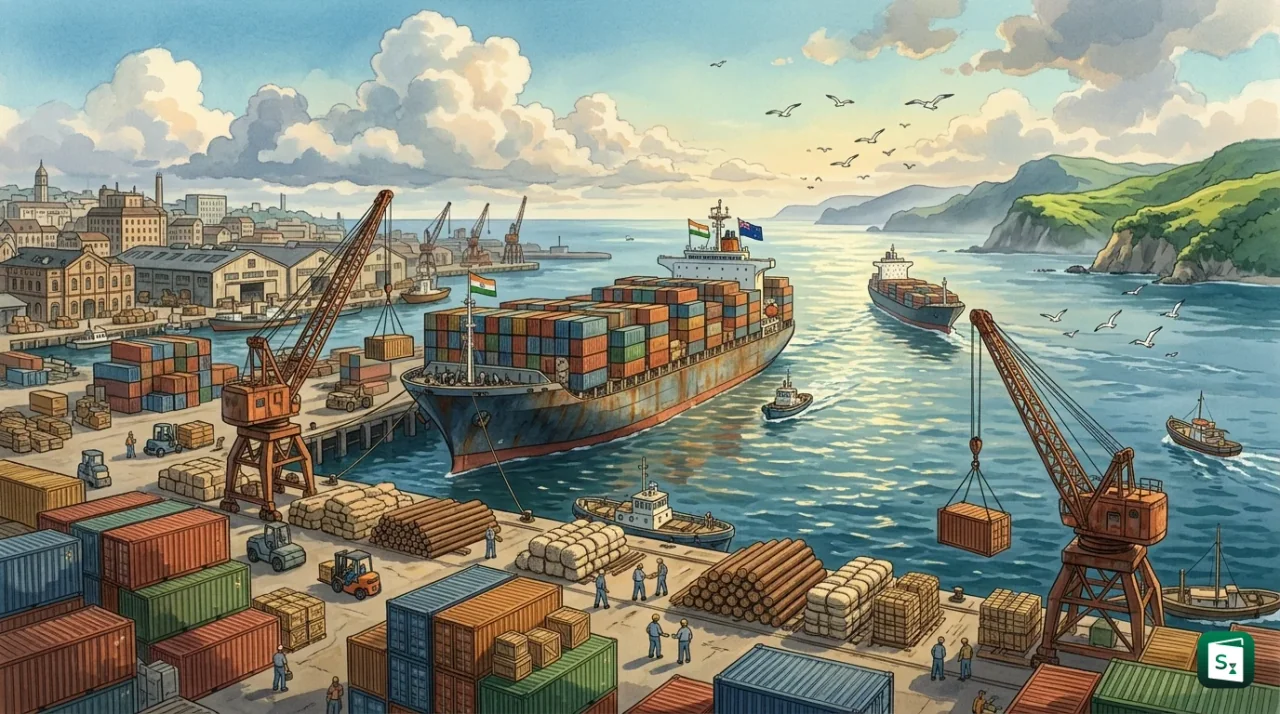
The India New Zealand Free Trade Agreement entered into force on 20 October 2026, on the occasion of Vijay Dashami. Commerce and Industry Minister Piyush Goyal and New Zealand Trade and Investment Minister Todd McClay jointly announced the launch through a virtual conference on 19 October 2026. The deal gives all Indian exports zero duty entry into New Zealand from day one, while India has protected dairy and other sensitive farm goods.
What Is the India New Zealand Free Trade Agreement?
The India New Zealand Free Trade Agreement is a bilateral pact that removes or reduces customs duties on goods, opens services markets, and eases movement of professionals and students between the two countries. India and New Zealand signed the agreement in New Delhi on 27 April 2026 after concluding talks on 22 December 2025. The agreement entered into force on 20 October 2026 after both sides completed ratification on 21 September 2026.
A free trade agreement is a treaty under which two countries lower tariffs (taxes charged at the border on imports) and non tariff barriers for each other. A tariff line is a single product category in the customs classification based on the Harmonised System. New Zealand maintains 8,284 tariff lines. Under this deal, duties on all these lines become zero for goods that meet the rules of origin from the date of entry into force.
For India, the outcome is unusually full. New Zealand eliminated duties ranging from zero to 10 percent, with an average of about 2.2 percent, in one go. For New Zealand, India offered a calibrated opening. India agreed to liberalise 70.03 percent of its tariff lines, which cover about 95 percent of current bilateral trade value. The remaining 29.97 percent of lines stay excluded with no duty cuts.
The agreement is comprehensive. Beyond goods, it covers services trade, investment facilitation, customs procedures, sanitary and phytosanitary measures (rules on food safety and plant and animal health), technical barriers to trade, agriculture cooperation, health and traditional medicine services, and mobility of students and workers.
When Did the India New Zealand FTA Come Into Effect?
The India New Zealand FTA came into effect on 20 October 2026. The Ministry of Commerce and Industry confirmed the date on 21 September 2026 after both countries finished domestic ratification. Exporters in New Zealand can claim tariff benefits from 20 October 2026 by obtaining a Certificate of Origin and sending it to the importer in India.
India and New Zealand launched fresh negotiations on 16 March 2025. Commerce and Industry Minister Piyush Goyal and New Zealand Trade and Investment Minister Todd McClay announced the launch on the eve of the meeting between Prime Minister Narendra Modi and New Zealand Prime Minister Christopher Luxon. Talks moved through five formal rounds between May and December 2025, with intersessional meetings in between, and concluded in about nine months.
| Date | Milestone |
|---|---|
| 16 March 2025 | India and New Zealand launch FTA negotiations |
| 22 December 2025 | Substantive conclusion of negotiations announced |
| 27 April 2026 | India New Zealand FTA signed in New Delhi at Bharat Mandapam |
| 21 September 2026 | Ratification processes completed in both countries |
| 20 October 2026 | FTA enters into force on Vijay Dashami |
The speed marks a break from the past. India and New Zealand had earlier negotiated between April 2010 and 2015 for ten rounds, but those talks stalled when India prioritised the Regional Comprehensive Economic Partnership (RCEP) talks. India later withdrew from RCEP in 2019. The 2025 to 2026 deal is therefore described by both governments as one of the fastest concluded free trade agreements by India with a developed country.
What India Gains: 100 Percent Duty Free Access on 8,284 Tariff Lines
New Zealand will eliminate duties on 100 percent of Indian exports from entry into force across all sectors. This helps labour intensive and farm linked exports that earlier faced peak tariffs up to 10 percent. The benefit applies only to originating goods, which means goods that meet the agreed rules of origin on where they are made or processed.
| Sector | Pre FTA Peak Tariff in New Zealand | Key Indian Exports That Benefit |
|---|---|---|
| Textiles and apparel | Up to 10 percent | Garments, fabrics, yarn, carpets and home textiles |
| Leather and footwear | Up to 10 percent | Footwear, bags, belts and finished leather |
| Engineering goods | Up to 10 percent | Auto parts, machinery, tools, tractors and irrigation equipment |
| Marine products | Up to 5 percent | Shrimp, fish and processed seafood |
| Agriculture and allied products | Up to 5 percent | Spices, fruits, vegetables, basmati rice and processed foods |
| Pharmaceuticals and medical devices | Up to 5 percent | Generic medicines, active pharma ingredients and AYUSH products |
| Plastics, rubber and chemicals | Up to 10 percent and up to 5 percent | Pipes, packaging, rubber goods and specialty chemicals |
| Electronics and electrical goods | Up to 10 percent | Components, wiring and instruments |
The zero duty access supports micro, small and medium enterprises (MSMEs), artisans, farmers, women led firms and young entrepreneurs. It also improves the position of Indian goods against competitors that already enjoy preferences in New Zealand.
The first symbolic shipment was flagged off around the entry into force announcement. Commerce Minister Piyush Goyal flagged off the first ever JCB machine export from India to New Zealand, signalling opportunities for construction and farm machinery. The two sides expect the deal to also serve as a gateway for Indian firms to the wider Oceania and Pacific Island markets.
What India Offered: 70.03 Percent Opening With Farm Safeguards
India agreed to open 70.03 percent of its tariff lines to New Zealand, covering about 95 percent of current New Zealand exports to India. The opening is staggered. Duties fall at once on some goods, step down over 3, 5, 7 and 10 years on many others, and fall only partly on a small set.
| Category | Share of Tariff Lines | Treatment | Examples |
|---|---|---|---|
| Immediate elimination | 30.00 percent | Zero duty from 20 October 2026 | Wood and logs, wool, sheep meat, raw hides, coal |
| Phased elimination | 35.60 percent | Zero duty in 3, 5, 7 or 10 equal yearly cuts | Petroleum oils, malt extract, vegetable oils, selected electrical and mechanical machinery |
| Tariff reduction only | 4.37 percent | Duty cut to half or to 2.5 percent, but not zero | Wine, pharma drugs, polymers, aluminium and iron and steel articles |
| Tariff rate quotas | 0.06 percent | Limited quantity at lower duty with price and seasonal conditions | Manuka honey, apples, kiwifruit and albumins including milk albumin |
| Exclusion list | 29.97 percent | No duty cut | Dairy, onions, chana, peas, corn, sugar and arms |
From day one, about 57 percent of current New Zealand exports to India become duty free. The share is set to rise to 82 percent after full phase in, with another 13 percent getting sharp tariff cuts.
Sensitive Sectors India Kept Excluded
India kept its most sensitive farm and strategic items fully outside duty cuts. The list includes milk, cream, whey, yoghurt, cheese, butter and other core dairy products, animal products other than sheep meat, onions, chana, peas, corn, almonds, sugar, artificial honey, animal and vegetable fats and oils, gems and jewellery, copper and aluminium items such as cathodes and ingots, and arms and ammunition. This protects dairy farmers and growers of pulses, oilseeds and horticulture produce.
Calibrated Access for Apples, Kiwifruit, Wine and Honey
For a few sensitive fruits and niche products, India allowed limited quotas with a minimum import price and seasonal windows. These tariff rate quotas (TRQs) let a fixed quantity enter at a lower duty, while imports above the quota pay the normal most favoured nation duty.
Apples face a base duty of 50 percent. Within quota, from 1 April to 31 August each year, shipments priced at or above $1.25 per kg pay 25 percent. The quota grows from 32,500 tonnes in year one to 45,000 tonnes from year six. Kiwifruit has a base duty of 33 percent. Within quota, shipments priced at or above $1.80 per kg enter at zero duty for a quantity that rises from 6,250 tonnes to 15,000 tonnes. Manuka honey and albumins get similar small but growing quotas. Wine keeps a 150 percent base duty for cheap bottles below $5 per 750 ml bottle, while premium bottles above $15 step down from 75 percent at entry to 25 percent by year ten.
How Will the FTA Change Services, Student Mobility and Visa Rules?
New Zealand has made its best services offer to India so far, with commitments across 118 services subsectors and most favoured nation treatment in 139 subsectors. This means New Zealand promises not to treat Indian suppliers worse than suppliers from any other country in those areas. Key areas include computer services, professional services, audio visual services, telecom, construction, tourism and travel, finance technology, education and environmental services.
The health and traditional medicine chapter is a first for New Zealand. New Zealand has agreed to facilitate trade in Ayurveda, Yoga and other traditional medicine services. The schedule covers AYUSH disciplines (Ayurveda, Yoga and Naturopathy, Unani, Siddha, Sowa Rigpa and Homeopathy) alongside Maori health practices. This supports wellness providers, medical value travel and collaboration in yoga and traditional care.
On mobility, the FTA creates a new Temporary Employment Entry (TEE) pathway for up to 5,000 Indian professionals in New Zealand at any one time for stays up to three years. Most places are linked to skilled roles on New Zealand Green List (the official list of occupations with skill shortages), such as information technology, engineering, health care, education and construction. A small number cover iconic Indian occupations such as AYUSH practitioners, yoga instructors, Indian chefs and music teachers. Applicants still need a job offer from an accredited employer and must meet qualification, English language, health and character conditions. The visa does not lead directly to residence.
Students gain clearer rights. Indian students can work up to 20 hours per week while studying, a commitment that holds even if domestic policy changes. Post study work rights are extended for Indian graduates. Holders of a science, technology, engineering and mathematics bachelor degree can stay up to three years, master degree holders up to three years, and doctoral holders up to four years.
A new working holiday scheme will start within two years of entry into force. It will allow 1,000 Indians aged 18 to 30 each year to spend up to 12 months in New Zealand with rights to work to support the stay.
Investment, Farm Productivity and Other Cooperation
New Zealand has committed to facilitate $20 billion in investment into India over 15 years. The funds are expected to support manufacturing, food processing, renewable energy, services and jobs linked to MSMEs and women led enterprises. The commitment signals confidence in Indian growth and builds on models such as the India European Free Trade Association deal, which links investment to jobs.
Agriculture cooperation is paired with market access. India and New Zealand will run an Agricultural Productivity Partnership with Centres of Excellence for apples, kiwifruit and honey. Work includes better planting material, orchard management, post harvest handling, cold chains, food safety and training for growers. All quota access for these products is monitored by a Joint Agriculture Productivity Council, so productivity support moves with trade opening.
Other gains include faster pharma access and simpler borders. Indian drug makers get a fast track process in New Zealand, while customs rules require release of goods within 48 hours of arrival and efforts to clear perishables and express consignments within 24 hours. A dedicated committee on biosecurity, food and primary products will help resolve sanitary and technical barriers. The FTA will be reviewed within one year of entry into force and every two years after that, which leaves room to deepen dairy and other left out areas. India also secured a promise that if India gives dairy access to a comparable partner in future, New Zealand can seek consultations for similar treatment.
Why the Agreement Matters for Bilateral Trade
Merchandise trade between India and New Zealand stood at about $1.3 billion in 2024 to 25, up 49 percent from $873 million in 2023 to 24. Indian exports rose to $711 million, up 32 percent, while imports from New Zealand were about $600 million. India kept a surplus of about $111 million. Services add more depth. Indian services exports to New Zealand reached $634 million in 2024, up 13 percent, led by travel, information technology and business services.
New Zealand is a high income economy with per capita income of about $49,380, imports of $47 billion and exports of $42 billion in 2024. Yet it ranks only around 21st as a goods export market for New Zealand and around 71st as an export destination for India. High tariffs had held back exchange. Both sides now aim to double bilateral trade in five years. Around 300,000 people of Indian origin live in New Zealand, about 5 percent of its population, and form a bridge for demand, tourism and talent flows.
The deal fits into a wider set of Indian trade agreements. India has signed 17 free trade agreements so far, of which 16 were already in force before 20 October 2026. Recent pacts include Mauritius (2021), the United Arab Emirates (2022), Australia (2022), the European Free Trade Association with Iceland, Liechtenstein, Norway and Switzerland (signed 2024, in force 1 October 2025), the United Kingdom (signed 24 July 2025, in force 15 July 2026) and Oman (signed 18 December 2025, in force 1 June 2026). Talks with the European Union were concluded on 27 January 2026. India stayed out of RCEP after withdrawing in 2019, and is now building bilateral deals that protect farm interests while opening labour intensive exports and services.
Key Takeaways
- The India New Zealand FTA entered into force on 20 October 2026 after signing on 27 April 2026 in New Delhi.
- New Zealand gives 100 percent duty free access on all 8,284 tariff lines to Indian originating goods from day one.
- India liberalised 70.03 percent of tariff lines covering 95 percent of bilateral trade value, while 29.97 percent stays excluded.
- Core dairy products, onions, chana, peas, sugar and vegetable fats and oils are fully excluded to protect Indian farmers.
- New Zealand will facilitate $20 billion investment into India over 15 years and open 118 services sectors with mobility for 5,000 TEE visa holders and post study work up to four years for PhDs.