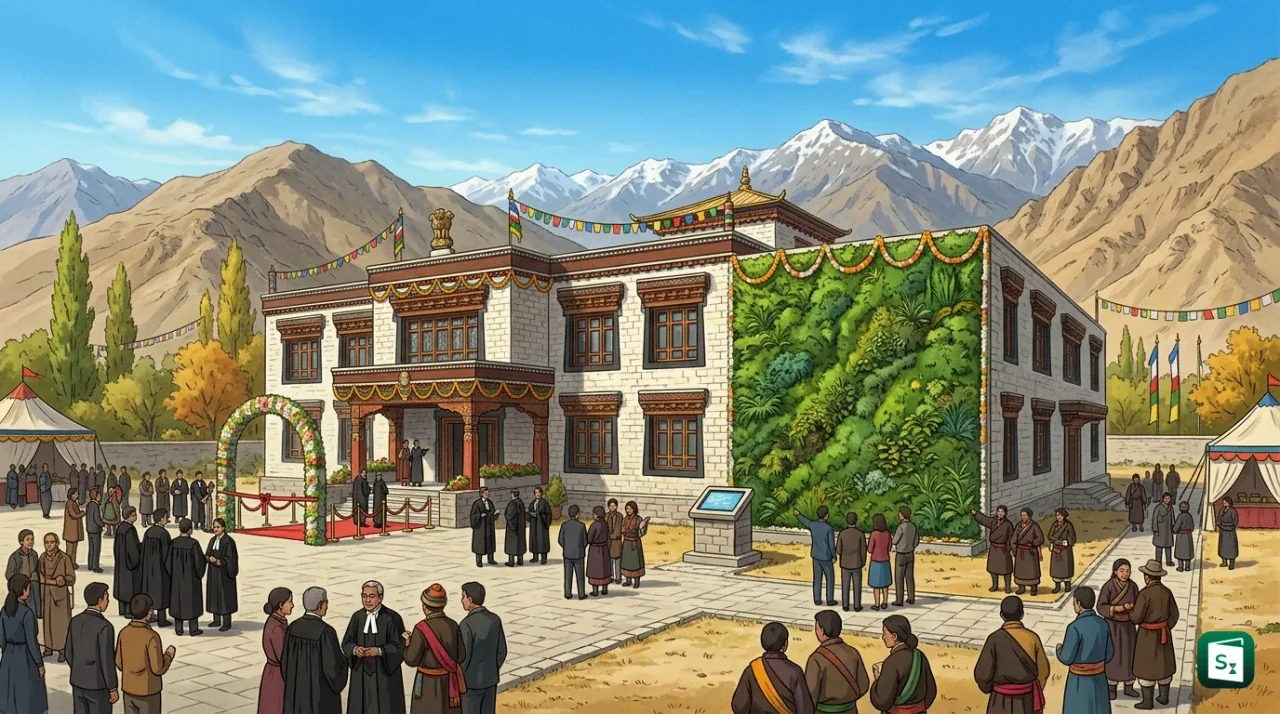
Chief Justice of India Surya Kant inaugurated the Ladakh Bench of the High Court of Jammu and Kashmir and Ladakh at Melongthang in Leh on 18 October 2026. The new permanent bench, located at an altitude of about 3,500 metres, will serve litigants of Leh and Kargil and began regular judicial sittings on 21 October 2026. At the same ceremony, the Chief Justice launched four initiatives covering green cover, e-filing, digital records and transparent recruitment.
Does Ladakh Have a High Court? Where Is the Ladakh Bench Located?
The Ladakh Bench is a permanent bench of the High Court of Jammu and Kashmir and Ladakh, located at Melongthang in Leh. Ladakh does not have a separate High Court. All cases from Ladakh fall under this common High Court, whose principal seats are at Jammu and Srinagar.
The High Court of Jammu and Kashmir and Ladakh is the common High Court for the Union Territories of Jammu and Kashmir and Ladakh. A common High Court means one High Court serves two territories instead of each having its own. Ladakh comes under this court for all High Court matters, and the new bench at Leh brings its physical presence to Ladakh for the first time.
The Ladakh Bench functions from the High Court Complex at Melongthang, Leh, at an altitude of about 3,500 metres (over 11,500 feet). This makes it the highest altitude High Court bench in India. The complex has been equipped as a fully IT enabled and paperless court. It includes a digitisation centre, filing counter, bar room, litigants sitting area, conference room and video conferencing room to support daily hearings without shifting files on paper.
High Court of Jammu Kashmir and Ladakh: Parent Court and Jurisdiction Base
The High Court of Jammu and Kashmir and Ladakh traces its roots to the High Court of Judicature established in 1928 by Order No. 1 dated 26 March 1928. The first Chief Justice was Lala Kanwar Sein, with two puisne judges. Puisne judges are judges of a High Court other than the Chief Justice. The usual places of sitting were Jammu and Srinagar, and the court later gained powers of superintendence over subordinate courts along with writ powers for protection of fundamental rights.
The present position of the court flows from the Jammu and Kashmir Reorganisation Act, 2019. Parliament passed this law after the changes to Article 370 of the Constitution. From 31 October 2019, the former state was split into two Union Territories, Jammu and Kashmir and Ladakh. The old Jammu and Kashmir High Court became the common High Court for both Union Territories. Ladakh initially comprised Leh and Kargil districts, with Leh as a main administrative centre.
The Union Cabinet approved the proposal for a bench in Ladakh in August 2026. The bench was then formally created under the Union Territory of Ladakh (Sitting of Bench of the High Court in Ladakh) Regulation, 2026, issued by the President under Article 240 of the Constitution read with Section 58(2) of the Reorganisation Act. Article 240 gives Parliament and the President the power to make regulations for certain Union Territories. This legal backing makes the Leh bench a permanent bench, not a temporary circuit sitting.
| Year | Milestone for the Court and Ladakh |
|---|---|
| 1928 | High Court of Judicature established for Jammu and Kashmir state |
| 1954 | Jurisdiction of the Supreme Court extended to Jammu and Kashmir |
| 2019 | Reorganisation Act creates Union Territories of Jammu and Kashmir and Ladakh on 31 October |
| August 2026 | Union Cabinet approves High Court bench for Ladakh |
| 18 October 2026 | Ladakh Bench inaugurated at Melongthang, Leh |
Who Is Justice Surya Kant?
Justice Surya Kant is the 53rd Chief Justice of India, sworn in on 24 November 2025. Born on 10 February 1962 at Hisar in Haryana, he rose from district court practice to the Supreme Court. His tenure as Chief Justice runs until retirement on 9 February 2027.
The Chief Justice of India is the head of the Supreme Court and the Indian judiciary. Justice Surya Kant is the first person from Haryana to hold this post. He started practice at the District Court in Hisar in 1984 and shifted to the Punjab and Haryana High Court in Chandigarh in 1985, where he handled constitutional, service and civil matters.
Justice Surya Kant became the youngest Advocate General of Haryana on 7 July 2000. An Advocate General is the chief law officer of a state government. He was designated Senior Advocate in March 2001 and became a permanent judge of the Punjab and Haryana High Court on 9 January 2004. He served as Chief Justice of Himachal Pradesh High Court from 5 October 2018 and was elevated as a judge of the Supreme Court of India on 24 May 2019.
As a Supreme Court judge, Justice Surya Kant was part of several widely reported benches, including those on the abrogation of Article 370, the suspension of the colonial era sedition law, the Pegasus spyware inquiry, electoral roll revision and reservation of seats for women in bar associations. He took oath as Chief Justice on 24 November 2025 after appointment on 30 October 2025, succeeding Justice B R Gavai. His tenure of about 15 months places the Ladakh Bench inauguration within the early phase of his term.
Inauguration Ceremony at Melongthang in Leh: What Happened
The Chief Justice of India inaugurated the Ladakh Bench on 18 October 2026 at the High Court Complex in Melongthang, Leh. The Chief Justice received a ceremonial Guard of Honour on arrival, unveiled the inauguration plaque and took a guided tour of the court complex. The formal function opened with the National Song and National Anthem, followed by a welcome address by Dr Justice Pushpendra Singh Bhati, Chief Justice of the High Court of Jammu and Kashmir and Ladakh.
The dais included Supreme Court judges Justice M M Sundresh, Justice P S Narasimha and Justice Arun Palli, Attorney General R Venkataramani, Ladakh Lieutenant Governor Vinai Kumar Saxena and High Court judges Justice Sanjeev Kumar, Justice Sindhu Sharma and Justice Rajnesh Oswal. Chief Secretary Ashish Kumar Kundra, former High Court Chief Justice Justice Tashi Rabstan, the Registrar General M K Sharma, Additional and Deputy Solicitors General, senior officers of the civil administration, police and Army, and presidents of the Bar Associations of Leh and Kargil also attended. The presence of both Leh and Kargil Bars underlined that the bench will serve the whole Union Territory.
In his address, the Chief Justice linked the bench to Article 39A of the Constitution. Article 39A, added by the 42nd Amendment in 1976, directs the state to provide free legal aid so that no citizen is denied justice due to poverty or other disability. He said Ladakhis had waited patiently since becoming a separate Union Territory and had to brave snow, landslides and flight cancellations to reach Jammu or Srinagar. Regular hearings at Leh began on 21 October 2026. A Division Bench of Chief Justice Pushpendra Singh Bhati and Justice Sanjay Parihar took up the first batch, while Justice Parihar also held Single Bench sittings on 22 and 23 October. A Division Bench means a bench of two judges, while a Single Bench means a bench of one judge.
The High Court identified 75 cases from Ladakh for listing before the new bench in the opening week. The bench will initially sit twice a week with judges on rotation from Jammu and Srinagar. To reduce travel to New Delhi, the Chief Justice announced that Supreme Court cases from Ladakh will be bunched and listed on a single day and heard through video conferencing once facilities at Leh are fully ready. He also called for recruitment of local youth in court staff, e-Sewa Kendras and stronger legal aid. An e-Sewa Kendra is a help centre inside court premises where litigants can get information, filing help and video hearing support.
Four Initiatives Launched: Green Wall and Digital Judicial Services
The Chief Justice launched four initiatives at the inauguration to combine environmental care with digital access and fair hiring. The Lieutenant Governor highlighted the Green Wall as a step for ecological sustainability in the cold desert of Ladakh. Ladakh gets very low rainfall, faces dust winds and soil loss, and has a short growing season, so organised plantation and protection of green patches around public buildings carry special value.
The other three initiatives are digital. The e-Filing Portal for the Ladakh Bench allows advocates and litigants to file cases online without travelling to court. This matters in a region where villages are far apart and winter road closures can stop movement for weeks. The Document Management System (DMS) stores case files, orders and records in digital form so judges and staff can search, share and preserve them without paper bundles. The Online Recruitment Portal of the High Court will handle future hiring for the High Court and district judiciary through online applications, notices and updates. The stated aim is to make recruitment more transparent, accessible and efficient.
| Initiative | What It Does | Why It Matters for Ladakh |
|---|---|---|
| Green Wall | Plantation and green cover around court premises | Supports conservation in a fragile cold desert ecology |
| e-Filing Portal | Online filing of cases for Ladakh Bench | Saves travel to Jammu or Srinagar for advocates in remote areas |
| Document Management System | Digital storage and retrieval of judicial records | Enables paperless working and faster case tracking |
| Online Recruitment Portal | Online process for High Court and district judiciary jobs | Improves transparency and access for local youth |
The Chief Justice also initiated work for solar power systems at 11 locations connected with the judiciary. Solar power fits Ladakh well because the region receives strong sunlight for most of the year despite extreme cold. The move signals a shift toward renewable energy and lower running costs for court infrastructure, along with the paperless model of the new bench.
Why the Ladakh Bench Matters: Access to Justice at 3500 Metres
The core gain is physical proximity. Until now, a litigant from Nubra, Zanskar, Drass or Changthang had to travel to Srinagar or Jammu for a High Court hearing. That journey often meant flights that get cancelled in winter, long road travel through high passes, hotel stay and loss of workdays. For poor litigants, the cost of travel itself could block access to appeal or writ remedies. A writ is a constitutional remedy under Articles 226 and 32 through which High Courts and the Supreme Court protect fundamental rights.
The bench also strengthens local legal practice. Lawyers of Leh and Kargil can now argue High Court matters from home, appear through hybrid hearings and use e-filing and video links. Hybrid hearing means some participants are present in court while others join online. Over time, regular sittings, legal aid and e-Sewa support are expected to draw more youth from Ladakh into the legal profession and court services. The Chief Justice pointed to a child studying in Kargil or Nubra who may one day argue before this bench and later sit on it as a judge.
The timing carries weight. Ladakh became a separate Union Territory in 2019, and the demand for a local bench grew over the next seven years. The inauguration fulfils a long standing request and completes the basic judicial map for the territory, with district courts at Leh and Kargil now linked to a High Court bench within Ladakh itself. The Lieutenant Governor described it as justice reaching the doorstep, since it cuts travel, cost and delay while keeping the same common High Court and the same law.
High Court Benches in India: The Wider Context
India has 25 High Courts (as of October 2026). High Courts stand at the head of judicial administration in their territory and hear appeals, writs and supervision matters over subordinate courts under Articles 214 to 231 and writ powers under Article 226. Some High Courts serve more than one state or territory. The Bombay, Gauhati and Punjab and Haryana High Courts are well known common courts, and the Jammu and Kashmir and Ladakh High Court belongs to this group.
Where case load from a distant region is large, a permanent bench sits through the year at a place other than the principal seat. A permanent bench has judges posted to hear cases regularly at that location. Where the load is smaller, a circuit bench holds sittings for a few weeks or days in a year, with judges travelling from the principal seat. The Ladakh Bench has been created as a permanent bench with twice weekly sittings to start, with scope to scale up as case numbers grow.
| High Court | Principal Seat | Known Bench or Benches |
|---|---|---|
| High Court of Jammu and Kashmir and Ladakh | Jammu and Srinagar | Leh (Ladakh Bench) |
| Allahabad High Court | Prayagraj | Lucknow |
| Bombay High Court | Mumbai | Nagpur, Aurangabad, Panaji |
| Madras High Court | Chennai | Madurai |
| Madhya Pradesh High Court | Jabalpur | Gwalior, Indore |
| Rajasthan High Court | Jodhpur | Jaipur |
| Karnataka High Court | Bengaluru | Dharwad, Kalaburagi |
| Gauhati High Court | Guwahati | Kohima, Aizawl, Itanagar |
| Kerala High Court | Kochi | Covers Lakshadweep (no separate bench) |
This comparison shows why Leh matters. Like Madurai for southern Tamil Nadu, Lucknow for central Uttar Pradesh and Jaipur for eastern Rajasthan, Leh gives a distinct region its own regular High Court presence. For Ladakh, the argument is stronger because of altitude, weather and distance, which make travel to Jammu or Srinagar far harder than travel within the plains.
Key Takeaways
- The Ladakh Bench of the High Court of Jammu and Kashmir and Ladakh was inaugurated at Melongthang, Leh on 18 October 2026 by Chief Justice of India Surya Kant.
- Regular hearings at the Leh bench began on 21 October 2026, with 75 cases listed in the opening week before benches led by Chief Justice Pushpendra Singh Bhati and Justice Sanjay Parihar.
- The four initiatives launched were the Green Wall, e-Filing Portal, Document Management System and Online Recruitment Portal, along with solar power work at 11 locations.
- Ladakh falls under the High Court of Jammu and Kashmir and Ladakh, a common High Court with principal seats at Jammu and Srinagar, first established in 1928.
- Justice Surya Kant is the 53rd Chief Justice of India, sworn in on 24 November 2025 with tenure until 9 February 2027, and is the first CJI from Haryana.