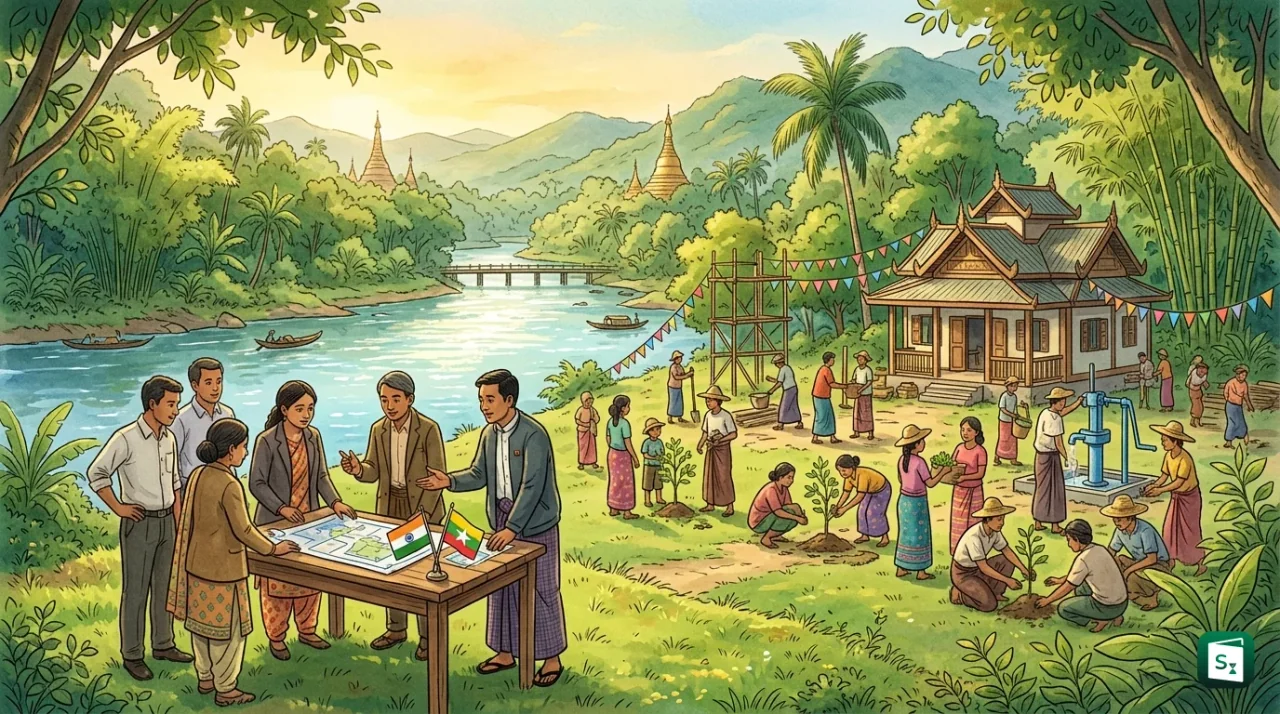
India and Myanmar signed Memorandums of Understanding (MoUs) for five Quick Impact Projects (QIPs) in Naypyitaw on 15 October 2026. The projects together cost $247,502.47 for the financial year 2026-27 and are funded under the Mekong-Ganga Cooperation (MGC) framework. They cover water and sanitation support for schools, road and sports works, boiler training and audit software, and signal continued grassroots cooperation between the two neighbours.
What is a Memorandum of Understanding?
A Memorandum of Understanding (MoU) is a written agreement between two parties that records their shared intent to work together on a specific task. The MoU lists the roles, funds, timelines and monitoring method for that task. It is generally not a strictly enforceable commercial contract, but it creates a formal public commitment that guides implementation.
A MoU signing ceremony is the formal event where authorised representatives sign this document. In government cooperation, the ceremony confirms political consent and starts the project clock. In the Naypyitaw ceremony, the Indian side was represented by First Secretary Amit Shreeansh, and the Myanmar side by Director Generals of the concerned ministries. The signing took place in the presence of senior witnesses, which is the usual practice to show that both governments back the projects.
MoU Signing Ceremony in Naypyitaw
The Ministry of Investment and Foreign Economic Relations of Myanmar hosted the signing ceremony in Naypyitaw on 15 October 2026. Naypyitaw, also spelled Nay Pyi Taw, is the capital city of Myanmar. It houses the union ministries and serves as the venue for most bilateral signing events.
The MoUs were signed by First Secretary Amit Shreeansh of the Embassy of India in Yangon and the Director Generals of the relevant Myanmar ministries. Ambassador of India to Myanmar Abhay Thakur (as of October 2026) and Myanmar Union Minister U Aung Kyaw Hoe, who holds charge of National Planning, Investment and Foreign Economic Relations, attended as witnesses. The Embassy of India announced the outcome on 16 October 2026.
This was the second such signing in two months. A similar set of five MoUs had been signed on 11 September 2026. Myanmar officials stated that India has provided a total of 10 Quick Impact Projects for fiscal year 2026-27, including the five signed in October. The back to back signings show that the annual pipeline for the year is now fully tied up.
What Are the Five Quick Impact Projects?
The five Quick Impact Projects for 2026-27 have a combined value of $247,502.47. Each project costs about $50,000, which fits the standard QIP ceiling under the Mekong-Ganga Cooperation framework. The projects were chosen by Myanmar ministries to meet immediate local needs. They are short duration works with visible results within a year.
| Project | Implementing Ministry or Office | Purpose |
|---|---|---|
| WASH Support for Earthquake-Affected Schools | Ministry of Education | Provide clean drinking water, sanitation and hygiene facilities in schools damaged by the earthquake |
| Upgrading the Village Ring Road at National Races Village | Ministry of Ethnic Affairs | Improve the ring road in Yangon to support public recreation and visitor access |
| Upgrading the Boiler Operator Training Centre | Ministry of Industry and MSME Development | Strengthen training equipment and facilities for boiler operators |
| Construction of Futsal Stadium at Pathein Gyi Boys Training School, Mandalay | Ministry of Social Welfare, Relief and Resettlement | Build sports infrastructure for children in a training school |
| Purchase of CaseWare IDEA Data Analytics Software | Office of the Union Auditor General | Supply audit software to improve data analysis in public audit |
A Quick Impact Project (QIP) is a small grant project that fills a specific gap at community level. QIP stands apart from large infrastructure loans because it uses grants, not credit. The gestation period is normally up to one year. Examples include solar electrification, school buildings, health posts, farm equipment and disaster relief stores.
In July 2026, Ambassador Thakur handed over solar systems for 50 households of earthquake affected ethnic families in Inle in Taunggyi. That solar project was also a QIP under the same framework. It shows how QIPs are used for quick relief and recovery after the March 2025 earthquake in Myanmar.
What is Mekong-Ganga Cooperation?
The Mekong-Ganga Cooperation (MGC) is a sub regional cooperation group formed by India and five Southeast Asian nations to promote cooperation in tourism, culture, education, and transport and communications. The MGC was launched on 10 November 2000 in Vientiane, Lao PDR, with the signing of the Vientiane Declaration. The group is named after the Ganga river in India and the Mekong river in Southeast Asia, two civilisational rivers that link the people of the region.
The MGC began with four core areas. The scope has since expanded to health and traditional medicine, agriculture, small and medium enterprises, water resources management, science and technology, skill development and capacity building. The working system includes an Annual Ministerial Meeting held alongside the ASEAN Ministerial Meeting, a Senior Officials Meeting, and five working groups. The meetings are co chaired every year by India and one Mekong country. The 12th Foreign Ministers Meeting was held in Bangkok in July 2023.
Member Countries and Institutional Framework
The MGC has six members. India is the only South Asian member. The other five are in Southeast Asia and are also members of ASEAN.
| Member Country | Lead Role in MGC Working Group |
|---|---|
| India | Education and human resource development |
| Thailand | Tourism |
| Cambodia | Culture |
| Lao PDR | Communications and transportation |
| Vietnam | Plan of Action |
| Myanmar | Member country and beneficiary of connectivity and QIP support |
The MGC Plan of Action guides cooperation for a fixed period and is reviewed by ministers. India funds an MGC Scholarship Scheme through the Indian Council for Cultural Relations (ICCR) for students from Mekong countries to study in India. The official MGC portal is maintained by the Ministry of External Affairs in New Delhi.
Quick Impact Projects Under the Framework
The Government of India announced Quick Impact Projects for Cambodia, Lao PDR, Myanmar and Vietnam, together called CLMV, at the 6th MGC Ministerial Meeting in New Delhi on 4 September 2012. The programme created an India CLMV QIP Revolving Fund with an annual contribution of $1 million. The fund was later raised to $1.25 million after the India Cambodia Joint Statement in 2018 and to $2 million after the India Vietnam Summit in 2020.
Each QIP costs not more than $50,000. The emphasis is on short duration and high visibility, with completion normally within one year. Projects cover roads, community centres, education, health, sanitation and community development. Joint Project Monitoring Committees with members from both sides track progress.
As of 31 July 2026, the MGC portal reports 199 sanctioned QIP schemes since 2015-16, of which 155 are completed and 44 are under implementation. The country split is given below.
| Country | Sanctioned | Completed | Under Implementation |
|---|---|---|---|
| Cambodia | 72 | 50 | 22 |
| Vietnam | 66 | 56 | 10 |
| Lao PDR | 36 | 33 | 3 |
| Myanmar | 25 | 16 | 9 |
For 2026-27, another 27 QIPs were under approval across all four countries, including 10 in Myanmar. Under the bilateral Framework Agreement on QIPs, India has committed up to $500,000 per year for such projects in Myanmar. Indian officials note that more than 25 QIPs have been sanctioned across states and regions of Myanmar in sectors such as renewable energy, civic infrastructure, agriculture, rural development, education, handloom, disaster risk reduction and cultural restoration.
Why Myanmar is Important for India
Myanmar is important for India because it is the only Southeast Asian country that shares both land and maritime borders with India and serves as the land bridge between Northeast India and Southeast Asia. Myanmar is central to the Act East Policy, border security for four northeastern states, and alternate sea access for the Northeast through the Bay of Bengal.
Myanmar is India’s gateway to ASEAN. India launched the Look East Policy in the early 1990s to rebuild economic links with Southeast Asia. The policy was upgraded to the Act East Policy, announced at the East Asia Summit in Myanmar in November 2014. The Act East Policy places the North Eastern Region at the centre of engagement with Southeast Asia and focuses on cross border connectivity, trade, culture and security.
India Myanmar relations rest on history, culture and Buddhism, along with practical interests. Bilateral trade moves through land border posts and sea routes, and includes farm produce, timber, fish, garments, medicines and construction material. Development cooperation is a core pillar. India assistance, valued at about $1.5 billion with nearly $1 billion as grants, ranges from large connectivity works to grassroots assets like schools, solar power, hospitals and farm machinery. The Myanmar Institute of Information Technology in Mandalay and the 200 bedded Women and Children Hospital in Monywa are examples of institution building supported by India.
Security cooperation is equally vital. Stability along the border affects Manipur, Mizoram, Nagaland and Arunachal Pradesh. Both sides work on insurgent movement, arms and drug smuggling, and management of displacement after the 2021 military takeover in Myanmar. India has also provided humanitarian help after natural disasters, including relief after the March 2025 earthquake.
Connectivity Context: Kaladan Project, Sittwe Port and India Myanmar Thailand Trilateral Highway
Large connectivity projects form the backdrop to small QIPs. The QIPs build local goodwill, while the big corridors aim to cut cost and time for the Northeast.
The Kaladan Multi Modal Transit Transport Project (KMMTTP) is a joint initiative of India and Myanmar to create an alternate route from eastern India to Northeast India. The route combines sea, river and road. A ship travels 539 km from Kolkata to Sittwe Port in Rakhine State through the Bay of Bengal. Goods then move 158 km by inland vessel along the Kaladan river from Sittwe to Paletwa jetty. From Paletwa, a 109 km two lane road links to Zorinpui in Mizoram.
Sittwe Port sits at the mouth of the Kaladan river. The port was built with Indian funding at a cost of about $120 million under a Framework Agreement for construction and operation of the transit facility. The waterway section was completed and inaugurated in May 2023, when the first Indian cargo ship reached Sittwe. By 15 May 2026, the port had handled more than 301 vessels. The road section from Paletwa to Zorinpui is still under construction. Once fully open, the project is expected to cut transport time and cost by more than 50 percent on the Kolkata to Aizawl route compared with the long road journey through Siliguri, also called the Chicken Neck.
The India Myanmar Thailand Trilateral Highway is a 1,360 km four lane highway under construction. It connects Moreh in Manipur to Mae Sot in Thailand through Myanmar. The road work on the Tamu to Kalewa section was completed and handed over to Myanmar in 2009. Work on the Kalewa to Yargi section progressed in phases, with a stretch handed over in October 2025. The highway is a flagship of the Act East Policy and is meant to boost trade, tourism and people to people contact. Progress has slowed in parts of Sagaing region due to conflict after 2021, damaged bridges and displacement.
India is also developing Integrated Check Posts and Border Haats to support legal trade and local livelihoods along these corridors.
India Myanmar Border and Neighbourhood Geography
India and Myanmar share a 1,643 km land border along with a maritime boundary in the Bay of Bengal. Four northeastern states touch Myanmar. Arunachal Pradesh accounts for 520 km, Nagaland for 215 km, Manipur for 398 km and Mizoram for 510 km. The boundary was formally delimited by a bilateral treaty signed on 10 March 1967, and about 1,472 km has been demarcated on ground.
The border is guarded by the Assam Rifles. The Assam Rifles was raised in 1835, is headquartered in Shillong, and is often called the Sentinels of the Northeast. It functions under the administrative control of the Ministry of Home Affairs and the operational control of the Indian Army. The force also handles counter insurgency duties in the Northeast.
The border region has deep ethnic ties. For decades, local residents could move without strict checks under the Free Movement Regime (FMR). In December 2024, India regulated the regime to allow visa free movement only up to 10 km, down from 16 km earlier. The Union Government announced in February 2024 that the entire border would be fenced with an anti cut and anti climb fence. The Cabinet Committee on Security approved a project worth about ₹31,000 crore for fencing and border roads. The Border Roads Organisation is the construction agency. Only a small portion was complete by mid 2025, and work continues in Manipur, Mizoram and Nagaland amid forest terrain and local concerns.
The Way Forward
The five new MoUs complete the 10 project pipeline for 2026-27 in Myanmar. The next test is execution within the one year QIP cycle. Joint Project Monitoring Committees will need to certify completion and ensure that assets like school WASH blocks, the ring road, the training centre, the futsal stadium and the audit software remain in active use.
For India, the larger goal is to link quick local gains with steady progress on the Kaladan road link and the Trilateral Highway. Small grants keep development partnership visible in villages and towns even when large corridors face delays. If QIPs are completed on time and the two flagship corridors advance toward full operation by 2027, India Myanmar connectivity will move from promise to daily use for trade, education and health in the border region.
Key Takeaways
- Five MoUs for Quick Impact Projects worth $247,502.47 were signed in Naypyitaw on 15 October 2026 for FY 2026-27 under the Mekong-Ganga Cooperation.
- The Mekong-Ganga Cooperation was launched on 10 November 2000 in Vientiane with six members: India, Cambodia, Lao PDR, Myanmar, Thailand and Vietnam.
- Each QIP costs not more than $50,000 with completion normally within one year, and 199 QIPs have been sanctioned since 2015-16, of which 155 are completed.
- Sittwe Port in Rakhine State was inaugurated in May 2023 as part of the Kaladan Multi Modal Transit Transport Project linking Kolkata to Mizoram via Sittwe and Paletwa.
- The India Myanmar Thailand Trilateral Highway is 1,360 km long and connects Moreh in Manipur to Mae Sot in Thailand through Myanmar.