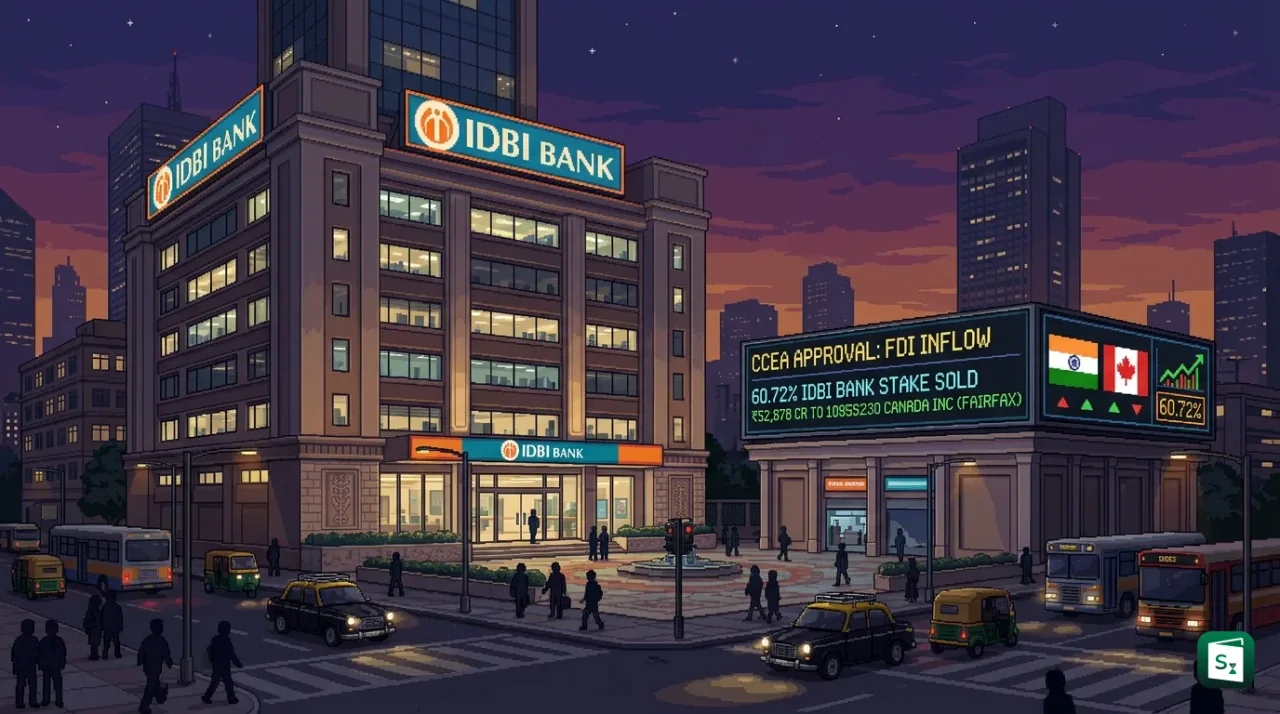
The Cabinet Committee on Economic Affairs (CCEA) approved the sale of a 60.72% stake in IDBI Bank Ltd to 10955230 Canada Inc, a wholly owned subsidiary of Canada based Fairfax Financial Holdings Ltd, for ₹52,878.08 crore on 14 October 2026. The IDBI Bank stake sale includes 30.48% held by the Government of India and 30.24% held by the Life Insurance Corporation of India (LIC). Once completed, the transaction will become the largest Foreign Direct Investment (FDI) in India’s financial sector so far.
What Is the IDBI Bank Stake Sale Approved by CCEA?
The IDBI Bank stake sale is the strategic sale of a controlling 60.72% equity stake in IDBI Bank Ltd to Fairfax Financial Holdings through its subsidiary 10955230 Canada Inc for ₹52,878.08 crore at ₹81 per share. The CCEA approved Fairfax as the strategic buyer on 14 October 2026 after a two stage competitive bidding process.
The deal splits the sale between the two existing promoters. The Government of India will sell 30.48% and the Life Insurance Corporation of India (LIC) will sell 30.24%. LIC is India’s largest life insurer and is headquartered in Mumbai. It is owned by the Government of India and functions under the Ministry of Finance.
After the sale, the Government will hold 15% and LIC will hold 19%. Both will withdraw their nominees from the board and become public shareholders. Management control will pass fully to the strategic buyer. The CCEA has also allowed the Alternative Mechanism, an empowered group of ministers, to sell the residual government stake later through the open market.
| Component of IDBI Bank Stake Sale | Detail |
|---|---|
| Strategic buyer | 10955230 Canada Inc (parent entity Fairfax Financial Holdings Ltd, Canada) |
| Total stake on sale | 60.72% |
| Government of India share on sale | 30.48% (holding will fall from 45.48% to 15%) |
| LIC share on sale | 30.24% (holding will fall from 49.24% to 19%) |
| Purchase price | ₹52,878.08 crore (about $5.6 billion) at ₹81 per share |
| Benchmark valuation | ₹75.99 per share fixed by two independent valuation agencies |
| Next steps | RBI fit and proper clearance, share purchase agreement, mandatory open offer, completion expected by end of FY27 |
What Is IDBI Bank and Why Was It Privatised?
IDBI stands for Industrial Development Bank of India. The institution was set up on 1 July 1964 under the IDBI Act, 1964 as a wholly owned subsidiary of the Reserve Bank of India (RBI). The RBI is India’s central bank and banking regulator, headquartered in Mumbai. IDBI worked for 40 years as a Development Financial Institution (DFI). A DFI is a specialised institution that gives long term finance for industry and infrastructure.
IDBI was converted into a banking company on 1 October 2004 under the IDBI (Transfer of Undertaking and Repeal) Act, 2003. Its headquarters is at IDBI Tower, Cuffe Parade, Mumbai. Today IDBI Bank Ltd is a full service universal bank with more than 2,000 branches, over 3,000 ATMs, total business of ₹6.27 lakh crore (as of 30 September 2026) and a balance sheet of ₹4.11 lakh crore (as of 31 March 2025).
Is IDBI a Government Bank?
IDBI Bank is currently classified as a private sector bank for regulatory purposes by the RBI with effect from 21 January 2019. The classification changed after LIC acquired a 51% controlling stake on that date and took over management control. At present the Government holds 45.48% and LIC holds 49.24%, but control rests with LIC as promoter.
The confusion is natural. The Government had earlier directed departments to treat IDBI Bank as a public sector bank for government business because combined government and LIC holding was close to 95%. After the Fairfax transaction, both the Government and LIC will become public shareholders with no board seats.
Why Was IDBI Bank Privatised?
IDBI Bank was chosen for strategic disinvestment because weak asset quality had forced repeated capital support from public funds. The RBI placed IDBI Bank under the Prompt Corrective Action (PCA) Framework on 5 May 2017 after gross bad loans crossed critical limits. The PCA framework restricts lending, branch expansion and dividend payments until the bank restores capital and asset quality.
Gross non performing assets stood at 31.78% in September 2018. The Government infused about ₹25,000 crore between 2010 and 2020. LIC then infused capital and took control in January 2019. The RBI lifted PCA restrictions on 10 March 2021 after recovery. By March 2026, gross bad loans had fallen to 2.32%, capital adequacy had risen from 6.22% to 26.65%, and net profit touched a record ₹9,513 crore in FY26. The Government decided that private ownership would now bring growth capital and reduce dependence on public funds.
How Was the Strategic Buyer Selected and Valued?
The Department of Investment and Public Asset Management (DIPAM) managed the sale. DIPAM is the department under the Ministry of Finance that handles government equity, disinvestment and asset monetisation. The CCEA gave in principle approval for strategic sale with transfer of management control in May 2021. The Preliminary Information Memorandum inviting Expressions of Interest was issued on 7 October 2022.
Only bidders cleared as fit and proper by the RBI and cleared for security by the Ministry of Home Affairs could enter the bidding stage. Five parties submitted initial interest. Four met the eligibility conditions. Two submitted final techno financial bids. The two qualified bidders were Fairfax Financial Holdings and Dubai based Emirates NBD.
The price discovery was careful. An earlier round set a reserve price of ₹94.42 per share, but bids fell short and the process was paused in March 2026. IDBI shares were narrowly traded and volatile. The price moved between ₹61.01 and ₹118.38 during the valuation period. It stood at ₹42.40 before the 2022 interest announcement and ₹108.12 before financial bids were invited on 8 January 2026.
The Government therefore ignored the market price and used independent valuation. Two professional agencies used the market multiple method based on closing accounts of all public sector banks on 31 March 2026, plus an asset valuation covering land, buildings and liabilities. The average benchmark came to ₹75.99 per share. Fairfax bid ₹81 per share, above the benchmark and above fair value estimates. The Core Group of Secretaries on Disinvestment and the Alternative Mechanism recommended the bid. The CCEA accepted it.
| Milestone in IDBI Bank Disinvestment | Date |
|---|---|
| CCEA in principle approval for strategic sale | May 2021 |
| Expression of Interest invitation | 7 October 2022 |
| Security and RBI fit and proper clearance | July 2024 |
| Financial bids invited, reserve price ₹94.42 | January 2026 |
| Bids below reserve, process paused | March 2026 |
| Revised best offer bids invited | May to July 2026 |
| CCEA approves Fairfax at ₹81 per share | 14 October 2026 |
Who Is Fairfax Financial Holdings and What Are Its Plans?
Fairfax Financial Holdings Ltd is a Canada based financial holding company founded and led by India born billionaire Prem Watsa. The company is listed in Toronto and invests in insurance, banking and financial services across the world. In India, Fairfax invests through Fairfax India Holdings Corporation. Its Indian portfolio includes Bengaluru airport, Go Digit General Insurance and Go Digit Life Insurance (together called Digit), IIFL Capital Services, 5paisa and CSB Bank.
Under the bid, the Fairfax purchaser will pay about 23% premium over IDBI Bank’s book value as of 30 June 2026. The group plans to fund the deal through cash reserves, existing credit lines, dividends and asset sales. Fairfax expects current Managing Director and Chief Executive Officer Rakesh Sharma to continue leading the combined business. The group has proposed N. S. Kannan, former chief of ICICI Prudential Life Insurance, as chairperson, subject to RBI approval. It also plans to use advisers Deepak Parekh, former HDFC Ltd chairman, and Paresh Sukthankar, former HDFC Bank deputy managing director, along with former CSB Bank chief C. V. R. Rajendran.
Fairfax wants to build a unified financial group around IDBI Bank. It plans to contribute its interests in Digit and IIFL Capital Services into IDBI Bank at market prices, subject to regulatory approvals. The combined group would offer banking, general insurance, life insurance, investment banking, broking, wealth management and asset management from one platform. Fairfax has said its aim is to make IDBI Bank a leading global Indian bank headquartered in India.
A key condition concerns CSB Bank, a Kerala based private bank in which Fairfax holds about 40%. RBI rules do not allow one promoter to control two banks at the same time. Fairfax must therefore merge CSB Bank with IDBI Bank or exit one of the banks within two years of completing the IDBI acquisition. RBI promoter norms will also require Fairfax to reduce its 60.72% holding to 40% within 10 years and to 26% within 15 years, with a five year lock in period at the start. The transaction also needs a mandatory open offer to minority shareholders under rules supervised by the Securities and Exchange Board of India (SEBI). SEBI is India’s capital market regulator, established in 1988 and given statutory powers through the SEBI Act, 1992. It is headquartered in Mumbai.
Why This Deal Matters for Banking and the Economy
The CCEA has described the IDBI Bank restructuring as the largest FDI in the financial sector so far. Foreign investment up to 74% is allowed in private banks under Indian rules, with at least 26% held by resident Indians. A deal of ₹52,878 crore at one stroke brings long term foreign capital into banking. It also reduces future pressure on the budget to recapitalise the bank.
The deal advances the Government’s strategic disinvestment policy. Strategic disinvestment means sale of substantial government equity along with transfer of management control. Privatisation is its subset where control passes to a private buyer. After Air India and Neelachal Ispat Nigam, IDBI Bank is the next large strategic sale under this policy. The Government’s share of about ₹26,540 crore will help cross the disinvestment and asset monetisation target of ₹80,000 crore for FY27.
For the banking system, private ownership is expected to improve credit flow, especially to micro, small and medium enterprises (MSMEs). The Government has said depositors and borrowers will see no disruption. RBI supervision will continue. Deposit insurance cover of up to ₹5 lakh under the Deposit Insurance and Credit Guarantee Corporation (DICGC) remains unchanged. IDBI Bank must still meet the 40% priority sector lending target and run schemes such as Pradhan Mantri Jan Dhan Yojana, Pradhan Mantri Jeevan Jyoti Bima Yojana, Pradhan Mantri Suraksha Bima Yojana, Atal Pension Yojana and Mudra.
Employee interests are protected under the IDBI (Transfer of Undertaking and Repeal) Act, 2003, which safeguards service conditions on transfer. Minority shareholders get protection through the mandatory open offer after the share purchase agreement is signed. The DIPAM Secretary has said the Government and LIC want to become public shareholders without board control, so the bank can raise funds on its own strength in future.
Key Takeaways
- The CCEA approved the IDBI Bank stake sale on 14 October 2026 for a 60.72% stake at ₹52,878.08 crore at ₹81 per share.
- The buyer is 10955230 Canada Inc, whose parent entity is Fairfax Financial Holdings Ltd led by Prem Watsa.
- The Government of India will sell 30.48% and LIC will sell 30.24%, retaining 15% and 19% respectively as public shareholders.
- IDBI stands for Industrial Development Bank of India, set up on 1 July 1964, converted into a bank on 1 October 2004, and classified as a private sector bank since 21 January 2019.
- Fairfax must resolve dual bank control within two years by merging CSB Bank with IDBI Bank or exiting one bank under RBI norms.
- The deal is set to become the largest FDI in India’s financial sector and needs RBI clearance and a SEBI-mandated open offer before completion.