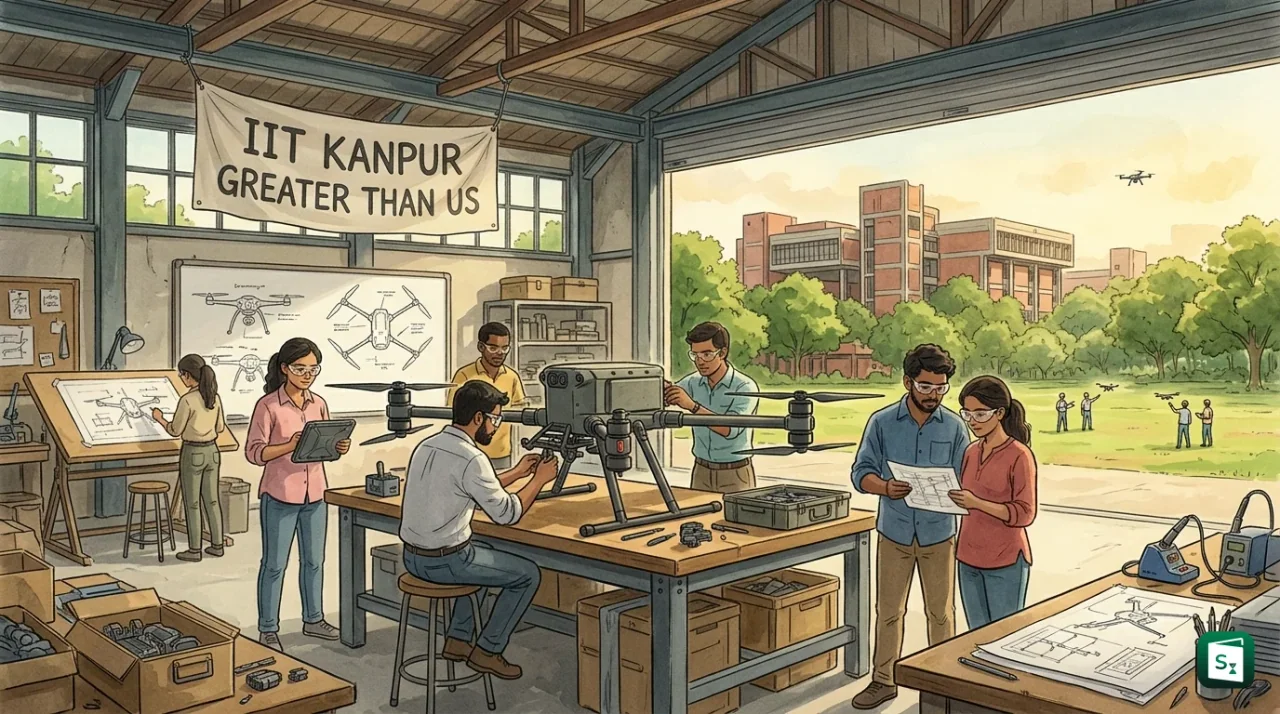
Defence Minister Rajnath Singh launched IIT Kanpur’s Greater Than Us campaign on 14 October 2026 at Bharat Mandapam in New Delhi, with a target to raise $1 billion (about ₹9,000 crore) by March 2029. At the same event, the Indian Institute of Technology Kanpur (IIT Kanpur) announced plans to set up a National Military Drone Technology Hub in partnership with the Ministry of Defence. The hub will help drone manufacturing companies in India build critical parts at home and cut dependence on imports.
IIT Kanpur Defence Drone Hub: What Has Been Proposed?
The Ministry of Defence gave in-principle approval in June 2026 for a ₹500 crore National Military Drone Technology Hub at IIT Kanpur. The hub is designed as a full stack facility for military drones. It will support design, testing and certification of payloads, data links, ground control stations and counter drone systems under one roof.
The proposal was prepared by the Uttar Pradesh Expressways Industrial Development Authority (UPEIDA), the nodal agency for the Uttar Pradesh Defence Industrial Corridor (UPDIC). The Uttar Pradesh government sent the proposal to the Ministry on 29 May 2026. This followed a review on 10 April 2026 by Chief Minister Yogi Adityanath to strengthen the existing drone Centre of Excellence at the institute. That Centre was earlier set up with a total outlay of ₹20.3 crore, of which ₹15.3 crore came from the state.
IIT Kanpur, established in 1959, is one of the first generation IITs. It is located at Kalyanpur near Kanpur in Uttar Pradesh on a campus of about 1,055 acres. The institute is led by Director Manindra Agrawal (as of October 2026). Its Startup Incubation and Innovation Centre (SIIC), set up in 2000 with support from the Small Industries Development Bank of India (SIDBI), has incubated more than 570 startups. The campus also hosts the C3iHub, a technology innovation hub for cybersecurity, and a DRDO-Industry-Academia Centre of Excellence.
For coordination, the Ministry has named the Army Design Bureau (ADB) as the single point of contact between IIT Kanpur, the state government and the Ministry. A Monitoring Committee under the Additional Secretary and Director General (Acquisition) held its first review on 3 June 2026. The institute was asked to submit a revised proposal with a whole of nation approach. On 14 October 2026, Rajnath Singh said the approval process was nearing completion.
The hub follows a civil military fusion model. It will take dual use technologies developed for civilian purposes, including work done under Drone Shakti, and adapt them for defence needs. Research, testing and standardisation will stay with IIT Kanpur. Manufacturing and maintenance will be spread across the six UPDIC nodes.
| UPDIC Node | Region in Uttar Pradesh | Planned Role in Drone Ecosystem |
|---|---|---|
| Kanpur | Central UP | Lead research, testing and standardisation at IIT Kanpur |
| Lucknow | Central UP | Manufacturing and system integration |
| Aligarh | Western UP | Components and hardware manufacturing |
| Agra | Western UP | Components and assembly |
| Jhansi | Bundelkhand | Manufacturing and testing, including missile and allied units |
| Chitrakoot | Bundelkhand | New manufacturing cluster and testing support |
The hub is also linked to indigenisation under the Make-1 and Make-2 categories of the defence procurement system. Make-1 projects receive government funding for prototype development. Make-2 projects are funded by industry with assured orders on success. Both routes aim to cut import dependence in critical drone subsystems such as sensors, secure links and control software.
What Is a Drone Hub and a Drone Defence System?
What Is a Drone Hub?
The IIT Kanpur drone hub is a central research, testing, certification and startup support centre for unmanned aircraft in one place. It connects laboratories, test ranges, incubators, manufacturers and the armed forces so that a design can move quickly from prototype to certified production and maintenance.
A hub is different from a single factory. A factory makes one product. A hub builds the shared base that many drone companies in India and UAV manufacturers in India can use. The shared base includes flight testing grounds, quality certification labs, training for pilots and engineers, and support for new drone making companies in India through incubation. The IIT Kanpur plan adds a military layer. It focuses on defence payloads, secure communication and standard setting for the services.
The term UAV means Unmanned Aerial Vehicle. In common use, drone and UAV mean the same flying machine without a pilot on board. In technical use, UAV refers to the aircraft alone, while the full system includes the ground station and data link. That full system is often called UAS, or Unmanned Aircraft System.
What Is a Drone Defence System?
A drone defence system is a set of sensors and weapons that finds hostile drones and stops them before they can attack. The IIT Kanpur military package covers the drone itself plus the system to defeat enemy drones, including radar detection, radio frequency analysis, cameras and electronic or kinetic action.
The need for such systems has grown fast. Small drones are cheap, hard to see on radar and can carry cameras, explosives or jammers. An anti drone system manufacturer in India therefore builds a layered chain. Radar gives the first alert at long range. Radio frequency sensors check if a drone control link is active. Electro optical and infrared cameras confirm what the object is. Then the system uses soft kill or hard kill means. Soft kill means jamming the link or satellite navigation. Hard kill means shooting it down with guns, lasers or interceptor drones.
| Drone Subsystem | What It Does | Why It Matters for Indigenisation |
|---|---|---|
| Airframe and motors | Body, propellers and propulsion for lift and movement | Basic manufacturing already present in India |
| Flight controller and software | Stabilises flight and follows mission commands | Controls quality and security of operations |
| Data link and ground station | Sends video and commands between drone and operator | Encrypted, jam resistant links are critical in war |
| Payloads and sensors | Cameras, radar, LiDAR and weapons or relief material | Determines surveillance and strike capability |
| Batteries and power systems | Provides endurance and range | Affects flight time and payload weight |
| Counter drone unit | Detects and neutralises hostile drones | Fast growing demand from armed forces and airports |
Why Indigenous Manufacturing Matters for Defence Drones
The IIT Kanpur leadership has said that India can assemble drones but still imports many critical parts. Motors, chips, high resolution sensors, lithium ion batteries, secure radio modules and flight control software often come from abroad. This dependence creates risk. Supplies can stop during a conflict. Hidden software backdoors can compromise missions. Costs stay high.
The central government changed the import rules to push local production. On 9 February 2022, the Directorate General of Foreign Trade (DGFT) prohibited the import of drones in Completely Built Up (CBU), Semi Knocked Down (SKD) and Completely Knocked Down (CKD) form. Imports are allowed only for research and development by government bodies, recognised educational institutions and manufacturers, and for defence and security purposes, with authorisation from DGFT after consulting the concerned ministries. The import of drone components was kept free, so drone manufacturing companies in India could import parts like diodes, chips and motors without DGFT permission while they built local capacity.
This ban built on earlier reforms. The Drone Rules, 2021, notified on 25 August 2021, cut forms from 25 to 5 and removed the need for security clearance before registration. The Drone Airspace Map of 24 September 2021 opened nearly 90 percent of Indian airspace as a green zone for flights up to 400 feet. The Production Linked Incentive (PLI) scheme for drones and drone components, notified on 30 September 2021 with an outlay of ₹120 crore for three years, offers 20 percent incentive on value addition. The stated national goal is to make India a global drone hub by 2030.
A made in India drone in this policy sense means a drone whose design, software and integration are controlled in India, even if some parts are still imported. That control matters for defence. If the design and software are Indian, the forces can repair, upgrade and secure the system without foreign help. Over time, the IIT Kanpur hub aims to replace imported subsystems with home grown versions. Priority areas include encrypted data links for contested airspace, electro optical tracking, stealth materials, quantum sensing and cybersecurity for drone networks. The institute has already built a heavy payload logistics drone and a strike drone through faculty led startups, and its cybersecurity team runs a security operations centre at the Bhilai Steel Plant.
How Are Drones Used in War?
Military drones are unmanned aircraft used by armed forces for watching enemy positions, guiding artillery, carrying supplies, striking targets and blocking enemy drones. They range from small hand launched quadcopters for frontline troops to large high altitude aircraft that can stay in the air for more than a day.
The change in warfare is clear. Small surveillance drones give live video of bunkers and movement across the Line of Control and the Line of Actual Control. Loitering munitions wait in the sky and strike when a target appears. Logistics drones carry ammunition, medicines and food to high altitude posts where helicopters face limits. Swarm tactics use many low cost drones together to overwhelm air defences. On the defensive side, armies now need drone detection radars and jammers to protect bases, airports, ports and large public events.
The Indian Army, the Indian Air Force and the Indian Navy have all expanded drone use. The Army uses drones for surveillance, targeting and logistics in mountains and deserts. The Air Force uses them for intelligence and airbase protection. The Navy uses long endurance drones for patrol over the Indian Ocean. This three service demand explains why the Ministry wants a national hub that can design military payloads, secure links and ground stations to a common standard, and then get them certified faster for field use.
The Greater Than Us Campaign and the Wider Defence Push
The drone hub was announced during the launch of IIT Kanpur’s Greater Than Us campaign. The campaign aims to raise $1 billion by March 2029 and is described as the largest fundraising drive by any IIT. Commitments of ₹4,155 crore, or nearly half the target, were already in place before the public launch. Supporters include alumni, donors, companies and government partners.
The campaign rests on three pillars. Foundation, with a goal of ₹5,000 crore, will build research infrastructure. The centrepiece is a ₹524 crore Central Research Facility with shared high end equipment. It includes a ₹160 crore semiconductor and device processing centre with a clean room, plus spectroscopy and microscopy centres. A ₹200 crore High Performance Computing facility with advanced graphics processors will support artificial intelligence and scientific simulation. Four new student residences of 1,000 seats each are under construction, with the first expected by June 2027. The plan also lists 96 faculty apartments and a new Centre for Mental Health and Wellbeing.
Talent, with a goal of ₹3,000 crore, will fund students and faculty. It covers scholarships, more doctoral fellowships and support for every eligible student. It also funds faculty chairs, young faculty fellowships and a global visiting faculty programme. The institute has started market linked hiring, first used at the Gangwal School of Medical Sciences and Technology, with 150 positions planned. Admissions through hackathons and olympiads and a student entrepreneurship programme for defence, aerospace, medical technology, clean technology and agricultural technology are part of this push.
Frontier connects basic research to real products. Its goal was ₹1,000 crore, and commitments of ₹1,556 crore have already crossed that mark. Work covers artificial intelligence (AI), cybersecurity, drones, medical technology, sustainability, semiconductors and quantum technology. Plans include a Quantum Technology Centre that will bring hardware and software development together, a Centre of Excellence for Semiconductor Packaging to support chip assembly and testing, a medical devices prototyping and testing facility, and a drug discovery programme for cancer, metabolic and neurodegenerative diseases. IIT Kanpur notes that its AI engine already powers the government grievance system CPGRAMS, which is the Centralised Public Grievance Redress and Monitoring System.
At the launch, alumnus Rahul Gautam committed ₹180 crore to set up the Gautam School of Innovation and Entrepreneurship (G-SINE) at the institute’s Noida campus. The school will have its own faculty and degree programmes and will open in July 2027 with an MBA in Technology and Entrepreneurship. It will train founders for AI, cybersecurity, digital health, biotechnology, drones and advanced manufacturing. It will work with the proposed Deep Tech Hub and draw on SIIC experience.
Defence Minister Rajnath Singh linked the campaign to self reliance. He said Atmanirbhar Bharat must go beyond making products in India to building the capacity to think, design, create and innovate. He cited the institute’s DRDO-Industry-Academia Centre of Excellence as a working model and welcomed the proposal for a School of Defence Technologies. He also pointed to the government approved ₹1 lakh crore Research, Development and Innovation (RDI) Scheme to draw private investment into advanced research. The message was for close work between the armed forces, the Defence Research and Development Organisation (DRDO), academic institutions, defence public sector units, industry and startups, so that lab research turns quickly into equipment the forces can use.
| Campaign Pillar | Target | Focus Areas |
|---|---|---|
| Foundation | ₹5,000 crore | Central research facility, semiconductor lab, computing, hostels and faculty housing |
| Talent | ₹3,000 crore | Scholarships, fellowships, faculty chairs, global faculty and student startups |
| Frontier | ₹1,000 crore (₹1,556 crore committed) | Quantum, semiconductors, drones, AI, cybersecurity, MedTech and drug discovery |
Key Takeaways
- The National Military Drone Technology Hub at IIT Kanpur received in-principle approval from the Ministry of Defence in June 2026 with a proposed outlay of ₹500 crore.
- The Greater Than Us campaign was launched by Rajnath Singh on 14 October 2026 at Bharat Mandapam, targeting $1 billion by March 2029 with ₹4,155 crore already committed.
- The Army Design Bureau is the single point of contact for the hub, with monitoring by the Additional Secretary and Director General (Acquisition).
- Import of drones in CBU, SKD and CKD form has been prohibited since 9 February 2022, while import of drone components remains free to support local assembly.
- Alumnus Rahul Gautam committed ₹180 crore for the Gautam School of Innovation and Entrepreneurship at IIT Kanpur’s Noida campus, opening in July 2027.