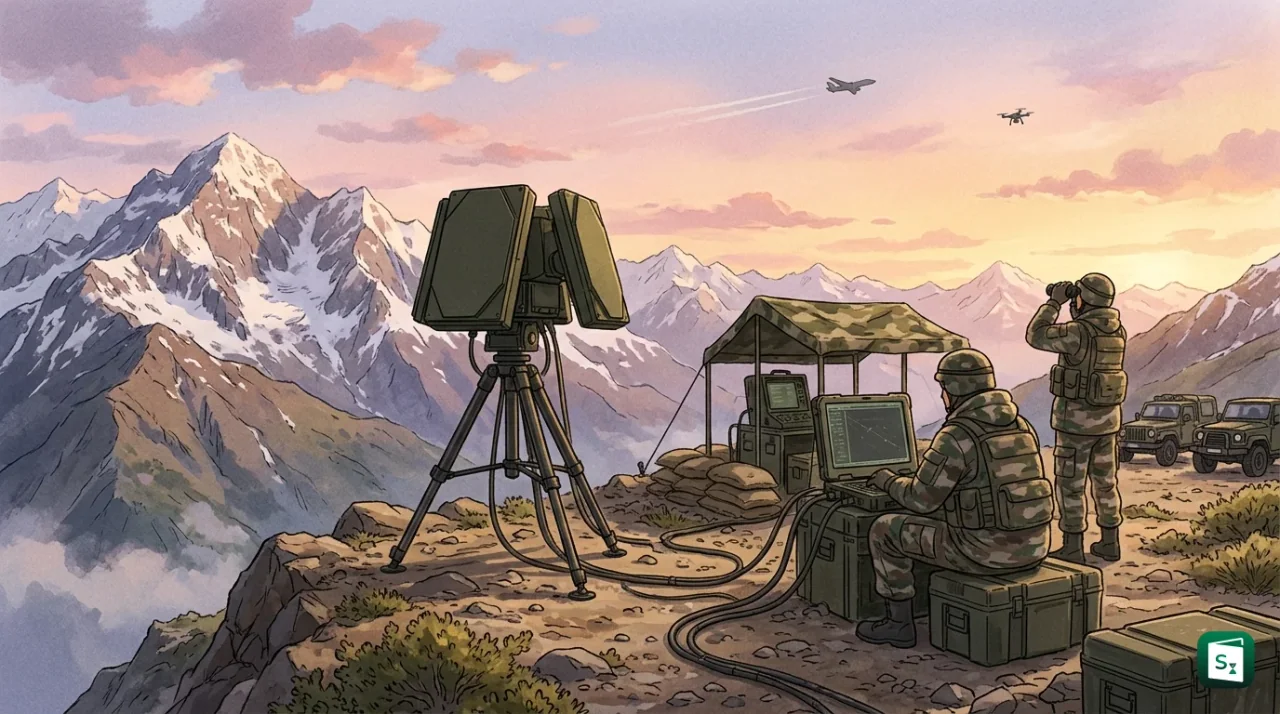
The Ministry of Defence signed a ₹770 crore contract with Bharat Electronics Limited (BEL) on 21 October 2026 to supply the Indian Army with Improved Low Level Light Weight Radar (LLLR-I) systems. The radar can detect and track fighter-size aircraft, mini drones and micro drones, and can rank aerial targets by threat. The deal fills a low-altitude blind spot in the Army’s air defence grid at a time when small unmanned aircraft have become a routine battlefield threat.
What Is the LLLR-I Radar?
The Improved Low Level Light Weight Radar (LLLR-I) is a man-portable Indian Army surveillance radar built to detect, track and prioritise low-flying targets, from fighter-size aircraft to micro drones. It is an upgraded, AESA-based version of the Aslesha radar, designed by DRDO’s Electronics and Radar Development Establishment (LRDE) and manufactured by BEL.
The name itself explains the role. Radar is short for Radio Detection and Ranging, a system that sends out radio waves and reads the echoes that bounce back from objects in the air. “Low level” refers to the altitude band it watches, roughly the first few thousand feet above the ground, where hills, buildings and the curve of the earth hide aircraft from big long-range radars. “Light weight” signals that the set can be broken down, carried by soldiers and shifted by vehicle, rail, aircraft or helicopter sling.
The LLLR-I is not a single box. The Army’s tender describes it as a complete system with four parts. These are a three-dimensional search radar, a Commander’s Display Unit (CDU) that shows the air picture, a Target Designation System (TDS) that passes tracks to weapon crews, and an integral power supply unit. The display unit can sit away from the antenna and control the radar remotely, which keeps operators out of the immediate danger zone.
This is a markedly different machine from the original LLLR family. The Aslesha, which entered Indian Air Force service in the early 2020s, uses an S-band semi-active array antenna. The LLLR-I replaces that with an active array and adds signal processing built for very small targets. The result is a radar that belongs to the same tactical family but performs a harder job.
Why Low-Level Radars Matter for India’s Air Defence
No single radar can watch an entire country’s sky. Long-range surveillance radars see far, but they see best at height. Radio waves travel in straight lines, so the earth’s curvature creates a shadow beneath them. Mountains add their own blind spots. A fighter flying at 100 metres can slip through a valley that a radar sitting on a distant peak cannot look into.
Low-level radars solve this by moving forward with the troops. They act as gap-fillers, filling the low-altitude holes left by the larger network. They are placed near the asset they protect, whether that is an airbase, a bridge, a headquarters or a moving armoured column. The Army calls these Vulnerable Areas and Vulnerable Points (VA/VP).
This low band is the responsibility of the Corps of Army Air Defence, a separate arm of the Indian Army since 10 January 1994. It traces its origins to anti-aircraft units raised in 1939, and its motto is Akashe Shatrun Jahi, meaning “kill the enemy in the sky”. The corps handles terminal air defence, roughly the airspace below 5,000 feet, using guns, short-range missiles and the radars that guide them.
Does India Have a Layered Air Defence System?
Yes. India operates a layered air defence system in which the Air Force handles wide-area surveillance while the Army’s Corps of Army Air Defence protects vulnerable points at low altitude. Long-range radars, low-level gap-fillers, guns, short-range missiles and the Akashteer control network work as one grid.
The Drone Threat That Changed Air Defence
Drones can be detected by radar, but only when the radar is sensitive enough to pick out an echo far weaker than that of an aircraft. A drone breaks the assumptions that shaped air defence for decades. It is small, slow, cheap and often flies below the horizon of every large radar in the area. Its radar cross-section (RCS), the measure of how much energy it reflects back, can be smaller than that of a bird. The Army’s 2026 tender asked for radars able to pick out targets with an RCS of 0.001 square metres, about the signature of a micro drone.
Operation Sindoor in May 2025 made the problem concrete. Pakistan sent waves of drones, including Turkish-origin loitering systems and small commercial types, against military and civilian sites along the western front. The Army’s guns and the Akashteer control network performed well, but the episode exposed how much depended on seeing the intruders early enough. A radar that detects a drone at 40 kilometres gives commanders time to decide. One that detects it at four kilometres leaves almost none.
The threat is now layered. Mini and micro drones creep along at low altitude, while kamikaze drones dive at speed and fighter aircraft arrive high and fast. A single sensor that can sort these contacts, and tell a gun crew which one to shoot first, is far more useful than separate systems that cannot talk to each other.
How the LLLR-I Detects Small Drones and Fighter Jets
The LLLR-I is a pulse-Doppler, software-defined radar. A pulse-Doppler radar sends short bursts of radio energy and compares the frequency of the returning echo with the frequency it sent. An object moving towards the radar returns a slightly higher frequency, and one moving away returns a slightly lower one. This shift lets the radar separate a moving drone from stationary clutter such as trees, walls and hill slopes.
Software-defined means the radar’s waveforms and processing can be changed through software rather than rebuilt in hardware. That matters for a system expected to serve for a decade or more against threats that will keep changing.
AESA, GaN and 360-Degree Coverage
The antenna is the heart of the improvement. A phased array is an antenna built from many small radiating elements whose signals combine to form a beam that can be steered electronically. The LLLR-I uses an Active Electronically Scanned Array (AESA), a phased array in which every element has its own small transmit and receive module. The radar steers its beam by adjusting the timing and phase of the signal across those elements, so it can point in a new direction in microseconds without physically turning.
The LLLR-I goes further with gallium nitride (GaN) amplifiers. GaN can handle more power in a smaller space and wastes less of it as heat than the older gallium arsenide technology. Higher power in the transmit path and lower noise in the receive path together improve the chance of catching a weak echo from a tiny drone. GaN also helps the radar resist jamming, because it can spread energy across a wider band of frequencies.
Four fixed phased-array panels are mounted on tripods to give 360-degree coverage with no rotating parts. The panels are passively cooled, and the system carries no liquids and no mechanical drive. Fewer moving parts means fewer breakdowns, longer intervals between failures and less maintenance in the field.
Track While Scan and Target Prioritisation
A radar that only detects is of limited use. The LLLR-I tracks while it scans, meaning it keeps watching the whole airspace while maintaining a track on each detected object. The Army’s tender asked for simultaneous tracking of more than 100 targets, with a minimum of 20 tracks passed to at least 10 command posts or weapon systems up to 20 kilometres away.
The feature highlighted by the Ministry of Defence is target prioritisation. The system can rank contacts by parameters such as speed, position and direction of travel, and display the most dangerous ones first. In a swarm attack, this tells a gun crew whether to engage the fast diver heading for the fuel depot or the slow observer circling overhead.
Target information travels to weapon systems through wired or wireless links, so the radar does not have to sit beside the launcher. Electronic counter-countermeasure features help it keep working when an adversary tries to jam or deceive it.
| Parameter | LLLR-I detail |
|---|---|
| Role | Low-level air surveillance and target designation |
| Radar type | Pulse-Doppler, software-defined, 3D AESA |
| Coverage | 360 degrees from four fixed panels, no moving parts |
| Amplifiers | Gallium nitride (GaN) |
| Targets | Fighter-size aircraft, helicopters, UAVs, mini and micro drones |
| Detection range sought | About 50 km (Army 2026 tender) |
| Tracking | More than 100 targets, track while scan (Army 2026 tender) |
| Data sharing | 20 tracks to 10 command posts or weapon systems up to 20 km away |
| Mobility | Man-portable, vehicle, rail, air and helicopter sling |
| Terrain | Plains, desert, mountains and high altitude up to 5,000 metres |
| Deployment time | Under 10 minutes (Army 2026 tender) |
Man-Portable Design for Mountains and Deserts
Weight is a tactical requirement, not a convenience. On the Line of Control and the Line of Actual Control, roads are scarce and ridges block line of sight. A radar that needs a crane and a concrete pad cannot follow an infantry battalion up a spur.
The LLLR-I can be dismantled into loads, carried by soldiers and moved on the Army’s in-service load-carrying vehicles. Its panels mount on tripods, and the whole set can be brought into operation in minutes. The same design works in the plains of Punjab, the Thar desert and the high Himalayas, which lets the Army standardise training and spares across very different commands.
What the ₹770 Crore Contract Covers
The contract was signed in New Delhi on 21 October 2026 in the presence of Defence Secretary Rajesh Kumar Singh, with officials from the Ministry of Defence and BEL present. The value is approximately ₹770 crore, and the Indian Army is the user. The ministry’s announcement did not disclose the number of radar sets or the delivery schedule.
That silence is normal at signing. The quantity is usually visible in the tender that precedes the contract. On 6 February 2026, the ministry had issued a Request for Proposal (RFP) for 30 LLLR-I systems and two Classroom Variant Radars, at an estimated ₹725 crore. That tender was run on the fast-track route under the Buy (Indian) category, with a minimum of 60 per cent indigenous content.
The February terms also set a delivery clock. The first batch of 15 radars and one classroom variant was to arrive within 12 months of the advance payment, with the rest following in the next six months. Each system was required to have a service life of at least 10 years, and integration with the Akashteer network was mandatory rather than optional.
The procurement follows the standard capital acquisition chain laid down in the Defence Acquisition Procedure (DAP) 2020. A requirement moves from a Request for Information, to staff qualitative requirements, to Acceptance of Necessity (AoN) from the Defence Acquisition Council, then to an RFP, technical evaluation, field trials, contract negotiation and finally signature. DAP 2020 gives the highest priority to Buy (Indian-IDDM), meaning Indian-designed, developed and manufactured equipment, and requires 60 per cent indigenous content for the Buy (Indian) route.
The order also sits inside a busy month for BEL. The company disclosed additional orders worth ₹1,011 crore since its previous update on 13 October 2026, covering the LLLR-I, communication equipment, sonar, jammers, upgrades and spares.
How the LLLR-I Plugs Into the Akashteer Network
A radar is only as good as the chain that carries its information to a weapon. For the Indian Army, that chain is Akashteer, an automated air defence control and reporting system built by BEL and inducted in 2024. The name means “sky arrow”. It fuses inputs from tactical radars, low-level radars, the Akash surface-to-air missile system and other sensors into a single air picture, then passes targets to the most suitable weapon.
Akashteer replaced a manual process in which voice calls and paper plots slowed every decision. It now links Army sensors with the Indian Air Force’s Integrated Air Command and Control System (IACCS) and the Navy’s Trigun network. That joint picture is meant to reduce the risk of friendly fire and shorten the sensor-to-shooter loop, the time between detecting a threat and engaging it.
Operation Sindoor tested the system under live conditions for the first time. Army air defence units reported a near-total success rate against Pakistani drones and missiles, with the network passing targets to gun systems close to the point of intrusion. In June 2026, the IACCS and Akashteer combine was upgraded and validated during Exercise Josh 2-26 along the western front, with the stated aim of cutting reaction times further.
The LLLR-I is designed to feed this network from the edge. Its target designation system can push tracks to command posts and weapon systems over wired or wireless links, and the Army’s tender made Akashteer compatibility a mandatory specification. The radar also has to meet the Army Cyber Group criteria for connecting to the Army Data Network, which governs how a battlefield sensor is allowed to join a secure military network.
The Army is extending the same architecture to mobile formations. The Defence Acquisition Council cleared the Carrier Air Defence Tracked (CADET) programme on 27 March 2026, and a subsequent RFP sought 83 tracked carriers fitted with Akashteer equipment for self-propelled gun and missile units. A low-level radar that can be carried forward and plugged into that network gives mechanised columns their own air picture instead of depending on a distant rear headquarters.
The LLLR Family: Aslesha, Bharani and Ashwini
India’s LLLR radar fleet has grown in stages, and the names can confuse. Most of these systems carry the names of nakshatras, the lunar mansions of the Hindu calendar, a naming style DRDO uses across its radar line.
The Bharani Mk I is a 2D low-level radar. It gives range and bearing but not height, weighs little, runs on batteries and is designed for mountainous ground where it can be split into loads and moved by men, mules or helicopter. It serves as an early warning sensor for Army air defence weapons guarding vulnerable points.
The Aslesha Mk I is a 3D set, meaning it provides range, bearing and height. It uses an S-band semi-active array, can track about 100 targets while scanning and covers low and medium altitudes. It was developed for the Indian Air Force, with work beginning in 2004 and a production contract for 21 systems placed with BEL in 2012. The type was inducted into the Air Force in 2021.
The Ashwini, or Low Level Transportable Radar (LLTR), is a larger and more powerful machine than any LLLR. It is a rotating active phased array radar with an instrumented range of about 200 kilometres and the ability to detect a target with a two square metre radar cross-section at roughly 150 kilometres. In March 2025, the ministry signed a ₹2,906 crore contract with BEL for Ashwini radars for the Air Force.
| System | Type | User | Key trait |
|---|---|---|---|
| Bharani Mk I | 2D low-level radar | Army Air Defence | Battery powered, mule and man portable, mountain use |
| Aslesha Mk I | 3D low-level radar | Indian Air Force | S-band semi-active array, about 50 km range |
| LLLR-I | 3D AESA low-level radar | Indian Army | GaN amplifiers, 360-degree fixed panels, drone detection |
| Ashwini (LLTR) | 4D transportable radar | Indian Air Force | Rotating active array, about 200 km instrumented range |
The distinction between an LLLR and an LLTR is tactical. The LLLR is a short-range gap-filler that moves with a battalion. The LLTR is a longer-range transportable radar that fills gaps in the wider air defence grid, often behind the forward line. Both are Indian designs produced by Indian industry, which is the point the ministry stressed in its announcement.
Indigenous Manufacturing, BEL’s Order Book and the Road Ahead
BEL is a Navratna defence public sector undertaking under the Ministry of Defence, established in Bengaluru in 1954. It builds radars, missile electronics, communication equipment, electronic warfare systems, avionics and naval systems, and has diversified into areas such as homeland security, smart cities, space electronics and electronic voting machines.
The company’s scale has grown sharply with India’s defence spending. BEL reported revenue from operations of ₹27,479.63 crore in FY 2025-26, a rise of about 16 per cent, with profit after tax of ₹6,048.48 crore. Its order book stood at ₹73,882 crore on 1 April 2026 and crossed ₹75,000 crore during FY 2026-27. Manoj Jain is the Chairman and Managing Director of BEL (as of October 2026).
Why the Deal Matters for the Defence Industry
The LLLR-I contract is small next to the ₹2,906 crore Ashwini order. Its industrial value lies in the supply chain behind it. A radar of this kind pulls in antenna panels, transmit and receive modules, power units, cables, displays and software from a spread of smaller firms. The ministry specifically linked the order to Micro, Small and Medium Enterprises, which supply a large share of defence electronics components.
The wider numbers explain the Make in India push. India’s indigenous defence production reached a record ₹1.78 lakh crore in FY 2025-26, while defence exports hit ₹38,424 crore, up from ₹686 crore in 2013-14. The government has set targets of ₹3 lakh crore in annual production and ₹50,000 crore in exports by 2029. Every indigenous radar order adds to the installed base that supports maintenance, upgrades and, eventually, export offers.
The stock market took the news calmly. BEL shares were trading about 2 per cent lower at around ₹363.50 on the morning of 22 October 2026, a reminder that a ₹770 crore order is now routine for a company of its size rather than a surprise that resets expectations.
The Gaps That Remain
The LLLR-I improves detection, but it does not close the low-altitude problem by itself. Numbers matter as much as capability. The Army has also sought up to 45 Low Level Light Weight Radars (Enhanced), fitted with electro-optical tracking and passive radio-frequency detection, and up to 48 Air Defence Fire Control Radar-Drone Detectors to control guns and very short-range missiles.
Detection is only the first half of the fight. A drone swarm can overwhelm a network through sheer numbers, and jamming can blind a radar that relies only on active transmission. That is why the Army is pursuing passive sensors, jammers, laser systems, drone catchers and interceptor drones alongside new radars. The LLLR-I gives the Akashteer network better eyes at low altitude. Whether that translates into a dependable shield depends on what the network can do once those eyes spot a threat.
Key Takeaways
- The Ministry of Defence signed a ₹770 crore contract with Bharat Electronics Limited on 21 October 2026 to procure LLLR-I radars for the Indian Army.
- The LLLR-I is an upgraded, AESA-based version of the Aslesha radar, designed by DRDO’s Electronics and Radar Development Establishment (LRDE) and produced by BEL.
- The radar uses gallium nitride amplifiers and four fixed phased-array panels to provide 360-degree coverage without any moving parts.
- It can detect and track fighter-size aircraft, mini drones and micro drones, and can prioritise aerial targets by threat.
- A 6 February 2026 tender had sought 30 LLLR-I systems and two classroom variants at about ₹725 crore, with a minimum of 60 per cent indigenous content.
- The LLLR-I is built to integrate with Akashteer, the Army’s automated air defence network that links to the IAF’s IACCS and the Navy’s Trigun system.
- BEL’s order book stood at ₹73,882 crore on 1 April 2026, while India’s indigenous defence production reached ₹1.78 lakh crore in FY 2025-26.