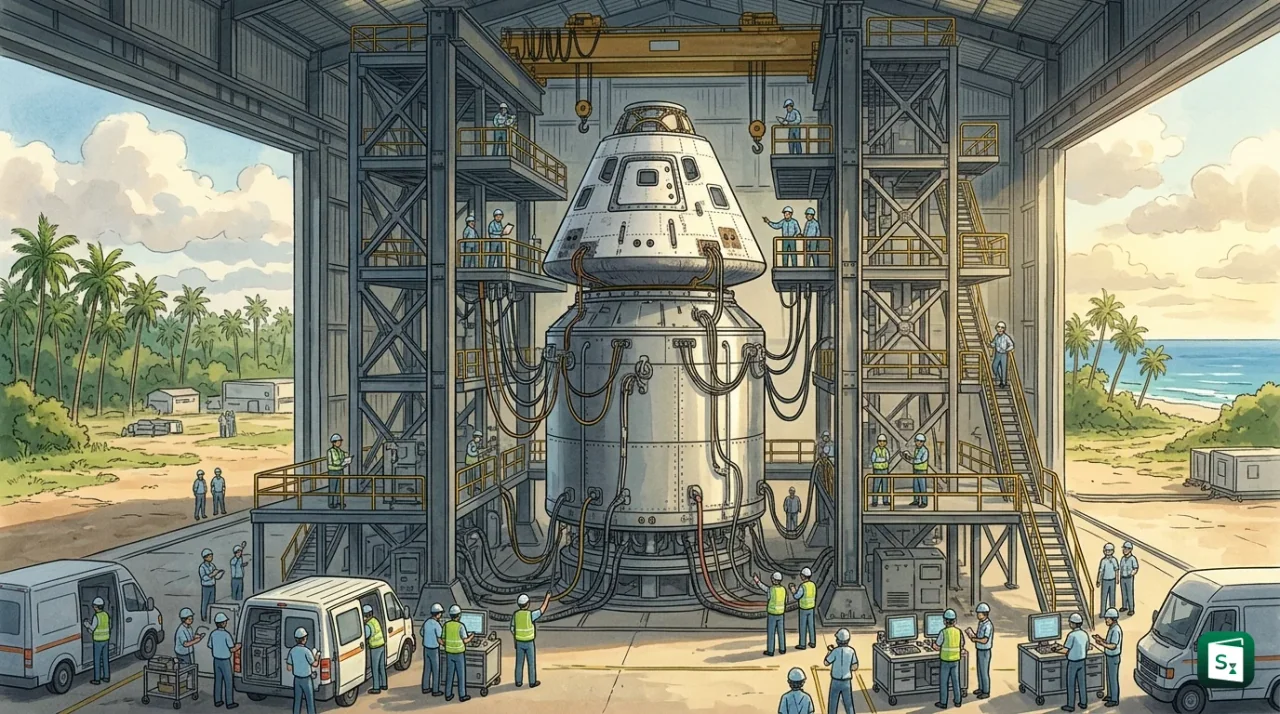
ISRO has completed a series of Crew Module (CM) and Service Module (SM) separation tests for the Gaganyaan mission at the Vikram Sarabhai Space Centre (VSSC) in Thiruvananthapuram. The tests confirmed that the two sections of the orbital module can part cleanly, a step that must work flawlessly before astronauts return through Earth’s atmosphere. The results clear a key design milestone for Gaganyaan-1 (G1), the first uncrewed flight of India’s human spaceflight programme, which is targeted for launch in 2026.
What Are the Crew Module and Service Module?
The Crew Module is the pressurised, habitable cabin that carries the crew and protects them during re-entry. The Service Module is the unpressurised rear section that provides propulsion, power, thermal control and avionics support while the spacecraft is in orbit.
The two modules are joined before launch and travel as one unit called the Orbital Module. They remain attached through the ascent and the entire on-orbit phase of the mission. The Crew Module breaks away only when the spacecraft is ready to begin its return to Earth.
| Feature | Crew Module (CM) | Service Module (SM) |
|---|---|---|
| Primary role | Houses and protects the crew | Supports the crew module in orbit |
| Pressurisation | Pressurised inner structure | Unpressurised structure |
| Key contents | Crew interfaces, life support, avionics, deceleration system | Propulsion, power, thermal system, avionics, deployment mechanisms |
| After separation | Returns to Earth and splashes down at sea | Left behind in space before re-entry |
Crew Module: The Habitable Capsule
The Crew Module has a double-walled construction. A pressurised metallic inner structure creates an Earth-like environment for the crew, while an unpressurised outer structure carries the Thermal Protection System (TPS) that shields the capsule from the intense heat of re-entry.
Inside, the module holds crew interfaces, human-centric equipment, the life support system, avionics and the deceleration system. It also carries a side hatch for entry and exit, and an inflatable Crew Module Uprighting System (CMUS) that turns the capsule upright after it splashes down in the sea.
Service Module: Power and Propulsion
The Service Module is an unpressurised structure mounted behind the crew cabin. It carries the spacecraft’s thermal control system, propulsion system, power systems, avionics and deployment mechanisms.
Its engines perform the orbit circularisation burn that raises the spacecraft to its planned altitude. Later, the same propulsion system carries out the deorbit burn that slows the spacecraft enough to begin its descent. Once that burn is complete, the Service Module has finished its job and the Crew Module separates from it.
What Did the Separation Tests Validate?
The tests validated the complete Crew Module and Service Module separation sequence, including the severing of umbilical links and the ability of critical crew module systems to withstand the mechanical shock produced by pyrotechnic separation devices.
ISRO built a dedicated test setup at VSSC that reproduced the full Crew Module and Service Module assembly. The rig carried extensive instrumentation to record what happened at every stage of the separation. Engineers then simulated the separation event, including the cutting of several umbilical connections between the two modules.
Severing the Umbilical Links
The two modules are not merely bolted together. They exchange electrical signals and fluids through umbilical connections. All electrical communication between the Crew Module and Service Module passes through these links, along with the fluid lines needed by the Environmental Control and Life Support System (ECLSS).
The interface uses two umbilicals, known as CSU-1 and CSU-2, with one on each side. When the modules separate at CSU-1, the Crew Module side umbilical, CSU-2, must also detach cleanly before the capsule re-enters the atmosphere. An umbilical that fails to release could leave a trailing component that damages the heat shield or disturbs the capsule’s orientation.
The VSSC tests reproduced this sequence and confirmed that the connections part as designed. They also checked the Crew Module Deployable Umbilical Shield, the protective cover that closes over the umbilical area after detachment.
Surviving the Shock of Separation
Separating two spacecraft modules is not a gentle process. Pyrotechnic devices fire in a precisely timed order, and the resulting shock travels through the structure. Every sensitive system on board must continue to work after that jolt.
ISRO used the tests to demonstrate the robustness and shock-survivability of several critical Crew Module subsystems.
| System tested | Function | Why it matters during separation |
|---|---|---|
| Avionics systems | Control and monitor the spacecraft | Must keep functioning after the pyro shock |
| Inertial Navigation Systems | Track the capsule’s position and orientation | Guidance for re-entry depends on it |
| Thermal Protection System | Shield the capsule from re-entry heat | Cracks or loosening could be fatal |
| Crew Module Deployable Umbilical Shield | Covers the umbilical area after release | Protects the heat shield surface |
| Crew Module Uprighting System pyros | Inflate floats after splashdown | Must fire reliably to turn the capsule upright |
| Thermal and Humidity Control System pyros | Regulate cabin conditions | Crew survival depends on a stable cabin |
Why the Separation Event Decides Mission Success
The return journey leaves no room for a second attempt. Once the Service Module fires its deorbit burn, the spacecraft is committed to re-entry. The Crew Module must then separate, turn its heat shield towards the direction of travel, survive temperatures of several thousand degrees Celsius, deploy its parachutes and splash down safely.
If the separation fails, the consequences are severe. The capsule would still be attached to the Service Module, which carries heavy propulsion hardware and solar panels. That extra mass and irregular shape would upset the capsule’s aerodynamic stability during descent. The heat shield might not face the airflow correctly, and the parachute sequence could be compromised.
For this reason, ISRO treats the separation system as a crew-safety critical item rather than a routine mechanical function. The system relies on multiple precisely sequenced events involving pyrotechnic devices and jettisoning mechanisms. Each event must fire in the correct order and within a narrow time window.
The same principle applies to other separation events on the capsule. The apex cover, which protects the parachutes during launch and re-entry, is jettisoned at a predetermined altitude using pyrotechnically actuated thrusters. The parachutes themselves deploy in a carefully ordered sequence. A fault in any one of these steps can cascade into a failure.
The VSSC tests therefore did more than check that two metal structures come apart. They confirmed that the shock of separation does not disable the navigation, thermal protection or recovery systems that the crew will depend on minutes later.
How the Gaganyaan Mission Is Built
Gaganyaan is India’s first indigenous human spaceflight programme. It aims to send a crew of three to low Earth orbit at about 400 km for a three-day mission and bring them back safely, with a planned splashdown in Indian sea waters.
The programme is implemented by the Human Space Flight Centre (HSFC) in Bengaluru, which was formed in January 2019. HSFC coordinates the work of other ISRO centres, academic institutions and industry partners. The Vikram Sarabhai Space Centre leads the launch vehicle work, while Hindustan Aeronautics Limited has fabricated the Crew Module structure.
The Orbital Module and Its Launch Vehicle
The Orbital Module rides on the Human Rated Launch Vehicle Mark 3 (HLVM3). This is a modified version of the LVM3, the heavy-lift rocket that carried the Chandrayaan-3 mission towards the Moon. Every system on the rocket has been reconfigured to meet human-rating standards, which demand far higher reliability than an uncrewed satellite launch.
The HLVM3 has three stages. Two large solid rocket boosters, designated S200, provide the initial thrust. A liquid core stage, L110, takes over next. A cryogenic upper stage, C32, places the orbital module in its intended orbit.
At the top of the stack sits the Crew Escape System (CES). It carries a set of quick-acting, high-burn-rate solid motors designed to pull the Crew Module away from a failing rocket, either on the launch pad or during the ascent. ISRO has developed and static-tested all five types of CES motors.
Mission Profile at a Glance
| Parameter | Detail |
|---|---|
| Programme | Gaganyaan, India’s first human spaceflight programme |
| Lead centre | Human Space Flight Centre, Bengaluru |
| Launch vehicle | HLVM3, a human-rated version of LVM3 |
| Crew capacity | Three astronauts |
| Target orbit | Low Earth orbit at about 400 km |
| Mission duration | Three days |
| Launch site | Satish Dhawan Space Centre, Sriharikota |
| Recovery | Sea splashdown, with recovery by the Indian Navy |
| Deceleration | A sequence of ten parachutes |
Gaganyaan-1, Vyommitra and the Launch Timeline
Gaganyaan-1 is the first uncrewed orbital test flight of the programme. It will carry Vyommitra, a half-humanoid robot, and is targeted for the fourth quarter of 2026, ahead of two more uncrewed flights and the first crewed mission.
The G1 flight will not carry astronauts. Its job is to prove that the spacecraft, the launch vehicle and the ground systems work together as intended. The mission will validate technologies being flown for the first time, including the life support system, the separation systems and the parachute-based recovery sequence.
What Is Vyommitra?
Vyommitra is an AI-enabled half-humanoid robot built by ISRO. Its name comes from the Sanskrit words vyoma, meaning space, and mitra, meaning friend. The robot was unveiled in January 2020 and was designed at the Vikram Sarabhai Space Centre.
The robot has a female appearance, with a head, torso and arms but no legs, so that it can be seated in a crew seat. Its body is built largely from aluminium alloy to withstand the pressure and vibration of launch. On uncrewed missions, Vyommitra stands in for a human crew, allowing ISRO to observe how cabin systems behave without putting astronauts at risk.
On board, Vyommitra can operate switch panels, monitor cabin parameters, handle functions of the Environmental Control and Life Support System and issue warnings about changes in air pressure. It can recognise crew members, respond to questions in Hindi and English and simulate human functions during the mission.
When Will Gaganyaan Launch?
The first uncrewed Gaganyaan mission, G1, is targeted for the fourth quarter of 2026. The first crewed flight is targeted for 2027, after two more uncrewed missions in the same configuration. ISRO has not announced a fixed launch date for G1.
ISRO Chairman V. Narayanan (as of October 2026) has said that work on G1 is in an advanced stage and that the mission is planned within the 2026 calendar year. The schedule has shifted several times since the programme was sanctioned, with ISRO prioritising crew safety over fixed dates.
| Mission | Type | Payload | Target |
|---|---|---|---|
| G1 | Uncrewed orbital flight | Vyommitra half-humanoid | Fourth quarter of 2026 |
| G2 | Uncrewed orbital flight | Mission hardware and experiments | 2027 |
| G3 | Uncrewed orbital flight | Mission hardware and experiments | 2027 |
| H1 | Crewed orbital flight | Three Indian astronauts | 2027 |
Vikram Sarabhai Space Centre: Where the Tests Took Place
VSSC is ISRO’s lead centre for launch vehicle technology, located in Thiruvananthapuram, Kerala. It designs and develops rockets, propulsion systems, avionics and spacecraft structures, and it has been the technical base for India’s space programme since the 1960s.
The centre began as the Thumba Equatorial Rocket Launching Station (TERLS), set up after the Indian National Committee for Space Research was formed in 1962. Thumba was chosen because it lies close to the magnetic equator, a location well suited for atmospheric and ionospheric research using sounding rockets.
The first rocket to lift off from Thumba, a Nike Apache supplied by the United States, flew on 21 November 1963. In February 1968, TERLS was dedicated to the United Nations by Prime Minister Indira Gandhi, giving it an international character. After Vikram Sarabhai’s death in December 1971, the facility was renamed in his honour in 1972.
Today VSSC is the largest research and development establishment within ISRO. Its programmes include the Polar Satellite Launch Vehicle (PSLV), the Geosynchronous Satellite Launch Vehicle (GSLV), the LVM3 and critical technologies for human spaceflight. The centre also houses facilities at Valiamala for mechanisms and vehicle integration, and at Vattiyoorkavu for composite structures. Its director is Dr. U. P. Rajeev (as of October 2026).
Testing the separation system at VSSC made practical sense. The centre already handles stage separation systems, spacecraft mechanisms and structural qualification, and it has the instrumented rigs needed to reproduce the forces involved in a real separation event.
From Gaganyaan to Bharatiya Antariksh Station
The Bharatiya Antariksh Station is India’s planned modular space station, targeted to become operational by 2035. It will consist of five modules, and the government has already approved the development and launch of the first module, BAS-01.
Gaganyaan is the first step towards that larger goal. A space station requires reliable life support, docking capability, crew transport and long-duration operations. Each of these technologies is being tested through the Gaganyaan flights. ISRO has already demonstrated autonomous docking in orbit through the SpaDeX experiment in December 2024, a capability that will be essential for assembling the station module by module.
The programme’s scope was expanded in September 2024. The Union Cabinet raised the outlay to ₹20,193 crore and increased the number of approved missions from three to eight. The revised plan added an uncrewed mission and four precursor flights linked to the space station. The original sanction, granted in January 2019, had a budget of ₹9,023 crore for two uncrewed flights and one crewed flight.
| Year | Milestone |
|---|---|
| 2018 | Gaganyaan announced in the Independence Day address |
| 2019 | Programme sanctioned with ₹9,023 crore; HSFC formed in Bengaluru |
| 2023 | TV-D1 test validates the Crew Escape System in flight |
| 2024 | Cabinet raises outlay to ₹20,193 crore and expands the programme to eight missions |
| 2026 | G1 uncrewed orbital flight targeted with Vyommitra |
| 2027 | First crewed mission targeted |
| 2028 | First Bharatiya Antariksh Station module targeted for launch |
| 2035 | Bharatiya Antariksh Station planned to become operational |
| 2040 | Indian crewed Moon landing target |
India is also drawing on international partnerships for the human spaceflight programme. The European Space Agency is providing network operations support, the Australian Space Agency is cooperating on crew and Crew Module recovery, France’s CNES has trained ISRO flight surgeons and ground support teams, and Russia’s Roscosmos has supplied crew seats, viewports and flight suits while training the first batch of astronaut-designates at the Gagarin Cosmonaut Training Centre.
The Way Forward
A successful separation test does not close the book on Gaganyaan. Several qualification activities remain before the G1 vehicle is cleared for the launch pad. The second Test Vehicle mission, TV-D2, is intended to demonstrate the Crew Escape System in an abort scenario. Further parachute drop tests and recovery trials are also part of the run-up.
Mission campaign activities for a human-rated flight begin about 90 days before launch, far earlier than the roughly 60-day window used for a routine satellite mission. That longer window reflects the extra reviews, inspections and safety clearances involved. A National Review Committee examines the complete mission configuration before a launch date is confirmed.
The four astronaut-designates are Group Captain Prasanth Balakrishnan Nair, Group Captain Ajit Krishnan, Group Captain Angad Pratap and Group Captain Shubhanshu Shukla. They were named at VSSC in February 2024 and have been training at the Astronaut Training Facility in Bengaluru. Group Captain Shubhanshu Shukla has since flown to the International Space Station as the pilot of Axiom Mission 4 in 2025, gaining operational experience that feeds back into the programme.
If the remaining milestones hold, India will become the fourth country to send humans to orbit using its own launch vehicle, after the Soviet Union, the United States and China. More importantly, the capability being built around Gaganyaan, from life support and crew recovery to docking and space station modules, will shape India’s space programme for the next two decades.
Key Takeaways
- ISRO completed a series of Crew Module and Service Module separation tests at the Vikram Sarabhai Space Centre in Thiruvananthapuram in October 2026.
- The tests validated the separation system design and the shock survivability of avionics, inertial navigation systems, heat shield systems and pyrotechnic devices in the Crew Module.
- The Crew Module separates from the Service Module before re-entry, using a precisely sequenced set of pyrotechnic and jettisoning events.
- Gaganyaan-1 (G1), the first uncrewed mission, will carry the Vyommitra half-humanoid and is targeted for the fourth quarter of 2026.
- The Gaganyaan programme was sanctioned in January 2019 with ₹9,023 crore, and the outlay was raised to ₹20,193 crore in September 2024 for eight missions.
- The Bharatiya Antariksh Station, a five-module space station, is targeted to become operational by 2035.