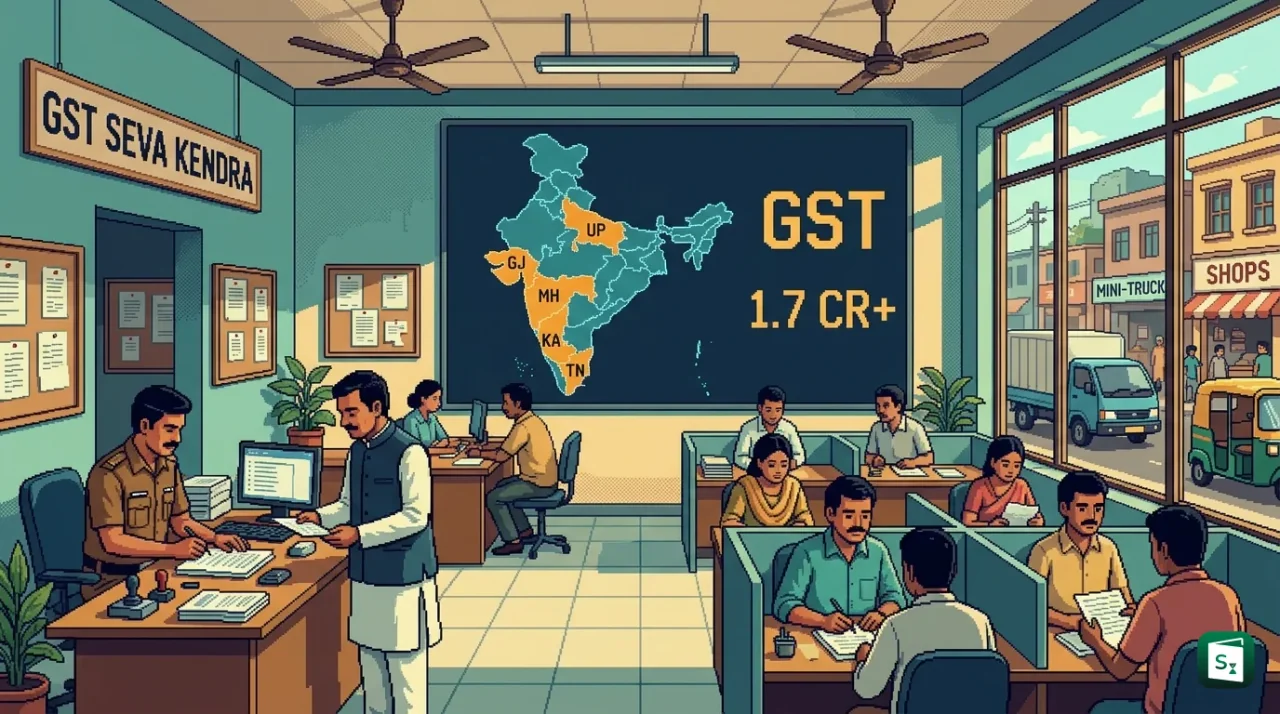
The central government has announced a new Goods and Services Tax (GST) Standing Committee with 12 states, giving Karnataka, Maharashtra, Uttar Pradesh, Gujarat and Tamil Nadu permanent seats on the panel. The remaining seven seats will rotate among medium and small states every two years. Working under the GST Council framework, the committee will coordinate the next phase of reform: widening India’s taxpayer base from 1.7 crore registered taxpayers without resorting to intrusive enforcement.
What Is the New GST Standing Committee?
The new GST Standing Committee is a panel of senior state and central tax officials that will coordinate tax administration and taxpayer-base expansion. It is not a constitutional body. It works within the GST framework and feeds into the policy process led by the GST Council, which remains the apex constitutional authority under Article 279A.
The panel will have representatives from 12 states, drawn from three size categories. Five large states hold permanent seats. Four medium states and three small states share the seven remaining seats on a rotation. The structure gives the biggest revenue-contributing states continuity, while smaller states still get a regular voice in decisions that affect the whole country.
The committee’s mandate is practical rather than legislative. It will identify gaps in GST registration, study why registered businesses under-report turnover, and find ways to bring unregistered firms into the formal tax net. The Centre has offered data analytics and technology support to every state for this exercise.
Five Large States Get Permanent Seats
The five permanent members are Karnataka, Maharashtra, Uttar Pradesh, Gujarat and Tamil Nadu. These states together account for a large share of India’s GST collections and registered taxpayers. They also have some of the largest active taxpayer bases in the country.
Permanent membership means these states will not leave the committee when the rotation cycle changes. This continuity matters because tax administration data, audit practices and inter-state supply chains need stable institutional memory. A state that rotates out every two years has less time to build that memory.
Rotational Seats and the Two-Year Cycle
The other seven seats are distributed among four medium states and three small states. These members will change every two years. The rotation is intended to prevent the committee from becoming a closed club of large states and to spread administrative capacity to smaller tax jurisdictions.
| Category of state | Number of seats | Membership type |
|---|---|---|
| Large states | 5 | Permanent |
| Medium states | 4 | Rotational, every two years |
| Small states | 3 | Rotational, every two years |
| Total | 12 | Mixed |
The announcement did not name the medium and small states. The design, however, mirrors the logic of the GST Council itself, where every state has a seat but the largest states carry the heaviest administrative load.
Why the Taxpayer Base Is Now the Big Focus
GST rate rationalisation and procedural simplification are largely complete. The 56th GST Council meeting in September 2025 collapsed the old four-slab structure into two main rates of 5% and 18%, with a 40% demerit rate for a small set of luxury and sin goods. The 57th meeting in October 2026 moved to process reforms, including easier registration, faster refunds and the removal of arrest provisions under GST.
With the rate and process architecture settled, the remaining lever is the size of the tax base. A wider base spreads the tax burden across more businesses, reduces reliance on a narrow group of large taxpayers, and makes revenue collection more stable during economic slowdowns.
India’s 1.7 Crore Registered Taxpayers
India had about 1.7 crore registered GST taxpayers as of September 2026, up from 66.5 lakh in 2017, when GST was launched. The growth reflects both new registrations and the formalisation of small businesses that earlier operated outside the tax system.
| Indicator | Latest available figure |
|---|---|
| Registered GST taxpayers | About 1.7 crore (September 2026) |
| Registered taxpayers in 2017 | 66.5 lakh |
| Gross GST collection, 2025-26 | About ₹22.27 lakh crore |
| Gross GST collection, April to September 2026 | About ₹12.46 lakh crore, up 11.6% year on year |
| Invoices processed by GST system | 3,053 crore (as of 30 September 2026) |
| E-way bills generated | 833.82 crore (as of 30 September 2026) |
The numbers show scale, but they also hide a weakness. Many registered businesses file returns without paying any tax in cash because they set off their entire liability against input tax credit (ITC), the credit a business gets for tax already paid on its purchases. Some retail sales are shown as business-to-business transactions so that buyers can claim credit. These are the gaps the new committee is expected to study.
Data Analytics, Invoice Matching and B2C E-Invoicing
The Centre’s approach is to use data rather than raids. Tax officials will compare invoices, returns and e-way bills to spot mismatches. The Invoice Management System (IMS) allows buyers to accept, reject or hold each invoice, which keeps the seller’s reported liability and the buyer’s claimed credit aligned.
The bigger change is business-to-consumer (B2C) e-invoicing. States are expected to adopt it on a voluntary basis from 1 April 2027. The Goods and Services Tax Network (GSTN) will provide a B2C application on its portal, where customers can generate invoices. The aim is to capture transaction data down to the final buyer, not just up to the last registered dealer.
Officials have said businesses will be encouraged through incentives and easier audit treatment rather than an immediate mandate. The model borrows from the Income Tax Department’s NUDGE (Non-intrusive Usage of Data to Guide and Enable) approach, which uses risk analytics and behavioural prompts to push taxpayers towards compliance.
What Is the GST Council and How Does It Work?
The GST Council is the constitutional body that decides the broad design of India’s Goods and Services Tax. It is chaired by the Union Finance Minister and includes the finance or taxation ministers of every state and union territory with a legislature. It recommends rates, exemptions, model laws, threshold limits and special provisions.
Is the GST Council a Constitutional Body?
Yes. The GST Council is a constitutional body, not a statutory one. It was created by Article 279A, which was inserted by the Constitution (One Hundred and First Amendment) Act, 2016. The article came into force on 12 September 2016, and the Council was constituted on 15 September 2016. Its first meeting was held on 22 and 23 September 2016 in New Delhi.
This distinction matters. A statutory body can be reshaped by an ordinary law of Parliament. A constitutional body draws its authority from the Constitution itself, so its composition and voting rules can be changed only through a constitutional amendment. The GST Council’s recommendations carry heavy weight because both Parliament and state legislatures have committed to the Council’s framework under the amended Constitution.
Composition, Voting Weightage and Secretariat
The Council’s membership is defined in Article 279A(2). The Union Finance Minister is the Chairperson. The Union Minister of State in charge of Revenue or Finance is a member. Every state government nominates its finance or taxation minister, or another minister, as a member. The Chairperson of the Central Board of Indirect Taxes and Customs (CBIC) attends as a permanent invitee without voting rights.
Decisions are taken by a majority of not less than three-fourths of the weighted votes of members present and voting. The Centre carries one-third of the total vote weight, and all states together carry two-thirds. Half the total members form the quorum. In practice, the Council has usually decided by consensus, which is why it is often described as a laboratory of cooperative federalism.
Article 279A(4) lists the subjects on which the Council can make recommendations. These include the taxes and cesses to be subsumed, the goods and services to be taxed or exempted, model GST laws, the principles governing place of supply, threshold limits, rate bands, special rates for raising funds during natural calamities, and special provisions for specified states. Under Article 279A(5), the Council recommends the date from which GST will apply to petroleum crude, high-speed diesel, petrol, natural gas and aviation turbine fuel.
The Supreme Court has held that the Council’s recommendations are not binding. Parliament and the state legislatures retain simultaneous power to legislate on GST, so the Council works as a high-level consultative forum whose advice carries substantial political and institutional weight.
The GST Council Secretariat is based in New Delhi and functions under the Department of Revenue, Ministry of Finance. The Secretary to the Government of India in the Department of Revenue serves as its ex-officio Secretary. The Secretariat supports the Council’s meetings, prepares agenda notes and coordinates with the states and the Centre.
| Feature | GST Council | New GST Standing Committee |
|---|---|---|
| Nature | Constitutional body under Article 279A | Administrative committee of officials |
| Members | Union Finance Minister and state finance ministers | Officials from 12 states |
| Role | Recommends rates, laws and policy | Coordinates tax administration and base expansion |
| Decision powers | Weighted voting, usually consensus | Advisory and operational coordination |
The new committee therefore does not replace the GST Council. It sits below it, doing the technical and administrative groundwork that the Council’s ministerial members can then use for policy decisions.
Which Committee Recommended GST in India?
The idea of a nationwide GST was first proposed by the Kelkar Task Force on indirect taxation in the early 2000s. The design and road map were later prepared by the Empowered Committee of State Finance Ministers, which released its First Discussion Paper on GST in November 2009.
The Kelkar Task Force suggested a comprehensive GST built on the value-added tax (VAT) principle. At the time, India’s indirect tax system was split between central levies such as excise duty and service tax, and state levies such as VAT, entertainment tax and octroi. Taxes piled up on one another, exports carried hidden costs, and inter-state trade faced checkposts and paperwork.
The proposal was first announced in the Union Budget speech for 2006-07. The Empowered Committee of State Finance Ministers then worked with the Centre on the design. A Constitution Amendment Bill was introduced in 2011, but it lapsed. The effort resumed with the Constitution (122nd Amendment) Bill, 2014. Parliament passed it in August 2016 after amendments, and the required number of states then ratified it.
The result was the Constitution (One Hundred and First Amendment) Act, 2016, which received presidential assent on 8 September 2016. It inserted Article 279A and gave both Parliament and state legislatures simultaneous power to legislate on GST. The new tax replaced 17 taxes and 13 cesses and came into effect on 1 July 2017.
The GST Council has held 57 meetings so far, with the latest on 8 October 2026. The 56th meeting delivered the rate overhaul popularly called GST 2.0, and the 57th meeting delivered process reforms. The new Standing Committee extends this arc from policy design into day-to-day tax administration.
How the Standing Committee Fits Into the GST 2.0 Reform Arc
The GST reform story has moved in clear stages. The launch in 2017 built the institutional and digital plumbing. The 2025 rate overhaul simplified the tax structure. The 2026 process reforms reduced the compliance burden. Base expansion is the next stage, and it is the stage where administrative coordination matters most.
From Rate Rationalisation to Process Reforms
The 56th GST Council meeting on 3 September 2025 approved the shift to a two-rate structure of 5% and 18%, with a 40% rate for a small list of demerit and luxury goods. It also exempted individual health and life insurance policies and cut rates on a long list of consumer goods. Most of these changes took effect from 22 September 2025.
The 57th GST Council meeting on 8 October 2026 turned to process. It recommended removing the power of arrest under Section 69 of the Central Goods and Services Tax (CGST) Act, raising the prosecution threshold from ₹1 crore to ₹5 crore, and cutting the general penalty from ₹25,000 to ₹10,000. It also approved automatic registration in low-risk cases, simpler cancellation, faster refunds and a faceless adjudication framework. The GST Appellate Tribunal (GSTAT) had already begun accepting appeals in 2025, giving taxpayers a dedicated forum for disputes.
| Reform phase | Focus | Key milestone |
|---|---|---|
| 2017 | Launch and digital backbone | GST rolled out on 1 July 2017 |
| 2025 | Rate rationalisation | Two-slab structure of 5% and 18% |
| 2026 | Process simplification | 57th Council meeting, 8 October 2026 |
| 2026 onward | Base expansion | 12-state GST Standing Committee |
The Third Phase: Base Expansion
Base expansion is harder than rate reform. A rate cut is announced once and applied uniformly. Widening the base requires state-level registration drives, data matching, audits and follow-up with individual businesses. That is why the Centre has created a standing body of state officials rather than issuing a one-time circular.
The committee will work with GSTN on identified data gaps. Some analysis has already been shared with states. The early focus is on businesses that are registered but show unusual patterns: no cash tax payment, turnover that does not match bank or e-way bill data, or retail sales declared as business-to-business supplies.
The base-expansion phase is also designed to be less confrontational than earlier enforcement drives. Officials have repeatedly said the aim is facilitation, not harassment. A taxpayer who starts reporting honestly should face less audit risk, not more. The committee’s success will be measured by how many new businesses join the system and how many existing ones improve the quality of their disclosures.
What the New Committee Means for Cooperative Federalism
GST is India’s clearest experiment in cooperative federalism. The Centre and the states share one tax base, one digital platform and one decision-making forum. The new Standing Committee adds an administrative layer to that shared system. It brings state tax officials into a permanent working relationship with the Centre’s indirect tax machinery.
Constitutional Articles Governing GST
The GST framework rests on a set of constitutional provisions that together explain why GST required a constitutional amendment rather than an ordinary law. Each provision does a distinct job.
| Article | Provision |
|---|---|
| Article 246A | Gives Parliament and state legislatures simultaneous power to make laws on GST |
| Article 269A | Governs levy and collection of GST on inter-state trade and commerce, including imports |
| Article 270 | Provides for distribution of GST revenue between the Centre and the states |
| Article 279A | Creates the GST Council and defines its composition, functions and voting |
| Article 366(12A) | Defines GST as a tax on the supply of goods, services or both, excluding alcoholic liquor for human consumption |
The GST Council’s design reflects a careful balance. Every state has a seat, but the Centre holds one-third of the vote weight and all states together hold two-thirds. No side can push through a decision alone, because a three-fourths majority is required. This is why the Council has generally worked by consensus.
Balancing Large and Small States
The permanent seats for five large states are a practical recognition of administrative reality. These states have the largest taxpayer bases, the most complex supply chains and the greatest revenue exposure. Their officials are more likely to have the data and the technical teams needed to run a national base-expansion programme.
The rotation for medium and small states prevents the committee from becoming a permanent club. A small state that spends two years on the panel can learn from the Centre’s analytics systems and from larger states’ audit practices, then carry that capacity back to its own tax department. Over time, this can narrow the wide gap in administrative capacity between states.
The arrangement does carry a risk. Smaller states may argue that permanent seats give large states disproportionate influence over the committee’s agenda. The counter is that the committee is advisory and administrative, while the GST Council remains the final policy forum where every state has a vote. The committee’s recommendations cannot bypass the Council’s constitutional process.
Challenges and the Way Forward
The committee’s task is politically sensitive. Tax base expansion touches small businesses, informal workers and state-level revenue politics. A heavy-handed approach can damage trust, while a weak approach can leave leakages intact. The design has to balance revenue needs with ease of doing business.
Risks That Could Slow the Rollout
Data privacy is an immediate concern. The committee will work with GSTN on transaction-level data, bank details and e-way bill records. States must ensure that this information is used only for tax administration and is protected from misuse. A data breach or an allegation of political use would damage the credibility of the entire exercise.
Administrative capacity is another constraint. Smaller states may not have enough analysts to process the data the Centre shares. Without training and technical staff, the analytics will sit unused. The Centre’s promise of technology support has to translate into working systems at the state level, not just reports in Delhi.
Compliance cost is a third risk. B2C e-invoicing adds a step for small retailers who currently issue simple paper bills. If the process is slow or expensive, small businesses may resist or find workarounds. The voluntary start from April 2027 gives room to test the system and fix problems before any mandate.
A Phased, Incentive-Led Approach
The Centre’s stated approach is to make compliance attractive rather than compulsory. Businesses that adopt B2C e-invoicing may face fewer audit queries because their data will already be visible to the tax system. That is a tangible incentive for a small firm that wants to avoid lengthy notices.
The committee will need to publish clear timelines and simple guidance. The 57th Council meeting already moved in this direction with a comprehensive registration circular, standard documents and frequently asked questions. A similar approach for base expansion would help taxpayers understand what is expected of them.
Officials have indicated that the results will take at least a year to show. That is a realistic timeline. Registration drives, data matching and behavioural change do not produce instant revenue. The test will be whether the committee can widen the base without turning the exercise into a fresh compliance burden.
Key Takeaways
- The new GST Standing Committee will have representatives from 12 states, split into five large, four medium and three small states.
- Karnataka, Maharashtra, Uttar Pradesh, Gujarat and Tamil Nadu are the five permanent members of the committee.
- The seven remaining seats will rotate every two years among medium and small states.
- India had about 1.7 crore registered GST taxpayers as of September 2026, up from 66.5 lakh in 2017.
- The GST Council is a constitutional body under Article 279A, created by the Constitution (One Hundred and First Amendment) Act, 2016.
- B2C e-invoicing is expected to begin on a voluntary basis from 1 April 2027, with GSTN providing the application on its portal.