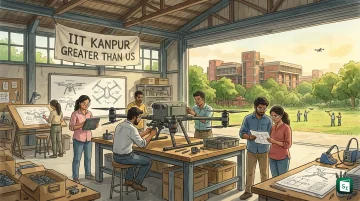
Union Minister Rajnath Singh has launched the ‘Greater Than Us’ fundraising campaign of the IIT Kanpur, targeting $1 billion by March 2029 to strengthen research, innovation, and technological infrastructure.
The IIT Kanpur has also announced plans to establish a defence drone hub in partnership with the Ministry of Defence to indigenise critical components and reduce dependence on imports.
The Uttar Pradesh government has renamed the Bhadohi district as ‘Sant Ravidas Nagar Bhadohi’ to honor the legacy of the saint and social reformer Sant Ravidas.
The Ministry of Civil Aviation has granted a No Objection Certificate (NOC) to Air Ayodhya, a regional airline operated by Megamax Aviation Pvt Ltd.
The airline is authorized to operate under the Regional Connectivity Scheme - Ude Desh ka Aam Nagrik (RCS - UDAN) to improve air connectivity in the underserved regions of Uttar Pradesh (UP).
The Uttar Pradesh government has launched ‘Bharat Taxi’ to support transport workers. The government has also introduced the ‘Mukhyamantri Krishak Samriddhi Yojana’ for farmers.
Under the scheme, agricultural loans are provided through the Cooperative Gramya Vikas Bank, with the interest rate reduced from 11% to 6%.
The Uttar Pradesh Cabinet, chaired by CM Yogi Adityanath, has approved 23 development proposals focusing on industrial growth and employment.
Key approvals include the establishment of an ethanol plant in Mathura and the “UP Toy Manufacturing Promotion Policy 2025” to incentivize specialized manufacturing. The measures also cover various infrastructure projects and welfare reforms to strengthen the socio-economic framework of the state.
The 140-year-old ‘Parichha Weir’ in Jhansi, Uttar Pradesh, has been designated as a World Heritage Irrigation Structure (WHIS) by the International Commission on Irrigation and Drainage (ICID).
It is to be noted that the weir was originally proposed in 1855 by Captain Strachey to serve the Bundelkhand region.
The IIT Kanpur in Uttar Pradesh has established a Centre of Excellence (CoE) on Innovative and Integrated Ecosystem for Green Hydrogen (ECOGEN). This initiative has been launched under the UP Green Hydrogen Policy 2024.
Dr Prabodh Bajpai has been appointed as the Principal Investigator to lead the ECOGEN initiative. The proposal for this CoE was approved by the committee constituted by the Government of Uttar Pradesh and sanctioned by the UP New and Renewable Energy Development Agency (UPNEDA).
The Ancient Buddhist Site of Sarnath in Varanasi, Uttar Pradesh, has been inscribed as the 45th UNESCO World Heritage Site of India. The announcement was made during the 48th Session of the World Heritage Committee (WHC) held in Busan, South Korea.
The site had been on the UNESCO Tentative List since 1998, marking the end of a 28-year wait for this designation. This is the 4th UNESCO World Heritage Site in Uttar Pradesh. With 45 sites, India now ranks 6th globally in terms of the number of World Heritage properties.
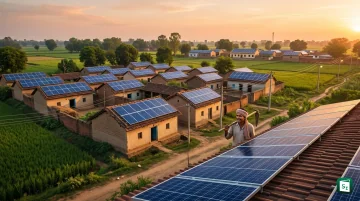
Uttar Pradesh has become the second-largest state in India for domestic rooftop solar installations under the 'PM-Surya Ghar: Muft Bijli Yojana' with 6.75 lakh installations, surpassing Maharashtra.
Gujarat leads the ranking with 7.4 lakh installations, while Maharashtra ranks third with 6.74 lakh installations.
The Ministry of Petroleum and Natural Gas has approved financial assistance of ₹150 crore for India's first private-sector 91 Kilo Litres Per Day (KLPD) Hybrid Second-Generation (2G) Ethanol Biorefinery, located in Dhanaura, Uttar Pradesh.
The assistance is provided through the Centre for High Technology (CHT) under the PM JI-VAN (Jaiv Indhan- Vatavaran Anukool fasal awashesh Nivaran) Yojana. The biorefinery produces sustainable 2G ethanol using agricultural residues.
The Council of Scientific and Industrial Research-Central Road Research Institute (CSIR-CRRI) has signed a Memorandum of Agreement (MoA) with the Public Works Department (PWD) of Uttar Pradesh and the School of Planning and Architecture (SPA), New Delhi. The collaboration aims to implement a scientific framework for the paving and greening of urban roads.
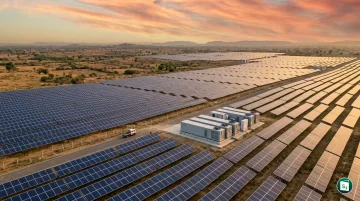
Union Minister Rajnath Singh has approved the establishment of a 250 MW Solar Power Project at the Sitapur Ex-Cantonment area in Uttar Pradesh. This is the first large-scale green energy installation developed on vacant defence land.
The project will feature an integrated Battery Energy Storage System (BESS) to store surplus energy and ensure a stable power supply. NTPC Ltd will implement the project through a competitive bidding process.
The Jai Prakash Narayan Bird Sanctuary, also known as Surha Tal, in Uttar Pradesh has been declared as the 100th Ramsar Site of India. PM Narendra Modi announced this milestone on World Environment Day (June 5).
With this designation, India ranks 3rd globally in the total number of Ramsar sites, trailing only the UK and Mexico, and holds the 1st position in Asia. This sanctuary marks the 13th Ramsar site in Uttar Pradesh, whereas Tamil Nadu currently holds the highest tally of Ramsar sites in India with 20 designated wetlands.
Union Minister Rajnath Singh and Uttar Pradesh CM Yogi Adityanath have inaugurated the ‘Nausena Shaurya Vatika’ in Lucknow. Built at a cost of ₹19 crore, this Open-Air Display Museum is spread over 2 acres and is dedicated to the spirit, valour, and prowess of the Indian Navy.
The museum showcases artefacts and weapon systems from the INS Gomati, which was decommissioned in 2022 after 34 years of service.
The RBI has imposed regulatory restrictions on the Uttar Pradesh-based Nagar Sahakari Bank Ltd due to deteriorating financial conditions and supervisory concerns. Under these restrictions, a withdrawal cap of ₹10,000 per depositor has been placed on all savings, current, and other accounts for 6 months.
Union Minister Jitendra Singh has unveiled two AI-enabled weather forecasting models to provide hyperlocal monsoon and rainfall data. The models were collaboratively developed by the India Meteorological Department (IMD), the Indian Institute of Tropical Meteorology (IITM), Pune, and the National Centre for Medium Range Weather Forecasting (NCMRWF).
The “AI-Enabled Monsoon Advance Forecasting System” provides subdistrict or block-level forecasting for the first time, covering 3,196 blocks across 15 states and 1 Union Territory (UT) in the rainfed monsoon core zone of India. It is to be noted that the system predicts monsoon progression up to 4 weeks in advance with an error margin of 4 days.
The “High Spatial Resolution Rainfall Forecast” is a pilot project in Uttar Pradesh that uses the “Mithuna” weather model to downscale 12.5-km grids to a 1-km resolution. It generates specific rainfall forecasts for up to 10 days in advance.
PM Narendra Modi has participated in the ‘Mahila Sammelan’ in Varanasi (Kashi) and inaugurated development projects worth ₹6,350 crore.
He also inaugurated the 594 km long Ganga Expressway in Hardoi, which is a greenfield access-controlled project. Constructed at a cost of ₹36,230 crore, the expressway connects 12 districts and features a 6-lane configuration (expandable to 8 lanes).
The National Institute of Pharmaceutical Education and Research (NIPER) in Raebareli has signed an MoU, a Confidential Disclosure Agreement (CDA), and a Technology Transfer Agreement with the Hyderabad-based Lofty Laboratories.
The collaboration aims to promote research, innovation, and technology commercialisation to strengthen the ties between academia and industry in the pharmaceutical and biotechnology sectors.
The Uttar Pradesh government has introduced a 10-year warranty model for rural water schemes under the Jal Jeevan Mission (JJM), becoming the first state in India to mandate long-term accountability under the JJM framework. Under the ‘Jal Arpan’ initiative, the ownership of village water infrastructure is transferred to Gram Panchayats (GPs). The policy mandates that construction agencies must handle the operation and maintenance (O&M) of the water systems for a period of 10 years.