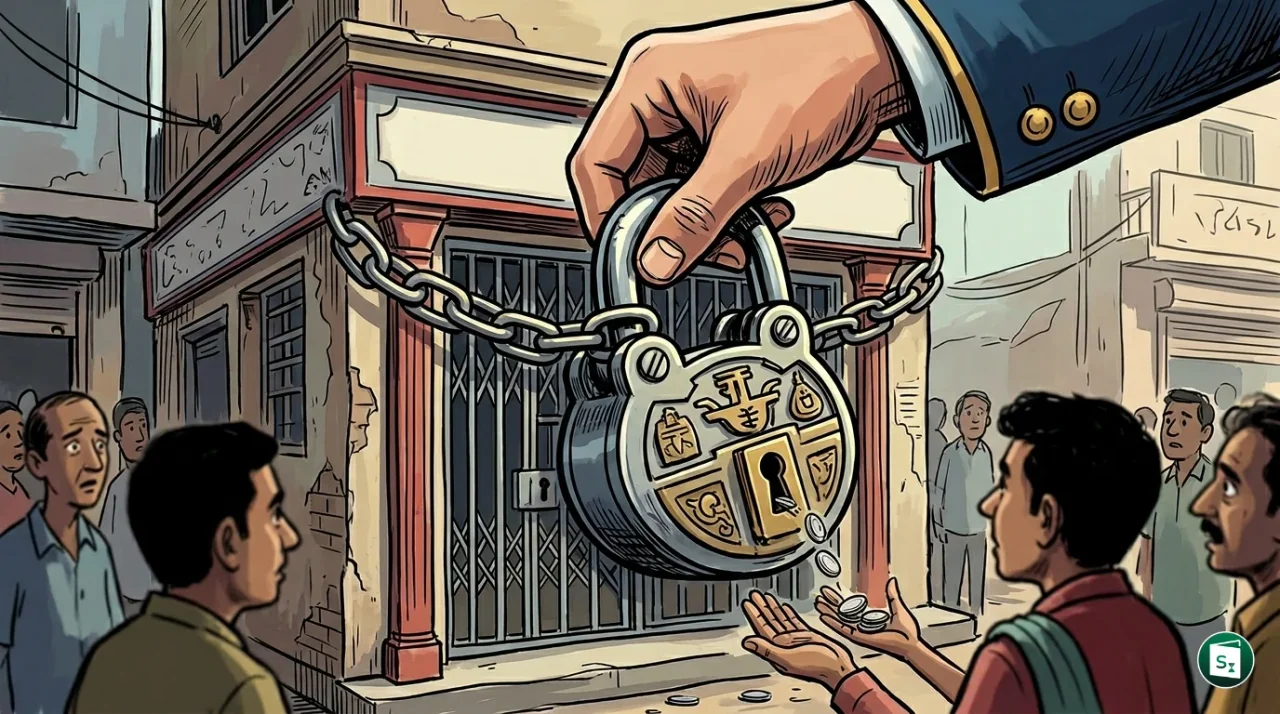
The Reserve Bank of India (RBI) has imposed several regulatory restrictions on the Uttar Pradesh-based Nagar Sahakari Bank Ltd starting May 2026. These directions include a withdrawal limit of ₹10,000 for all types of accounts, citing the bank’s deteriorating financial health and supervisory concerns. The restrictions will remain in force for six months, subject to further review by the central bank.
Scope of Operational Restrictions
The central bank issued these directions under the Banking Regulation Act, 1949, effectively placing the bank under a regulatory moratorium. While the bank is allowed to continue its operations, it faces severe limitations on its daily financial activities.
Under the current directions, the bank is prohibited from granting or renewing any loans and advances. It is also barred from making any fresh investments or accepting new deposits from the public. Furthermore, the bank cannot borrow funds or incur any new liabilities without prior written approval from the RBI. These measures are designed to prevent further financial bleeding and protect the existing assets of the institution.
The restrictions also extend to the disposal of assets. The bank cannot sell, transfer, or otherwise dispose of any of its properties or assets except as permitted under the specific directive. However, the bank is allowed to meet essential operational expenses, such as employee salaries, rent, and electricity bills, to ensure that the basic administrative machinery continues to function. The RBI has clarified that these directions should not be seen as a cancellation of the bank’s license; the bank will continue to operate with these limitations until its financial position shows signs of improvement.
Legal Framework: Section 35A of the BR Act
The power to impose such restrictions is derived from Section 35A of the Banking Regulation Act, 1949. This section empowers the central bank to issue directions to any banking institution in the interest of the public, to prevent the affairs of any banking company from being conducted in a manner detrimental to the interests of the depositors, or to secure the proper management of the banking company.
For co-operative banks, these powers are read along with Section 56 of the same Act. Over the years, the regulatory control of the RBI over co-operative banks has been significantly strengthened to bring them on par with commercial banks in terms of governance and financial transparency. When the RBI observes “supervisory concerns,” which often include inadequate capital, poor liquidity, or failure to comply with KYC (Know Your Customer) norms, it invokes these powers to safeguard the banking system’s integrity. In the case of Nagar Sahakari Bank, the regulator noted that despite previous engagements to improve its functioning, a lack of concrete efforts necessitated this formal intervention.
Protection for Depositors: The DICGC Cover
While the withdrawal cap of ₹10,000 may cause immediate inconvenience, depositors are protected by a statutory safety net. The Deposit Insurance and Credit Guarantee Corporation (DICGC), a wholly-owned subsidiary of the RBI, provides insurance for bank deposits in India. Under the current rules, every depositor in a bank is insured up to a maximum of ₹5,00,000 for both principal and interest amount.
If a bank is placed under such regulatory directions, the DICGC is mandated to pay the insured amount to eligible depositors within 90 days of the restrictions being imposed. This 90-day rule was introduced to provide timely relief to small depositors who might otherwise face financial hardship during a prolonged bank moratorium.
| Feature | Details |
|---|---|
| Maximum Insurance Limit | ₹5,00,000 per depositor, per bank |
| Accounts Covered | Savings, Current, Fixed (FD), and Recurring (RD) |
| Payment Timeline | Within 90 days of RBI directions |
| Premium Payment | Paid entirely by the bank (no cost to depositors) |
Effective from April 1, 2026, the RBI and DICGC have also introduced a Risk-Based Premium framework. Under this system, banks with better financial health pay lower insurance premiums, while riskier banks are required to pay higher rates. This encourages co-operative banks to maintain stronger financial positions to reduce their operational costs.
Regulatory Landscape for Co-operative Banks
The action against Nagar Sahakari Bank is part of a broader trend of intensified oversight by the RBI in the co-operative banking sector. Throughout 2025 and 2026, the regulator has shifted toward stricter governance standards and modernization. A key recent development is the Banking Laws (Amendment) Act, 2025, which streamlined reporting timelines and standardized the tenure of directors in co-operative banks to a maximum of 10 years.
To prevent directors from circumventing these term limits, the RBI also mandated a three-year cooling-off period in May 2026. This means a director who completes a continuous 10-year term must wait for three years before being eligible for re-election. Such measures aim to professionalize the boards of Urban Co-operative Banks (UCBs) and ensure they operate with the same level of accountability as commercial banks. The central bank’s “zero-tolerance” approach toward non-compliance, particularly regarding KYC and capital adequacy, is intended to weed out non-viable entities and strengthen the overall financial stability of the co-operative sector in India.
Key Takeaways
- The RBI has imposed operational restrictions on Nagar Sahakari Bank Ltd., Etawah, for a period of six months starting May 2026.
- A withdrawal cap of ₹10,000 per depositor has been placed on all types of accounts held with the bank.
- The regulatory directions were issued under Section 35A of the Banking Regulation Act, 1949, read with Section 56.
- Every depositor is eligible for an insurance claim of up to ₹5,00,000 from the DICGC, a subsidiary of the RBI.
- The DICGC is required to pay the insured amount within 90 days of the imposition of such regulatory restrictions.
- Recent governance reforms include the Banking Laws (Amendment) Act, 2025, and a mandatory three-year cooling-off period for board directors.