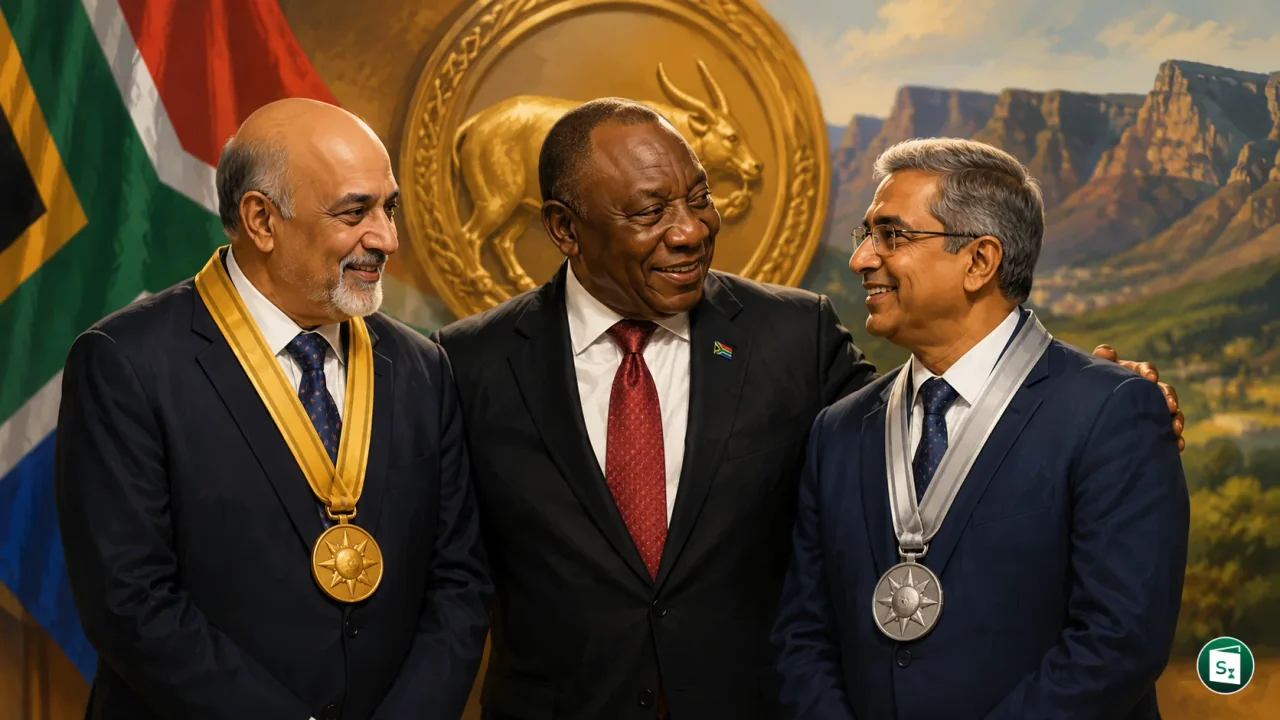
South African President Cyril Ramaphosa conferred the Order of Mapungubwe, the nation’s highest civilian honour, on distinguished Indian-origin professors Salim Abdool Karim and Keertan Dheda on May 27, 2026. The awards recognize their groundbreaking contributions to medical science, particularly in the fields of epidemiology, pulmonology, and global health policy. This recognition highlights the significant impact of the Indian diaspora in South Africa and their role in tackling some of the world’s most pressing health challenges.
What is the Order of Mapungubwe?
The Order of Mapungubwe is the highest civilian honour in South Africa, awarded to citizens for excellence and exceptional achievement that has an international impact and serves the interests of the Republic. It was instituted on December 6, 2002, as part of the country’s post-apartheid national orders system. The award is named after the ancient Kingdom of Mapungubwe, which flourished a millennium ago in the Limpopo province and was a sophisticated centre of trade and metallurgy.
Symbolism and Categories
The central motif of the award is the Golden Rhinoceros, a gold-plated figurine discovered at the archaeological site of Mapungubwe. This rhinoceros symbolizes human resourcefulness and the kingdom’s excellence in science and creativity. The order is conferred in four distinct categories:
| Category | Description |
|---|---|
| Platinum (OMP) | For exceptional and unique achievements (highest grade) |
| Gold (OMG) | For exceptional achievements |
| Silver (OMS) | For excellent achievements |
| Bronze (OMB) | For outstanding achievements |
The first recipient of the Order of Mapungubwe was Nelson Mandela, who received the Platinum category in 2002 for his monumental role in national reconciliation.
Professor Salim Abdool Karim: A Global Leader in Epidemiology
Professor Salim Abdool Karim was awarded the Order of Mapungubwe in Gold for his monumental contributions to medical science and public health. As a world-renowned infectious diseases epidemiologist, his research has fundamentally changed the prevention and treatment of HIV and tuberculosis (TB) globally. He serves as the Director of the Centre for the AIDS Programme of Research in South Africa (CAPRISA) and is a professor at the University of KwaZulu-Natal.
Pioneering HIV and TB Research
One of Professor Karim’s most significant achievements was co-leading the landmark CAPRISA 004 trial. This study provided the first proof-of-concept that a tenofovir-based microbicidal gel could prevent the sexual transmission of HIV in women, a discovery hailed as a major breakthrough in the fight against AIDS. Furthermore, his work on HIV-TB co-infection established the optimal timing for starting antiretroviral therapy (ART) in patients with tuberculosis, significantly reducing mortality rates and shaping international clinical guidelines.
Leadership During the COVID-19 Pandemic
Beyond his work on HIV and TB, Professor Karim played a pivotal role during the COVID-19 pandemic. He served as the Chair of the South African Ministerial Advisory Committee on COVID-19, providing rigorous, data-driven scientific guidance that anchored the nation’s early response. His ability to communicate complex science to the public and policy makers helped South Africa navigate the various waves of the pandemic. He also serves on the World Health Organization (WHO) Science Council and the UNAIDS Scientific Expert Panel.
Professor Keertan Dheda: Revolutionizing TB Diagnostics
Professor Keertan Dheda received the Order of Mapungubwe in Silver for his pioneering scientific research in pulmonology and respiratory medicine. His work has revolutionized the clinical and public health management of tuberculosis (TB) and drug-resistant respiratory infections. Professor Dheda is recognized as an international expert whose research has shaped public health policy in multiple countries and has been instrumental in the global rollout of advanced diagnostic tools.
Innovations in Testing and Management
Professor Dheda has been at the forefront of developing and implementing novel diagnostic tools, such as the urine TB LAM test. This test has been shown to reduce mortality in hospitalized patients with advanced HIV and has been adopted by the WHO for global use. His research challenged long-held assumptions about drug-resistant TB, proving that these strains were being widely transmitted within communities rather than being less infectious.
Active Community Case-Finding
One of his most impactful contributions is shifting the approach to TB detection from passive case-finding to active community-based screening. By using mobile DNA-based diagnostic units, his teams have brought high-quality diagnostics directly to vulnerable populations. This proactive approach ensures earlier treatment and reduces the transmission of the disease. In addition to his scientific work, Professor Dheda founded the charity Free of TB to support patients and families affected by the disease, demonstrating his commitment to holistic health solutions.
South Africa’s National Orders System
The Order of Mapungubwe is the premier honour among South Africa’s national orders, which were redesigned after 1994 to reflect the values of a democratic and non-racial society. These awards are the highest accolades that the President can bestow on citizens and foreign nationals.
Other significant national orders include:
- Order of the Baobab: Awarded for distinguished service in the fields of business, the economy, science, medicine, and community service.
- Order of Luthuli: Recognizes South African citizens who have made a meaningful contribution to the struggle for democracy, human rights, and justice.
- Order of Ikhamanga: Awarded for excellence in the fields of arts, culture, literature, music, journalism, and sport.
- Order of the Companions of OR Tambo: Bestowed upon foreign heads of state and other foreign dignitaries for showing friendship and support to South Africa.
- Mendi Decoration for Bravery: Awarded to South African citizens who have performed extraordinary acts of bravery that placed their lives in great danger.
These honours serve as a powerful symbol of national pride and unity, celebrating individuals whose lives and work exemplify the best of the South African spirit and their contribution to the global community.
Key Takeaways
- South African President Cyril Ramaphosa conferred the Order of Mapungubwe on Indian-origin professors Salim Abdool Karim and Keertan Dheda on May 27, 2026.
- The Order of Mapungubwe is the highest civilian honour in South Africa, instituted in 2002 and named after an ancient African kingdom.
- Professor Salim Abdool Karim received the award in the Gold category for his pioneering research in HIV prevention and tuberculosis epidemiology.
- Professor Keertan Dheda was awarded in the Silver category for his breakthroughs in tuberculosis diagnostics and pulmonology.
- The Golden Rhinoceros of Mapungubwe is the central motif of the award, symbolizing excellence and human resourcefulness.
- The first recipient of the Order of Mapungubwe was Nelson Mandela, who was honoured with the Platinum category in 2002.