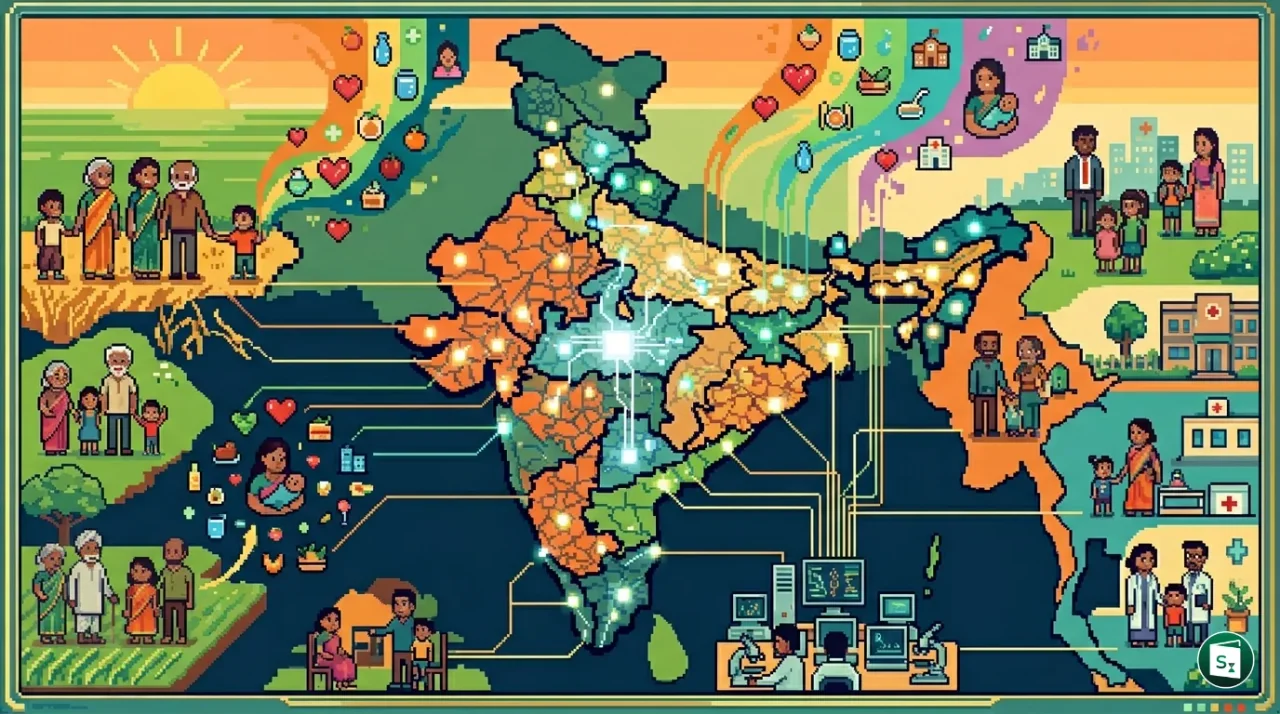
The Ministry of Health and Family Welfare released the report of the National Family Health Survey 6 (NFHS-6) on June 17, 2026, marking a significant milestone in India’s data driven health monitoring. This latest round of the survey provides a detailed snapshot of the health and demographic status of the Indian population based on data collected during 2023 and 2024. The findings serve as a critical tool for policymakers to evaluate the impact of existing health schemes and design future interventions.
Understanding the National Family Health Survey
The National Family Health Survey (NFHS) is a large scale, multi round survey conducted across a representative sample of households throughout India. Since its inception in 1992, it has become a vital source of information on fertility, family planning, infant and child mortality, reproductive health, nutrition, and anaemia. The survey is coordinated by the International Institute for Population Sciences (IIPS), which is based in Mumbai and was established in 1956.
The Ministry of Health and Family Welfare (MoHFW) designates IIPS as the nodal agency for all rounds of the NFHS. Each round provides high quality data that allows for state and district level comparisons, enabling the government to monitor progress toward national and international goals, including the Sustainable Development Goals (SDGs).
| NFHS Round | Survey Period | Nodal Agency |
|---|---|---|
| NFHS-1 | 1992 to 1993 | IIPS Mumbai |
| NFHS-2 | 1998 to 1999 | IIPS Mumbai |
| NFHS-3 | 2005 to 2006 | IIPS Mumbai |
| NFHS-4 | 2015 to 2016 | IIPS Mumbai |
| NFHS-5 | 2019 to 2021 | IIPS Mumbai |
| NFHS-6 | 2023 to 2024 | IIPS Mumbai |
Scope and Coverage of NFHS-6
The NFHS-6 was conducted between 2023 and 2024, covering a vast geographic area and a diverse population. The survey successfully reached 6.79 lakh households across 715 districts in India. This coverage includes all States and Union Territories (UTs), with the exception of Manipur, where the survey could not be completed due to specific logistical and local conditions.
The survey methodology involves a multi stage stratified sampling process. In rural areas, villages serve as the primary sampling units, while in urban areas, Census Enumeration Blocks are used. The massive scale of the survey ensures that the data is statistically significant at the district level, which is essential for decentralised planning and local governance.
| Coverage Metric | Details |
|---|---|
| Total Households | 6.79 Lakh |
| Total Districts | 715 |
| Period of Survey | 2023 to 2024 |
| Nodal Agency | IIPS Mumbai |
Key Indicators and Data Points
The NFHS-6 evaluates the status of health and demographics through 101 major indicators. These indicators are carefully chosen to reflect the core priorities of India’s health policy and to provide a basis for international comparisons. The data collected provides insights into several critical areas, including maternal and child health, gender equity, and social determinants of health.
Some of the primary themes covered by the 101 indicators include:
- Maternal and Child Health: This includes prenatal care, institutional deliveries, and immunization coverage for children.
- Nutrition and Anaemia: The survey measures the prevalence of stunting, wasting, and underweight conditions among children, as well as anaemia levels across different age groups.
- Family Planning: It tracks the Total Fertility Rate (TFR) and the usage of various contraceptive methods.
- Water and Sanitation: The data sheds light on the accessibility of clean drinking water and improved sanitation facilities at the household level.
- Gender and Domestic Violence: The survey includes sensitive indicators related to women’s empowerment and experiences of domestic violence.
The comprehensive nature of these indicators allows the government to identify specific regions or communities that require targeted interventions. By tracking these metrics over multiple rounds, the NFHS helps in assessing the long term impact of flagship schemes like Ayushman Bharat, Poshan Abhiyaan, and Jal Jeevan Mission.
Significance of the Survey for Future Policy
The release of the NFHS-6 findings comes at a crucial time as India strives to achieve its health targets and improve its position on global indices. The survey data is used by the Ministry of Health and Family Welfare, NITI Aayog, and various other ministries to monitor the progress of developmental programmes. It also serves as a baseline for measuring the impact of the National Health Policy 2017, which aims to increase government health expenditure to 2.5 percent of GDP.
Furthermore, the data is extensively used by researchers, international organizations like the World Health Organization (WHO) and UNICEF, and civil society to advocate for health reforms. The evidence based approach of the NFHS ensures that policy decisions are grounded in reality, helping in the efficient allocation of resources and the reduction of health disparities across the country.
Key Takeaways
- The National Family Health Survey 6 (NFHS-6) was released by the Ministry of Health and Family Welfare on June 17, 2026.
- The International Institute for Population Sciences (IIPS) in Mumbai, established in 1956, served as the nodal agency for the survey.
- The survey covered 6.79 lakh households across 715 districts in India during the 2023 to 2024 period.
- Findings were collected across 101 major indicators, focusing on maternal health, child nutrition, family planning, and gender equity.
- The survey data will be used to track progress toward the Sustainable Development Goals (SDGs) and the targets set in the National Health Policy 2017.
- Manipur was the only state excluded from this round of the survey due to local logistical challenges.