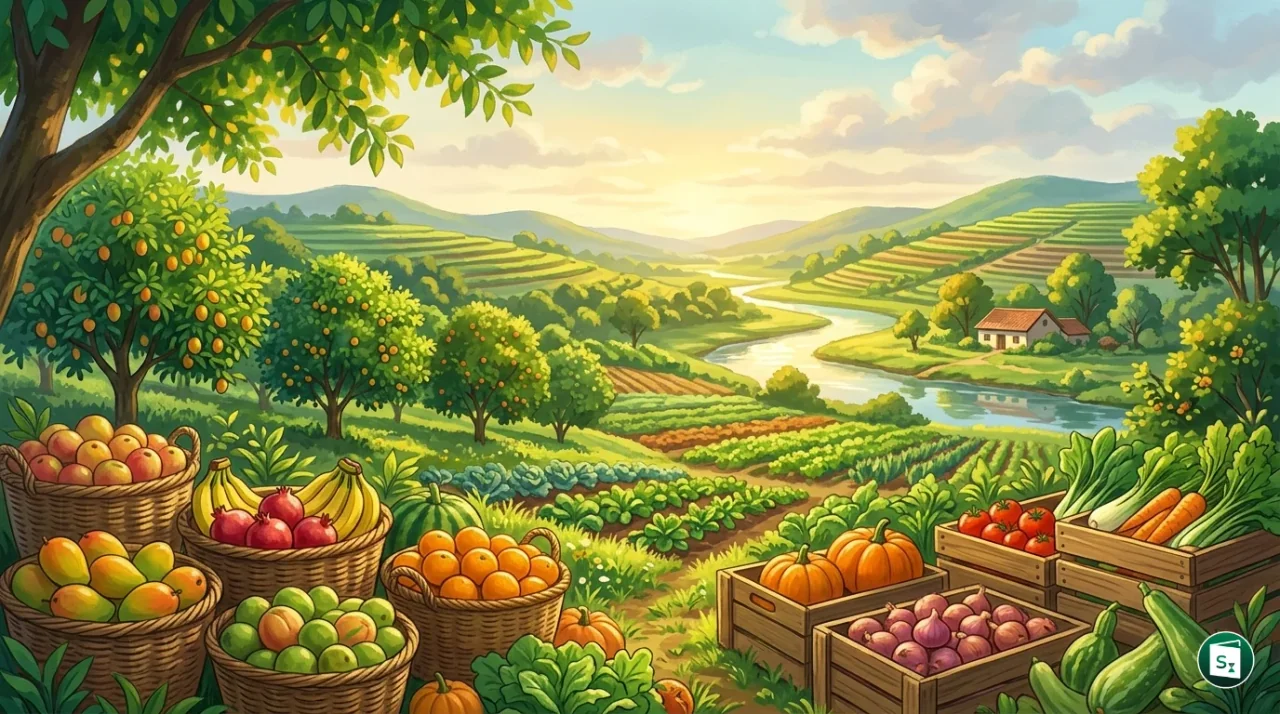
The Department of Agriculture and Farmers Welfare released the Second Advance Estimates of Horticulture Crops for 2025-26 on June 17, 2026, projecting a record production of 377.78 million tonnes. This estimate marks a 1.90 percent increase over the previous year, driven primarily by robust growth in fruit and key vegetable outputs. The data highlights the sector’s resilience and its growing contribution to the overall agricultural gross value added in the country.
Record Growth in India’s Horticulture Sector
The Second Advance Estimates for the 2025-26 agricultural year reveal that India’s horticulture sector continues to outperform traditional foodgrain production, a trend that began in 2012-13. The Department of Agriculture and Farmers Welfare (DA&FW), which operates under the Ministry of Agriculture and Farmers Welfare, compiles these estimates based on data from State Horticulture Departments and market arrivals.
The total horticulture production is projected to reach 3,777.76 lakh tonnes (LT), cultivated across an area of 301.51 lakh hectares. While the area under cultivation saw a marginal increase of only 0.05 percent, the production grew by 1.90 percent. This disparity indicates significant improvements in productivity and yield per hectare, reflecting the successful adoption of modern farming technologies and better crop management practices.
Understanding Advance Estimates
In the Indian agricultural system, the government releases multiple sets of advance estimates to help policymakers, traders, and farmers make informed decisions. These forecasts are critical for managing food security, setting procurement targets, and stabilizing market prices. While foodgrains typically see four sets of estimates, horticulture follows a slightly different cycle with three advance estimates before the final data is released.
Breaking Down the Numbers: Fruits and Vegetables
The expansion in India’s horticulture output is broadly distributed across two major categories: fruits and vegetables. India currently ranks as the second largest producer of fruits and vegetables in the world, trailing only China.
| Category | 2024-25 (Final Estimate) | 2025-26 (Second Advance Estimate) | Percentage Growth |
|---|---|---|---|
| Total Horticulture | 370.74 MT | 377.78 MT | +1.90% |
| Total Fruits | 117.65 MT | 121.48 MT | +3.25% |
| Total Vegetables | 217.80 MT | 221.00 MT | +1.47% |
| Total Area | 30.14 million ha | 30.15 million ha | +0.05% |
Fruits: Yield Gains Drive Growth
Fruit production is estimated to reach 1,214.75 lakh tonnes, marking a significant increase of 3.25 percent compared to the previous year. This growth is particularly noteworthy because it has been achieved through productivity gains rather than a large expansion in acreage. The surge is primarily attributed to higher yields in major commercial crops such as Banana, Mango, Papaya, Apple, and Guava. The study of fruit crops, known as Pomology, remains a high-priority area for Indian agricultural research institutions.
Vegetables: Steady Increase in Staples
Vegetable production, or Olericulture, is projected to grow by 1.47 percent, reaching 2,210 lakh tonnes. The area under vegetable cultivation increased by 0.75 percent, reaching 118.79 lakh hectares. Beyond the staples, the estimates also show positive trends in the production of Okra (Ladyfinger), Peas, Cauliflower, and Bottle Gourd.
The “TOP” Crops: Focus on Tomatoes, Onions, and Potatoes
The three essential kitchen staples—Tomato, Onion, and Potato, collectively known as the TOP complex—receive special attention in government monitoring due to their impact on food inflation. The government launched Operation Greens specifically to stabilize the supply and prices of these three crops, which was later expanded to cover all fruits and vegetables.
| Crop | 2024-25 (Final) | 2025-26 (2nd Advance) | Trend |
|---|---|---|---|
| Potato | 58.57 MT | 59.89 MT | +2.25% |
| Tomato | 20.60 MT | 21.46 MT | +4.19% |
| Onion | 30.77 MT | 30.74 MT | -0.10% |
Analysis of the TOP Trends
Among the staples, Tomato production is expected to see the most significant jump of 4.19 percent, reaching 214.61 lakh tonnes. This increase is driven by a combination of higher acreage and improved yields. Potato production is also projected to grow healthily by 2.25 percent, reaching nearly 599 lakh tonnes.
However, Onion production presents a unique scenario. While the area under onion cultivation is expected to rise by 2.31 percent to reach 20.14 lakh hectares, the actual production is estimated to remain nearly stable at 307.37 lakh tonnes. This indicates a slight decline in average productivity in some regions, which has offset the gains from increased planting area. Monitoring onion supply remains critical as India is one of the world’s leading producers and exporters of the crop.
Strategic Importance of Horticulture in India
Horticulture has evolved from being a subsidiary sector to a primary engine of agricultural growth in India. The period between 1991 and 2003 is often called the Golden Revolution, marked by a surge in the production of honey, fruits, and other horticultural products. Today, while horticulture occupies only about 13 to 18 percent of India’s total cropped area, it contributes nearly 33 percent to the agricultural Gross Value Added (GVA).
The government supports the sector through the Mission for Integrated Development of Horticulture (MIDH), an umbrella scheme launched in 2014-15. This mission focuses on the holistic development of the horticulture sector, covering fruits, vegetables, root and tuber crops, mushrooms, spices, flowers, aromatic plants, coconut, cashew, cocoa, and bamboo. The shift toward horticulture is also seen as a vital strategy for doubling farmers’ income, as these high-value crops offer much higher returns per unit area compared to traditional cereals like wheat or rice.
Beyond economics, horticulture plays a crucial role in ensuring nutritional security by providing essential vitamins and minerals. With India aiming to become a major global exporter, the sector’s growth is expected to create significant employment opportunities in cold chain logistics, food processing, and specialized farming.
Key Takeaways
- India’s total horticulture production is projected to reach a record 3,777.76 lakh tonnes in 2025-26, as per the Second Advance Estimates.
- The total area under horticulture cultivation is estimated at 301.51 lakh hectares, reflecting a marginal 0.05 percent increase.
- Fruit production is expected to rise by 3.25 percent to reach 1,214.75 lakh tonnes, driven by productivity gains in crops like Banana and Mango.
- Vegetable production is estimated at 2,210 lakh tonnes, with a significant 4.19 percent growth projected for Tomato production.
- Onion production is expected to remain stable at 307.37 lakh tonnes despite a 2.31 percent increase in the area under cultivation.
- Horticulture contributes approximately 33 percent to India’s agricultural Gross Value Added (GVA) while occupying a relatively small portion of the total cropped area.