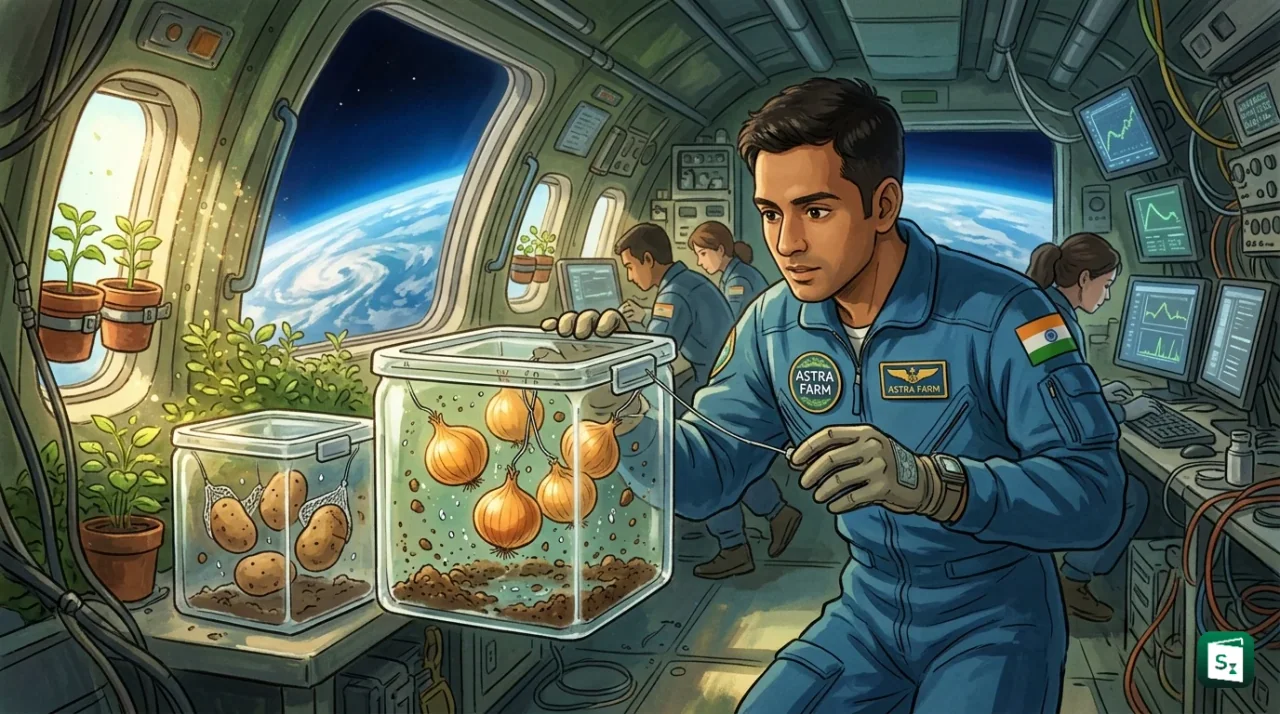
Captain Aman Johri, an Indian analog astronaut and astronautics engineer, has successfully completed a pioneering microgravity research flight under Project Astra Farm, a space agriculture initiative focused on studying staple crops from Maharashtra. The mission carried locally grown onions and potatoes aboard a specially designed passive microgravity payload in collaboration with the National Research Council Canada (NRC-CNRC). This experiment marks one of India’s first dedicated efforts to investigate how regional agricultural produce behaves in reduced-gravity conditions, with implications for both future space missions and climate-resilient farming on Earth.
Who Is Captain Aman Johri?
Captain Aman Johri is a Mumbai-based astronautics engineer and one of India’s youngest analog astronauts. He holds a Master’s degree in Astronautics Engineering from Purdue University in the United States, specializing in astrodynamics, spaceflight operations, and electric propulsion systems. He also holds an Aerospace Engineering degree from SRM University, Chennai, and is a trained helicopter pilot.
Over the past three years, Johri has undergone an intensive astronaut training programme that includes analog astronaut missions, spaceflight ground school, underwater neutral buoyancy laboratory training, zero-gravity flights, high-G exposure, extravehicular activity (EVA) spacesuit operations, and orbital mission simulations. He is the founder and CEO of Jatayu Unmanned Technologies, an aerospace and defence firm.
The term analog astronaut refers to a person who participates in simulations and experiments on Earth that replicate spaceflight conditions. These missions help test technologies, human performance, and scientific protocols before actual spaceflight, without the cost and risk of launching into orbit.
What Is Project Astra Farm?
Project Astra Farm is a space agriculture initiative led by Indian analog astronaut Captain Aman Johri to study Maharashtra-grown onions and potatoes in microgravity. Conducted with a passive payload aboard the National Research Council Canada (NRC-CNRC) aircraft, it aims to make Maharashtra a hub for space farming and resilient food systems.
The initiative has a dual-use scientific mandate. On one hand, it seeks to develop space farming protocols to support ISRO’s Gaganyaan human spaceflight programme and future missions to lunar bases and Martian settlements. On the other, it aims to generate insights that can improve crop resistance against climate change, extreme weather, post-harvest losses, and spoilage on Earth.
How Was the Microgravity Experiment Conducted?
The experiment used a passive microgravity payload, a specially designed container that houses biological samples and exposes them to reduced-gravity conditions without requiring active power or complex support systems. The payload was flown aboard a research aircraft operated by the National Research Council Canada (NRC-CNRC).
The NRC operates a Falcon 20 research aircraft that performs parabolic flights, a standard method for creating short-duration microgravity environments on Earth. In a parabolic flight, the aircraft climbs steeply and then follows a ballistic arc. During the downward phase of each parabola, the aircraft and everything inside it experience near-weightlessness for about 20 to 25 seconds. A typical flight can perform 20 to 30 such parabolas, giving researchers repeated windows of microgravity to study how materials and biological samples behave.
During this flight, Captain Johri also unfurled the Indian National Flag, marking a symbolic celebration of India’s growing capabilities in human space exploration.
Why Onions and Potatoes for Space Research?
Onions and potatoes were chosen for this experiment for several practical and scientific reasons. Both crops are staple foods with high nutritional value, long storage potential, and well-understood biology, making them ideal candidates for space agriculture experiments.
Potatoes are a rich source of carbohydrates, vitamins, and minerals. NASA has identified potatoes as one of the most suitable crops for deep-space missions because they can be grown in controlled environments and provide high calorie yield per unit area. Potato plants have been studied in space by NASA as early as 1995, when they were tested aboard the Space Shuttle to understand how tubers develop in microgravity.
Onions are valued for their long shelf life, high nutrient density, and natural antimicrobial properties. They also contain compounds that help preserve other food items, making them useful for long-duration missions where food spoilage is a critical concern.
The decision to use crops grown in Maharashtra is significant. Maharashtra is one of India’s largest producers of both onions and potatoes. The state accounts for a substantial share of the country’s onion output, with major growing regions in Nashik, Pune, and Ahmednagar districts. Using locally sourced produce connects the research directly to India’s agricultural reality and makes the findings applicable to Indian farming conditions.
Post-Flight Analysis: The Role of BARC
After the microgravity phase, the crop samples are slated to undergo nuclear food irradiation at facilities associated with the Bhabha Atomic Research Centre (BARC) under the Department of Atomic Energy (DAE). This stage is conducted in partnership with Hindustan Agro Co-Op Ltd, a cooperative supported by the Government of Maharashtra.
Food irradiation is a process that exposes food to controlled amounts of ionizing radiation, such as gamma rays, to eliminate bacteria, insects, and fungi, and to delay ripening and sprouting. BARC has extensive experience in this field, with established research on extending the shelf life of potatoes and onions using radiation technology.
The experiment will compare irradiated and non-irradiated samples after the microgravity exposure. Scientists will study biological, physiological, and cellular changes to understand how reduced gravity and radiation interact to affect plant tissue. This comparative analysis could unlock new methods for long-term food preservation in space and more resilient agriculture on Earth.
BARC, established in 1954 and headquartered in Mumbai, is India’s premier nuclear research facility. Its work in food irradiation is part of a broader portfolio that includes applications of radiation technology in healthcare, industry, and agriculture.
Significance for India’s Space and Agriculture Goals
Project Astra Farm arrives at a crucial moment for India’s space ambitions. ISRO’s Gaganyaan programme aims to send Indian astronauts to low Earth orbit, with the crewed mission expected by late 2026. For any human spaceflight programme, developing reliable food systems is one of the greatest technical challenges. Astronauts on the International Space Station currently rely mostly on pre-packaged food, but for longer missions to the Moon or Mars, growing fresh food in space becomes essential.
India has already taken steps in this direction. In 2024, ISRO successfully conducted the CROPS (Compact Research Module for Orbital Plant Studies) experiment, which germinated cowpea seeds in space and demonstrated that plants can grow in microgravity using Indian technology.
The current experiment under Project Astra Farm goes further by studying how the cellular biology of staple crops responds to reduced gravity, and combining that with post-flight irradiation analysis. The findings could contribute to developing food systems for long-duration spaceflight, including orbital missions, lunar bases, and Martian settlements. They may also lead to climate-resilient crops by applying insights from how plants respond to extreme environments. Better understanding of storage and preservation under stressful conditions could reduce post-harvest losses, while the overall work helps build India’s indigenous capability in space biotechnology research.
Captain Johri is preparing for a future orbital spaceflight mission and continues to work with stakeholders aligned with the Gaganyaan human spaceflight ecosystem. His efforts represent a growing convergence between India’s traditional agricultural strength and its emerging space capabilities.
Key Takeaways
- Captain Aman Johri, India’s youngest analog astronaut, completed a microgravity research flight under Project Astra Farm focused on Maharashtra-grown onions and potatoes.
- The experiment was conducted using a passive microgravity payload aboard a Falcon 20 research aircraft operated by the National Research Council Canada (NRC-CNRC).
- After the microgravity phase, the crop samples will undergo nuclear food irradiation at facilities associated with BARC under the Department of Atomic Energy (DAE).
- Captain Johri holds an Astronautics Engineering degree from Purdue University and is a trained helicopter pilot and founder of Jatayu Unmanned Technologies.
- Project Astra Farm aims to establish Maharashtra as a hub for space agriculture, with dual-use benefits for Gaganyaan missions and climate-resilient farming on Earth.
- Onions and potatoes were chosen for their high nutritional value, long shelf life, and status as staple crops of Maharashtra, a leading producer of both commodities.