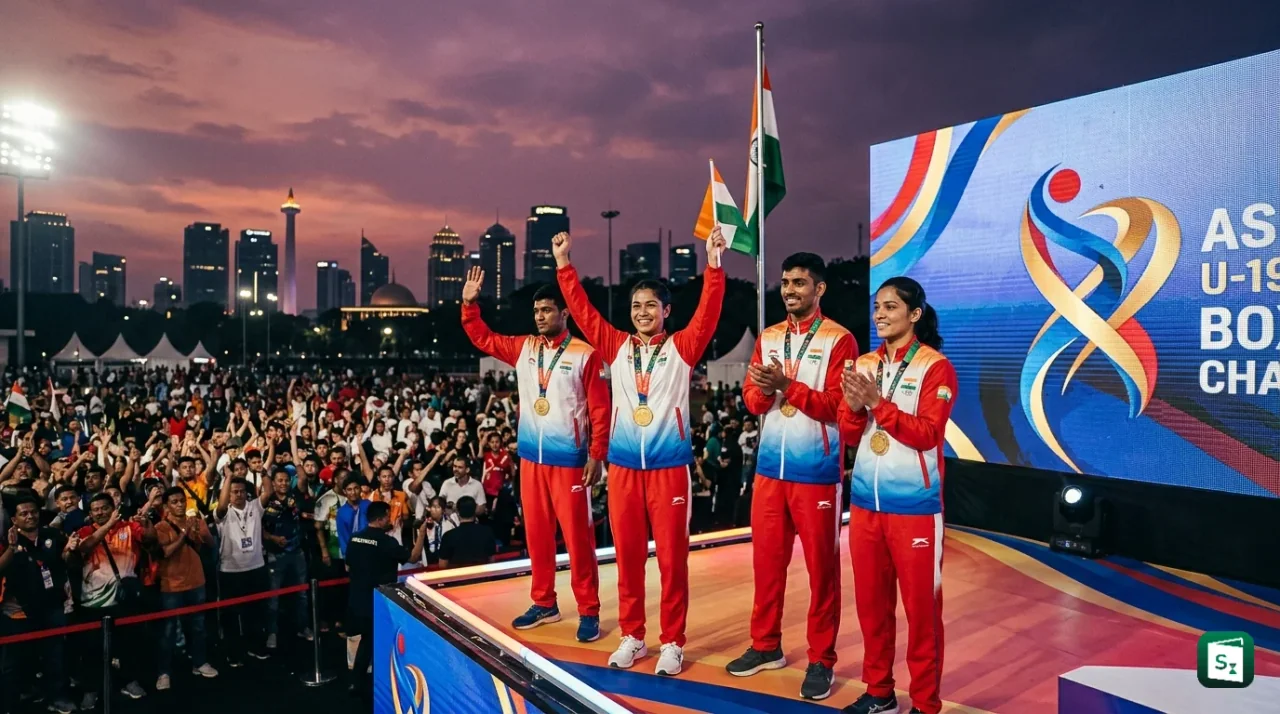
India won 29 medals (five gold, 13 silver, 11 bronze) at the inaugural Asian U-19 and U-23 Boxing Championships 2026, held in Jakarta, Indonesia from July 5 to 16. The Indian contingent finished third in the overall medal tally, while Uzbekistan dominated the table with 33 medals (including 21 gold) and Kazakhstan secured the second spot. Five Indian boxers across the two age categories brought home gold medals, underlining the growing depth of India’s youth boxing programme.
A Historic First: The Inaugural Championships
The Asian Boxing U-19 and U-23 Championships were held for the first time in 2026, organised by the Asian Boxing Confederation (ASBC). The tournament brought together 329 boxers from 20 national federations across Asia, competing in multiple weight categories in both men’s and women’s divisions. Jakarta, the capital of Indonesia, hosted the two-week event at a time when Asian youth boxing is witnessing rapid growth.
The Boxing Federation of India (BFI), headquartered in Gurugram, Haryana, sent a strong and balanced squad across both age groups. The BFI, which replaced the earlier Indian Amateur Boxing Federation as the national governing body for boxing in India, has been focusing on age-group development programmes to build a pipeline of talent for senior international events.
The U-19 category featured boxers aged under 19, while the U-23 division catered to athletes under 23, providing a crucial bridge between youth and elite-level competition.
India’s Five Gold Medalists
India’s five gold medals came from both age categories and across men’s and women’s events, showcasing the breadth of talent in the country’s boxing system.
U-19 Women: Chandrika Bhoresh Pujari and Prachi
Chandrika Bhoresh Pujari won the gold medal in the women’s U-19 51kg category. She defeated Uzbekistan’s Nazokat Mardonova by a unanimous 5:0 decision in the final. Chandrika, a World Boxing Futures Cup gold medalist, was one of the key names in the Indian squad and lived up to expectations with a dominant campaign.
Prachi added another gold in the women’s U-19 57kg category. She overcame Indonesia’s Dira Artika in the final, demonstrating composure and technical superiority. Her victory contributed to India’s strong showing in the U-19 women’s section, where the team won a total of two gold and six silver medals.
U-23 Women: Nisha
Nisha claimed India’s lone gold in the women’s U-23 section by winning the 54kg final. She defeated Japan’s Koiin Kokufu with a convincing 5:0 scoreline. The U-23 women’s team overall collected one gold, four silver, and four bronze medals, with Nikita Chand (60kg), Kajal (65kg), and Muskan (75kg) settling for silver after close finals against Uzbek opponents.
U-23 Men: Vishvanath Suresh and Ganga
In the men’s U-23 category, Vishvanath Suresh won gold in the 50kg division. The reigning Asian Champion defeated Japan’s Daichi Iwai by a 3:2 split decision in a closely contested final. Vishvanath had earlier made headlines at the Asian Boxing Championships 2026 (elite level) where he upset the reigning world champion Sanzhar Tashkenbay in the quarterfinals.
Ganga matched his teammate’s achievement by winning the men’s U-23 55kg gold. He edged past Kazakhstan’s Bexulatn Boranbek with a 3:2 split decision, adding a second men’s U-23 gold to India’s tally. Vanshaj (65kg) also reached the final but lost to Uzbekistan’s Ilkhomjon Ergashev, settling for silver.
India’s Overall Performance: Category-Wise Breakdown
Across both age groups and genders, India won a total of 29 medals. Here is the category-wise distribution:
| Category | Gold | Silver | Bronze | Total |
|---|---|---|---|---|
| U-19 Women | 2 | 6 | 0 | 8 |
| U-23 Women | 1 | 4 | 4 | 9 |
| U-19 Men | 0 | 2 | 4 | 6 |
| U-23 Men | 2 | 1 | 3 | 6 |
| Total | 5 | 13 | 11 | 29 |
India’s U-19 women’s team was the standout performer, securing two gold and six silver medals. The U-23 women’s team added depth with nine medals. In the men’s sections, India registered six medals each in U-19 and U-23, with Vishvanath Suresh and Ganga delivering the two golds in the U-23 category.
In the U-19 men’s category, India assured itself of six medals early in the tournament after a dominant quarterfinal round. Aditya (55kg), Sikander (60kg), Mausam Suhag (65kg), Devender Choudhary (75kg), Sagar (85kg), and Shubham Rajput (90kg) all reached the semifinals. However, Aditya and Shubham Rajput lost their finals, settling for silver. The U-19 men’s team also contributed four bronze medals through semifinal finishes.
How Other Nations Performed
Uzbekistan emerged as the dominant force, winning 21 gold medals across the two age groups. In the U-19 competition alone, Uzbekistan won seven of the ten gold medals on offer. The U-23 men’s section saw Uzbekistan and Kazakhstan each claim three golds, while India won two.
Kazakhstan finished second in the overall standings. Its men’s team alone secured five gold, eight silver, and three bronze medals across the U-19 and U-23 categories. The Central Asian boxing powers continued to demonstrate the strength of their development systems, which have produced multiple Olympic and world champions over the years.
Significance for Indian Boxing
India’s performance in Jakarta is a strong indicator of the progress being made in grassroots and age-group boxing development. The Boxing Federation of India has prioritised youth development programmes, including national camps, exposure trips, and domestic competitions, to identify and groom talent from an early age.
Several of India’s gold medalists at these championships have already gained international experience at other major events. Vishvanath Suresh had competed at the elite Asian Boxing Championships earlier in 2026, while Chandrika Bhoresh Pujari had won the World Boxing Futures Cup. This mix of youth and early exposure to high-level competition is precisely the pathway that leading boxing nations use to produce future Olympic and world championship medallists.
India has traditionally been a strong force in Asian boxing, with legends like Mary Kom (six-time world champion and Olympic bronze medalist) and Vijender Singh (Olympic bronze medalist) putting Indian boxing on the global map. The current generation of youth boxers, including those who performed in Jakarta, represent the next wave of talent aiming to build on that legacy.
India’s showing at the inaugural U-19 and U-23 Asian Championships also reflects the broader growth of the sport in the country. Boxing is now widely practised in states such as Haryana, Manipur, Uttar Pradesh, and Punjab, which have produced a steady stream of national and international medalists. The sport’s inclusion in the Khelo India programme has further strengthened the talent pipeline at the school and college levels.
Key Takeaways
- India won 29 medals (five gold, 13 silver, 11 bronze) at the inaugural Asian U-19 and U-23 Boxing Championships 2026 in Jakarta.
- Uzbekistan topped the medal table with 21 gold medals, followed by Kazakhstan in second place; India finished third.
- The five Indian gold medalists were Chandrika Bhoresh Pujari (U-19 women, 51kg), Prachi (U-19 women, 57kg), Nisha (U-23 women, 54kg), Vishvanath Suresh (U-23 men, 50kg), and Ganga (U-23 men, 55kg).
- The championships were organised by the Asian Boxing Confederation (ASBC) and featured 329 boxers from 20 nations.
- The Boxing Federation of India (BFI), headquartered in Gurugram, Haryana, is the governing body for boxing in India.