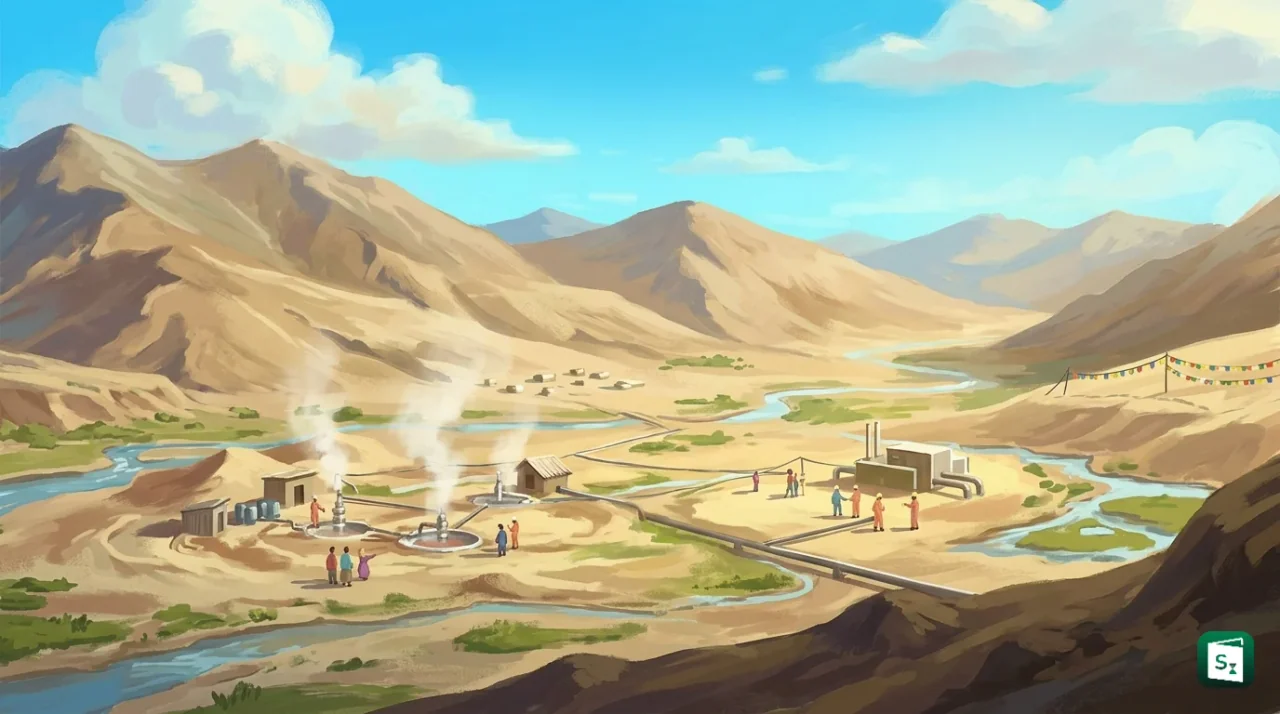
Ladakh Lieutenant Governor VK Saxena commissioned India’s first and deepest geothermal wells at Puga Valley in eastern Ladakh, marking a historic step towards the country’s first demonstration-scale geothermal power project. The two wells, each drilled to a depth of 1,000 metres by the ONGC Energy Centre at an altitude exceeding 14,000 feet, will power a planned 1 MW pilot geothermal power plant. Engineers recorded a maximum temperature of 135 degree Celsius at just 400 metres depth, confirming the region’s strong geothermal potential.
What Is Geothermal Energy?
Geothermal energy is the heat stored beneath the Earth’s surface. This heat originates from two main sources: the residual heat left over from the planet’s formation and the continuous radioactive decay of elements such as uranium, thorium, and potassium deep within the Earth’s core. Because this heat is constantly replenished, geothermal energy is considered a renewable and sustainable resource.
This heat can be tapped in three ways. Deep hydrothermal reservoirs containing hot water or steam are accessed through drilling; the steam drives turbines to generate electricity. Near-surface systems such as hot springs provide direct heat for bathing, greenhouse cultivation, and space heating. Shallow ground resources maintain a constant temperature throughout the year and can be used with geothermal heat pumps for heating and cooling buildings.
Geothermal power generation follows a straightforward process. Deep wells are drilled into underground reservoirs where hot water or steam is trapped. The steam rises under pressure and spins a turbine connected to a generator, producing electricity. The cooled water is then reinjected into the reservoir to maintain pressure and ensure the system remains sustainable over the long term.
Unlike solar and wind energy, which are intermittent and depend on weather conditions, geothermal power plants can operate 24 hours a day, seven days a week. They also have a small land footprint and produce very low carbon emissions. A well-managed geothermal reservoir can remain productive for several decades, with capacity factors exceeding 80 to 90 per cent.
The Puga Valley Geothermal Project
Puga Valley lies in the Changthang Plateau of southeastern Ladakh, about 170 km east of Leh. The valley sits at the junction of the Indian and Eurasian tectonic plates along the Indus Suture Zone, a region of intense geological activity that has created over a hundred natural hot springs, fumaroles, and mud pools across the valley floor. This makes Puga the most promising geothermal field in India, with estimated subsurface temperatures exceeding 240 degree Celsius according to geothermometric studies.
The project is being implemented under a tripartite agreement between the Ladakh Administration, the Ladakh Autonomous Hill Development Council (LAHDC), Leh, and the ONGC Energy Centre. The original memorandum of understanding had expired in early 2026, causing a delay of several months. Ladakh LG VK Saxena intervened personally to facilitate a five-year renewal of the MoU in June 2026, after which drilling resumed and was completed rapidly.
The first well (GT-02) was drilled to its target depth of 1,000 metres on 22 May 2026. The second well (GT-03) was spudded on 3 June 2026 and completed in just over a month, reaching 1,000 metres on 8 July 2026. Both wells were executed by the ONGC Energy Centre, the research and development arm of ONGC, which was established in 2005 with a mandate to undertake projects in new and renewable energy technologies.
A notable technical achievement was the temperature reading of 135 degree Celsius recorded at just 400 metres depth. Engineers expect even higher temperatures at greater depths, which would be sufficient to operate the proposed 1 MW pilot power plant. The wells are the deepest geothermal wells ever drilled in India, setting a new benchmark for the country’s geothermal exploration programme.
India’s Geothermal Potential and Policy Framework
India’s geothermal resources remain largely untapped despite being identified decades ago. The Geological Survey of India (GSI) has mapped 381 hot springs across the country, with surface temperatures ranging between 35 and 89 degree Celsius. The estimated geothermal power generation potential is about 10,600 MW.
These resources are spread across 10 recognised geothermal provinces: the Himalayan Province (which includes Puga Valley), Naga-Lusai, Andaman and Nicobar, Son-Narmada-Tapi, West Coast, Cambay Graben, Aravalli, Mahanadi, Godavari, and South Indian Cratonic Provinces. Key sites beyond Puga include Chumathang (also in Ladakh), Manikaran (Himachal Pradesh), Tattapani (Chhattisgarh), Bakreshwar (West Bengal), and Tuwa (Gujarat).
In September 2025, the Ministry of New and Renewable Energy (MNRE) launched India’s first National Policy on Geothermal Energy, 2025. The policy aims to accelerate exploration, promote commercial projects, and integrate geothermal energy into the country’s renewable energy mix.
Under the policy, state governments can issue exploration leases valid for 3 to 5 years and development leases for power generation valid for up to 30 years through a single-window clearance mechanism. The government provides financial support of up to 100 per cent for research institutions and up to 70 per cent for private sector entities under the Renewable Energy Research and Technology Development Programme. Geothermal projects have also been included under the Carbon Credit Trading Scheme and made eligible under Renewable Purchase Obligations.
The policy promotes emerging technologies such as Enhanced Geothermal Systems, Advanced Geothermal Systems, and geothermal energy storage. It also mandates the establishment of a national geothermal resource data repository through collaboration between the GSI, the Ministry of Mines, and the Ministry of Earth Sciences.
Why This Matters for Ladakh and India
The Puga Valley geothermal project has significance that extends well beyond its modest 1 MW generation capacity.
Energy Security for Ladakh: Ladakh, especially the Changthang region, faces extreme winters with temperatures dropping well below freezing. The region depends heavily on diesel generators for electricity, with fuel having to be transported over long distances through treacherous mountain roads. A reliable geothermal power source can reduce this dependence significantly, providing round-the-clock electricity even during the harshest winters when solar generation is minimal and road connectivity is cut off.
Ladakh’s Carbon Neutrality Goal: The Ladakh administration has set a vision of making the Union Territory carbon neutral. Geothermal energy, with its low-carbon baseload power, directly supports this ambition. Beyond electricity generation, the geothermal resource can be used for space heating, greenhouse cultivation, year-round agriculture, food processing, and geotourism, all of which can contribute to the region’s socio-economic development while keeping emissions low.
India’s Net Zero 2070 Target: At the national level, the Puga project serves as a proof of concept for commercial geothermal power generation in India. India has set a target of achieving Net Zero emissions by 2070 and has committed to installing 500 GW of non-fossil fuel electricity capacity by 2030. Geothermal energy, which currently has zero contribution to India’s power mix, can become a meaningful pillar in this transition alongside solar, wind, and hydropower.
Technology Demonstration: The project has given Indian engineers and scientists hands-on experience in deep geothermal drilling at extreme altitudes. This knowledge will be invaluable for replicating geothermal projects at other promising sites such as Chumathang in Ladakh itself, Manikaran in Himachal Pradesh, and Tattapani in Chhattisgarh. The success of the Puga wells demonstrates that India now has the technical capability to execute high-altitude geothermal drilling, a skill that few countries possess.
Key Takeaways
- India’s first and deepest geothermal wells were commissioned at Puga Valley, Ladakh, each reaching a depth of 1,000 metres.
- The wells were drilled by the ONGC Energy Centre, the R&D arm of ONGC established in 2005.
- They will power a 1 MW pilot geothermal power plant, India’s first demonstration-scale geothermal project.
- The maximum temperature recorded was 135 degree Celsius at a depth of 400 metres.
- India’s estimated geothermal power potential is 10,600 MW, spread across 381 hot springs and 10 geothermal provinces.
- The National Policy on Geothermal Energy, 2025, notified by MNRE, provides the policy framework for geothermal exploration and development in India.
- Globally, the leading geothermal power producers include the United States, Indonesia, and the Philippines.