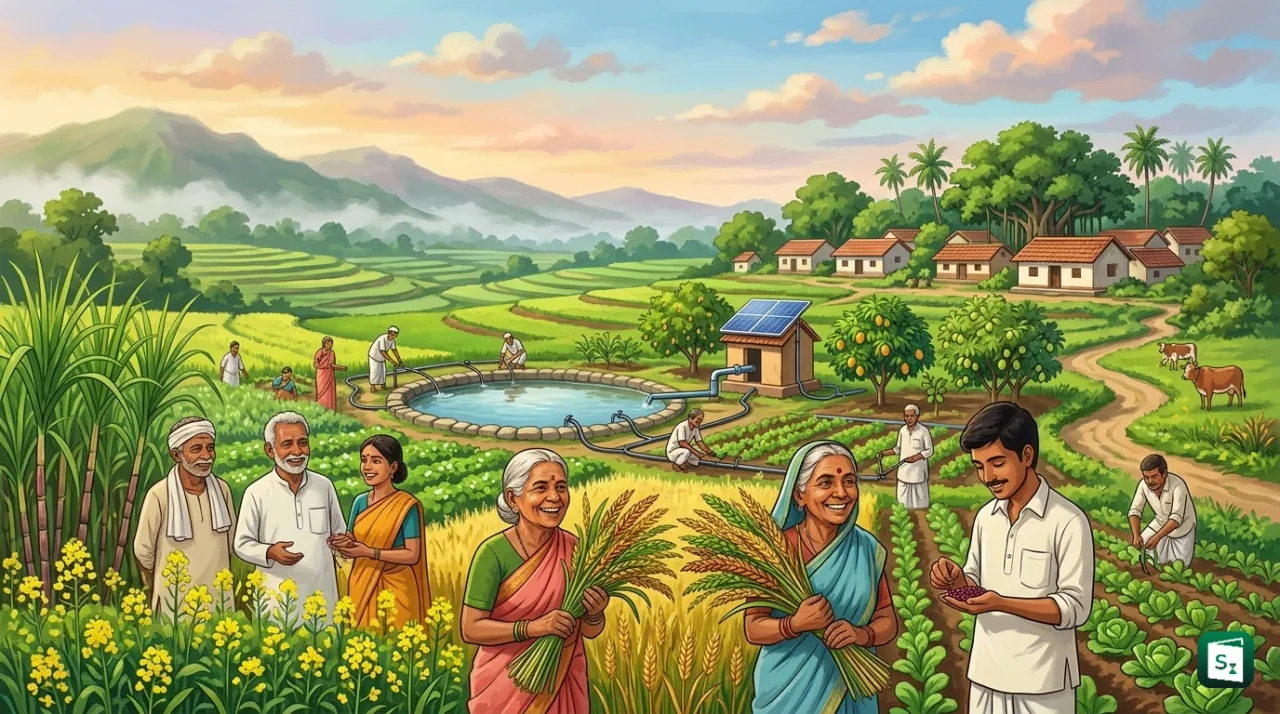
Union Agriculture Minister Shivraj Singh Chouhan unveiled the roadmap for Viksit Krishi and Samruddh Kisan as a core pillar of the government’s Viksit Bharat 2047 vision during the 98th Foundation Day of the Indian Council of Agricultural Research (ICAR) in New Delhi. The minister outlined seven ambitious goals covering climate-resilient farming, technology outreach to millions of farmers, and institutional transformation of ICAR’s extension network. The event also saw the release of 43 new crop varieties, 17 technologies, and the signing of over 70 MoUs with private sector partners and startups.
ICAR: 98 Years of Agricultural Research Leadership
The Indian Council of Agricultural Research (ICAR) was established on 16 July 1929 as a registered society under the Societies Registration Act, 1860, following the recommendations of the Royal Commission on Agriculture. Headquartered in New Delhi, ICAR is the apex body for coordinating, guiding, and managing research and education in agriculture and allied sciences in India. It functions under the Department of Agricultural Research and Education (DARE), Ministry of Agriculture and Farmers Welfare.
Over its 98-year journey, ICAR has built the world’s second-largest agricultural research system, comprising 101 institutes, 71 agricultural universities, and 731 Krishi Vigyan Kendras (KVKs) spread across the country. It played a defining role in India’s Green Revolution during the 1960s and 1970s, which transformed the nation from a food-deficit country to a food-surplus one. India today is the world’s second-largest producer of foodgrains, fruits, vegetables, milk, and fisheries, and ICAR’s research in high-yielding varieties, soil science, and plant protection has been central to this achievement.
The Seven Pillars of Viksit Krishi
In his address, Chouhan described the partnership between farmers and scientists by saying, “If farmers are the soul of agriculture, scientists are its brain.” He called for a shift from a focus on quantity to quality in agricultural production, stressing that India’s growing access to global markets through new trade agreements demands high-quality, export-oriented, and health-friendly farm products. The roadmap rests on seven distinct goals, each targeting a specific gap in India’s agricultural ecosystem.
100 Climate Smart Villages
Chouhan announced that before ICAR completes its 100th year, the organisation should develop at least 100 Climate Smart Villages across the country. These villages will serve as live demonstration sites for climate-resilient agriculture, integrated farming systems, water and soil conservation, and practical risk-reduction models. The initiative is a direct response to the growing challenges posed by El Nino, erratic monsoons, and rising temperatures, which have made Indian agriculture increasingly vulnerable to climate shocks. The Climate Smart Villages concept, originally piloted globally by the CGIAR Research Programme on Climate Change, Agriculture and Food Security (CCAFS), aims to build local capacity for adapting to climate variability through location-specific interventions.
Mission ICAR 100 and KVK Modernisation
Under Mission ICAR-100, the next two years will be dedicated to transforming Krishi Vigyan Kendras (KVKs) from conventional training centres into multi-functional hubs. Each KVK will function as an innovation hub, a climate advisory centre, a startup support centre, and a farmer technology demonstration centre. The first KVK was established in 1974 at Puducherry, and the network has since grown to 731 KVKs across India. Under the new mandate, every KVK must conduct a fortnight-long nationwide outreach programme covering at least 100 villages to demonstrate ICAR research and technologies directly to farmers at the grassroots level.
Technology Outreach to 100 Million Farmers
The Minister set a target that ICAR technologies, scientific innovations, and modern agricultural solutions should reach at least 100 million farmers by ICAR’s centenary year in 2029. Currently, a significant gap exists between laboratory research and field-level adoption by small and marginal farmers, who make up more than 80% of India’s farming community. Achieving this goal requires a massive scaling up of technology dissemination through KVKs, digital platforms, and public-private partnerships.
One Institute, One Grand Innovation
Under the One Institute-One Grand Innovation initiative, every ICAR institute is required to deliver at least one transformational innovation within the next two years. This could be a new crop variety, a vaccine for livestock or fisheries, a digital tool, or a climate-smart agricultural solution capable of creating significant national impact. The initiative is designed to move ICAR institutes beyond routine research and push them toward breakthrough, outcome-oriented science that directly improves farmers’ lives.
Open Digital Knowledge Platform
Chouhan proposed the creation of an ICAR Open Digital Knowledge Platform that will make scientific advisories, crop guidance, soil testing information, weather forecasts, and market updates freely accessible on farmers’ mobile phones. The platform is built on a mobile-first approach, recognising that smartphone penetration in rural India has crossed 50% and continues to grow. This initiative aims to democratise access to agricultural expertise, allowing a farmer in a remote village to receive real-time advice from ICAR scientists without visiting a KVK or agricultural office.
Crackdown on Counterfeit Seeds and Pesticides
Referring to widespread complaints about counterfeit and substandard agricultural inputs, Chouhan called for stronger legal provisions against fake seeds and pesticides. He urged scientists to develop simple field-level diagnostic tools that enable farmers to instantly verify the quality of seeds and pesticides at the point of purchase. The issue of spurious inputs is a persistent problem in Indian agriculture. According to government data, fake pesticides account for nearly 30% of the total pesticide market in India, leading to significant crop losses and financial distress among farmers.
Internal Resource Generation Target
The Minister set a financial target of generating ₹10,000 crore in internal resources by 2029 through the commercialisation of ICAR technologies, crop varieties, vaccines, and licensing arrangements. While government funding will continue, this move is aimed at making ICAR financially self-reliant and incentivising its scientists to develop marketable innovations. The regularisation of services of over 150 ICAR employees was also announced, which Chouhan described as the correction of a long-pending administrative injustice.
New Varieties, Technologies and Industry Tie-ups
The Foundation Day celebrations served as a platform for showcasing ICAR’s latest research output. 43 new crop varieties were released, covering high-yielding and disease-resistant crops across cereals, pulses, oilseeds, and horticultural crops. These include nutrient-rich varieties developed to address hidden hunger and malnutrition, a persistent public health challenge in India. 17 technologies and products were launched, spanning livestock and fisheries vaccines, biofertilisers, biopesticides, and digital agricultural solutions. 14 publications covering advances in agricultural science were also released.
| Category | Number | Key Focus |
|---|---|---|
| New crop varieties | 43 | High-yielding, disease-resistant, nutrient-rich |
| Technologies/products | 17 | Vaccines, biofertilisers, digital tools |
| Publications | 14 | Agricultural research and extension |
| MoUs signed | 70+ | Technology transfer and licensing |
More than 70 Memorandums of Understanding (MoUs) and technology licensing agreements were signed with private companies, startups, and other stakeholders. These agreements are designed to accelerate the transfer of ICAR’s laboratory innovations to farmers’ fields through commercial partnerships. The focus on indigenous vaccines for Foot-and-Mouth Disease and other major animal diseases is particularly significant, as India has the world’s largest livestock population and disease outbreaks cause severe economic losses to dairy and meat farmers.
Key Takeaways
- The Viksit Krishi and Samruddh Kisan roadmap was unveiled by Shivraj Singh Chouhan at ICAR’s 98th Foundation Day as a pillar of Viksit Bharat 2047.
- ICAR was established on 16 July 1929 and is headquartered in New Delhi, functioning under the Department of Agricultural Research and Education (DARE).
- India will develop 100 Climate Smart Villages before ICAR’s centenary to demonstrate climate-resilient and integrated farming models.
- Under Mission ICAR-100, each of the 731 Krishi Vigyan Kendras (KVKs) across India will cover at least 100 villages and transform into innovation, climate advisory, and startup support hubs.
- The One Institute-One Grand Innovation initiative requires every ICAR institute to deliver at least one transformational innovation within two years.
- An ICAR Open Digital Knowledge Platform will provide free advisories, weather data, and market information on farmers’ mobile phones.
- ICAR aims to generate ₹10,000 crore in internal resources by 2029 through technology commercialisation and licensing.