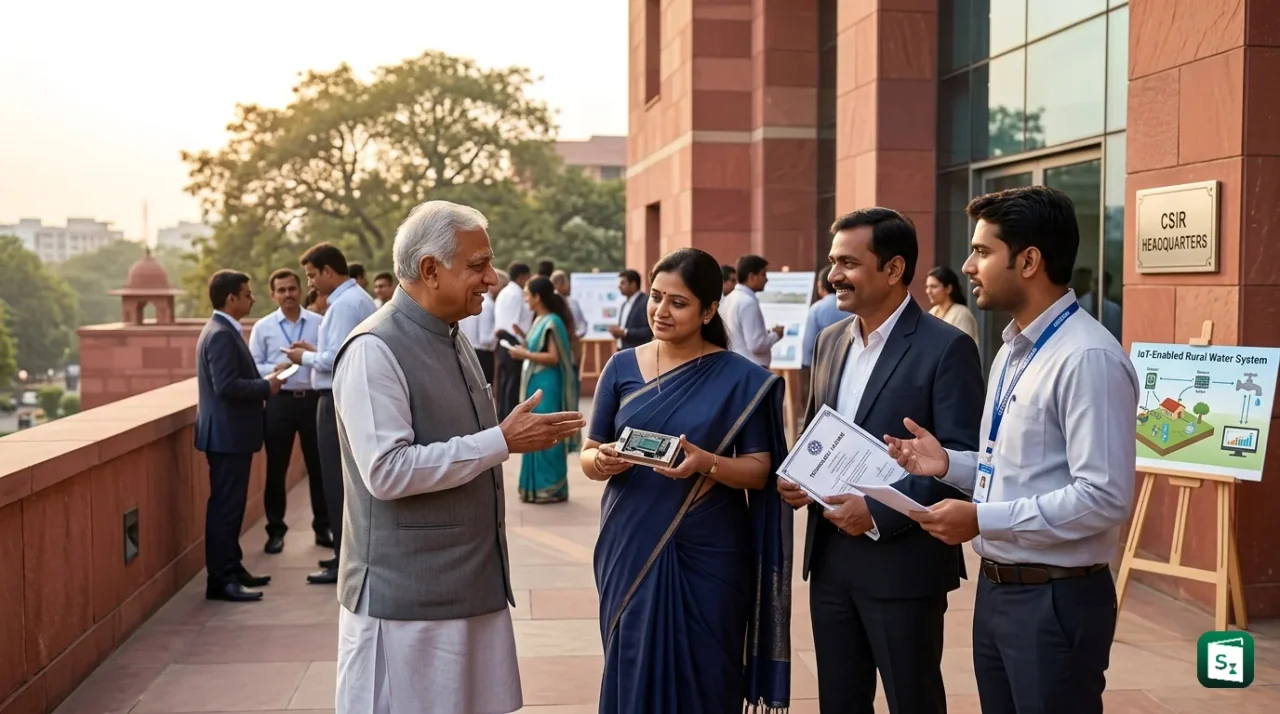
The Council of Scientific and Industrial Research (CSIR) held a Technology Transfer Event at its headquarters in New Delhi, coordinated by the CSIR-Central Scientific Instruments Organisation (CSIR-CSIO) of Chandigarh, where four indigenously developed technologies were licensed to industry partners. The event also marked the commercial launch of an Internet of Things (IoT)-enabled rural water service delivery, measurement, and monitoring system and recognised ₹1.67 crore in royalty received from Bharat Electronics Limited (BEL) for the licensed production of indigenous defence technologies. Together, these milestones reflect CSIR’s growing efforts to bridge the gap between laboratory research and real-world industrial and social applications.
The Technology Transfer Event
The programme was held at CSIR Headquarters on Rafi Marg in New Delhi and was attended by Dr. N. Kalaiselvi, Director General of CSIR and Secretary of the Department of Scientific and Industrial Research (DSIR), along with senior scientists and representatives from partner industries. Prof. Shantanu Bhattacharya, Director of CSIR-CSIO, presented an overview of the laboratory’s technology commercialisation initiatives and royalty achievements.
The event was organised under CSIR’s broader mandate of translating research into commercially viable products, a mission that has gained renewed urgency under the government’s Atmanirbhar Bharat (Self-Reliant India) campaign. CSIR-CSIO, established in 1959 and headquartered in Chandigarh, is one of CSIR’s 37 national laboratories and specialises in the design and development of scientific and industrial instruments, including defence avionics, agricultural electronics, and biomedical devices.
The Four Technologies Transferred
Three of the four technologies were licensed to Pump Academy Private Limited, a Bengaluru-based company, while the fourth was transferred to Bharat Electronics Limited (BEL), Panchkula, for defence applications.
Motor and Power Monitoring Tools for Industry
The three technologies licensed to Pump Academy are designed for industrial condition monitoring and energy efficiency:
- Induction Motor Stethoscope (MSCOPE): This device monitors the health and performance of induction motors by detecting early-stage faults such as bearing wear, rotor imbalances, and stator winding issues. It helps industries adopt predictive maintenance, reducing unplanned downtime and repair costs.
- Portable and Universal Motor-cum-Pump Performance Monitor (PU-MPPM): This instrument assesses the operational efficiency of motors and pumps in real time. It measures parameters such as flow rate, power consumption, and mechanical performance, allowing industries to optimise energy usage and identify underperforming equipment.
- i-Power Quality Analyser (IPQA): This device analyses electrical power quality parameters including voltage fluctuations, harmonic distortion, and power factor. It supports industries in maintaining stable electrical systems and avoiding equipment damage caused by poor power quality.
These three tools together address a critical gap in India’s industrial ecosystem: the lack of affordable, indigenous condition monitoring equipment. Most such instruments are currently imported at high cost.
Critical Optics for SU-30 Fighter Aircraft
The fourth technology transferred was the Optical Module and Beam Combiner Assembly for the Head-Up Display (HUD) used in SU-30 aircraft programmes. This was licensed to Bharat Electronics Limited (BEL), a defence public sector undertaking. A HUD projects critical flight data such as altitude, airspeed, and targeting information onto a transparent screen in the pilot’s line of sight, allowing them to access information without looking down at instruments. The optical module and beam combiner are the core components that make this projection possible. Indigenous production of these components reduces India’s dependence on foreign suppliers for SU-30 avionics and strengthens the domestic defence manufacturing supply chain.
IoT-Enabled Rural Water Monitoring System
A major highlight of the event was the commercial launch of the Affordable IoT-enabled Water Service Delivery, Measurement and Monitoring Sensing System for rural deployment. The technology was launched through Biometry Technologies Private Limited, New Delhi.
The system is designed to address one of rural India’s most persistent challenges: the lack of real-time data on water quality, quantity, and service delivery. It uses a network of IoT sensors deployed at water sources, storage tanks, and distribution points to continuously monitor parameters such as water level, flow rate, turbidity, pH, and contamination levels. This data is transmitted wirelessly to a central dashboard accessible to local authorities and village water committees.
Key benefits include early detection of contamination events, reduction of water wastage through leak identification, improved maintenance planning for rural water supply infrastructure, and better accountability in service delivery. For a country where a significant portion of the rural population relies on groundwater and piped water schemes that often function erratically, such a system can be transformative. The technology aligns with the goals of the Jal Jeevan Mission, which aims to provide tap water connections to every rural household.
Royalty from BEL: A Milestone for Indigenous Defence Manufacturing
The event also recognised the royalty of ₹1.67 crore received from Bharat Electronics Limited (BEL) during the financial year 2025-26 for the licensed production of indigenous military avionics technologies developed by CSIR-CSIO. These technologies include:
| Technology | Purpose |
|---|---|
| Head-Up Display (HUD) | Projects flight data onto the cockpit windshield |
| Drogue Lights | Illumination systems for aerial refuelling operations |
| Taxi Landing Lights | High-intensity lights for aircraft ground movement |
| HUD I-Level Tester | Diagnostic equipment for testing HUD performance |
| Boresight Alignment Tool | Precision tool for calibrating aircraft weapon systems and sensors |
This royalty revenue is significant for two reasons. First, it demonstrates that CSIR laboratories can develop defence technologies that meet the stringent quality and reliability standards of the Indian armed forces. Second, it contributes to CSIR’s External Cash Flow (ECF) targets, a key performance metric that measures how much revenue laboratories generate from external sources such as industry licensing and consultancy. The growing ECF is an indicator of CSIR’s increasing industry relevance and move towards self-sustaining research.
CSIR and CSIR-CSIO: Pillars of Indigenous Innovation
The Council of Scientific and Industrial Research (CSIR) was established on 26 September 1942 as an autonomous body under the Ministry of Science and Technology, with its headquarters at Anusandhan Bhawan, Rafi Marg, New Delhi. The Prime Minister of India serves as its ex-officio President. With a network of 37 national laboratories and over 14,000 staff, CSIR is one of the largest publicly funded research and development organisations in the world.
CSIR-CSIO, where the four transferred technologies were developed, was established in 1959 in New Delhi and relocated to Chandigarh in 1962. It is one of CSIR’s premier laboratories focused on scientific and industrial instrumentation. Its major research areas include defence avionics, optical devices and systems, biomedical instrumentation, agricultural electronics (Agrionics), and micro-electromechanical systems (MEMS).
The laboratory has a strong track record of technology commercialisation. The current royalty from BEL adds to a growing list of successful transfers that span military avionics, industrial monitoring equipment, and now rural water management solutions. Addressing the event, Dr. N. Kalaiselvi emphasised that converting scientific research into practical products and processes that create value for industry while delivering tangible benefits to society remains central to CSIR’s mission.
Key Takeaways
- The Council of Scientific and Industrial Research (CSIR) held a Technology Transfer Event in New Delhi, coordinated by CSIR-CSIO, Chandigarh, transferring four indigenous technologies to industry.
- Three industrial monitoring tools (MSCOPE, PU-MPPM, and IPQA) were licensed to Pump Academy Private Limited, Bengaluru, for condition monitoring and energy efficiency applications.
- The Optical Module and Beam Combiner Assembly for the Head-Up Display (HUD) of SU-30 aircraft was transferred to Bharat Electronics Limited (BEL), Panchkula, strengthening indigenous defence manufacturing.
- An IoT-enabled rural water service delivery, measurement, and monitoring system was commercially launched through Biometry Technologies Pvt. Ltd., supporting real-time water quality and quantity monitoring in villages.
- CSIR-CSIO received ₹1.67 crore in royalty from BEL during FY 2025-26 for licensed production of military avionics technologies including HUD, drogue lights, and boresight alignment tools.
- CSIR was established on 26 September 1942, is headquartered in New Delhi, and operates under the Ministry of Science and Technology with the Prime Minister as its ex-officio President.
- CSIR-CSIO was established in 1959 in New Delhi and relocated to Chandigarh in 1962, specialising in scientific and industrial instrumentation and defence avionics.