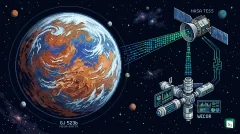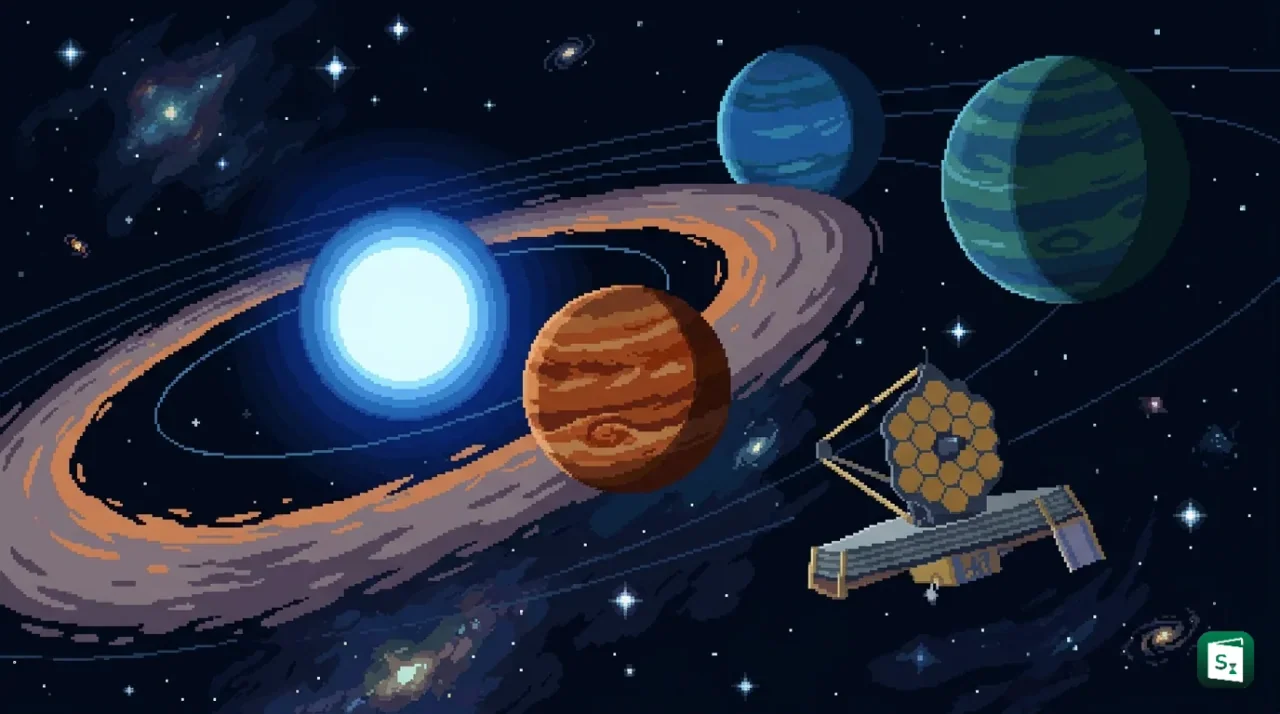
Astronomers using NASA’s James Webb Space Telescope (JWST) have discovered a new giant exoplanet named Beta Pictoris d, hidden for over a decade within one of the most studied planetary systems in the Milky Way. Located 63 light-years from Earth and estimated to be 23 million years old, the planet has a mass at least two times that of Jupiter. The discovery makes the Beta Pictoris system only the second known planetary system to host at least three directly imaged planets.
The Beta Pictoris System
Beta Pictoris is a young star of spectral type A6V, located about 63 light-years from Earth in the constellation Pictor. It is roughly 23 million years old, which is extremely young compared to our Sun’s 4.6 billion years. This youth makes it an invaluable laboratory for studying how planetary systems form and evolve.
The star is surrounded by a prominent debris disk, a vast ring of dust and rocky material left over from the process of planet formation. This disk is one of the brightest known and has been studied extensively since the 1980s. The inner edge of this debris disk has a sharply defined structure that had long puzzled astronomers, with some predicting the existence of an undiscovered planet to explain it.
Beta Pictoris d: A Planet Hidden in Plain Sight
Beta Pictoris d was discovered independently by two teams working on different telescopes. One team, led by Ben Sutlieff of the University of Edinburgh and Markus Bonse of the European Southern Observatory (ESO) , used ESO’s Very Large Telescope (VLT) in Chile. The other team, led by Aidan Gibbs at the University of California, San Diego, used NASA’s James Webb Space Telescope.
The planet had been hiding in archival observations for more than a decade. Once the teams knew where to look, they found Beta Pictoris d in images dating back as far as 11 years, captured by the VLT’s SPHERE instrument and JWST’s NIRCam instrument. It was hidden in plain sight because its faint glow was drowned out by the bright debris disk and the glare of its larger neighbor, Beta Pictoris b.
Beta Pictoris d is the faintest exoplanet ever imaged directly from Earth when corrected for distance, being 100 times fainter than Beta Pictoris b. It is also among the lightest exoplanets to ever be imaged from the ground.
How JWST Found It: Spectroscopy Over Imaging
What makes this discovery particularly significant is the method used. While Beta Pictoris b and c were found through direct imaging (capturing the planet’s own light as a bright point of light in a picture), Beta Pictoris d was discovered primarily through spectroscopy.
The Gibbs team was using JWST’s NIRSpec (Near-Infrared Spectrograph) instrument, specifically its Integral Field Unit (IFU) , to study the atmosphere of Beta Pictoris b. This instrument captures both an image and a spectrum from every pixel in the field of view. While analyzing the data, the team noticed an unexpected signal: a distinctive pattern of carbon monoxide absorption lines, spread out like a barcode.
This spectroscopic fingerprint is a telltale sign of a giant planet atmosphere. The debris disk, which acts like fog and scatters light, was effectively ignored by the spectroscopic method, which isolates only the narrow molecular signatures unique to a planetary atmosphere. Follow-up observations using JWST’s MIRI (Mid-Infrared Instrument) detected water vapor and methane, confirming the planet’s identity and providing detailed information about its atmosphere.
This marks the first time a directly imaged planet has been discovered primarily through moderate-resolution spectroscopy rather than traditional coronagraphic imaging.
The Three Giant Planets of Beta Pictoris
With the discovery of Beta Pictoris d, the system now hosts three known giant planets, each with distinct characteristics:
| Planet | Mass | Discovery Method | Year Discovered |
|---|---|---|---|
| Beta Pictoris b | ~10 times Jupiter | Direct Imaging | 2008 |
| Beta Pictoris c | ~10 times Jupiter | Direct Imaging / Radial Velocity | 2019 |
| Beta Pictoris d | ~2 times Jupiter | Spectroscopy | 2026 |
Beta Pictoris d has the widest orbit of the three, circling its star at roughly 30 astronomical units (AU) , comparable to the distance of Neptune from the Sun. It sits just inside the inner edge of the debris disk. This position is key: its gravity is believed to be responsible for sculpting the debris disk’s sharply defined inner edge, a mystery that had persisted for decades.
The only other planetary system known to host at least three directly imaged planets is HR 8799, a system about 135 light-years away, discovered in 2008 by a team led by Christian Marois.
Why This Discovery Matters
The discovery of Beta Pictoris d carries significance on multiple fronts.
A new way to find planets: The spectroscopic method used here opens a powerful new path for exoplanet discovery. Instead of searching for faint points of light in images, astronomers can now look for chemical fingerprints in spectroscopic data. This approach is particularly effective in systems with bright debris disks, where traditional imaging struggles.
Understanding planetary system evolution: The Beta Pictoris system, being just 23 million years old, offers a rare direct view of a planetary system in its infancy. Studying all three planets together, within the same formation environment, helps scientists test theories of how gas giants form and migrate. Beta Pictoris d is remarkably similar to 51 Eridani b, another directly imaged planet of similar age, giving astronomers two data points to anchor their models.
The faintest imaged from Earth: Capturing a planet just 2.4 Jupiter masses from the ground using ESO’s VLT is a milestone. It demonstrates the growing capability of ground-based telescopes to detect fainter and smaller exoplanets, paving the way for ESO’s upcoming Extremely Large Telescope (ELT) , which is expected to find even more low-mass planets.
Solving a long-standing puzzle: Beta Pictoris d’s mass and orbital position perfectly explain the debris disk’s sharp inner edge structure, confirming a prediction astronomers had made years ago.
About JWST: The James Webb Space Telescope, launched on 25 December 2021 aboard an Ariane 5 rocket from Kourou, French Guiana, is the world’s premier space science observatory. It is an international collaboration led by NASA with partners ESA (European Space Agency) and CSA (Canadian Space Agency) . JWST operates in a solar orbit near the Sun-Earth L2 Lagrange point, about 1.5 million kilometers from Earth.
Key Takeaways
- Beta Pictoris d is a giant exoplanet with a mass at least two times that of Jupiter, discovered using NASA’s James Webb Space Telescope (JWST) .
- The planet is located 63 light-years from Earth in the Beta Pictoris system, which is just 23 million years old.
- Beta Pictoris is only the second known planetary system, after HR 8799, to host at least three directly imaged planets.
- The planet was discovered primarily through spectroscopy (detecting carbon monoxide, water vapor, and methane in its atmosphere), not traditional direct imaging.
- The discovery was independently confirmed by ESO’s Very Large Telescope (VLT) , which found the planet hiding in archival data spanning 11 years.
- Beta Pictoris d is the faintest exoplanet ever imaged directly from Earth when corrected for distance, being 100 times fainter than Beta Pictoris b.