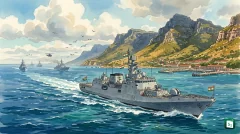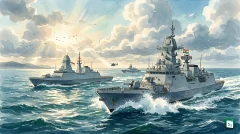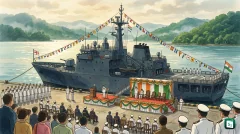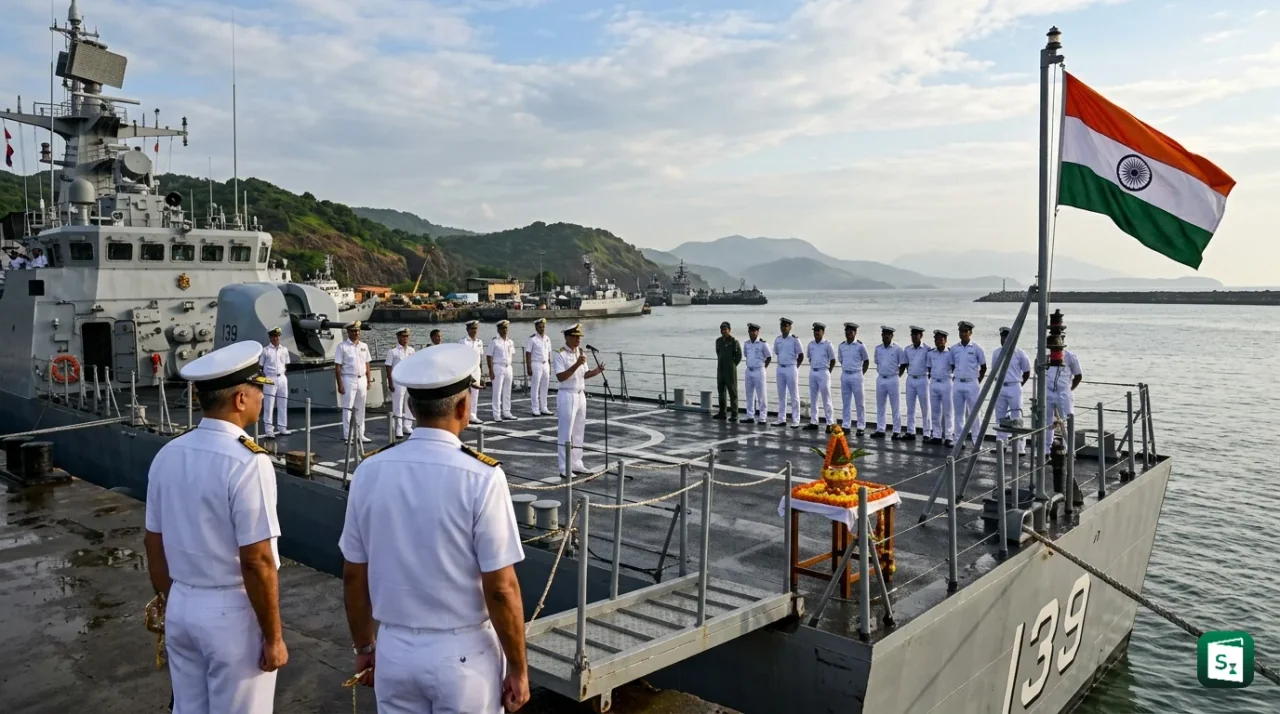
The Indian Navy commissioned INS Malvan, the second Mahe-class Anti-Submarine Warfare Shallow Water Craft (ASW-SWC), at Karwar on 22 July 2026. Built by Cochin Shipyard Limited (CSL) with over 80% indigenous content, the vessel is the sixth of 16 ASW-SWCs to join the fleet under one of India’s most ambitious indigenous warship building programmes. The commissioning ceremony was presided over by Air Chief Marshal AP Singh, Chief of the Air Staff, highlighting the growing emphasis on tri-service integration.
The Mahe Class and the 16-Ship ASW-SWC Programme
The ASW-SWC programme was conceived as a replacement for the ageing Abhay-class corvettes, four of which were commissioned between 1989 and 1991 and have since been decommissioned. In April 2019, the Ministry of Defence signed contracts worth ₹6,311 crore each with two public sector shipyards, Cochin Shipyard Limited (CSL) in Kochi and Garden Reach Shipbuilders & Engineers (GRSE) in Kolkata — for the construction of eight vessels each, totalling 16 ships.
The 16 ships are divided into two sub-classes. The eight built by CSL are designated the Mahe class (named after Mahe in Puducherry), and the eight built by GRSE are designated the Arnala class (named after Arnala fort in Maharashtra). While both classes share the same anti-submarine warfare mission profile and over 80% indigenous content, they have subtle design differences. INS Malvan is the second Mahe-class vessel to be commissioned, after INS Mahe, which joined the Navy on 24 November 2025.
Under the CSL contract, the first ship was to be delivered within 42 months, with subsequent deliveries of two ships per year. The last hull in the 16-ship programme is expected to be delivered by June 2028. The programme is managed under the Buy and Make India category of defence procurement, which mandates significant domestic manufacturing.
Technical Profile and Armament
The Mahe-class vessels measure 78 metres in length with a beam of 11.26 metres and a displacement of approximately 900 to 1,100 tonnes. They are powered by three marine diesel engines coupled with water-jet propulsion, making them the largest waterjet-powered warships in the Indian Navy. This propulsion system gives the vessels a top speed of 25 knots and a range of 1,800 nautical miles at cruising speed, with an endurance of 14 days. The crew complement is 57 personnel, including seven officers.
Sensor Suite
The ships are equipped with the Abhay hull-mounted sonar (HMS), developed by DRDO’s Naval Physical and Oceanographic Laboratory (NPOL) and manufactured by Bharat Electronics Limited (BEL). This active sonar system detects, tracks, and classifies underwater targets using advanced adaptive signal processing. Additionally, the vessel carries a towed Low Frequency Variable Depth Sonar (LFVDS) for deep-water detection, an Integrated Platform Management System (IPMS), and electronic warfare support measures including radar and communications intercept capabilities.
Weapon Systems
For anti-submarine warfare, INS Malvan carries a forward-mounted RBU-6000 anti-submarine rocket launcher, two triple lightweight torpedo launchers on either side for firing Advanced Light-Weight Torpedoes (ALWT), and mine-laying rails for deploying anti-submarine mines. For surface engagement and self-defence, the ship is armed with a 30 mm Naval Surface Gun as the main gun and two 12.7 mm Stabilised Remote Controlled Guns from Ordnance Factory Tiruchirappalli.
The combat suite is integrated through an Advanced ASW Combat Management System, which computes fire-control solutions and coordinates the firing of torpedoes and rockets against underwater targets.
Indigenous Content and Aatmanirbhar Bharat
INS Malvan features over 80% indigenous content by value, a clear indicator of India’s growing self-reliance in defence shipbuilding. The vessel’s design was developed by Smart Engineering & Design Solutions (SEDS), a Kochi-based private firm that became the first Indian private company to design a warship for the Indian Navy. Finland-based Surma provided signature management software and design inputs for combat survivability.
A wide range of Indian defence companies supplied the ship’s equipment. Bharat Electronics Limited (BEL) supplied the sonar systems and electronic warfare suites. Mahindra Defence Systems provided the Integrated Anti-Submarine Warfare Defence Suite (IADS), including torpedo decoy launching systems. The steel for the vessels was sourced domestically from Steel Authority of India Limited (SAIL).
The vessel is a reflection of the government’s Aatmanirbhar Bharat vision, which aims to reduce dependence on foreign defence imports. CSL, incorporated in 1972 as a fully owned Government of India company and headquartered in Kochi, Kerala, is the largest shipbuilding and maintenance facility in India. The shipyard previously built India’s first indigenous aircraft carrier, INS Vikrant, which was commissioned in September 2022.
During the commissioning ceremony, Air Chief Marshal AP Singh praised the Indian Navy’s practice of embedding officers directly into the shipbuilding process, a model that accelerates the transfer of operational expertise to the design and construction phase. He suggested that similar practices could be adopted across the Army and Air Force to boost self-reliance in the wider defence ecosystem.
Historical and Cultural Significance
INS Malvan takes its name from the coastal town of Malvan in the Sindhudurg district of Maharashtra. The town is closely linked to the maritime legacy of Chhatrapati Shivaji Maharaj, who built the first indigenous naval force in the 17th century. Shivaji Maharaj recognised the strategic importance of sea power long before it became a cornerstone of modern Indian defence doctrine, constructing coastal forts such as Sindhudurg and Vijaydurg and building a fleet of warships to protect the Konkan coast from foreign incursions.
The ship’s crest features the Bagh Nakha (Tiger’s Claw), a symbol of bravery, agility, and audacious warfare tactics. The crest is surrounded by waves representing the vast seas and the Indian Navy’s commitment to remaining ever vigilant. The vessel’s motto, “Silent Claws”, captures its stealth capabilities and its ability to strike underwater targets swiftly and lethally.
INS Malvan also carries forward the legacy of its predecessor, an inshore Indian Naval Minesweeper that served with distinction until its decommissioning in 2003. The choice of name and crest reflects the Indian Navy’s move to shed colonial-era naming conventions and embrace indigenous historical and cultural symbols, a trend that has accelerated in recent years.
Key Takeaways
- INS Malvan is the second Mahe-class Anti-Submarine Warfare Shallow Water Craft and was commissioned at Karwar on 22 July 2026.
- It is the 6th of 16 ASW-SWCs being built for the Indian Navy under the overall programme, and the 2nd of 8 Mahe-class vessels being constructed by Cochin Shipyard Limited.
- The ship features over 80% indigenous content, with key systems from BEL, Mahindra Defence, and SAIL, and design by Smart Engineering & Design Solutions (SEDS).
- The ASW-SWC programme (total cost ~₹12,622 crore) replaces the ageing Abhay-class corvettes and is split between CSL (Mahe class) and GRSE (Arnala class).
- The vessel is armed with an RBU-6000 rocket launcher, lightweight torpedo tubes, and mine-laying rails, and is equipped with DRDO-developed Abhay hull-mounted sonar.
- The crest features the Bagh Nakha (Tiger’s Claw) and the ship’s motto is “Silent Claws”, reflecting its stealth and lethality in anti-submarine operations.