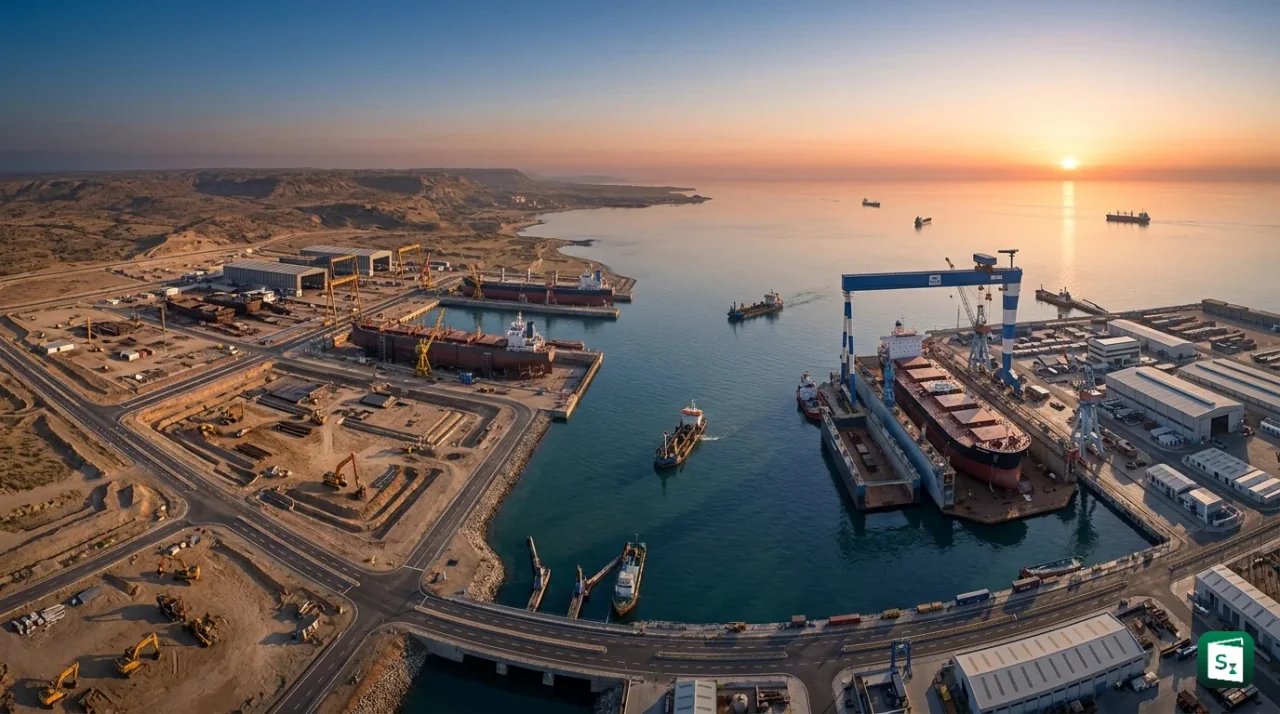
The Ministry of Ports, Shipping and Waterways (MoPSW) has granted in-principle approval for two large maritime infrastructure projects in Gujarat under the Shipbuilding Development Scheme (SbDS). The first is a Greenfield Shipbuilding Cluster at Kuchhadi in the Porbandar district, spread across nearly 2,000 acres. The second is a Ship Repair Facility at Vadinar in the Gulf of Kutch, to be developed at a cost of ₹1,570 crore by Cochin Shipyard Ltd (CSL) and the Deendayal Port Authority (DPA).
What Is the Shipbuilding Development Scheme?
The Shipbuilding Development Scheme (SbDS) is a central sector scheme of the Ministry of Ports, Shipping and Waterways, notified in December 2025, with a budgetary allocation of ₹19,989 crore (approximately $2.2 billion). It is one of two complementary schemes announced by the government to transform India’s shipbuilding sector, the other being the Shipbuilding Financial Assistance Scheme (SBFAS), which has an outlay of ₹24,736 crore.
The SbDS is designed to address structural infrastructure gaps in India’s shipbuilding ecosystem. Its key components include the development of Greenfield shipbuilding clusters across coastal states, expansion and modernisation of existing Brownfield shipyards, and the establishment of an India Ship Technology Centre under the Indian Maritime University for research, vessel design, and skill development. The scheme also introduces a Credit Risk Coverage Framework that provides government-backed insurance for pre-shipment, post-shipment, and vendor-default risks.
A distinctive feature of the SbDS is the provision of land at near-zero cost to participating shipyards. Land allocated for each cluster is transferred at a notional value of ₹1 to a Special Purpose Vehicle (SPV) set up as a joint venture between the central government and the respective state. The land is leased to shipyards for 60 years, with provisions for extension, substantially lowering upfront capital requirements for investors.
Greenfield Shipbuilding Cluster at Kuchhadi, Porbandar
The cluster will be developed through the National Shipbuilding and Heavy Industries Park-Gujarat (NSHIP-Gujarat), an SPV jointly promoted by MoPSW and the Gujarat Maritime Board (GMB). The GMB, established in 1982 under the Gujarat Maritime Board Act, 1981, is the first maritime board in India and is headquartered in Gandhinagar.
Spread across nearly 2,000 acres at Kuchhadi in the Porbandar district, the integrated maritime manufacturing cluster will house modern shipyards, ancillary manufacturing units, common infrastructure, and capability development centres. The project is designed to build large commercial vessels with an annual production capacity of 1.2 million to 1.5 million gross tonnage (GT).
The scheme envisages the development of three to four such clusters across coastal states, with a limit of one cluster per state. Each cluster is planned with roughly 1,000 acres for shipyards and the remaining area for ancillary industries, logistics, and training institutions. At least one Anchor Shipyard in each cluster must have a minimum design capacity of 0.5 million GT per annum, to be achieved within 10 years of commissioning.
Why Porbandar?
Porbandar’s location on the Saurashtra coast offers natural advantages for shipbuilding. The district has a coastline along the Arabian Sea and is well positioned near major shipping lanes connecting the Gulf of Kutch and the Gulf of Khambhat. Its proximity to existing ports such as Porbandar Port and the availability of large tracts of land make it an ideal site for a greenfield cluster. The region also has access to a skilled workforce from Gujarat’s established engineering and manufacturing base.
Ship Repair Facility at Vadinar
The second approved project is a Ship Repair Facility at Vadinar in the Gulf of Kutch, to be jointly developed by Cochin Shipyard Ltd (CSL) and the Deendayal Port Authority (DPA) at a total investment of ₹1,570 crore. The facility had earlier received clearance from the Cabinet Committee on Economic Affairs (CCEA) in May 2026. It qualifies for 25% financial assistance on eligible capital infrastructure cost under the SbDS.
Specifications and Capabilities
The facility is planned as a brownfield development with a 650-metre jetty, two large floating dry docks, and comprehensive workshops and associated marine infrastructure. Once operational, it will be able to repair vessels measuring up to 300 metres in length. This directly addresses a critical gap in India’s ship repair infrastructure, as the country currently lacks adequate domestic capacity to repair large vessels exceeding 230 metres in length.
Strategic Location
Vadinar’s location in the Gulf of Kutch offers several advantages. The area has a natural deep draft, is well connected to major shipping routes, and is in close proximity to key ports such as Mundra and Kandla. The Gulf of Kutch is already home to several major port and refinery projects, making it a natural hub for maritime industrial activity.
Employment and Economic Impact
The project is expected to generate approximately 290 direct jobs and around 1,100 indirect jobs across ship repair, logistics, and ancillary industries. It will also create opportunities for skill development and enable the growth of maritime ancillary services and MSMEs in the surrounding region.
India’s Shipbuilding Landscape: Challenges and Ambitions
India currently accounts for less than 1% of global shipbuilding output and ranks approximately 18th worldwide, despite handling nearly 95% of its trade by volume through maritime routes. In contrast, China, South Korea, and Japan together account for 95% of new shipbuilding orders by tonnage. India’s current shipbuilding capacity is roughly 100,000 gross tonnage (GT), compared to China’s 39 million GT, South Korea’s 20 million GT, and Japan’s 9 million GT.
The government’s long-term maritime strategy under Maritime India Vision 2030 and Maritime Amrit Kaal Vision 2047 sets ambitious targets. India aims to rank among the top 10 shipbuilding nations by 2030 and reach the top 5 by 2047. The country plans to scale domestic shipbuilding capacity to 4.5 million GT annually by 2047 and expand its merchant fleet to roughly 100 million GT. These efforts are expected to generate approximately 22 lakh direct and indirect jobs.
Key Institutional Players
Cochin Shipyard Ltd (CSL), headquartered in Kochi, Kerala, is India’s largest shipbuilding and repair facility. It was established in 1972 and is a central public sector undertaking under MoPSW. CSL has the capacity to build and repair the largest vessels in India and has already secured orders for hydrogen fuel-cell and other low-carbon vessels.
Deendayal Port Authority (DPA), formerly known as Kandla Port Trust, operates the Deendayal Port (Kandla) in Gujarat. The port was constructed in the 1950s and declared a major port in 1955. It is one of India’s busiest ports on the west coast, handling a significant share of the country’s maritime trade.
Key Takeaways
- The Ministry of Ports, Shipping and Waterways (MoPSW) has approved a Greenfield Shipbuilding Cluster at Kuchhadi in Porbandar, Gujarat, covering nearly 2,000 acres.
- A Ship Repair Facility at Vadinar in the Gulf of Kutch will be developed at a cost of ₹1,570 crore by Cochin Shipyard Ltd (CSL) and the Deendayal Port Authority (DPA).
- The Shipbuilding Development Scheme (SbDS) is a central sector scheme with a budgetary allocation of ₹19,989 crore, notified in December 2025.
- The scheme provides land at a near-zero cost (₹1) to an SPV for developing shipbuilding clusters, with land leased to shipyards for 60 years.
- The Porbandar cluster aims for an annual production capacity of 1.2 to 1.5 million gross tonnage (GT), while the Vadinar facility can repair vessels up to 300 metres in length.
- India currently accounts for less than 1% of global shipbuilding output and aims to rank among the top 5 shipbuilding nations by 2047.