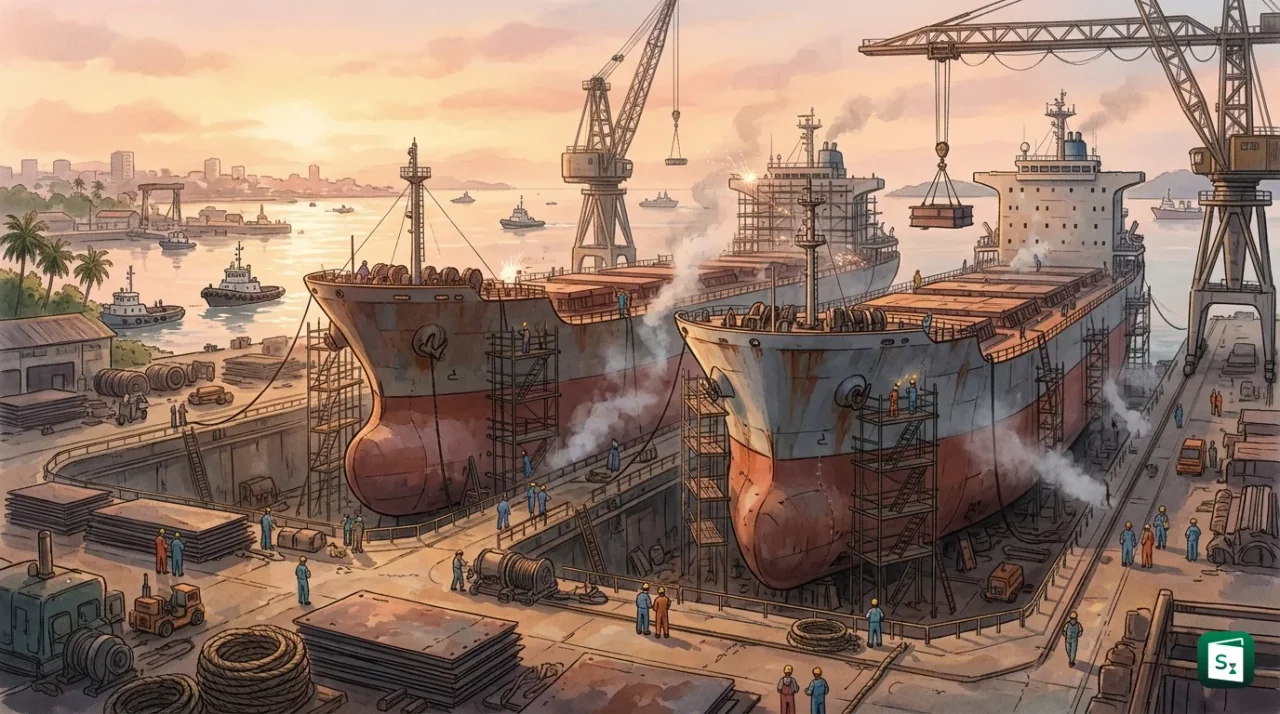
Union Minister for Ports, Shipping and Waterways Sarbananda Sonowal launched two credit risk insurance products for Indian shipyards at the 21st Maritime State Development Council (MSDC) meeting in Mumbai on 13 October 2026. The Shipbuilding Project Credit Risk Insurance Policy (SbPCP), developed by ECGC Ltd, covers export orders, while the Business Credit Shield Policy for Shipbuilders (BCSPS), developed by New India Assurance, covers domestic orders. Both operate under the Shipbuilding Development Scheme (SbDS), the ₹19,989 crore arm of a ₹69,725 crore national package to rebuild India’s shipbuilding industry.
What Are the SbPCP and BCSPS?
The SbPCP is a credit risk insurance policy from ECGC Ltd that protects shipyards executing export orders against buyer default or cancellation. The BCSPS is a New India Assurance product that covers domestic shipbuilding contracts against specified payment risks. Both are government-backed and the first of their kind in Indian shipbuilding.
| Feature | SbPCP | BCSPS |
|---|---|---|
| Full name | Shipbuilding Project Credit Risk Insurance Policy | Business Credit Shield Policy (Shipbuilders) |
| Developed by | ECGC Ltd | The New India Assurance Company Ltd |
| Projects covered | Export shipbuilding projects | Domestic shipbuilding projects |
| Main protection | Default or cancellation by an overseas buyer | Specified payment risks from domestic buyers |
| Government role | Premium subsidy and direct support to the insurer on claims | Premium subsidy and direct support to the insurer on claims |
| Parent scheme | Shipbuilding Development Scheme | Shipbuilding Development Scheme |
What Is Credit Risk Insurance?
Credit risk insurance protects a seller from loss when a buyer fails to pay. In shipbuilding, the seller is the yard and the buyer is the shipowner who ordered the vessel. The cover protects the yard’s cash flow when contracted payments do not arrive on time.
Credit risk insurance differs from marine insurance, which protects the ship or cargo against physical perils such as fire, collision or storms. The credit risk product focuses on the buyer’s ability and willingness to pay, not on damage to the vessel.
The Three Risks the Scheme Framework Covers
The SbDS credit risk framework, issued in December 2025, identifies three distinct risks that can damage a shipyard. The two new products put that framework into practice through state-owned insurers.
| Risk | What it covers |
|---|---|
| Pre-shipment risk | Loss when a buyer defaults or cancels the contract while the vessel is still being built |
| Post-shipment risk | Non-payment after delivery because of disputes, defects or other contractual issues |
| Vendor default risk | Loss when a supplier fails to deliver critical components or equipment |
Shipbuilding contracts are usually paid in stages linked to physical progress, such as steel cutting, keel laying, launching and delivery. A yard commits labour, steel, engines and design work long before the final payment arrives. If a buyer stops paying at the second or third milestone, the yard must finance the unfinished vessel from its own balance sheet. A large custom-built ship is also hard to resell, because it is designed for a particular owner and route.
The two policies are meant to close that gap. The government will subsidise the premium and stand behind the insurer when a valid claim is filed. The scheme guidelines also require the products to be priced nominally, with the ₹1,443 crore risk coverage corpus expected to become self-sustaining over time.
Why Credit Risk Cover Matters for Indian Shipyards
A shipyard spends heavily before it earns. Steel, engines, design, skilled labour and dry dock time are committed years ahead of delivery, while payments arrive in instalments. Industry estimates put the working capital requirement at roughly 25 to 35 per cent of a vessel’s cost across the construction period.
The cost of that money is high in India. A yard borrowing at domestic interest rates of about 10 to 11 per cent is competing with rivals in South Korea and China that borrow at far lower rates and often receive state-backed export credit and refund guarantees. A delayed instalment therefore does more than postpone revenue. It adds interest cost, strains the yard’s credit lines and can force it to slow work on other vessels in the same yard.
The Bank Guarantee Bottleneck
Shipowners rarely pay in advance without security. They ask for a refund guarantee, a promise that their advance payments will be returned if the yard fails to deliver. Indian banks usually issue this as a bank guarantee, which consumes the yard’s credit limits and often requires collateral.
Lenders became cautious about shipbuilding after several private yards collapsed in the 2010s, leaving unpaid loans and incomplete vessels. Smaller and mid-sized yards still struggle to obtain adequate bank guarantees, even when they have confirmed orders. That limits the size of the contracts they can bid for and pushes them towards safer, smaller domestic work.
A credible insurance cover changes the lender’s calculation. If a buyer’s default is insured, the yard’s cash flow is less likely to break, and the bank’s exposure looks safer. The Ministry of Ports, Shipping and Waterways expects this to improve access to finance and help Indian yards compete for larger export orders.
The cover does not solve every cost problem. Indian yards still pay more for steel, equipment and capital than their East Asian competitors. The Shipbuilding Financial Assistance Scheme addresses that side of the equation by offering 15 per cent assistance for vessels below ₹100 crore, 20 per cent for vessels above ₹100 crore and 25 per cent for green, hybrid or specialised vessels. The insurance products address the payment risk, while the assistance scheme addresses the cost gap.
Inside the Shipbuilding Development Scheme
The Shipbuilding Development Scheme is the capacity-building pillar of the government’s maritime package. The Union Cabinet approved it on 24 September 2025 with an outlay of ₹19,989 crore, and it will remain open for applications until 31 March 2036. Its stated goal is to raise India’s shipbuilding capacity to 4.5 million Gross Tonnage (GT) a year, support mega shipbuilding clusters and set up the India Ship Technology Centre under the Indian Maritime University.
| Pillar | Outlay | Main purpose |
|---|---|---|
| Shipbuilding Financial Assistance Scheme | ₹24,736 crore | Cost support to yards, including shipbreaking credit notes |
| Maritime Development Fund | ₹25,000 crore | Long-term finance and interest support for maritime projects |
| Shipbuilding Development Scheme | ₹19,989 crore | Clusters, capacity expansion, risk cover and capability building |
| Legal and policy reforms | Not fund-based | Infrastructure status for large ships and a new legal framework |
Within SbDS, the largest allocations are ₹9,930 crore for greenfield clusters and ₹8,261 crore for brownfield capacity expansion. A separate ₹1,443 crore is earmarked for credit risk coverage, which funds the insurance framework behind the two new policies. Smaller amounts are set aside for capability development, including skilling and technology support.
Greenfield clusters are new shipbuilding hubs built from scratch, usually through a 50:50 special purpose vehicle between the Centre and a coastal state. Brownfield expansion refers to adding capacity at existing yards, with capital assistance of up to 25 per cent of the approved project cost and a ceiling of ₹1,500 crore per yard. Both routes are meant to move Indian yards from small vessels to larger and more complex ships.
The National Shipbuilding Mission and Its Role
The National Shipbuilding Mission (NSbM) is the apex body that oversees the scheme. It evaluates applications, verifies claims, aggregates demand from government departments and public sector undertakings, and negotiates foreign collaborations. The Mission has a ten-year mandate, with committed liabilities honoured after the scheme period ends.
The Sagarmala Finance Corporation Limited (SMFCL) acts as the implementation agency and releases funds to the insurance providers. Only government-owned entities or public sector undertakings are eligible to become credit risk cover agencies. The scheme guidelines require them to obtain the necessary regulatory approvals, follow actuarial discipline, report quarterly and submit to audits by the Comptroller and Auditor General of India. The government’s liability is capped at the approved corpus.
The ₹1,443 crore risk corpus is small compared with the size of the projects it will cover. The guidelines treat it as seed capital that should become self-sustaining through nominal premiums, rather than a fund that pays for every loss in the sector.
The Two Insurers Behind the Policies
| Insurer | Established | Ownership | Headquarters | Product |
|---|---|---|---|---|
| ECGC Ltd | 30 July 1957 | 100 per cent Government of India, Ministry of Commerce and Industry | Mumbai | SbPCP for export projects |
| New India Assurance | 23 July 1919 | Government of India, Ministry of Finance | Mumbai | BCSPS for domestic projects |
What Is ECGC Limited?
ECGC Limited is a wholly government-owned export credit agency set up in 1957. It provides credit risk insurance to Indian exporters and banks, protecting them against non-payment by overseas buyers for commercial or political reasons. It functions under the Ministry of Commerce and Industry and is headquartered in Mumbai.
The organisation began as the Export Risk Insurance Corporation in 1957, was renamed the Export Credit and Guarantee Corporation in 1964, became the Export Credit Guarantee Corporation of India Limited in 1983 and took its present name, ECGC Ltd, in 2014. It is a member of the Berne Union, an international association of export credit and investment insurers.
ECGC’s experience matters for export shipbuilding. An export contract involves foreign law, currency movements, political instability and a buyer whose finances are harder to verify than a domestic client’s. ECGC already assesses country risk and buyer creditworthiness for thousands of exporters, and the SbPCP extends that machinery to shipbuilding contracts.
What Is the New India Assurance Company Limited?
The New India Assurance Company Limited is India’s largest public sector general insurer. Founded in 1919 by Sir Dorabji Tata, it was nationalised in 1973 and is owned by the Government of India under the Ministry of Finance. Its headquarters is in Mumbai.
New India Assurance operates in more than 25 countries and has one of the widest domestic branch networks among Indian insurers. The Insurance Regulatory and Development Authority of India has classified it as a Domestic Systemically Important Insurer, a tag given to companies whose failure could disrupt the financial system. Its existing marine and trade credit products give it the underwriting base for a specialised shipbuilders’ policy.
The division of work between the two insurers follows the nature of the risk. Export cover needs country risk assessment and international recovery expertise. Domestic cover needs local credit information, a large claims network and familiarity with Indian buyers, including government agencies and public sector companies.
India’s Place in Global Shipbuilding
India builds less than one per cent of the world’s commercial tonnage. The country ranked 16th in global shipbuilding with a share of about 0.06 per cent (as of 2026), far behind the three East Asian giants that dominate the market.
| Country | Share of global ship deliveries by gross tonnage (2024) |
|---|---|
| China | 54.5% |
| South Korea | 28.0% |
| Japan | 12.6% |
| India | 0.06% |
The gap is striking because India is a major maritime trading nation. Around 95 per cent of India’s merchandise trade by volume moves by sea, yet most of that cargo travels on ships owned and built abroad. Shipbuilding has strong spillovers into steel, engines, marine electronics, design and skilling, so a weak yard base also weakens the wider industrial ecosystem.
India’s strength lies in naval and defence shipbuilding. Cochin Shipyard Limited built the indigenous aircraft carrier INS Vikrant, commissioned in 2022. Mazagon Dock Shipbuilders builds destroyers and submarines, while Garden Reach Shipbuilders and Engineers (GRSE), Goa Shipyard and Hindustan Shipyard build frigates, patrol vessels and coast guard ships. The country also has a large ship repair and shipbreaking base, though its share of the global ship repair market remains small.
How Many Shipyards Does India Have?
India has 61 shipyards: 8 under central public sector undertakings, 2 under state governments and 51 in the private sector (as of 2026). Most build small and medium vessels, and only a handful can handle large ocean-going commercial ships.
The small yard base is why the government is trying to fix demand before capacity. The ministry has aggregated orders for more than 400 vessels to be built in India over the next decade. Government and public sector orders worth up to ₹200 crore must be placed with Indian yards, and the Right of First Refusal policy gives priority to Indian-built, then Indian-flagged and Indian-owned vessels in public tenders. Large ships have also been granted infrastructure status, which allows owners and yards to access longer-tenure, lower-cost finance.
The export side is beginning to move. Cochin Shipyard won an order from French shipping major CMA CGM for six feeder container vessels, one of the largest commercial export contracts secured by an Indian yard. Private builder Swan Defence and Heavy Industries has won orders for chemical tankers and bulk carriers from European owners. Those orders are small compared with Chinese or Korean order books, but they show that Indian yards can win work when financing and delivery confidence improve.
The 2030 and 2047 Targets
Two policy documents set the direction. Maritime India Vision 2030 (MIV 2030) aims to place India among the top 10 shipbuilding nations by 2030 and lists more than 150 initiatives across ports, shipping and inland waterways. Maritime Amrit Kaal Vision 2047 (MAKV 2047) raises the ambition to the top five by 2047, with shipbuilding output of 4.5 million GT a year and a much larger share of global orders.
The global market makes the target difficult but not impossible. The worldwide shipbuilding order book has climbed to a 15-year high of roughly 316 million GT, and ageing fleets plus decarbonisation rules are forcing shipowners to order new vessels. A country that can offer credible delivery timelines and competitive finance can win part of that wave. The insurance policies are designed to make Indian yards look less risky to both buyers and lenders.
What Is the Maritime State Development Council?
The Maritime State Development Council is a Centre-state body created in 1997 to coordinate port and maritime development. Since 15 May 2026, it is a statutory consultative body under the Indian Ports Act, 2025. The Union Minister for Ports, Shipping and Waterways chairs it.
The Indian Ports Act, 2025 received presidential assent on 21 August 2025 and replaced the Indian Ports Act, 1908. The Act established and empowered State Maritime Boards for non-major ports and gave the MSDC a legal foundation. The Council was formally established through notification S.O. 2524(E) dated 15 May 2026, issued under Section 3 of the Act.
The Council’s members are the ports ministers of maritime states and union territories, the Minister-in-charge of Puducherry and the administrators of other coastal union territories, senior officers of the Indian Navy and the Indian Coast Guard dealing with coastal security, and the Secretary of the Ministry of Ports, Shipping and Waterways as Member Secretary. Under Section 6, the Council advises the Centre on the National Perspective Plan, recommends changes to the port legal framework, and issues guidelines on port data and tariff transparency.
What Did the 21st Meeting Decide?
The 21st meeting set a March 2027 deadline for One Nation One Port Process reforms and Sagar Setu integration across all ports. It made electronic tariff publication mandatory and launched the two shipbuilding credit risk insurance policies.
The Mumbai meeting was the Council’s first in its statutory form. The Mumbai meeting brought together ministers representing Gujarat, Goa, Maharashtra and Puducherry, along with maritime board chiefs from Andhra Pradesh, Odisha, West Bengal, Karnataka, Tamil Nadu and Kerala and the chairpersons of major ports.
| Decision | Detail |
|---|---|
| One Nation One Port Process | Common documentation and re-engineered procedures at all ports by March 2027 |
| Sagar Setu integration | All ports to join the Maritime Single Window by March 2027 |
| Port tariffs | Electronic publication made mandatory |
| State rules | Subordinate rules under Section 77 to be notified within three months |
| Port master plans | States to prepare plans for non-major ports using the adopted template |
| Long-term vision | MIV 2030 and MAKV 2047 targets adopted, covering over 500 initiatives |
Sagar Setu is the Maritime Single Window, a digital platform that lets ports, customs, shipping lines and regulators exchange documents through one system. One Nation One Port Process aims to make documentation and procedures uniform across major and non-major ports, so a shipment does not face a different set of forms at every port.
For shipbuilding, the Council’s role is indirect but important. Shipyards depend on ports for imported steel, equipment and heavy modules, and on coastal shipping to move completed vessels and cargo. A more predictable port system lowers the cost of building and delivering ships. At the meeting, the Council also backed connectivity projects under the Sagarmala programme, launched in 2015 to promote port-led development, and endorsed the National Coastal and Inland Shipping Strategic Plan. The Council asked states to develop shipbuilding, ship repair and recycling clusters along with port-linked industrial regions that offer plug-and-play infrastructure and faster approvals.
The Limits of an Insurance Safety Net
As of October 2026, the launch leaves several practical questions unanswered. The ministry has not published the premium subsidy rate, the maximum sum insured, the list of exclusions or the claim settlement conditions. Those details will decide whether the cover is useful to a mid-sized yard or only to large players with strong balance sheets.
The policies also cover a specific risk. They protect the yard when a buyer fails to pay. They do not protect the buyer if the yard itself fails to deliver, which is the risk addressed by a refund guarantee. An export buyer may still insist on a bank guarantee or a refund guarantee before placing an order, so the new policy does not remove the yard’s need for bank limits.
From Policy Launch to Claims Settlement
Insurance underwriting depends on reliable loss data. Shipbuilding credit risk in India has little of it, because the market has been small and few claims have been tested. ECGC and New India Assurance will have to build actuarial models, set reserves and train underwriters in vessel construction schedules and maritime contract law. The scheme guidelines acknowledge this by asking the agencies to invest in sector-specific expertise and to report policy numbers, claims and fund use every quarter.
The ₹1,443 crore corpus is another constraint. A single large vessel can cost more than ₹1,000 crore, and a series order can run into several thousand crore. Such a small pool cannot absorb a wave of simultaneous defaults. The corpus design therefore relies on nominal premiums and the expectation that claims will be rare once lenders and buyers gain confidence.
There is also a moral hazard risk. If a yard or a lender knows that a default is insured, it may become less careful about the buyer’s creditworthiness. The guidelines try to guard against this through risk assessment, due diligence and fraud prevention by the insurers, but the quality of that underwriting will only become clear after the first few claims.
The Road Ahead
The insurance products are one piece of a much larger effort. The Shipbuilding Financial Assistance Scheme addresses cost competitiveness, the Maritime Development Fund addresses long-term finance, and the Shipbuilding Development Scheme addresses clusters and capacity. The package cannot compensate for weak execution, delayed deliveries or a shortage of skilled welders, naval architects and marine engineers.
India’s target of 4.5 million GT a year is far above the current output of about 50,000 GT. Reaching it will require new greenfield yards, a domestic supply chain for engines and marine equipment, and a steady flow of commercial orders beyond government contracts. The two insurance policies improve the odds by making payment risk more manageable, but they cannot create demand or fix cost disadvantages on their own.
The immediate test is procedural. The government needs to publish the policy wordings and premium schedule, nominate the operational teams, and settle the first claims within a reasonable time. If yards and banks see that the cover works in practice, the scheme can lower the risk premium attached to Indian shipbuilding. If the details remain unclear or claims are slow, the policies will add cost without changing lender behaviour.
Key Takeaways
- Sarbananda Sonowal launched the Shipbuilding Project Credit Risk Insurance Policy (SbPCP) and the Business Credit Shield Policy for Shipbuilders (BCSPS) at the 21st MSDC meeting in Mumbai on 13 October 2026.
- The SbPCP, developed by ECGC Ltd, covers export shipbuilding projects, while the BCSPS, developed by New India Assurance, covers domestic shipbuilding projects.
- The Union government will subsidise insurance premiums and provide direct support to insurers when shipyards file valid claims.
- Both products operate under the Shipbuilding Development Scheme (SbDS), which has a ₹19,989 crore outlay and a ₹1,443 crore credit risk coverage corpus.
- The SbDS is part of the ₹69,725 crore shipbuilding and maritime package approved by the Union Cabinet on 24 September 2025.
- The Maritime State Development Council, constituted in 1997, became a statutory body under the Indian Ports Act, 2025, notified on 15 May 2026.
- ECGC Ltd, established on 30 July 1957 and headquartered in Mumbai, works under the Ministry of Commerce and Industry, while New India Assurance, founded in 1919, works under the Ministry of Finance.