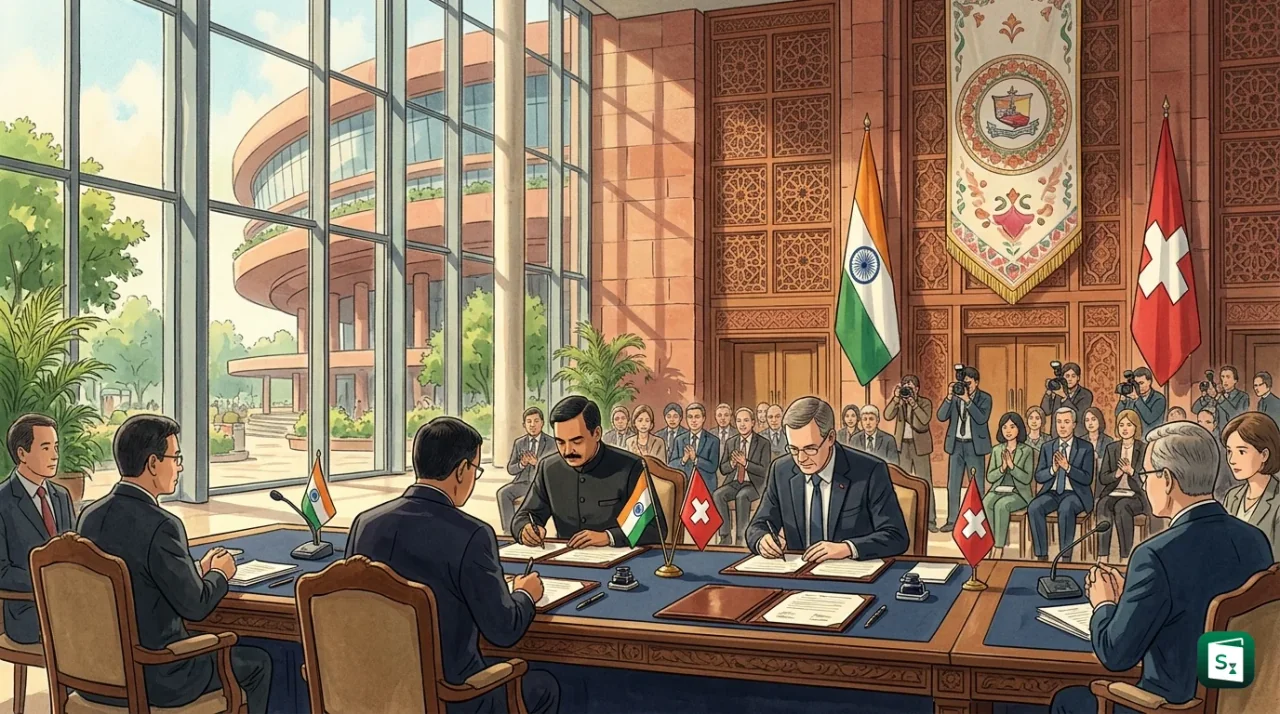
Swiss President Guy Parmelin made a State visit to India in October 2026, signing five agreements on migration, youth mobility, transport, scientific research and startup cooperation during talks with Prime Minister Narendra Modi on 5 October. The visit’s centrepiece was the second India-EFTA Prosperity Summit at Bharat Mandapam in New Delhi on 7 October, marking the first anniversary of the India-EFTA Trade and Economic Partnership Agreement (TEPA). The agreements add a people-centric layer to a trade partnership that now covers goods, services, investment and technology.
Why Guy Parmelin’s 2026 Visit Matters
Guy Parmelin’s trip was his first State visit to India and his second visit this year, after he attended the AI Impact Summit in New Delhi in February 2026. He travelled with what he described as the largest business delegation ever to accompany a Swiss president, a signal that Swiss firms see India as a long-term investment destination rather than only an export market. The timing was deliberate: the visit coincided with the first anniversary of TEPA, the trade pact that has become the foundation of India-Switzerland economic relations.
The bilateral relationship is older than the trade agreement. India and Switzerland established diplomatic ties through the Treaty of Friendship, signed in New Delhi on 14 August 1948, one of independent India’s earliest such treaties. The two countries will mark the 80th anniversary of diplomatic relations in 2028. Switzerland was India’s 15th largest trading partner in 2024-25, with total two-way trade of about $23.3 billion, and it is the largest trading partner among the four EFTA states. Around 350 Swiss companies operate in India, while Indian companies have invested close to $9 billion in Switzerland.
Who Is Guy Parmelin?
Guy Parmelin is the President of the Swiss Confederation for 2026 and heads the Federal Department of Economic Affairs, Education and Research (EAER). Born in 1959, he is a member of the Swiss People’s Party (SVP) from the canton of Vaud. He was elected to the seven-member Federal Council in December 2015 and has headed the EAER since 2019. This is his second term as president; he first held the office in 2021.
How Does the Swiss Presidency Work?
Switzerland does have a president, but the office works very differently from India’s. The Swiss government is a seven-member Federal Council with collective responsibility, and Switzerland has no prime minister. The Federal Assembly elects one council member as president for a one-year term. The president is described as first among equals: the person chairs council meetings and represents the country, but does not hold powers over the other six ministers. Parmelin’s authority in the India talks therefore came from his role as head of the economy department as much as from the ceremonial presidency.
What Is EFTA and How Is It Different from the EU?
The European Free Trade Association (EFTA) is a four-country trade bloc made up of Iceland, Liechtenstein, Norway and Switzerland. It was founded in 1960, is headquartered in Geneva, and focuses on free trade and economic cooperation among its members. EFTA is not the European Union. It is a free trade area, not a customs union, so each member sets its own tariffs on imports from outside the bloc and keeps its own trade policy.
EFTA was created by the Stockholm Convention on 4 January 1960 by seven countries: Austria, Denmark, Norway, Portugal, Sweden, Switzerland and the United Kingdom. Most of its original members later joined the European Communities, which is why the bloc shrank to four. Iceland joined in 1970 and Liechtenstein in 1991. The remaining four have chosen different relationships with the EU. Norway, Iceland and Liechtenstein are part of the European Economic Area (EEA), which extends the EU’s single market to them. Switzerland is not in the EEA; Swiss voters rejected EEA membership in a 1992 referendum, and Switzerland instead manages its EU relationship through a dense set of bilateral agreements.
| Feature | EFTA | European Union |
|---|---|---|
| Members | Iceland, Liechtenstein, Norway, Switzerland | 27 member states |
| Nature | Free trade area | Customs union and single market |
| Common external tariff | No | Yes |
| Political integration | Limited and intergovernmental | Supranational institutions and law |
| India arrangement | TEPA with the EFTA bloc | Separate India-EU FTA track |
Why EFTA Matters to India
EFTA’s four members have a combined population of only about 15 million, but they are among the world’s richest economies per person and control large pools of investment capital, technology and financial services. For India, the bloc is less about market size and more about access to Swiss banking, pharmaceuticals, precision engineering, insurance and research, along with Norwegian energy and maritime expertise. TEPA was India’s first free trade agreement with a European bloc, which gives it strategic value beyond the tariff numbers.
TEPA is also not India’s trade deal with the EU. The EU is a separate 27-member customs union with a much larger market and a different negotiating track. India’s agreements with EFTA and with the EU overlap in ambition but differ in legal structure, tariff schedules and services commitments. Treating the two as the same arrangement is one of the most common errors in commentary on the pact.
What Is the India-EFTA TEPA?
The India-EFTA Trade and Economic Partnership Agreement (TEPA) is a comprehensive free trade agreement between India and the four EFTA states. It was signed on 10 March 2024 and entered into force on 1 October 2025, after ratification by India and the EFTA countries. The agreement covers trade in goods, trade in services, investment, intellectual property rights, government procurement, competition, sustainable development and dispute settlement.
The negotiations were long and uneven. India and EFTA launched talks in January 2008, suspended them in 2013, and relaunched them in 2016 before concluding the deal in 2024. TEPA is India’s first free trade agreement with a European bloc and EFTA’s first such deal with India. It is also one of the few Indian trade agreements that includes an investment chapter and a formal link between market access and investment promotion.
The $100 Billion Investment and Jobs Commitment
TEPA’s most quoted number is $100 billion in foreign direct investment into India over 15 years, supported by a target of 1 million direct jobs. The figure is split into $50 billion in the first 10 years and $50 billion in the next five years. The EFTA states are also expected to facilitate investment through their trade promotion agencies, chambers of commerce and business delegations such as the one Parmelin brought in October.
The commitment is best read as an ambition backed by review provisions, not a guaranteed transfer of capital. Article 7.1 of the agreement frames the investment target as an aim, and the text provides for periodic reviews of progress. No automatic penalty follows if the target is missed. That distinction matters because Indian commentary sometimes treats the $100 billion figure as a contractual promise, while Swiss and EFTA documents describe it as a shared objective.
Market Access: The Numbers
On tariffs, EFTA covers 92.2% of its tariff lines and 99.6% of India’s exports to the bloc. India covers 82.7% of its tariff lines and 95.3% of EFTA exports to India. EFTA offers 100% coverage on non-agricultural products, while India has kept several sensitive agricultural products outside tariff elimination. The asymmetry reflects the different size and competitiveness of the two economies.
For Indian exporters, the gains are concentrated in industrial and labour-intensive products such as textiles, leather, gems and jewellery, machinery, chemicals and pharmaceuticals. For EFTA exporters, India’s tariff cuts open opportunities in precision engineering, medical devices, specialised machinery, processed foods and high-end consumer goods.
Services, IPR and Mobility
TEPA includes commitments on cross-border services, professional mobility, intellectual property and regulatory cooperation. The agreement provides for mutual recognition of professional qualifications in nursing, chartered accountancy and architecture, although recognition still depends on the domestic regulators of each country. It also creates a framework for cooperation on digital trade, competition policy and sustainable development.
The IPR chapter covers copyright, patents, trademarks, geographical indications and enforcement. For India, the sensitive question is whether these commitments go beyond the WTO’s TRIPS Agreement. The chapter is built on the TRIPS framework but adds transparency and enforcement obligations that Indian regulators will need to implement. The sustainable development chapter commits the parties to labour and environmental standards without making market access conditional on them.
The Five Agreements Signed During the Visit
After the Modi-Parmelin talks at Hyderabad House on 5 October, the two governments exchanged five agreements and understandings. They cover migration, youth mobility, road transport, scientific research and startup cooperation. None of them is a defence or nuclear pact, although the leaders discussed both sectors separately.
| Instrument | Parties | Core provision |
|---|---|---|
| MoU on Migration and Mobility Partnership | India and Switzerland | Multiple-entry visas up to 5 years, stays up to 6 months per visit, renewable one-year student permits, and cooperation against irregular migration |
| Agreement on Exchange of Young Professionals | India and Switzerland | Temporary employment for 300 young professionals annually per country, potentially rising to 500, with 30/90-day verification timelines |
| MoU on transport technologies and mobility systems | Ministry of Road Transport and Highways and Swiss EAER | Cooperation on electric vehicles, ropeways, tunnels, circular economy and sustainable infrastructure |
| Letter of Intent on scientific research | Department of Science and Technology and Swiss National Science Foundation | Exploratory research collaboration and a framework for long-term joint projects |
| Implementation Arrangement for AIT India | Department of Science and Technology and Zurich University of Applied Sciences | Bilateral startup cooperation through the Academia-Industry Training programme |
What the Migration and Mobility Pact Offers
The Migration and Mobility Partnership MoU is the most consequential of the five for Indian students and professionals. It provides for multiple-entry visas valid for up to five years, with stays of up to six months on each visit. Indian students can receive renewable one-year permits to pursue studies or training in Switzerland. The agreement also commits both sides to equal treatment principles and to cooperation against irregular migration, human exploitation and trafficking.
The pact is not a free-movement arrangement. It does not give Indians an automatic right to work in Switzerland, and Swiss visa and residence rules still apply. Its value lies in making the application process more predictable and in creating a formal channel for cooperation when students, researchers and workers move between the two countries.
What the Young Professionals Agreement Changes
The Young Professionals Agreement creates a dedicated exchange route for people early in their careers. It covers 300 persons annually per country, a number that can rise to 500 by mutual agreement. Participants can take up temporary employment in the other country to improve their professional and language skills in their field. The agreement sets 30-day and 90-day timelines for verifying nationality and residency status, which should reduce administrative delays.
Like the migration pact, it is quota-based and does not guarantee a job or a visa. Indian applicants still need a Swiss employer and must meet Swiss entry requirements. The difference is that the agreement formalises a route that previously depended on general immigration categories.
Transport, Science and Startup Cooperation
The transport MoU links India’s Ministry of Road Transport and Highways with Switzerland’s EAER. It focuses on sustainable infrastructure, including electric vehicles, ropeways, tunnel technology, circular economy practices and mobility systems. The MoU gives Swiss transport technology firms a government-to-government framework to pursue Indian projects in these areas.
The DST-SNSF Letter of Intent is aimed at researchers rather than companies. It supports exploratory collaboration, helps build partnerships for future joint research, and creates a broader framework for long-term projects in agreed priority areas. The DST-ZHAW implementation arrangement takes the existing Academia-Industry Training (AIT) India programme bilateral. AIT India helps early-stage researchers and founders turn scientific ideas into startups through exchanges, workshops, mentoring and networking in both countries. The arrangement gives the programme a formal intergovernmental basis and connects it to India’s startup ecosystem.
The Second India-EFTA Prosperity Summit at Bharat Mandapam
The second India-EFTA Prosperity Summit was held at Bharat Mandapam in New Delhi on 7 October 2026, two days after the Modi-Parmelin talks. It marked the first anniversary of TEPA’s entry into force and brought together Parmelin, Union Minister Ashwini Vaishnaw, Minister of State Jitin Prasada, Commerce Secretary Rajesh Agrawal, and ministers and senior representatives from Iceland, Liechtenstein and Norway, along with the EFTA Secretariat.
The summit combined a plenary with sectoral business-to-business meetings. Sessions covered smart and advanced manufacturing, healthcare and life sciences, the blue economy and maritime cooperation, and clean energy and climate innovation. Indian exporters and EFTA businesses also held a separate outreach event to discuss how to use TEPA’s tariff preferences, rules of origin and services commitments. The presence of several Swiss chief executives underlined the investment focus.
Parmelin used the platform to argue that governments cannot direct private capital but can create the conditions that attract it. He noted that around 53 Swiss companies had investment plans in India across 20 sectors and said there was practically no Indian state without a Swiss company. Norway’s representative said around 160 Norwegian companies were active in India. Vaishnaw, for his part, projected 6% to 8% real growth for India over the next five years and pointed to electronics as a showcase sector, with electronics exports rising eleven-fold and electronics manufacturing seven-fold.
One issue surfaced repeatedly: the investment protection agreement that Switzerland and India are still negotiating. TEPA’s investment chapter promotes and facilitates investment, but it does not replace a bilateral investment treaty with enforceable protections for Swiss investors. Parmelin welcomed progress in those talks, while Indian officials emphasised predictability and dispute resolution. The summit therefore did more than celebrate a first anniversary; it set the agenda for the agreement’s unfinished business.
Why Bharat Mandapam Matters
Bharat Mandapam is part of the India Trade Promotion Organisation complex at Pragati Maidan in central New Delhi. It was inaugurated on 26 July 2023 and became globally visible as the venue of the 2023 G20 New Delhi Summit. The complex includes a convention centre, exhibition halls and supporting facilities, and it is now a default venue for large international economic events. Hosting the India-EFTA summit there placed the trade pact in the same diplomatic setting as India’s G20 presidency.
One Year of TEPA: Early Results and Unfinished Work
TEPA completed its first year on 1 October 2026. The early record is encouraging but uneven. Swiss and Norwegian companies have announced plants, expansions and partnerships, Indian exporters have a new set of preferential tariffs to use, and the agreement has given both governments a structured dialogue on investment, services and regulatory issues. At the same time, the headline trade numbers remain distorted by gold, and several of the agreement’s most ambitious promises depend on work that has barely started.
What Has TEPA Delivered in Its First Year?
The clearest visible outcome is business attention. Around 53 Swiss companies have investment plans in India across 20 sectors, according to Parmelin’s remarks at the summit. Norway has about 160 companies active in India, a footprint that predates TEPA but now operates under a broader trade framework. Swiss direct investment in India stood at CHF 10.2 billion at the end of 2024, and around 350 Swiss companies operate in the country. The first year has also given Indian exporters a reason to study EFTA rules of origin, conformity assessment and services trade.
On tariffs, EFTA’s commitments cover 92.2% of tariff lines and 99.6% of India’s exports, with full coverage of non-agricultural products. India’s schedule covers 82.7% of tariff lines and 95.3% of EFTA exports. These are strong numbers on paper. The practical test is whether Indian small and medium enterprises can meet European standards, paperwork and delivery requirements, and whether Swiss firms move beyond announcements to actual construction and hiring.
The Gold Problem in the Trade Data
India-Switzerland trade is dominated by gold. Switzerland is a major refining and trading hub, and Indian imports of Swiss gold dwarf Indian goods exports to Switzerland. That makes the bilateral trade deficit look enormous and masks what is happening in machinery, pharmaceuticals, chemicals, textiles and processed foods. A rise or fall in gold shipments can change the headline deficit without saying much about TEPA.
This is why the agreement’s success should be judged on non-gold exports, services, investment and job creation, not only on the total trade figure. It is also why Indian officials have urged exporters to build long-term supply relationships rather than treat Switzerland as a one-off market. EFTA states together import goods and services worth more than $500 billion a year, so even a small share of that demand can be significant for Indian firms.
What Remains Unfinished?
Four issues stand out. First, the investment protection agreement between India and Switzerland is still under negotiation, and without it some Swiss investors will continue to weigh political and regulatory risk. Second, non-tariff measures remain a bigger obstacle than tariffs for many products, especially in food, pharmaceuticals and medical devices. Third, the mutual recognition arrangements for nurses, chartered accountants and architects need operational systems before professionals can use them. Fourth, awareness among small firms remains uneven, and the benefits of TEPA will not materialise if exporters do not know how to claim them.
The Indian government has asked export promotion councils and state governments to prepare five-year action plans for each EFTA market. That is a sensible shift from signing ceremonies to implementation. The test for the second year is whether those plans translate into shipping orders, joint ventures and factory floors.
Defence, Nuclear Energy and Strategic Cooperation
The five agreements were economic and civilian, but the Modi-Parmelin talks ranged wider. The Prime Minister said the two sides had identified new opportunities in defence production and nuclear energy, alongside infrastructure, mobility, science and technology, innovation, health, clean energy and space. They also discussed cooperation in Yoga and Ayurveda, areas where Switzerland has a growing wellness market and India sees soft-power potential.
No defence or nuclear agreement was signed during the visit. That distinction matters. The discussions signal intent to explore these sectors, not a completed strategic partnership. India has long-standing defence ties with several European countries, and Switzerland has a specialised defence and precision engineering industry, but Swiss neutrality and arms export rules shape what Bern can offer. Any future defence cooperation would have to navigate those constraints as well as India’s own procurement and technology-transfer requirements.
On nuclear energy, the conversation is similarly exploratory. India is expanding its civilian nuclear programme and has signed civil nuclear agreements with several countries. Switzerland has decades of nuclear operating experience and expertise in safety, regulation and decommissioning. A future partnership could focus on technology, safety systems and workforce training rather than reactors, but no framework was announced during this visit.
Diplomacy Beyond the Bilateral
The two leaders also discussed Ukraine, West Asia and reform of global institutions. India has positioned itself as a voice for dialogue and peace in both conflicts, while Switzerland has used its neutral status to host diplomatic talks and humanitarian initiatives. Both governments said they share a commitment to democracy, the rule of law and multilateralism, even when their specific positions differ.
Switzerland will host the next AI Impact Summit in Geneva in 2027, following India’s hosting of the 2026 edition in New Delhi. That handover gives the two countries a natural follow-up agenda on artificial intelligence governance, digital public infrastructure and technology standards. It also explains why the relationship is broadening beyond trade even as TEPA remains its economic anchor.
The Way Forward
The immediate task is implementation. TEPA’s joint committee has to keep tariff schedules, rules of origin and services commitments on track. The migration and youth mobility pacts need functioning visa processes, not just legal text. The science and startup arrangements need calls for proposals, funding and clear intellectual property rules. And the investment target needs transparent reporting so that the $100 billion figure can be measured against actual flows rather than announcements.
The investment protection agreement is the most important unfinished item. Swiss companies cite legal certainty, dispute resolution and treatment standards when they weigh large Indian investments. India wants investment without exposing itself to claims it considers excessive. Bridging those positions will take time, but the summit’s explicit reference to progress suggests both sides see a deal as complementary to TEPA rather than a precondition for it.
There is also a communication gap to close. Many Indian exporters still associate Switzerland with gold and banking, not with machinery, medical devices, food processing or clean technology. Many Swiss firms know India’s large states but not its smaller markets and regulatory variation. Business-to-business meetings, state-level outreach and sector-specific delegations can narrow that gap. The five-year export plans requested by the Commerce Ministry are a start, but they need to reach firms that do not attend summits in Delhi.
The broader relationship has a natural milestone in 2028, the 80th anniversary of diplomatic relations. By then, TEPA will have been in force for three years, and the investment protection talks should have reached a conclusion. Artificial intelligence, digital public infrastructure, green hydrogen, skilling and space are the obvious new frontiers. The test is whether the five agreements of 2026 become working arrangements that change how students, researchers, investors and exporters operate, or remain diplomatic headlines.
Key Takeaways
- Five agreements, one visit: Guy Parmelin’s State visit produced pacts on migration and mobility, youth professionals, transport technology, scientific research and startup cooperation.
- Student and worker mobility gets a formal route: Indians can receive multiple-entry Swiss visas valid for up to five years, stays of up to six months per visit and renewable one-year student permits. The young professionals quota is 300 per country annually, with scope to rise to 500.
- TEPA is one year old: The India-EFTA trade pact entered into force on 1 October 2025. Its target of $100 billion in investment and 1 million jobs over 15 years is an aim backed by reviews, not a guaranteed transfer.
- The summit was about implementation: The 7 October summit at Bharat Mandapam highlighted 53 Swiss companies with plans across 20 sectors, 160 Norwegian companies in India, and sectors such as manufacturing, health, the blue economy and clean energy.
- EFTA is not the EU: EFTA has four members, is a free trade area rather than a customs union, and Switzerland is not in the EEA. TEPA is a separate agreement from India’s trade track with the European Union.
- The unfinished agenda is substantial: A Switzerland-India investment protection agreement, non-tariff barriers, operational mutual recognition for professionals and uneven awareness among small firms remain the main gaps.
- Defence and nuclear talks produced no pact: The leaders discussed defence production and nuclear energy, but the five signed instruments were civilian. The next diplomatic milestone is the 80th anniversary of India-Switzerland relations in 2028.