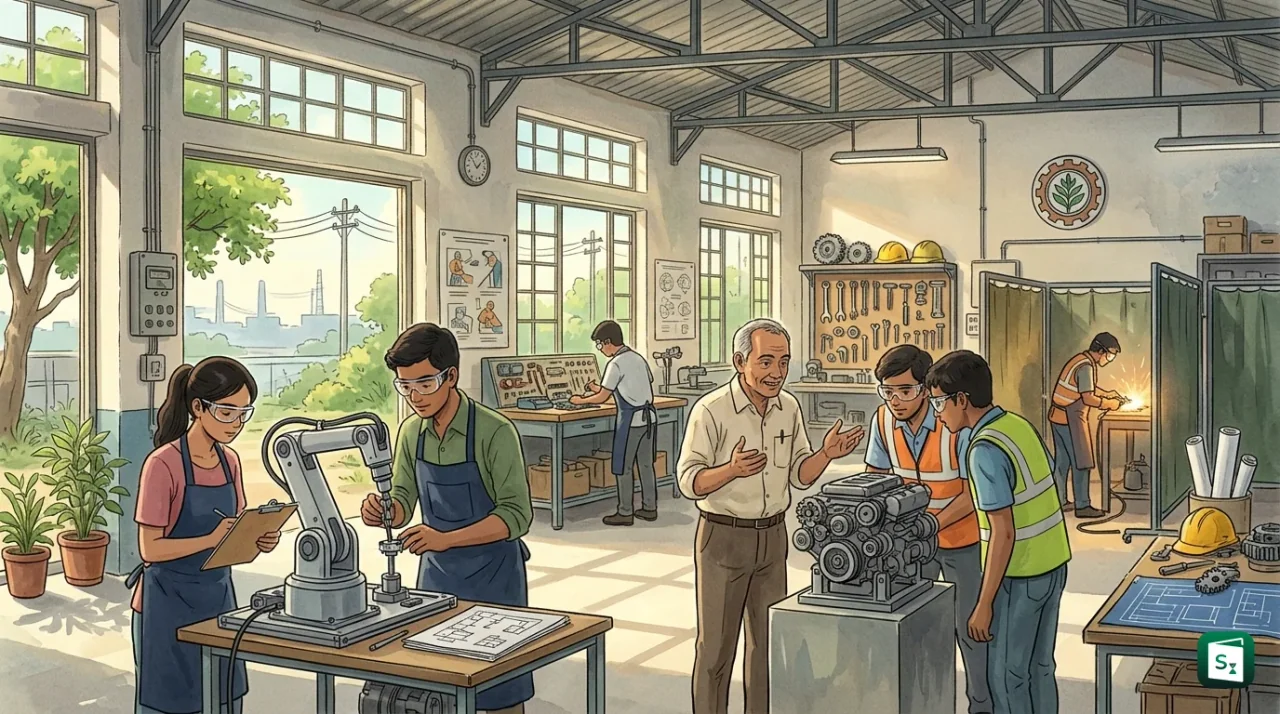
The Ministry of Skill Development and Entrepreneurship signed shareholders’ agreements with ArcelorMittal Nippon Steel India (AM/NS India), Gujarat and Andhra Pradesh on 12 October 2026 to upgrade nine government Industrial Training Institutes under the PM Skilling and Employability Transformation through Upgraded ITIs (PM-SETU) scheme. The pact covers five ITIs in Gujarat’s Surat cluster at ₹240 crore and four in Andhra Pradesh’s Visakhapatnam cluster at ₹200 crore, taking the combined investment to ₹440 crore. It is one of the largest industry commitments approved under the ₹60,000 crore scheme, and it gives a private steelmaker a 51 per cent controlling stake in the companies that will run these institutes.
What Is the PM-SETU Scheme?
PM-SETU, or Pradhan Mantri Skilling and Employability Transformation through Upgraded ITIs, is a centrally sponsored scheme launched on 4 October 2025 to modernise 1,000 government ITIs and five National Skill Training Institutes. The Ministry of Skill Development and Entrepreneurship runs it through the Directorate General of Training.
The Union Cabinet approved the scheme on 7 May 2025, and it was rolled out later that year as a five-year programme. Its total outlay is ₹60,000 crore, funded through three sources: ₹30,000 crore from the Centre, ₹20,000 crore from the states and ₹10,000 crore from industry. This shared funding structure is central to the design. The government does not merely invite companies to donate equipment; it asks them to co-own and co-manage the institutions.
The Two Components
The scheme has two distinct parts. Component I covers the upgradation of 1,000 government ITIs, split into 200 Hub ITIs and 800 Spoke ITIs. These institutes receive smart classrooms, modern laboratories, digital content and new courses designed around industry demand.
Component II focuses on five National Skill Training Institutes (NSTIs) in Bhubaneswar, Chennai, Hyderabad, Kanpur and Ludhiana. These are being developed as National Centres of Excellence for training instructors, with partnerships involving Singapore, France, Australia and Germany.
The scheme moved from a pilot to a nationwide rollout in July 2026, when the National Steering Committee allowed states to take up all 200 identified ITI clusters. By 3 October 2026, 850 ITIs had been identified, including 172 hubs and 678 spokes, and 36 states and union territories had created dedicated budget heads for the scheme.
What Is an ITI? Full Form, Trades and Certification
An Industrial Training Institute, or ITI, is a vocational training institution that teaches engineering and non-engineering trades to students who have passed at least Class 8 or Class 10. Courses last one to two years under the Craftsmen Training Scheme and end with a National Trade Certificate.
The Craftsmen Training Scheme (CTS) was introduced in 1950 to create a steady supply of skilled workers for Indian industry. About 70 per cent of the training time is spent on practical work in workshops, and the rest on trade theory, workshop calculation and science, and employability skills. Trades range from electrician, fitter and welder to draughtsman, computer operator, cosmetology and food production.
| Feature | Details |
|---|---|
| Full form | Industrial Training Institute |
| Training scheme | Craftsmen Training Scheme, started in 1950 |
| Course duration | One to two years, depending on the trade |
| Entry qualification | Class 8 or Class 10 pass |
| Certification | National Trade Certificate under NCVT, or State Trade Certificate under SCVT |
| Skills framework | Courses mapped to the National Skills Qualification Framework (NSQF), mostly at Levels 4 and 5 |
| Apex regulator | National Council for Vocational Education and Training, notified on 5 December 2018 |
| Total ITIs in India | 13,888, including government and private institutes (2026) |
Most government ITIs are affiliated either to the National Council for Vocational Training (NCVT) or to a State Council for Vocational Training (SCVT). The NCVT certificate, called the National Trade Certificate, is accepted for recruitment to central government posts, public sector undertakings and private industry. The National Council for Vocational Education and Training (NCVET) acts as the overarching regulator for vocational education and sets qualification standards.
Instructors are trained separately through the Craft Instructor Training Scheme (CITS), a one-year programme run through NSTIs and Institutes of Training of Trainers. The Directorate General of Training is the apex central body for vocational training policy, curriculum, affiliation, instructor training and trade testing. It functions under the Ministry of Skill Development and Entrepreneurship.
The ₹440 Crore Agreement: What Exactly Was Signed
On 12 October 2026, the Directorate General of Training, the governments of Gujarat and Andhra Pradesh, and AM/NS India signed shareholders’ agreements to implement approved Strategic Investment Plans for two ITI clusters. These agreements create the legal framework for special purpose vehicles that will upgrade and operate nine government ITIs.
Two documents sit at the heart of the arrangement. A Strategic Investment Plan (SIP) is the detailed project proposal that lists the works, new trades, equipment and budget for a cluster. It is first vetted by the state steering committee and then approved by the National Steering Committee. A Shareholders’ Agreement (SHA) is the contract among the owners of the company created to execute that plan. Without an SHA, an approved SIP cannot move to the stage of actual construction and hiring.
Surat Cluster: Five ITIs, ₹240 Crore
The Surat cluster covers five government ITIs, with Government ITI Surat as the hub. Its four spokes are Government ITI Surat (Women), Government ITI Hajira, Government ITI Bardoli and Government ITI Sachin. The approved investment is ₹240 crore, spread over five years.
The cluster is built around Surat’s industrial base, which includes the Hazira steel complex, engineering units, process industries, textiles and advanced manufacturing. The plan targets enrolment of about 25,000 trainees over five years and is expected to add 3,528 training seats through upgraded and newly introduced programmes. It was approved by the National Steering Committee in July 2026.
Visakhapatnam Cluster: Four ITIs, ₹200 Crore
The Visakhapatnam cluster has four government ITIs. Government ITI (Old), Kancharapalem, is the hub, and it will share facilities with Government ITI (Girls), Industrial Estate, Government ITI Bobbili and Government ITI Narsipatnam. The approved investment is ₹200 crore.
This cluster has a special place in the scheme’s timeline. Its SIP was the first ever cleared under PM-SETU, on 30 May 2026, which made Andhra Pradesh the first state to operationalise an industry partnership under the scheme. The October 2026 shareholders’ agreement converted that approval into a functioning ownership structure.
| Cluster | State | Hub ITI | Spoke ITIs | Investment |
|---|---|---|---|---|
| Surat | Gujarat | Government ITI, Surat | Surat (Women), Hajira, Bardoli, Sachin | ₹240 crore |
| Visakhapatnam | Andhra Pradesh | Government ITI (Old), Kancharapalem | Visakhapatnam (Girls), Bobbili, Narsipatnam | ₹200 crore |
How the Hub-and-Spoke Model and SPVs Work
In the hub-and-spoke model, one strong ITI in a district acts as the hub and four nearby ITIs act as spokes. The hub houses advanced laboratories, innovation centres, trainer-training facilities, production units and placement cells. Spoke institutes share this infrastructure and run courses linked to the same cluster.
This design solves a practical problem. Advanced equipment for robotics, industrial automation or computer numerical control (CNC) machining is expensive, and every ITI cannot own a full set. By concentrating it in one hub and connecting surrounding institutes, the scheme spreads the benefit without duplicating costs. On average, each hub is linked to four spoke ITIs.
A Special Purpose Vehicle (SPV) is the company created for each cluster. In both the Surat and Visakhapatnam SPVs, AM/NS India holds 51 per cent, the Government of India holds 24.5 per cent and the respective state government holds 24.5 per cent. The industry partner is called the Anchor Industry Partner, and its majority stake gives it management control along with financial responsibility.
Analogy · A Company Built for One Job Expand analogy
An SPV works like a separate company floated only to build and run a particular project, similar to a joint venture created for a single highway. It has its own board, budget and accounts, so the ITIs are managed professionally instead of being absorbed into the daily administration of a government department.
AM/NS India will implement the project with its academic and technical partner, the New Age Makers’ Institute of Technology (NAMTECH). The company brings manufacturing and shop-floor expertise, while NAMTECH handles curriculum design, training delivery reforms, faculty development and academic innovation. The planned work includes modern workshops, new industry-relevant trades, revised curricula, instructor training and more hands-on learning time for trainees.
Why ArcelorMittal Nippon Steel India Is Funding ITIs
ArcelorMittal Nippon Steel India is a joint venture between ArcelorMittal and Nippon Steel, formed after the two companies acquired Essar Steel through India’s insolvency process in 2019. The company is one of India’s largest flat steel producers, and its workforce needs are growing quickly.
Its flagship Hazira integrated steel plant lies in Surat district, close to the five ITIs now covered by the Gujarat cluster. The plant is expanding its crude steel capacity from about 9 million tonnes to 15 million tonnes a year. That expansion will require thousands of welders, fitters, electricians, instrumentation technicians and automation operators, many of whom can be trained locally.
The Andhra Pradesh link is equally direct. AM/NS India operates an 8 million tonne a year pellet plant in Visakhapatnam, fed by a slurry pipeline from its beneficiation plant at Kirandul in Chhattisgarh. In March 2026, the company announced a greenfield integrated steel plant at Rajayyapeta in Andhra Pradesh, with a first-phase capacity of 8.2 million tonnes a year. A project of that size needs a steady pipeline of skilled workers, and the Visakhapatnam ITI cluster sits in the same coastal industrial belt.
| AM/NS India asset | Location | Link to the ITI cluster |
|---|---|---|
| Hazira integrated steel plant | Surat district, Gujarat | Lies near the Surat cluster and is undergoing a major capacity expansion |
| Vizag pellet plant | Visakhapatnam, Andhra Pradesh | Part of the company’s existing Andhra Pradesh operations |
| Proposed Rajayyapeta steel plant | Andhra Pradesh | First phase of 8.2 million tonnes a year will need a large technical workforce |
The arrangement also differs from ordinary corporate social responsibility spending. Under CSR, a company funds an activity and usually steps back. Under PM-SETU, the company holds equity, sits on the SPV board and carries responsibility for training outcomes, placements and the long-term running of the institutes.
Why This Matters for India’s Skill Ecosystem
The agreement tests whether private industry can run public vocational institutes better than the government alone. If the model works, it could raise training quality, align courses with real factory jobs and give young Indians a credible route into formal employment.
India’s ITI network has expanded sharply over the past decade. The number of ITIs, including private institutes, rose from 9,776 in 2014 to 13,888 in 2026, a jump of about 42 per cent. Enrolment climbed from 9.51 lakh in 2014-15 to 14.70 lakh in 2025-26, an increase of 54 per cent.
| Indicator | 2014 | 2026 |
|---|---|---|
| Number of ITIs | 9,776 | 13,888 |
| ITI enrolment | 9.51 lakh (2014-15) | 14.70 lakh (2025-26) |
The broader policy framework behind this growth is the Skill India Mission, launched on 15 July 2015 along with the National Policy for Skill Development and Entrepreneurship 2015 and the Pradhan Mantri Kaushal Vikas Yojana (PMKVY). The Ministry of Skill Development and Entrepreneurship itself was created in November 2014, taking over skilling functions that were earlier scattered across several departments. The National Skill Development Corporation (NSDC), set up in 2009, coordinates private participation in short-term skilling.
PM-SETU adds a long-term institutional layer to this architecture. Short-term schemes such as PMKVY train candidates in courses of a few months. ITIs, by contrast, offer one-year and two-year programmes that can build deeper technical competence. Strengthening them matters because factories, ports, power plants and construction sites repeatedly report a shortage of technicians who can operate and maintain modern equipment.
The global benchmark is also moving. At WorldSkills Shanghai 2026, the international vocational skills competition held from 22 to 27 September, India finished 10th, winning six silver medals and 20 Medals for Excellence. India had ranked 13th at WorldSkills Lyon 2024. The Skills Ministry has said it wants PM-SETU institutions to become centres of excellence that can produce future WorldSkills champions.
What Challenges Remain?
The scheme’s biggest test is execution. Industry participation is still uneven across states, instructor shortages persist, and the quality of training and placement data will decide whether upgraded ITIs actually improve jobs rather than just buildings.
By 12 October 2026, the National Steering Committee had approved 14 Strategic Investment Plans across eight states and one union territory, proposing an investment of ₹3,446 crore. That is a small share of the scheme’s ₹60,000 crore outlay, which shows how much work remains before the full network of 1,000 ITIs is covered. The committee cleared five more clusters in Maharashtra, Odisha and Jammu and Kashmir on 16 October 2026.
State-level capacity is another variable. While 36 states and union territories have created dedicated budget heads and 35 have set up steering committees, only 26 had begun inviting industry proposals by the scheme’s first anniversary. States with weak industrial bases may struggle to attract anchor partners on the scale seen in Gujarat and Andhra Pradesh.
Instructors remain a structural weakness. The National Council for Vocational Training requires all ITI trainers to be CITS-trained, but a 2021 assessment by the Directorate General of Training found that only about 15 per cent of the more than 95,000 instructor positions in the ecosystem were held by CITS-trained candidates. Component II of PM-SETU addresses this gap, and 3,744 trainers had been trained through NSTIs by October 2026. That number is useful, but it is still small against the size of the ITI system.
The ownership model also raises questions. A private company with a 51 per cent stake controls the SPV that runs government institutes. The scheme will need clear rules on fee levels, admission quotas for local and disadvantaged students, and public disclosure of placement records so that commercial priorities do not crowd out the public purpose of these institutes.
Verification of outcomes will matter as much as infrastructure. Earlier skilling programmes have been criticised for weak placement tracking, and PM-SETU’s credibility will depend on audited data showing how many trainees actually find jobs, apprenticeships or self-employment after completing their courses.
The Road Ahead
The immediate task is to incorporate the two special purpose vehicles and begin releasing funds for construction, equipment and new courses. The Surat cluster alone targets about 25,000 trainees over five years, so the first admission cycle after upgradation will be an early test of whether the new seats and trades match local demand.
At the national level, the National Steering Committee still has to clear investment plans for the remaining ITI clusters out of the 200 identified. The five NSTIs are also being linked to foreign partners, including Singapore for Chennai, France for Kanpur, Australia for Bhubaneswar and Germany for Hyderabad, to strengthen instructor training.
For AM/NS India, the payoff will be visible only when its expanded Hazira plant and the proposed Rajayyapeta steel plant begin hiring technicians trained in these institutes. If that pipeline works, other large manufacturers may be willing to take majority stakes in government ITIs, which would mark a lasting change in how India funds vocational education.
Key Takeaways
- The Ministry of Skill Development and Entrepreneurship signed shareholders’ agreements on 12 October 2026 with AM/NS India, Gujarat and Andhra Pradesh to upgrade nine government ITIs under PM-SETU.
- The Surat cluster covers five ITIs with an investment of ₹240 crore, while the Visakhapatnam cluster covers four ITIs with ₹200 crore, taking the combined investment to ₹440 crore.
- Each cluster will be managed by a Special Purpose Vehicle in which AM/NS India holds 51 per cent, the Centre holds 24.5 per cent and the state government holds 24.5 per cent.
- PM-SETU was launched on 4 October 2025 with an outlay of ₹60,000 crore to upgrade 1,000 government ITIs, comprising 200 hubs and 800 spokes, along with five National Skill Training Institutes.
- ITI stands for Industrial Training Institute; its courses run for one to two years under the Craftsmen Training Scheme, which began in 1950.
- The Visakhapatnam Strategic Investment Plan was the first cleared under PM-SETU, on 30 May 2026, making Andhra Pradesh the first state to operationalise an industry partnership under the scheme.
- India ranked 10th at WorldSkills Shanghai 2026, winning six silver medals and 20 Medals for Excellence, up from 13th place at Lyon in 2024.