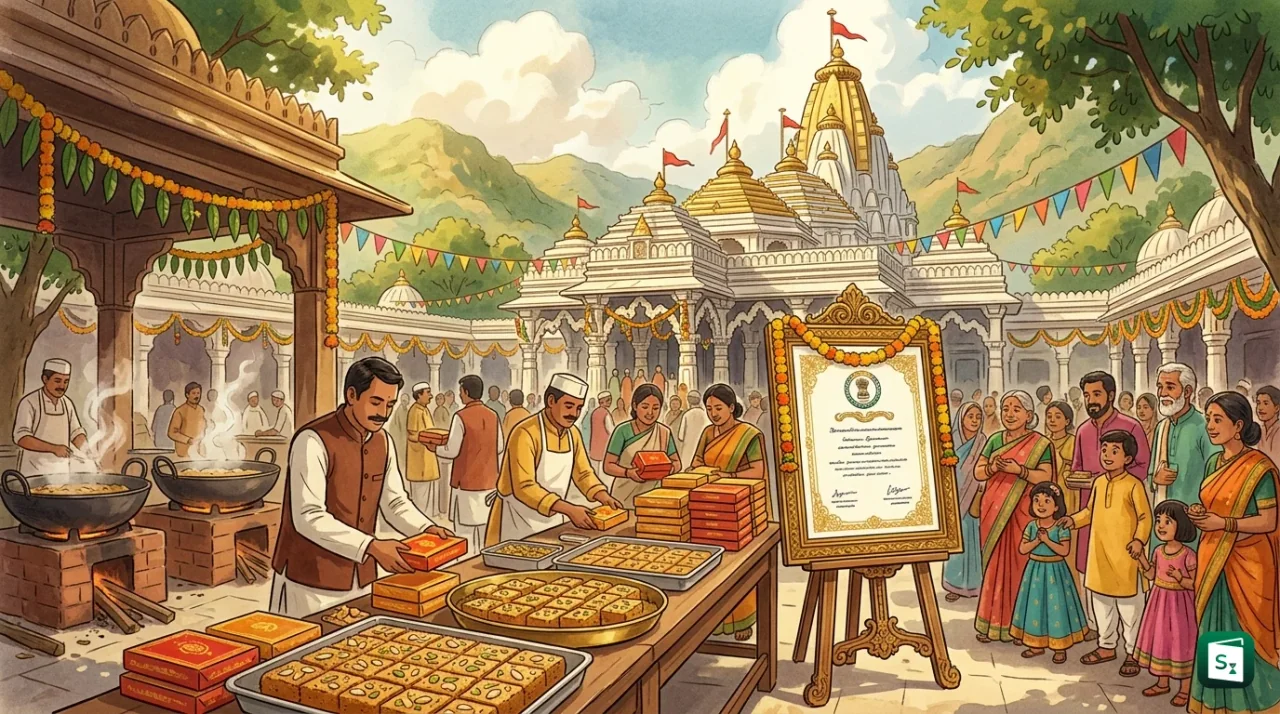
The traditional Mohanthal prasad of the Ambaji Temple in Gujarat has been awarded the Geographical Indication (GI) tag, giving one of the state’s most revered devotional offerings formal legal protection. The registration certificate was handed over to the Shree Arasuri Ambaji Mata Devasthan Trust at a ceremony held on the first day of Sharadiya Navratri in October 2026. The recognition places the temple’s signature sweet alongside other protected temple prasads in India and shields its name from imitation.
What Is the Ambaji Mohanthal GI Tag?
Ambaji Mohanthal is the traditional gram flour sweet offered as prasad at the Ambaji Temple in Banaskantha district, Gujarat. It received the Geographical Indication (GI) tag from the Geographical Indications Registry in October 2026, giving the temple trust the exclusive legal right to use the name for its authentic prasad.
The tag was granted in the name of the Shree Arasuri Ambaji Mata Devasthan Trust, the body that manages the temple and the preparation of the offering. The application was filed on 18 April 2024 and registered under Class 30, the category for foodstuffs, for the geographical area of Gujarat. The registration certificate carried the number 835 and was dated 1 October 2026.
Once a product is protected this way, no trader or manufacturer outside the authorised group can legally sell a sweet under the name Ambaji Mohanthal. The tag preserves the reputation of the original while allowing the trust and its authorised producers to take legal action against fakes.
Where Is the Ambaji Temple Located?
The Ambaji Temple stands in the town of Ambaji, in the Danta taluka of Banaskantha district, Gujarat, close to the Rajasthan border. It sits at an elevation of about 480 metres on the Arasur hills at the south-western end of the Aravalli range, near the seasonal source of the Saraswati river.
The shrine is counted among the 51 Shakti Peethas, the revered seats of the Goddess in Shaktism. Devotees believe that the heart of Sati fell at this spot, which is why Ambaji is also called the Hridaya Peetha, or the seat of the heart. The goddess here is known as Arasuri Amba, a name drawn from the Arasur hills.
One feature sets the temple apart from most Hindu shrines. The inner sanctum holds no idol or statue of the goddess. Worship centres on the Shree Visa Yantra (Viso Yantra), a sacred geometric diagram embossed on a metal plate and set in a wall niche. The plate is kept hidden behind a curtain, and devotees cover their eyes before approaching it. Priests decorate the niche with robes, jewellery and a silver mask so that it appears like an enthroned goddess.
The temple is built of white marble in the chachar chowk layout, an open square around which ceremonial rituals are held. The Gabbar Hill, about 4.5 km from the main town, is regarded as the original seat of the goddess and is reached by 999 steps or a ropeway. Located about 45 km from Mount Abu and 185 km from Ahmedabad, Ambaji draws lakhs of pilgrims every year, with the largest gathering at the Bhadarvi Poonam fair held in the Hindu month of Bhadrapada.
Mohanthal: The Age-Old Raj Bhog Offering of Ambaji
Mohanthal is a traditional Gujarati sweet made mainly from besan (gram flour), ghee, sugar and often khoa (milk solids). At Ambaji it is prepared as the Raj Bhog offering and distributed among devotees as prasad after being placed before the goddess.
The name comes from two words: Mohan, a name for Lord Krishna, and Thal, meaning a plate or dish. The sweet is popular across Gujarat, Rajasthan, the Braj region and Sindh, and is commonly made for festivals such as Diwali and Janmashtami. At the Ambaji Temple, however, it is offered daily as a fixed ritual rather than only on festive days.
The preparation follows a carefully guarded method handed down over generations. Besan is first mixed with a little ghee and milk to form a grainy mixture called dhrabo, which is left to rest and then sieved. This is roasted in ghee until it turns a light brown and releases a rich, roasted aroma. A one-string sugar syrup is then added and stirred to a semi-solid consistency, after which the mixture is spread on a greased tray, garnished with cardamom and nuts, and left to set overnight before being cut into pieces.
Ancient texts such as the Skanda Purana and the Jagad Purana describe an offering called Ghrit Misrit, in which ghrit means ghee and misrit refers to a blend of ingredients. The temple trust cites this as early evidence that a ghee-based sweet has been offered at Ambaji for centuries. The signature mustard-yellow colour, granular texture and distinct aroma are what separate the temple’s Mohanthal from the many look-alike sweets sold in the open market.
How Did Ambaji Mohanthal Receive the GI Tag?
The Shree Arasuri Ambaji Mata Devasthan Trust applied for the tag on 18 April 2024. After examination and a mandatory publication stage, the registry issued the registration certificate on 1 October 2026, and it was formally presented at Ambaji on 11 October 2026, the first day of Sharadiya Navratri.
The path from application to registration is a structured legal process, and the timeline below shows how it unfolded for Ambaji Mohanthal.
| Date | Event |
|---|---|
| 18 April 2024 | Application No. 1228 filed by the Shree Arasuri Ambaji Mata Devasthan Trust |
| 29 April 2024 | Formality Check Report issued by the registry |
| 14 November 2025 | Applicant’s reply to the Formality Check Report |
| 25 February 2026 | Examination Report issued |
| 25 May 2026 | Applicant’s reply to the Examination Report |
| 29 May 2026 | Application published in the Geographical Indications Journal |
| 1 October 2026 | Registration certificate No. 835 issued |
| 11 October 2026 | Certificate formally handed over to the temple trust at Ambaji |
The certificate ceremony was held at the chachar chowk in Ambaji town. It was presided over by Prof. Dr. Unnat P. Pandit, the Controller General of Patents, Designs and Trade Marks and Registrar of Geographical Indications (as of October 2026). Mihir Patel, the Banaskantha Collector and managing trustee of the temple trust, received the certificate. Representatives of the Confederation of Indian Industry (CII) Gujarat and a large number of devotees attended the event.
With registration complete, the GI protection for Ambaji Mohanthal is valid for ten years, up to 17 April 2034, and can be renewed in further ten-year blocks.
What Is a GI Tag and Who Grants It in India?
A Geographical Indication (GI) tag is an intellectual property right given to products whose quality, reputation or characteristics are tied to a specific place. In India, the Geographical Indications Registry in Chennai, working under the Ministry of Commerce and Industry, grants and administers the tag.
Full Form, Law and Nodal Body
The full form of GI tag is Geographical Indication Tag. The term comes from the World Trade Organization’s Agreement on Trade-Related Aspects of Intellectual Property Rights (TRIPS), which requires member countries to protect such names.
India’s governing law is the Geographical Indications of Goods (Registration and Protection) Act, 1999 (Act No. 48 of 1999). Parliament passed it in December 1999, and it came into force on 15 September 2003. The Act is administered by the Controller General of Patents, Designs and Trade Marks (CGPDTM), who also serves as the Registrar of Geographical Indications. All GI applications and records are handled by the GI Registry in Chennai, Tamil Nadu.
An application can be filed only by an association of persons, producers, an organisation, or an authority that represents the interests of the producers of the concerned goods. This is why the Ambaji application was filed by the temple trust rather than by an individual. Registration gives the proprietor and authorised users the exclusive right to use the name, and the power to sue anyone who misuses it. In India, Darjeeling Tea became the first product to receive a GI tag, in 2004-05.
GI Tags in Numbers
India’s official GI register listed 822 registered entries as of 2 May 2026. This is not the same as the number of unique products, because some items such as Darjeeling Tea are registered separately for both the name and a logo. The commonly quoted figure of 658 products counts unique products rather than register entries.
The registered GIs fall into distinct categories, as shown below.
| Category | Approximate Count | Examples |
|---|---|---|
| Handicrafts | 445 products and 27 logos | Pashmina, Banarasi Gulabi Meenakari |
| Agricultural | 251 | Basmati rice, Gir Kesar Mango |
| Food products | 66 | Tirupati Laddu, Bardhaman Mihidana |
| Manufactured | 64 | Nashik Valley Wine, Surat Cut Diamond |
| Natural products | 5 | Makrana Marble, Ambaji White Marble |
Gujarat already has a strong GI portfolio. Unjha Cumin and Unjha Fennel were added in July 2026, taking the state’s count to 31 GI products before the Mohanthal tag. Notably, Ambaji White Marble secured a GI tag in 2023, and the same temple town now holds a second, very different kind of recognition. Across India, more than 607 GIs have been granted since 2014, and the number of authorised users of GI products rose from about 365 in 2015 to nearly 29,000 by January 2025.
Ambaji Mohanthal Joins India’s GI-Tagged Temple Prasads
Ambaji Mohanthal now joins a select group of Indian temple offerings protected by a GI tag, including the Tirupati Laddu, Odisha Rasagola and Palani Panchamirtham. Such tags recognise that the taste and reputation of these prasads are inseparable from the shrine where they are prepared.
| Prasad | Temple / Origin | State | GI Year |
|---|---|---|---|
| Tirupati Laddu | Sri Venkateswara Temple, Tirumala | Andhra Pradesh | 2008 |
| Bandar Laddu | Bandar (Machilipatnam) | Andhra Pradesh | 2013 |
| Palani Panchamirtham | Dhandayuthapani Swamy Temple, Palani | Tamil Nadu | 2019 |
| Odisha Rasagola | Linked to the Jagannath Temple tradition, Puri | Odisha | 2019 |
| Ambaji Mohanthal | Ambaji Temple, Banaskantha | Gujarat | 2026 |
Mohanthal differs from a similar sweet, Mysore Pak, which received a GI tag in 2016. Both are built on besan, ghee and sugar, but Mysore Pak has a softer, porous and melt-in-the-mouth texture, while Mohanthal is firmer and granular with a roasted flavour. Mohanthal also carries a distinct religious association, as its name is linked to Lord Krishna, whereas Mysore Pak is associated with the Mysore palace kitchen.
What the GI Tag Means for Devotees and Artisans
For the temple trust, the GI tag is both a mark of prestige and a legal shield. It confirms that the name Ambaji Mohanthal can be used only by the trust and its authorised producers, so devotees who seek the authentic prasad can no longer be misled by look-alike sweets carrying the temple’s name. This protection matters because the sweet’s reputation rests on a specific method and place of preparation.
The benefits extend to the local economy. Sweet-makers and families in and around Ambaji who prepare the offering gain from the protected brand, much as artisans of other GI-tagged products do. A GI tag often lifts demand, improves prices and opens export markets. India’s large overseas diaspora, estimated at more than 35 million people, forms a natural market for authentic regional sweets. Institutions are also stepping in to promote such products. The Entrepreneurship Development Institute of India (EDII), based in Ahmedabad, runs a dedicated GI store that helps GI-tagged goods reach a wider market.
The immediate task for the temple trust is to keep the taste and purity intact while production grows. The aim, as officials at the handover ceremony noted, is to preserve the centuries-old tradition and pass it on to future generations while keeping the recipe free from cheap shortcuts. The GI tag gives the trust the legal footing to do exactly that.
Key Takeaways
- Ambaji Mohanthal, the traditional gram flour prasad of the Ambaji Temple in Gujarat, received the Geographical Indication (GI) tag in October 2026.
- The tag was granted to the Shree Arasuri Ambaji Mata Devasthan Trust, which filed application No. 1228 on 18 April 2024.
- Registration certificate No. 835 was issued on 1 October 2026 and is valid up to 17 April 2034.
- The Ambaji Temple, located in the Danta taluka of Banaskantha district, is one of the 51 Shakti Peethas and worships the Shree Visa Yantra in place of an idol.
- Mohanthal is prepared from besan, ghee, sugar and khoa, served at the temple as Raj Bhog, and is referred to as Ghrit Misrit in ancient texts like the Skanda Purana.
- GI tags in India are governed by the Geographical Indications of Goods (Registration and Protection) Act, 1999, and administered by the GI Registry in Chennai under the Ministry of Commerce and Industry.